Agenda-setting intelligence, analysis and advice for the global fashion community.
Agenda-setting intelligence, analysis and advice for the global fashion community.

At the start of the decade, many of fashion’s largest companies, under public pressure, pledged to halve or significantly reduce their supply chain emissions by 2030.
More than halfway to that deadline, the industry’s progress is largely behind schedule.
Though some companies, such as H&M and Kering, have made substantial headway, reducing emissions by more than a third, many others are lagging or have deferred original targets. Adidas and Inditex, for example, have managed only single-digit percentage reductions, despite targeting drops of 42 percent and 51 percent, respectively, by the end of the decade. Meanwhile, Burberry pushed its net-zero target by 10 years to 2050.
The issue isn’t limited to just a few players or those that could be accused of simply not trying. Sustainable industry coalition Cascale found in a report this year that fashion has made only marginal progress cutting its emissions. In a similar vein, the Apparel Impact Institute, an industry-backed organisation that works on decarbonisation projects across high-impact fashion suppliers in global manufacturing hubs, recently reported that it has achieved just 10.9 percent of its goal of cutting 100 million tonnes of carbon emissions by 2030.
ADVERTISEMENT
The reasons for the stalled progress are varied. Sustainability has slipped down the corporate agenda as economic pressures mount and consumers hesitate to pay more for greener products. Lawmakers in key markets, namely the US and Europe, have watered down climate-related regulations, meaning fewer consequences for companies that fall behind. And above all else, reducing emissions requires significant financial investments spread across a sprawling network of supplier factories that brands don’t directly own, a barrier the current landscape has made more difficult to overcome.
“The targets were set in a context in which they didn’t actually consider how they were going to implement it,” said Maxine Bédat, founder and director of sustainability think tank New Standard Institute. “It wasn’t an ambition problem. It was a roadmap problem.”
It may not have helped that climate targets became a hallmark of corporate sustainability strategies during the late 2010s and early 2020s against the backdrop of the Paris Agreement, before some key decarbonisation pathways, such as industrial electrification, had been proven at scale. Yet, even as those options have become more widely available, companies still haven’t devised realistic routes to reach their climate goals.
There aren’t simple divisions between which types of brands are succeeding and which aren’t. Luxury brands are not uniformly ahead of mass-market players, nor are fast-fashion retailers necessarily the ones specifically falling behind. Kering and H&M have made some of the strongest progress among major brands, while LVMH, Chanel and Inditex remain further from their targets.
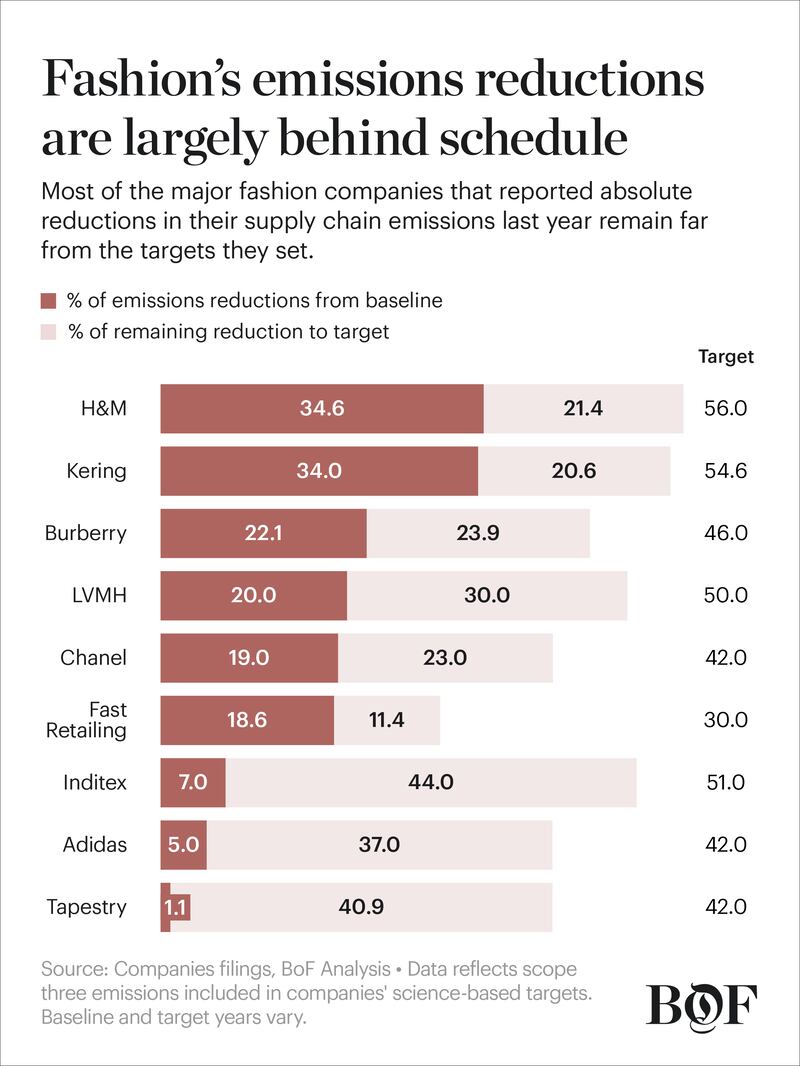
Meanwhile, Nike — according to its last sustainability report from 2024, after which the company stopped publishing it — has only reached 11 percent of its 30 percent reduction goal by 2030, while Adidas’ progress has also been sluggish, despite both companies being among the earliest adopters of science-based climate commitments.
As for shifting ambitions, Uniqlo-owner Fast Retailing is the exception, having recently raised its targets from a 20 percent drop in emissions to 30 percent by 2030 after making faster-than-expected progress. Meanwhile others have mostly recalibrated in the opposite direction, at least as far as longer-term goals are concerned. Alongside Burberry pushing its goal of achieving net-zero emissions back from 2040 to 2050, Ralph Lauren has replaced its 2040 net-zero commitment with a series of rolling five-year targets.
The industry’s progress, too, is more nuanced than what meets the eye. Companies including Hermès, Lululemon and Tapestry, for instance, all said they’ve made significant progress in reducing the intensity of their supply chain emissions i.e emissions relative to growth. The accessible luxury giant notably surpassed its 2030 target of reducing supply chain emissions intensity by 58.1 percent, reporting a 59.2 percent decline last year. But these gains do not necessarily translate into meaningful declines in overall emissions, the key to climate mitigation. Absolute greenhouse gas emissions have continued to rise at Hermès and Lululemon, and have fallen only marginally at Tapestry, a reflection that decoupling growth from emissions, especially in the short term, is not an easy goal to achieve.
According to Bedat, the slow nature of progress, or rather lack thereof, is a result of companies facing limited consequences for missing targets.
ADVERTISEMENT
“This has been the least surprising turn of events,” she said. The recent wave of target revisions — and, for some brands, a lack of transparency around near-term climate investments — is the predictable outcome of commitments made without clear implementation plans, she added.
Setting ambitious targets isn’t necessarily the problem, said Lewis Perkins, president of the industry-backed non-profit Apparel Impact Institute, which helps finance and implement decarbonisation projects across fashion’s key manufacturing hubs. They help create urgency, directing capital toward climate solutions and even leading to the creation of coalitions like AII.
“Audacious goals are important,” he said. “It gave us a North Star.”
But implementing the solutions to meet those goals is just as critical, if not more so, Perkins added. Necessary next steps include providing clearer roadmaps and robust financial support to suppliers, each of which operates under different energy and environmental conditions.
What brands can — or are willing to — control is just one part of the equation. The rest falls upon manufacturers across fashion’s sprawling supply chain, most of which operate independently from their brand partners.
Material manufacturing alone accounts for 55 percent of the industry’s emissions footprint, according to AII’s latest impact report, and continues to increase.
So far, the companies that have made the most progress on their decarbonisation trajectories have achieved their reductions largely by tackling coal use in supplier factories. H&M’s progress, for example, has been driven in large by efforts to replace coal with alternatives like biomass or through renewable-energy certificates. Others have been unable, or unwilling, to invest in helping their factory partners to upgrade their facilities.
“The industry at large is still getting its head around suppliers, and finding where its carbon sits,” Perkins said.
ADVERTISEMENT
Even if brands know how to help their suppliers mitigate emissions, execution can be complicated. Suppliers face competing business priorities, and have limited capital and varying levels of technical readiness. Often they’re caught between competing demands from different brands, each with its own sustainability agendas and timelines, on top of the on-the-ground realities they need to consider, such as the widespread impacts of heat stress. Yet still, factories may simultaneously be asked to reduce carbon emissions, cut water use, adopt circular materials, improve worker conditions and test new innovations, all while operating on thin margins and limited investment budgets.
By not tapping manufacturing partners in creating shared goals and objectives, the industry has missed an opportunity to create a “cohesive transformation plan that addresses multiple operational challenges simultaneously,” according to Perkins.
Many of the easiest emissions reductions have also been captured already through efficiency measures such as lighting upgrades, insulation improvements and operational optimisations, including less energy-intensive dyeing techniques. The next phase of decarbonisation is significantly harder and more expensive — bigger, higher impact projects such as steam heat pumps, electrification, thermal storage and replacing fossil fuel-powered industrial boilers. They can require seven-figure capital expenditures and longer payback periods, creating new challenges for both brands and suppliers.
“It’s time to get into the bigger and harder projects, but it’s about making the business case and moving to a supplier-first approach,” Perkins said.
There are indications the conversation within fashion may now be shifting from touting ambitious plans to slowly putting solutions in place that make an impact and meet the industry’s operational reality.
Last week, the world’s leading corporate climate target-setting body, the Science Based Targets initiative, or SBTi, unveiled a revised version of its Corporate Net-Zero Standard, widely regarded as the leading framework for corporate climate target-setting and verification. The SBTi’s revision reflects the broader industry’s shift in priorities, placing greater emphasis on near-term accountability and taking concrete steps to put decarbonisation measures in place, while giving companies more flexibility in how they reduce emissions in the long term.
“Businesses increasingly want climate frameworks that are scientifically robust while also being practical to implement across complex global operations and supply chains,” said David Kennedy, SBTi’s CEO.
Not everyone is convinced it will be effective.
“The whole situation with the Science Based Targets initiative is that it is a voluntary framework,” said Bédat, adding that companies in danger of falling short can as a result simply shift their targets. She notes that without a legislative push, brands will ultimately gravitate toward whatever best suits them at any given time.
Perkins, for one, said he remains optimistic, noting that the industry is finally moving beyond planning and pilot programmes into large-scale deployment of new innovations at suppliers.
This includes pushing ahead with electrification, thermal energy systems and industrial heat technologies, with organisations like AII offering financing help through gap grants, facilitating low-interest loans and lower-pay back periods — while also pushing tools like its Carbon and Energy Benchmark, which offers localised and standardised emissions data to incentivise companies to make better investments tied to decarbonisation. As that happens, AII expects emissions reductions to accelerate.
“It’s kind of like a hockey stick,” Perkins said. “As we move into these higher-impact projects, we’ll see this go up,” referring to the industry’s emissions reductions.
As AII’s work with its partners pushes ahead and scaled climate solutions emerge, in the short term they are unlikely to bring the industry back on track to meet its targets on their own. Still, they represent a step forward.
“It was ambitious,” Perkins said. “But here we are.”
Editor's Note: The chart in this story was updated with Chanel's 2025 emissions trajectory.
As the UN’s annual COP climate summit gets underway against a challenging backdrop, the industry’s near-term pledges to help cap planet-warming emissions are slipping out of reach.
Action is needed much faster than it will take for voluntary national commitments to kick in.
At this year’s Global Fashion Summit, the industry reframed sustainability around its financial value and presented it as a business survival strategy.

Shayeza Walid is Senior Editorial Associate covering Sustainability at The Business of Fashion. She reports on fashion's environmental impact, climate accountability, supply chain and labour issues. Based in London, she also contributes to BoF's Global Markets and UK coverage.
Loading recommended reads…
After the retail empire’s initial takeover bid failed, the company raised its holding to 50.08 percent in a move that will turn the German apparel brand into a subsidiary of Frasers.
The settlement, equivalent to 44 percent of the ultra fast-fashion company’s second-quarter profit, is the latest blow amid regulatory and tax crackdowns in Europe and the US that have hampered Shein’s growth.
Among the takeaways from the latest round of quarterly reports from European luxury groups: China’s hurting, industry growth in the US has slowed and quiet luxury is having a moment.
Bloomingdale’s chief executive Olivier Bron joins Imran Amed on The BoF Podcast to discuss how a name every American knows is re-earning its place in luxury and why he sees Europe’s biggest houses wrestling with the same problem.