Agenda-setting intelligence, analysis and advice for the global fashion community.
Agenda-setting intelligence, analysis and advice for the global fashion community.

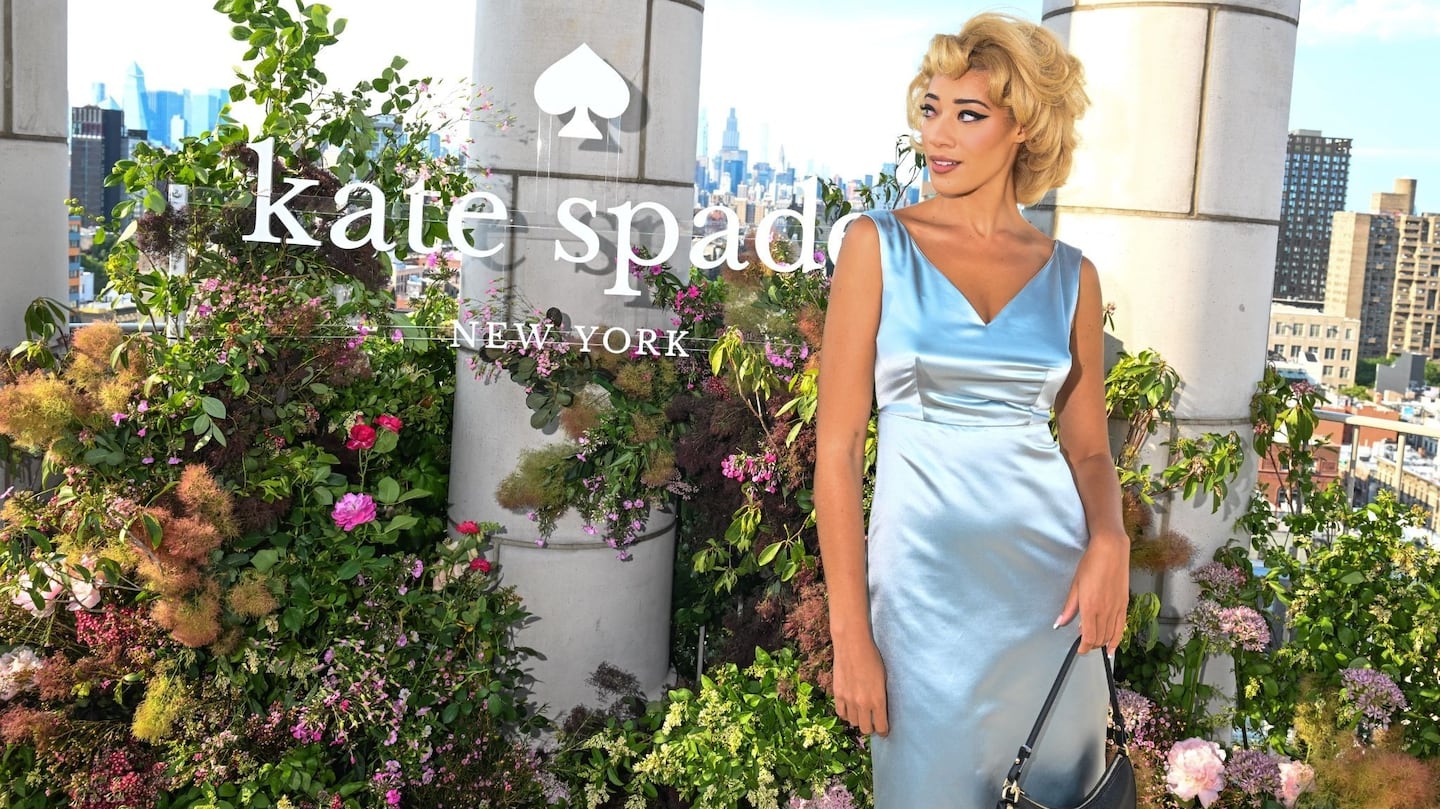
A new era is about to begin at Kate Spade.
This week, the Tapestry-owned brand announced the appointment of Scottish designer Jonathan Saunders as executive creative director. Saunders, who most recently served as chief creative officer at H&M-owned & Other Stories, will return to New York to start in his new post in August — the first time in nearly five years that the brand has a single creative leader. The last person to serve that role was Nicola Glass, a former Michael Kors designer, who departed in 2021.
In the last few years, design responsibilities were split between Jennifer Lyu, who handled leather goods and accessories, and Tom Mora, in charge of ready-to-wear, footwear and jewellery; both left the brand in 2024.
Bringing in a relatively high-profile creative is the the most substantial move Tapestry has made yet to ignite the turnaround at Kate Spade, which has struggled to generate the type of excitement and commercial momentum that fuelled the recent resurgence of its sister brand, Coach. Tapestry’s fiscal 2025’s sales laid bare their different fortunes: While Kate Spade sales contracted by over 10 percent from the year prior to $1.2 billion, Coach saw the opposite, hitting a record $5.6 billion, a 10 percent increase from 2024.
ADVERTISEMENT
It’s easy to imagine that Tapestry poured resources into Coach’s revival at the expense of Kate Spade. But Kate Spade always had the advantage of following the Coach comeback playbook, which entailed remixing Coach’s rich aesthetic heritage with a Gen-Z sensibility.
Saunders and the brand’s chief executive Eva Erdmann, who joined Kate Spade in 2024 from L’Oréal, can tap into the learnings from Coach creative director Stuart Vevers and CEO Todd Kahn, the engineers of its astounding growth streak.
There’s reason to believe a similar strategy that taps into nostalgia could work for Kate Spade: Like Coach, two of Kate Spade’s key assets are its accessibility and sentimental value, particularly among Millennial American women, who drove the brand’s most recent period of major growth in the early 2010s. There’s a Gen-X connection, too: In the 1990s, Kate Spade black nylon totes were such an “it” item that the brand earned a mention on “Sex and the City.” When the eponymous Spade died in 2018, there was an outpouring of grief as women shared their poignant memories of the brand online; for many, a Kate Spade was their first big handbag purchase.
The trend cycle, too, is well-suited to propel Kate Spade back to growth. After years of minimalism in fashion, maximalism has been making its way back into the discourse. That shift has benefitted brands selling bold prints a la Pucci or Missoni — both of which have seen a surge in sales over the past year — or whimsical accessories, like Miu Miu. Kate Spade has a reputation for both, while Saunders himself is known for his use of pattern and colour in his designs. (He was recruited by Alexander McQueen as a print designer shortly after graduating Central Saint Martins; he’s responsible for the designer’s beloved bird of paradise print.)
That’s not to understate the lofty task Saunders has ahead of him. Coach’s turnaround took years of patience: It took three years for Vevers’ vision (he joined the brand in 2013) to yield sales growth, and even more than that for Coach to regain its cultural relevance.
Coach’s strategy was part logistical cleanup, part rebuilding brand heat, which Kate Spade would be wise to replicate. The brand trimmed back its presence in outlet malls and department stores, and limited discounting to protect margins, focusing on core styles like the Tabby bag. It also zeroed in on younger consumers, overhauling its marketing to appeal to the key Gen-Z demographic.
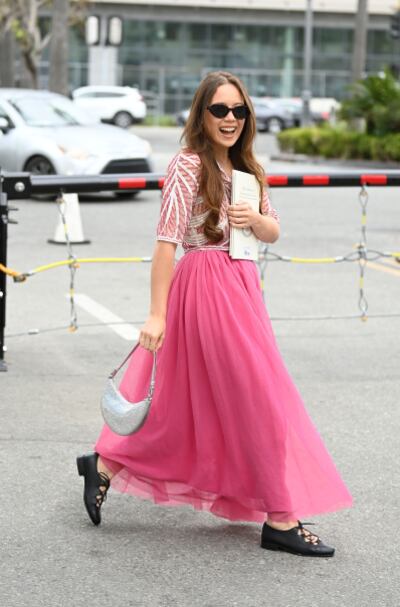
Already, there are signs Kate Spade is targeting a younger crowd. The brand has investing in marketing around the crescent-moon shaped Duo bag, placing it on Gen Z-friendly celebrities like jazz singer Laufey, “Obsession” star Inde Navarrette and Kendall Jenner (complete with a Dachshund bag charm, a favourite breed of Gen-Z influencers). It staged an entire event around the bag in June, with brand ambassador Reign Judge performing. It’s reminiscent of the strategy Coach took at the start of the decade with its Tabby bag.
While surely a start in the right direction, that strategy alone didn’t build Coach’s epic comeback. It’s up to Saunders and Erdmann to see the rest through.
ADVERTISEMENT
By Diana Pearl
Go Deeper:
Kate Spade Names Jonathan Saunders Executive Creative Director
After years without a single creative leader, the Tapestry-owned brand is betting the &Other Stories and DVF alum can help reignite growth and sharpen its identity.
Who’s up and down in the business of fashion, luxury and beauty this week.
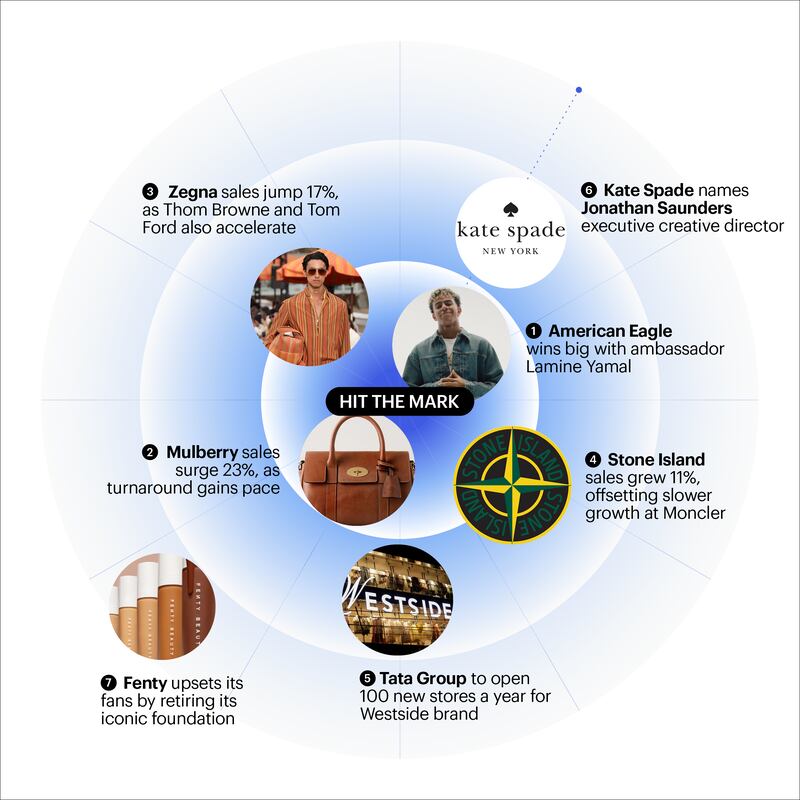
1. Lamine Yamal gave American Eagle a boost when the highly marketable Spanish footballer fronted a key back-to-school push days after his team won the World Cup.
2. Mulberry sales surged 23 percent as its turnaround under CEO Andrea Baldo gathers pace and the brand gears up for designer Christopher Kane’s runway debut in September.
3. Zegna Group reported second-quarter sales that beat analyst estimates, with revenues accelerating across its three labels Zegna, Thom Browne and Tom Ford.
ADVERTISEMENT
4. Stone Island sales jumped 11 percent on the back of strong demand in the Americas and Asia, outperforming Moncler Group’s flagship label.
5. India’s Tata Group is planning an aggressive retail rollout for its Westside brand, with as many as 100 new stores a year, as Zudio growth slows.
6. Tapestry’s Kate Spade label has hired former Diane von Furstenberg and & Other Stories creative director Jonathan Saunders to give its turnaround plans a boost.
7. Rihanna’s Fenty Beauty upset some fans of the brand when it announced it would discontinue its Pro Filt’r foundation, a product that pioneered shade inclusivity.
Catch up on all the news of the week in fashion, luxury and beauty here.
Loading recommended reads…
Sales of gems, precious metals and artwork at Japan’s department stores climbed 19 percent in the first half of 2026 from a year earlier to $2 billion.
Though Adidas dressed both teams in the World Cup finals, the global football tournament still presented some bright spots for Nike, writes Bloomberg’s Andrea Felsted.
From our archive, the creator and host of award-winning podcast “Articles of Interest” joins BoF founder, CEO and editor-in-chief Imran Amed to explore what clothing can reveal about identity, culture, labour and the world around us.
Saunders, the brand’s first creative director in five years and a skilled colourist, promises to give Kate Spade the clarity it has long lacked. Now, Tapestry must apply the same long-term brand-building discipline that fueled Coach’s success.