Agenda-setting intelligence, analysis and advice for the global fashion community.
Agenda-setting intelligence, analysis and advice for the global fashion community.

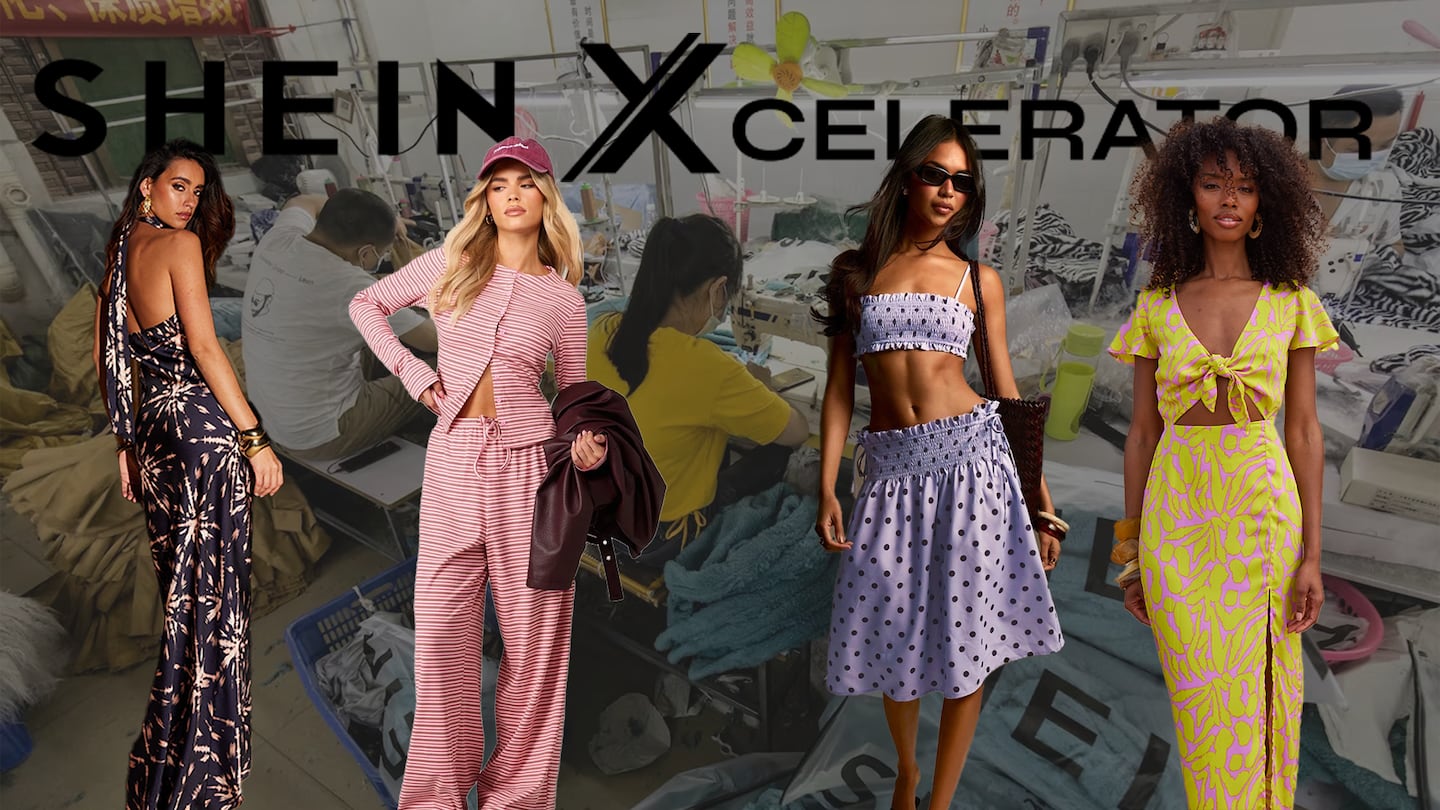
When Seb Mills, a veteran of the activewear industry, bought British womenswear brand Dancing Leopard out of administration in January 2025, he expected the turnaround to take time.
“The problem wasn’t the product,” said Mills, who was previously a director at Gymshark. “There was strong traffic even when I acquired the brand. It was just about getting the operational and commercial side of the business right.”
The company had struggled to manage its inventory, routinely finding itself understocked on its bestsellers, while slow-moving products piled up.
Then Mills met Cui He, senior director of Shein’s Xcelerator programme, an initiative by the fast-fashion giant that opens up its manufacturing and distribution infrastructure to select smaller labels. After officially joining the programme last November, Dancing Leopard was able to plug into the machinery behind Shein’s own rise: its unique on-demand production model, which allows it to rapidly respond to trends while minimising inventory risk; its heavily trafficked e-commerce platform, which received more than 300 million visitors in January according to Similarweb; and its global logistics and fulfilment network. Mills said it allowed the brand to fast-track many of the operational changes he had planned and focus on creative tasks.
ADVERTISEMENT
That’s the pitch Shein is now making as it tries to build the Xcelerator into a new business.
Officially launched in September last year, the programme is still small, and Shein has said little about it publicly. In an exclusive interview with The Business of Fashion, He said Shein currently has around 20 brands in the Xccelerator, with another five being onboarded in the coming months. Shein would only identify 11 of the labels, which in addition to Dancing Leopard include Cosmina, Athîral, Jian Lasala, Arc by Sigmas, Pimkie and Ellerissa. Missguided and the other brands under Sumwon Studios — the joint venture Shein and Missguided founder Nitin Passi formed after Shein bought the UK fast-fashion label in 2023 — are also part of the programme.
But He also acknowledged “the ambition is larger,” describing the initiative as a “new operating model” built on capabilities Shein has spent more than a decade refining.
“It’s a fully integrated suite of services,” He said. “Our special recipe to success is our on-demand supply chain, but with it brands also have access to our logistics and platform, which speaks to our capability of being very agile, flexible and globally targeted across 160 countries.”
For brands struggling with inventory risk, operational complexity and the cost of international expansion, Xcelerator essentially amounts to an operating system.
For Shein, it’s a way to diversify its business and maintain growth in the face of mounting reputational and regulatory pressures as it moves towards an IPO, said Sheng Lu, professor of fashion and apparel studies at the University of Delaware, who noted that data from Euromonitor shows the company lost market share in the US last year for the first time since 2021.
The “supply chain as a service” model would give it another way to profit from its operational prowess, similar to the way Amazon turned the cloud-computing platform it originally built for its own purposes into Amazon Web Services, a huge business that now underpins countless other companies.
“You can tell through this programme that Shein is evolving,” Lu said.
ADVERTISEMENT
Success is far from certain, however. In 2020, H&M Group opened its supply chain to other companies, saying at the time it would drive “long-term growth” for the group and let brands benefit from its sustainability investments. H&M shuttered the programme in 2022 after it failed to grow quickly enough.
Brands might also be reluctant to place so much of their operations in the hands of a competitor — one that has likely siphoned away some of their customers and been accused of producing at factories that make employees work excessive hours.
“Having all your eggs in one basket is always a bad idea over the long term,” said retail consultant Rick Watson, founder and chief executive of RMW Commerce Consulting.
Xcelerator is built on the same model that allowed Shein to outpace traditional fast-fashion competitors: small-batch production that allows for rapid testing and replenishment based on real-time demand.
The idea grew out of Shein X, the company’s designer incubator launched in 2021. But where that earlier initiative focused on creative talent, He said the Xcelerator was designed to “marry creativity with commercial discipline and economic viability.”
The turning point came in 2023, when Shein identified stronger-performing X participants that brought “more mature business capabilities to the table” namely Missguided, which was in the incubator before Shein acquired it. He said today the programme runs “in a very selective and exclusive way,” prioritising brands that will add value to the company’s ecosystem through strong existing visibility, as in the case of Pimkie and Missguided, or differentiated positioning, particularly those offering product categories Shein lacks or is looking to grow, such as menswear.
Brands in the programme keep control of product development and creative direction while tapping into Shein’s supply chain for sourcing, logistics and distribution. Mills said the label’s 10-person team is now able to focus more on product and brand-building because much of the operational burden has shifted elsewhere.
Dancing Leopard still operates its own Shopify site and app, but orders flow through Shein’s infrastructure, which handles fulfilment and much of the customer service. The brand has shut its UK warehouse and now relies on Shein’s global logistics network, which uses demand data to reposition popular items closer to customers and reduce delivery times at lower costs.
ADVERTISEMENT
For a label with limited resources, the appeal of the Xcelerator is straightforward.
“Small brands cannot afford to invest to build their own infrastructure, a very modernised and efficient supply chain, on their own,” said Lu.
Under Shein’s model, the brands can start with smaller minimum order quantities. If a style performs well, reordering happens automatically, reducing the forecasting risks that have long plagued fashion companies. The system addresses “the gap between supply and demand,” said Missguided’s Passi, who is now the CEO of Sumwon Studios, calling it “the single biggest roadblock facing the fashion industry today.”
Shein also provides access to global consumers that a small brand might otherwise struggle to reach. Mills said within three months of joining the Xcelerator, the company is already seeing traction in markets such as Brazil, where it now sees the strongest demand after the UK. “These are all sales that didn’t exist before,” he said.
Shein charges brands a platform fee based on sales, at a rate that is “competitive,” according to He, while also collecting fees on logistics fulfilment through its DTC model. The company is able to accommodate all the accelerator brands within “its existing capability of suppliers, but is also sourcing new ones based on design demand,” He said, with a growing internal team where a Shein project manager specifically works with a designated Xcelerator brand.
As of September 2025, brands in the Xcelerator programme have achieved an aggregate revenue of $400 million according to Shein, with online sales growing on average by 190 percent in the first year. Notably, a lion’s share of the revenue was generated by Missguided, the first Xcelerator brand, which made $300 million in two years, Shein said.
Retail consultant Watson called the Xcelerator “an undeniably disruptive innovation.”
“The economics of the model are straightforward,” he said. For brands, “it’s more efficient, it cuts out costs and middlemen, and [Shein] has the audience.”
Still, Watson pointed out that most early participants in the programme are likely to be smaller or distressed labels willing to trade some independence for operational ease. Building a business within another company’s infrastructure carries inherent risks, particularly if brands become overly reliant on a single platform for manufacturing, fulfilment and customer access.
Mills said brands that want to generate any sales through Shein need a strong identity, otherwise they can struggle to stand out on its vast, teeming platform.
The programme also raises broader questions about the influence of an already controversial player in fashion’s supply chain. Shein’s expansion into platform services comes amid sustained scrutiny over its business practices. The company has faced repeated criticism over supply-chain transparency, labour standards and its environmental impact, with investigations and regulatory pressure mounting across Europe.
Against that backdrop, the decision for brands to align themselves more closely with Shein’s infrastructure carries reputational risks.
“We didn’t naively jump into this at all,” Mills said, noting that Dancing Leopard weighed the risks alongside the potential upside before deciding to proceed. Meeting Shein’s leadership in China and understanding the mechanics of the model helped shape the final decision. “I wanted to actually understand the people and how it worked,” he said.
There is also a broader industry question of whether Xcelerator ultimately reinforces the dynamics Shein already accelerates. By having more brands operating like Shein, the system could intensify price competition and further pressure margins across the sector. Many competitors like H&M, Zara and Mango are trying to elevate their product offerings so as not to compete so directly against Shein.
For now, participants in Shein’s new venture seem focused on what the model enables rather than what it might disrupt.
Want to dive deeper into an insight from this article? Check out The Brain of Fashion, BoF’s new generative AI tool where you can unlock BoF’s sustainability archive with a single question.
The ultra-fast fashion retailer plans to invest over $1.45 billion into intelligent supply chain systems in Southern China in a bid to reinforce ties with Beijing as it deals with mounting challenges.
Other fashion brands can now tap on the fast-fashion retailer’s supply chain, which includes factories that can turn around new designs in 5-7 days, as long as they open a store on its online marketplace.

Shayeza Walid is Senior Editorial Associate covering Sustainability at The Business of Fashion. She reports on fashion's environmental impact, climate accountability, supply chain and labour issues. Based in London, she also contributes to BoF's Global Markets and UK coverage.
Loading recommended reads…
The French beauty giant's mass division grew faster than anticipated, largely driven by professional styling products.
As shoppers swap “sustainable” for “healthy,” BoF senior editorial associate Shayeza Walid joins senior correspondent Sheena Butler-Young to unpack why fabric content has become fashion’s newest flashpoint — and why Gap just found out the hard way.
The new national initiative, Fashion Britain, aims to increase growth, innovation and participation in the industry across key cities.
Brands are embedding ChatGPT-like tools directly into their e-commerce sites, with AI platform Daydream spurring adoption as it opens up its technology to third parties.