Agenda-setting intelligence, analysis and advice for the global fashion community.
Agenda-setting intelligence, analysis and advice for the global fashion community.

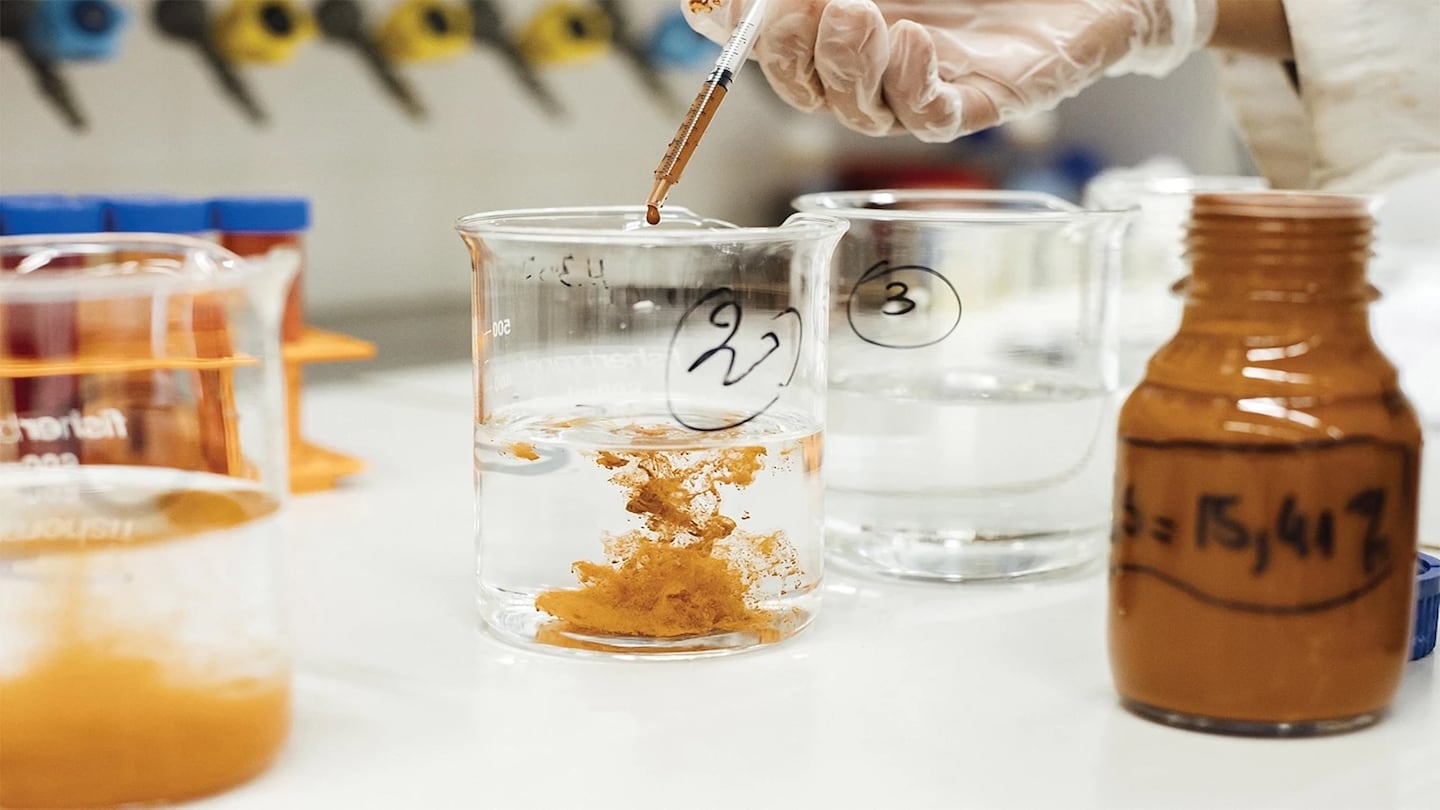
Factories that no longer run on coal; dyeing techniques that use less water; laundry units that run at lower temperatures; materials that come with a smaller carbon footprint.
These aren’t far off innovations. They are real, tangible changes that are helping some of fashion’s biggest brands inch closer to their climate goals as they roll out across the industry.
Nike’s planet-warming emissions are down 35 percent since 2020. Fast-fashion giant H&M Group’s emissions have fallen a similar amount compared to a 2019 baseline. Over the same timeline, Uniqlo-owner Fast Retailing has cut its emissions nearly 20 percent, prompting the Japanese retailer to adopt a more ambitious reduction target for the end of the decade. Meanwhile, Ralph Lauren has already surpassed the reduction goal it set for 2030.
To be sure, fashion still has a long way to go to address its environmental impact.The industry’s overall emissions are still rising, hitting a record 1 gigatonne of carbon dioxide equivalent in 2024, the latest year for which data is available.
ADVERTISEMENT
But pockets of innovation and operational change across the supply chain (where the majority of fashion’s emissions occur), are curbing the extremes of fashion’s climate overshoot.
In many cases, the changes driving real impact aren’t particularly buzzy or sexy. They’re technical, sometimes incremental and represent only the start of the work the industry as a whole needs to do. Still, they demonstrate that pathways to meaningful improvement already exist.
“It’s so easy to get hyper-focused on the shiny penny and what’s next,” said Lewis Schuler, head of innovation and vice president of advanced concepts at Alpine Group, a vertically integrated manufacturer that supplies brands including Lululemon, The North Face and Walmart. “There are a lot of logical things that could be done right now and show significant results”
Many of fashion’s biggest climate gains have come from a singular switch: suppliers moving off coal and towards lower-carbon sources of energy.
Coal is the world’s most polluting fossil fuel, but it’s also cheap, widely available and energy dense. That’s made it a staple fuel for boilers used in fashion factories, where high and steady temperatures are needed to wash, dye and process fabrics. It’s also made it a target for big brands. Many have pledged to get coal out of their supply chains altogether, putting pressure on their suppliers to switch to alternative energy sources.
Over the last few years, those efforts have started to pay off. The impact is showing up in brands’ climate reports in a significant way. For instance, the bulk of H&M, Fast Retailing and Ralph Lauren’s recent emissions reductions were driven by eliminating on-site coal use across suppliers.
In large part, coal’s displacement was achieved by pushing suppliers to switch to biomass like wood pellets or agricultural waste, a renewable energy source widely framed as a lower-carbon transition fuel.
Though a seemingly simple solution that can be achieved without investing in costly new machinery, the process has not necessarily been easy or cheap for manufacturers. Upgrades to enable boilers to run on biomass instead of coal can still cost as much as $600,000, according to multiple manufacturers. It’s a replacement that can be less accessible, more expensive and, critics argue, is still environmentally damaging, with its impact depending heavily on the feedstocks used and how they are sourced.
ADVERTISEMENT
The industry largely acknowledges biomass is only a stop-gap solution and bigger shifts will be needed to bend the curve on the sector’s carbon footprint. But proponents argue it can still help reduce emissions in the near term, as bigger decarbonisation projects have yet to become economically viable.
Not every intervention driving fashion’s emissions lower needs to be transformational on its own. Across the supply chain, established upgrades to more modern and efficient machinery and processes are delivering smaller gains that add up when deployed at scale, Alpine’s Schuler said.
Dope dyeing, a decades-old technique that can add colour pigments to synthetic materials like polyester before they are spun into yarn, reducing the water, chemicals and energy needed to dye finished fabric, is one such example.
Historically, large minimum orders and the need to commit to colours far in advance of production made it difficult for brands managing seasonal assortments and uncertain demand to use the process effectively. But over the years, manufacturers have been able to overcome those hurdles.
“What’s changed isn’t so much the fundamental technology,” said Alpine Group’s Schuler. “But our ability to remove many of the commercial barriers that historically made it difficult for brands to adopt at scale.”
Alpine now offers smaller orders, more colour options and shorter development times to brands. That’s encouraged greater uptake, with each new manufacturing run driving reductions in environmental impact. By switching the production of seven million pairs of jogging bottoms to dope dyeing, for instance, Alpine reduced emissions by 7,000 tonnes over three years. That’s an incremental gain on its own, but one that becomes meaningful when scaled over multiple lines and seasons.Elsewhere, Spanish textile technology company Jeanologia, whose equipment is used by more than 1,000 suppliers globally, has developed cost-neutral technologies tailored to individual factories that reduce the water, chemicals and energy used to finish garments, particularly denim. In 2025, its technologies avoided 103,530 tonnes of carbon emissions and 21.5 million cubic metres of water pollution compared with conventional processes, according to the company.
A long-promised shift to lower-impact materials is also playing out, though hard data on its impact is patchy. Alpine said it cut emissions by 16,000 tonnes by replacing 10 million yards of virgin nylon with recycled material in a leggings programme. At Nike, more than half of the brand’s total material mix now comes from lower-impact materials like recycled polyester and rubber and low-carbon leather alternatives. That’s helped avoid an estimated 890,000 tonnes of emissions in 2025 compared to conventional materials, according to the company’s 2025 sustainability report.
There is a ceiling, however, to how far these changes can take the industry. The incremental gains they bring are only meaningful if deployed at scale and can easily be wiped out by fashion’s rapacious volume growth.
ADVERTISEMENT
“The targets we have cannot survive through incremental improvements only,” said Vidhura Ralapanawe, executive vice president of innovation and sustainability at Epic Group. “Breakthroughs are necessary.”
At Epic, that realisation informed the development of a new factory in Odisha, India, designed from the outset to eventually operate with net-zero carbon emissions and water use.
The facility, funded by a $100 million debt-financing package from the World Bank, brings together interventions that would typically require costly retrofits in existing factories. Its design incorporates insulation and efficient cooling to cope with extreme heat, alongside heat recovery, heat pumps, renewable energy and systems to reduce and recycle water. Biomass is still used where electrification from off-grid renewables is not yet technically viable, but Epic is working to increase renewable electricity and storage capacity as the facility ramps up.
The goal was to develop a blueprint, but not one that requires exact replication. Many of the factory’s components can be adopted individually depending on what makes sense locally. “Even if you do 60 percent of what we are doing, that’s a replicable model,” Ralapanawe said.
In other parts of the value chain, innovations that could help achieve further emissions reductions are inching towards industrialisation. A rising cohort of textile-to-textile recyclers is hoping to push beyond long-standing commercial barriers with plans for large-scale plants. Meanwhile, industrial steam heat pumps are starting to show promise as an alternative to fossil-fuelled steam generation in textile mills if they can be scaled.
The bottom line: bigger reductions are possible, but increasingly require much larger investments in the infrastructure and materials underpinning how clothes are made.
Cost remains one of the biggest sticking points.
“To really move the needle to transition away from fossil fuels, to drive large-scale decarbonisation, someone’s going to have to pay for it,” said Kim Drenner, head of environmental impact at Patagonia.
It’s not going to be cheap and the question of who pays is particularly thorny because much of the infrastructure brands need to decarbonise isn’t theirs. Suppliers own the factories, boilers and machinery that require upgrading, but it’s risky for them to make big investments that will take years to pay off without long-term purchasing commitments from brands.
To address this problem, Patagonia, for one, is piloting a carbon-credit-style financing model for suppliers. Under the scheme, the brand pays suppliers to cover the costs of decarbonisation projects in exchange for the right to count the verified carbon savings towards its own climate targets. “We see that it is our responsibility as well to address these emissions,” Drenner said. “We are not squeezing factories and pressuring them to have to take on all the costs.”
However money isn’t the only obstacle – what solutions work also depend on where a factory is located, which makes the equation increasingly difficult across fashion’s sprawling supply-chain.
Access to renewable electricity, grid infrastructure, regulation, energy prices and technology varies significantly between manufacturing hubs. A project that makes financial sense in India or Taiwan, where factories can secure renewable electricity relatively easier, may not be viable in Bangladesh. Electrifying a factory also does little to reduce emissions if the power feeding it still comes from fossil fuels.
Even solutions that can deliver quick results, like biomass, come with complications. On top of that, current energy volatility and inflationary pressures don’t make the shifts many want to make any easier. All of this means fashion’s remaining emissions are progressively more difficult to eliminate.
Producing less altogether — one way Ralph Lauren has reduced its emissions for now — would perhaps be the biggest unlock. But in any case, tangible progress now depends on harder, dearer and larger shifts.
“Getting off coal was relatively easy,” said Ralph Lauren’s Berns. “There’s an increasing incremental difficulty going forward.”
While H&M and Kering have cut emissions by more than a third, the majority of fashion’s biggest brands remain behind the schedule they set for themselves.
Heat pumps similar to those widely used in homes and buildings offer a glimpse of how fashion manufacturers might slash their emissions, if only there were a one-size-fits-all solution.
Companies like H&M and Puma are pushing to get coal out of their supply chains by the end of the decade.

Shayeza Walid is Senior Editorial Associate covering Sustainability at The Business of Fashion. She reports on fashion's environmental impact, climate accountability, supply chain and labour issues. Based in London, she also contributes to BoF's Global Markets and UK coverage.
Loading recommended reads…
Resilient demand for heritage bags and a higher share of full-price sales boosted the British luxury handbag maker, sending shares nearly 4 percent higher in early trading.
Onur Aktas has been appointed chief executive of the Stockholm-based label as it plots global expansion.
The lingerie label is courting younger, digitally native customers through a YouTube docuseries, theatre screenings and live show access, while preserving the sexiness that made it iconic.
Some of fashion’s biggest brands have started to drive down their planet-warming emissions as proven solutions roll out across the supply chain.