Agenda-setting intelligence, analysis and advice for the global fashion community.
Agenda-setting intelligence, analysis and advice for the global fashion community.


Tarang Amin may be a clean-cut executive wearing tucked-in business casual, but he wields a fluffy powder brush with the deftness and enthusiasm of a YouTube beauty influencer. The 61-year-old’s own skin-care routine — moisturiser, sunscreen, two different primers, a hydrating concealer under his eyes and powder to finish it all — is something he picked up on the job. After all, Amin leads E.l.f. Beauty Inc., the roughly $5 billion cosmetics empire that sells more individual sticks, tubs and tubes of makeup than anyone else in the US.
He and I are perusing the E.l.f. Cosmetics aisle, lined neatly with crisp white and black packaging, inside an Ulta Beauty shop on 34th Street in Manhattan. A young woman approaches, grabbing three products in quick succession. Amin steps out of the way. “I don’t want to interrupt the sale,” he says, soft-spoken but beaming.
E.l.f. Cosmetics, whose products average about $7 each, is the No. 1 mass-market colour cosmetics brand in the US by unit sales, and it’s quickly catching up to century-old Maybelline, the leader when it comes to dollars spent, Amin says, citing Nielsen data. (Nielsen declined to confirm.) It’s one of five brands under the E.l.f. Beauty umbrella, along with E.l.f. Skin, Naturium, Well People and Rhode. Together the brands brought in $1.6 billion in net sales in the 2026 fiscal year, up 25 percent from 2025. The publicly traded company lays claim to a slew of enviable industry superlatives, including the biggest brand debut ever at makeup mega-retailer Sephora: the launch last September of its recently purchased Rhode line.
When E.l.f. picked up the viral, higher-end brand in 2025 for $1 billion, it was seen as a real coup. E.l.f. had been known for its affordable cosmetics, including “dupes” of other famous brands (Amin disputes the characterisation, noting that it doesn’t copy established brands but gives them an “E.l.f. twist”), and its slowing sales growth prior to the Rhode deal had worried some investors. Could it really afford to make such a large and buzzy acquisition?
ADVERTISEMENT
Turns out, yes. Rhode is on track to become the fastest beauty brand to reach net sales of $1 billion, Amin says. (Founded by model and media personality Hailey Bieber in 2022, Rhode did $390 million in net sales in fiscal 2026.) Passionate customers will buy virtually anything it sells: When Rhode released its summer collection of stick bronzers and milky luminizers this spring, it made $27 million in net sales on its direct-to-consumer website the first day. If Bieber posts about it, like when she mentioned using a body butter by E.l.f.’s Naturium during her pregnancy, the products are almost guaranteed to go viral. In September, Sephora will start selling Rhode in 19 European countries.
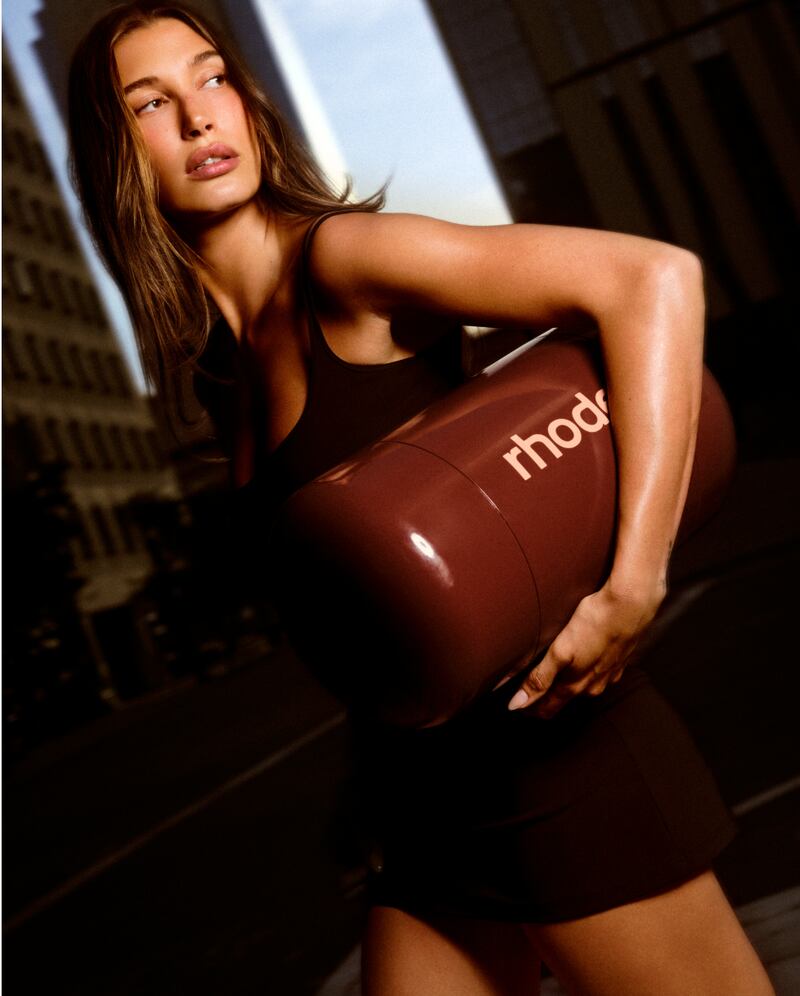
We’ve exited the Ulta to explore a rival Sephora near Madison Square Park, parking ourselves about halfway back in the store in front of the gondola selling Rhode products. It’s a piece of unassuming real estate for what Amin says is the chain’s No. 1 brand, but throngs of customers are still finding it. Two young women leave dejected when they discover the luminizers are sold out. “I can’t wrap my head around it,” he says, incredulous at Bieber’s reach and influence. He calls Rhode “one of the most phenomenal brands I’ve ever seen.” To borrow the modifier coined by his marketing team and used all over its social media, he seems pretty “elfing” delighted by it all.
E.l.f., which stands for “eyes, lips, face,” was co-founded by father-son duo Alan and Joseph Shamah in 2004. (Another E.l.f. founder, Scott-Vincent Borba, recently made headlines for renouncing a life of Los Angeles debauchery and becoming a Catholic priest. Amin doesn’t seem to be in danger of succumbing to hedonistic impulses; the most indulgent thing he’s done recently, he says, is buy a bouncy house for his 2½-year-old grandson at his home near E.l.f.’s Oakland, California, headquarters.) E.l.f. started out selling $1 makeup online, but it soon added more expensive products, then entered retailers such as Target Corp. For about eight years it even had almost two dozen of its own brick-and-mortar stores before Amin shuttered them in 2019, two years after Joseph Shamah left E.l.f.’s board.
Born in Kenya to Indian parents, Amin immigrated with his family to the US in the 1970s, settling near Washington, DC. His dad sold their house and took every penny they had to buy a motel, moving the family into the manager’s apartment. More properties followed, and Amin worked in every aspect of the business, including manning the front desk and cleaning rooms. “Beyond the fundamentals of business, the most important thing it taught me is how you treat people,” he says.
Amin attended Duke University for both college and business school, then got his start in the ’90s in Procter & Gamble Co.’s brand management department. His first brand was Pantene, and then he moved to the beleaguered Bounty, which he turned around, before heading to Clorox. He ultimately ended up at Schiff Nutrition International, a supplement maker, where investors at private equity firm TPG Growth brought him in as chief executive officer. After UK conglomerate Reckitt bought Schiff, Amin and TPG wanted to work together again and found E.l.f. He put in $26 million of his family’s money alongside TPG’s majority stake, became chief executive in 2014, took it public in 2016 and has been riding the ups and downs of consumer retail ever since.
Not all has been sparkly at the company. Unit sales were declining at the end of its 2026 fiscal year after it raised prices by $1 across the board, in response to President Donald Trump’s tariffs, a big increase for a product that might cost $6. (E.l.f. manufactures in a host of places, including the US, China, South Korea, Europe and Thailand.) The company somewhat backtracked, experimenting with price drops on several offerings. At Ulta its products display small yellow tags calling out the new, lower pricing.
Amin says E.l.f. “celebrates failure” as an opportunity to learn. “I do not want to become a big bureaucratic company. Let’s keep moving,” he says. “When things are really good, I get a little grumpy because I never want us to get complacent.”
For now, Amin is firmly focused on the future, including who might someday succeed him. In 2024, E.l.f. started an initiative to try to diversify the boardroom cheekily called “So Many Dicks,” a reference to the number of men named Richard, Rick or Dick on US public boards. But what about all the men, like Amin, still sitting in the CEO chairs of large beauty companies, whose customers are overwhelmingly women? He knows this is an issue, and he’s trying to fix it, citing potential internal candidates including Chief Financial Officer Mandy Fields. Plus, he recently appointed Kory Marchisotto, E.l.f.’s former chief marketing officer, to the new role of president of E.l.f. Brands to give her experience running a business. “It’s my job to make sure I’m qualifying that next generation,” Amin says, “so my successor can be a woman.”
ADVERTISEMENT
Sign up to The Business of Beauty newsletter, your complimentary, must-read source for the day’s most important beauty and wellness news and analysis.
With sales at its core line in decline, the company is tweaking everything from price, geographic distribution and categories to rebuild momentum.
As a K-shaped economy forces shoppers to make difficult decisions, mass and masstige brands are chasing growth with tactical deflation.
This week, Priya Rao has an interview with the most-talked-about founder in beauty, and dives into Swan’s viral bachelorette partnership.
Loading recommended reads…
Adidas would do well to tailor its Chinese business more closely to local tastes rather than simply importing a global formula, writes Bloomberg’s Juliana Liu.
Peter Ruis' surprise departure comes as the company faces “really tough” trading conditions.
The upscale department store says it will not be able to survive another year without new investment, as bidders for the chain circle.
The Omani fragrance house recorded another period of record growth as it continued to double-down on key geographies like the US and high-concentration perfumes.