Agenda-setting intelligence, analysis and advice for the global fashion community.
Agenda-setting intelligence, analysis and advice for the global fashion community.

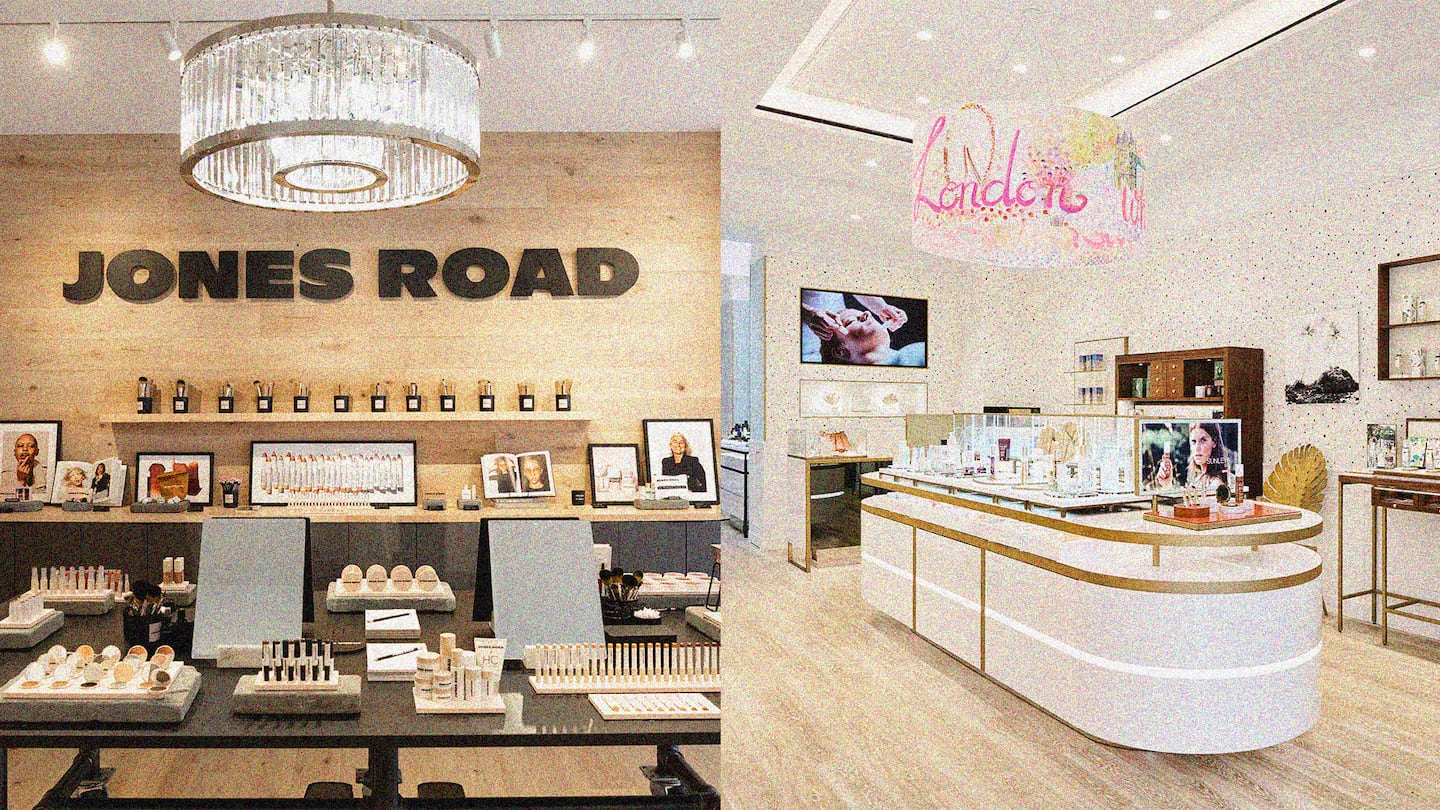
Wander around the fashionable neighbourhoods of New York, London, Paris, Seoul or Tokyo and you’ll notice the typical assortment of designer fashion boutiques, matcha cafés and upmarket furniture shops have a new neighbour: beauty stores — and lots of them.
Brands like Chanel, Dries Van Noten and Jones Road are increasing beauty’s monobrand footprint with new stores across the globe, be they a standalone jewel box like Guerlain’s outpost in New York’s newly renovated Waldorf Astoria hotel or a growing fleet like Sisley’s across Paris, Shanghai and Palm Beach. Last year, Chanel opened more than 25 beauty boutiques, while Estée Lauder Companies rented four neighbouring New York stores for its Kilian Paris, Tom Ford, Frederic Malle and Jo Malone London brands.
There’s several reasons behind beauty’s landgrab. Plush fixtures, flattering light and solicitous sales associates help to underpin any prestige brand’s luxury standing. Some brands may open their own stores near department stores that carry their lines as a hedge against the channel’s unpredictability and dwindling popularity — while their customer is clearly in that neighbourhood, the department store may not always be. Others simply wish to gain more insight into their customer’s shopping habits and fine-tune the experience.
“It’s hard to give a customer a real 360 brand experience in [multi-brand retail],” said Karen Raghavan, a fractional chief executive who previously led Benefit Cosmetics’ Asian business and was wellness brand Luna Daily’s chief commercial officer. While many big retailers no longer serve as brand builders, driving traffic to e-commerce websites is also costly and unpredictable. “[Opening a store] seems like a shiny thing to do in this highly saturated and competitive direct-to-consumer landscape.”
ADVERTISEMENT
When well-executed, owned stores can be both a meaningful volume driver and a brand-building exercise. Christine d’Ornano, co-owner and general manager of Sisley, said that around 30 percent of its revenues come from owned channels, including its website; it has more than 80 stores worldwide, 18 of which are flagship “maisons” that also offer facials, blow-dries and massages.
Brands may be tempted to look at the 50 percent plus margins they hand to the likes of Sephora and Ulta Beauty and feel they are getting a raw deal. But once the costs of a lease, payroll, security, shrinkage, visual merchandising and store maintenance are deducted, the equation looks different, said Raghavan. And it doesn’t always work: some of beauty’s most recognisable stores have recently shuttered, including Glossier, which confirmed in March it was closing nine locations to focus on its New York, Los Angeles and London flagships, while Chanel’s “concept” beauty store in SoHo closed in 2025.
Brands must be clear about the purpose that an owned store is serving in order to succeed. If an established brand simply needs space for customers to experience its products, the store’s acting as a billboard can deliver a calibrated return on investment. If it’s intended to be a powerful sales channel, a different strategy is needed.
“Some [brands] open stores as compensation rather than as a strategy… it’s not going to solve that [desirability] problem,” said Vincent Jeanniard, a senior beauty advisor who previously led commercial operations for L’Occitane, which has over 3,000 stores.
Beauty stores are often lavish in their design: consider the baby-pink caverns of Glossier’s fleet, replete with selfie-ready stations or the minimalist and yet instantly recognisable apothecary feel of Aesop’s over 400 storefronts, complete with trough-like sinks for hand-washing and product sampling.
However, turning a store into a meaningful sales driver means leveraging a more traditional skillset.
“You can develop a beautiful concept, but to ensure there is a consistent level of service and engagement means hiring, training and retaining the right people,” said Thomas Buisson, co-founder of investment firm Ilyos Capital and a former Aesop executive.
The store manager, for instance, and their ability to corral, motivate and inspire the team, has a big impact on a location’s performance.
ADVERTISEMENT
“There’s nothing that takes a store above expectations faster than a good store manager,” said Oliver Garfield, former chief executive of premium retailer Cos Bar. “And there’s nothing that’ll drive a store into the ground faster than a bad store manager.”
What that looks like in practice varies. At Jones Road, chief executive Cody Plofker said the company encourages managers to think of the store almost as their own business. They’ve learned over time that it wasn’t necessary for managers to be skilled makeup artists, but that “it’s more important that they’re a people leader,” he said. The brand operates 14 stores from Palm Beach to Boston, and will open new locations in Santa Monica, Atlanta and Charlotte, bringing its total count to 21 by the end of the year.
Hiring the right managerial team also means getting a business’ culture should be solid at the top. While retail decisions need to ladder up to broader company goals and have executive support, local leaders need to be trusted and deputised accordingly, empowered to course correct if an initiative is not resonating with customers.
“It’s address book, address book, address book as much as it is location, location, location,” said d’Ornano, adding that a store team’s ability to connect with local customers and build strong relationships is key to its overall retail success.
When successfully manoeuvred, owned retail can have a halo effect for other channels. d’Ornano said that when the company opens a new store, it often also improves its speciality or department store sales. The recent opening of Sisley’s maison in Dallas’ NorthPark shopping centre, for example, has helped boost sales at local Neiman Marcus counters.
“We’ve seen the changes in the [American] shopping habits, and want to make sure that we always have a place where our customers can go,” said d’Ornano.
At Jones Road, Plofker said while its fleet of stores can sometimes cannibalise direct e-commerce sales, they’re essential for the brand’s growth strategy of owning its customer relationships. “Being able to 100 percent own the entire experience allows us to control our destiny, even if it means it’ll be a little bit slower to grow,” he said, adding that the company has recently hired a head of retail marketing to maximise the impact of its stores. It has invested in community events like run clubs and “mum walks” to reach out to local customers.
Securing prime locations can be competitive, but there are workarounds: Buisson said that when he was leading Aesop’s retail efforts, they did not have budget for “key money”, a non-refundable deposit paid to secure a prime storefront. Instead, it chose what were, at the time, sleepier neighbourhoods like London’s Shoreditch, betting that the high concentration of advertising and creative agencies in the area would provide an aligned customer base. Noting that a key feature of the stores is the complimentary hand cream stationed outside — a customer does not even have to come in to sample it — he said, “If you don’t try to impose a concept that’s too marketing-heavy, it’s better.” It worked: L’Oréal acquired the brand for a record-breaking $2 billion in 2023 with a view to expand its retail presence in Asia.
ADVERTISEMENT
To succeed, stores need to feel special, offer either high-replenishment or high-margin products, and give customers a space for connection and education.
“To future-proof [an owned store], it needs to offer a lot more than just convenience,” said Garfield. “You have to find a reason that makes it better than just going online.”
The platform is now a top e-tailer for cosmetics, skincare and hair care, and smart legacy and indie brands are increasingly being lured by its proposition.
In the wake of Sephora tweens, brands and retailers have to win back Millennial and Gen-X shoppers who account for the lion’s share of beauty spend.
No longer the primary destination for beauty discovery, US department stores could learn by emulating the strategies of international peers.

Daniela Morosini is Senior Beauty Correspondent and Special Projects Editor at The Business of Beauty at BoF. She covers the global beauty industry, with an interest in how companies go to market and overcome hurdles.
Loading recommended reads…
At Giorgio Armani, designer Silvana is bringing her less idealised, more graphic touch to the brand without changing its essence, Angelo Flaccavento writes.
The comments by chief executive Giuseppe Marsocci come as the brand reportedly considers the possibility of LVMH, L’Oreal and EssilorLuxottica sharing the stake.
Drew Henry’s first show for Courrèges will be closely watched, as will Saint Laurent and Balenciaga for any signs that creative change is on the way. Plus, Celine and Margiela.
Louise Trotter’s Bottega Veneta was lighter and more clearly expressed the designer’s signature. Also: Angelo Flaccavento reports on Ferragamo, Dolce & Gabbana and Act No. 1.