Agenda-setting intelligence, analysis and advice for the global fashion community.
Agenda-setting intelligence, analysis and advice for the global fashion community.

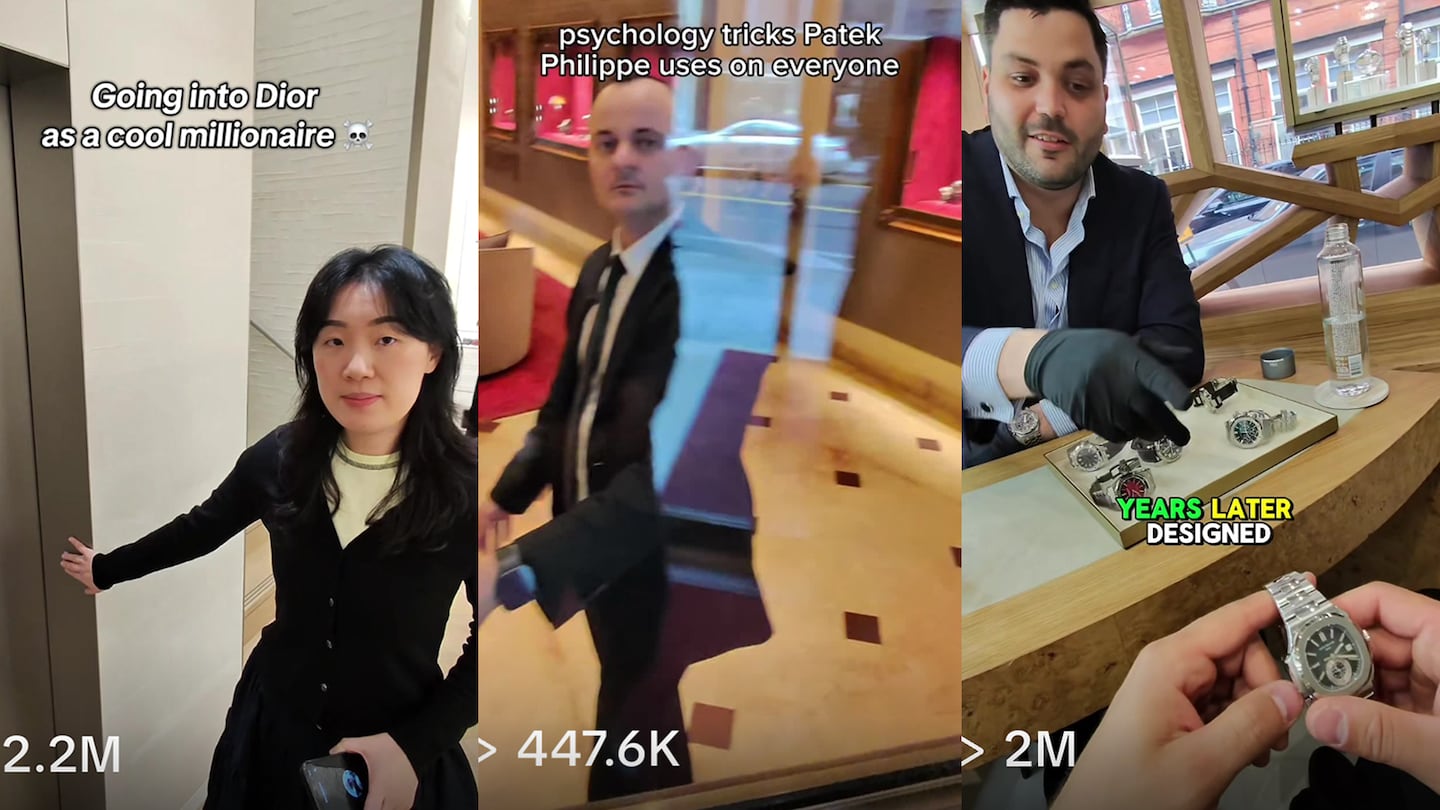
Have you ever wondered what it’s like to buy a watch from Patek Philippe?
In a TikTok video posted last fall, content creator Sami Varelli documents that exact process filmed via his Meta Ray-Ban glasses, which captures a voyeuristic point-of-view as he shakes hands with sales associates and flips through a product catalogue. When the staff realise he is recording, they ask him to take the glasses off or leave the store.
It’s hardly an altercation, and Varelli shakes hands with one of them once more before the video cuts out. But the clip has managed to generate 50 million views since November and thousands of comments debating the professionalism of the employees.
“They totally judged him and treated him badly,” reads one comment with 330,000 likes.
ADVERTISEMENT
Somewhere between a Go-Pro and a hidden camera, Meta glasses have introduced a new genre of social media videos that allows curious consumers to peer into the exclusive world of ultra-luxury shopping. “My videos give you an option to live your dream life through my eyes,” said content creator Rafal Krolak, who makes Meta glasses content under the username @norejectionguy.
But the rise of POV retail videos present a challenge for luxury labels and their carefully controlled brands. Hundreds of videos like Varelli’s Patek Philippe clip have gone viral on TikTok and Instagram. One person used smart glasses to film themselves in a Gucci store asking why the prices were so low. Another smart glasses-wearing creator asked to see the most expensive item in a Loro Piana store. Both videos brought the wrong kind of attention to the high-end Italian brands.
After a slow start, smart glasses are taking off: Facebook-owner Meta sold 7 million pairs in 2025, triple that of the two previous years combined, fuelling a wave of ‘POV’ content that can be captured far more discreetly than what was possible with phones. A flashing light signals when smart glasses are recording, but many users have figured out how to disable it and the resulting videos, which feel authentic in a sea of highly produced content, resonate online.
“What Meta glasses do is collapse the distance between living the experience and filming it,” said branding and marketing expert Jo Wong. “It’s a truly unmediated perspective, and audiences can feel that difference.”
The videos can be beneficial to brands. “Having people sneak cameras into your store to document the experience is a sign your brand still has something most brands can only dream of — genuine mystique,” said Wong.
Still, they often generate negative sentiment, in particular when they feature customer service experiences that can be perceived as elitist and quickly turn into a public relations liability.
“You have to tread carefully,” said Milton Pedraza, chief executive and founder of the Luxury Institute. “As a brand, you need to understand that you’re exposing yourself to liability and reputational risk.”
Many retailers already ban filming videos in their boutiques. In New York’s SoHo retail neighbourhood, sales associates at Louis Vuitton, Prada and Gucci all said they have a no-filming policy, but that there isn’t explicit protocol pertaining to smart glasses.
ADVERTISEMENT
In US law, filming and posting people in public spaces without their consent is legal. Individuals would only have a case to recover damages if they were filmed in spaces with a reasonable expectation of privacy, such as fitting rooms, said Julian Sarafian, a California-based attorney who represents content creators.
As recording becomes more ubiquitous and discreet, the use of smart glasses will only increase, according to Wong. This means a viable retailer solution will need to be more complex than simply putting up a “no videos” sign outside a store or having staff dissuade customers from filming. Enforcement of such policy could also lead to uncomfortable confrontations with customers, which are then captured in the resulting content.
First, it’s crucial to train staff to recognise what smart glasses technology looks like, said Robert Spector, customer service expert and author of “The Nordstrom Way.” This allows staff to know that they are being filmed.
But improving employee training, so that when they are captured in film, they come off as diplomatic representatives for their brands rather than chiding or standoffish may be the safest solution, said Lori Ruggiero, executive vice president and managing partner at 5W Public Relations.
“Act as if the cameras are always rolling.”
Labels from Dior to Gucci are rethinking their retail networks with a focus on fewer, higher-impact stores in ‘alpha’ cities as they seek better returns amid a prolonged industry downturn.
Higher-end fashion labels have become more prolific on the short-form video app in 2023. BoF unpacks how brands are growing buzz on TikTok.
Loading recommended reads…
Sales of gems, precious metals and artwork at Japan’s department stores climbed 19 percent in the first half of 2026 from a year earlier to $2 billion.
Though Adidas dressed both teams in the World Cup finals, the global football tournament still presented some bright spots for Nike, writes Bloomberg’s Andrea Felsted.
From our archive, the creator and host of award-winning podcast “Articles of Interest” joins BoF founder, CEO and editor-in-chief Imran Amed to explore what clothing can reveal about identity, culture, labour and the world around us.
Saunders, the brand’s first creative director in five years and a skilled colourist, promises to give Kate Spade the clarity it has long lacked. Now, Tapestry must apply the same long-term brand-building discipline that fueled Coach’s success.