Agenda-setting intelligence, analysis and advice for the global fashion community.
Agenda-setting intelligence, analysis and advice for the global fashion community.

In January 2024, the Los Angeles-based brand Selkie posted images online of kitschy, pastel prints featuring cats and puppies. One sweatshirt showed a fluffy white Persian standing by a pile of pink roses.
The response was not what founder Kimberley Gordon expected: a torrent of angry comments, including death threats.
Gordon’s crime, in the eyes of her fanbase, was using generative AI to help create her artwork. The response got so intense Gordon said she didn’t do any public events or go on TikTok for a year afterward.
“It was probably one of the worst things I’ve ever been through,” she said. “It was really impactful mentally.”
ADVERTISEMENT
The episode was an early, extreme example of the AI backlash brands have suffered when customers believed they used AI to create products or campaigns. Past targets include Baggu, Prada, Guess, J.Crew, Valentino and Gucci. Some openly — even proudly — disclosed their use of the technology; others never confirmed it. Neither approach has proved more effective in quelling the negative response once it gets going.

Many in the fashion industry predicted that consumers would come to accept AI imagery as its use in marketing and design became more common, and quality improved. But sentiment has only continued to sour as AI has become an even bigger part of the public discourse, and large language models have become more entrenched in the workplace and in daily life for millions.
“It seems more people are using AI, but also attitudes are growing more negative,” said Tamilla Triantoro, an associate professor in the School of Business at Quinnipiac University, which regularly polls Americans on different topics.
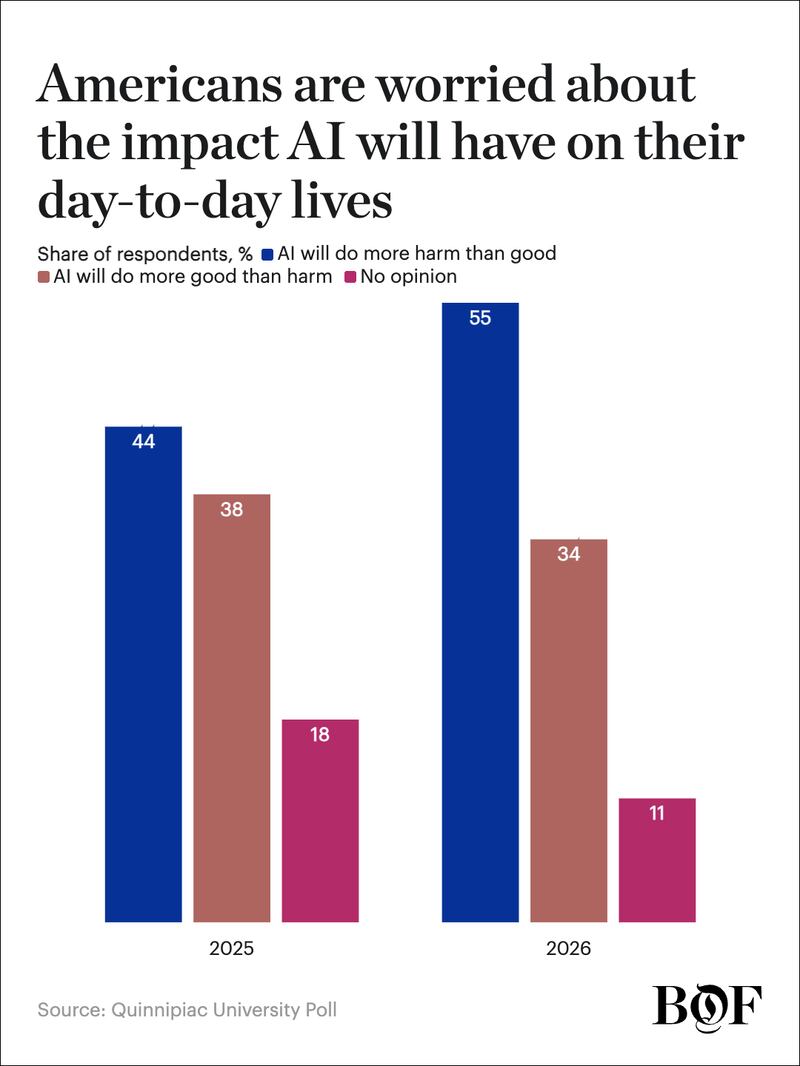
In March, Quinnipiac found that 55 percent of Americans said they believed AI would do more harm than good in their day-to-day lives, up from 44 percent in April 2025. In an NBC News poll the same month, Americans had slightly more negative views of AI than they did of Immigrations and Customs Enforcement, the federal agency that’s been widely condemned for tactics resulting in the deaths of immigrants and protesters.
The anxiety and anger towards AI have become palpable. This month, a man threw a Molotov cocktail at the home of OpenAI chief executive Sam Altman.
There are a variety of reasons for these feelings, including AI’s effect on jobs, its impact on the environment, the fact that its training data was used without consent, its potential for concentrating more wealth and power in the hands of tech billionaires and the repeated warnings of those billionaires and others that, if the technology isn’t developed with care, it could wipe out humanity.
Fashion and beauty brands hurrying to integrate AI across their businesses can’t afford to dismiss these views; they can have a direct impact on how brands are perceived. A report by YouGov and consumer intelligence company Meltwater found that 32 percent of consumers surveyed across different markets, among them the US, UK, Germany and Singapore, said they would trust a brand less if they knew it generated content with AI.
Triantoro said Quinnipiac’s polling revealed a few causes for the negative attitudes people harbour towards AI, among them the lack of transparency from companies around the technology; its role in spreading misinformation online, creating a situation where nobody can trust what they see; and the threat it poses to jobs.
ADVERTISEMENT
These factors are also shaping how customers view fashion’s use of AI.
“If you extrapolate right now, a luxury brand that uses AI in a very visible way signals not advancement, but more so cutting costs, perhaps eliminating human labour and perhaps replacing human creativity,” said Triantoro, who wrote her PhD dissertation on how brands communicate values like authenticity online.
When Prada posted images of its Spring/Summer 2026 campaign on Instagram last month, numerous people criticised the images, which many believed had been made with AI.
“It just seemed like the laziest version of what you could really achieve,” said photographer Joe Horner, whose comment on the post, “Ai in high fashion makes me sad,” received more than 1,500 likes.
Horner isn’t opposed to AI generally. He’s worked with AI artists, and uses the technology himself for tasks like correcting grammar in emails. He’s dyslexic, he noted, and AI can be helpful.
But he worries his own work was used without his knowledge to train AI models, and that companies are using the technology purely to cut costs and make as much money as possible at the expense of workers. In a report earlier this year by several UK-based creative associations, 58 percent of photographers said they had lost assignments because of generative AI, with average losses of £14,400 ($19,400) per professional photographer. (Prada previously told The Business of Fashion it used AI only in post-production after doing a full photoshoot for its campaign.)
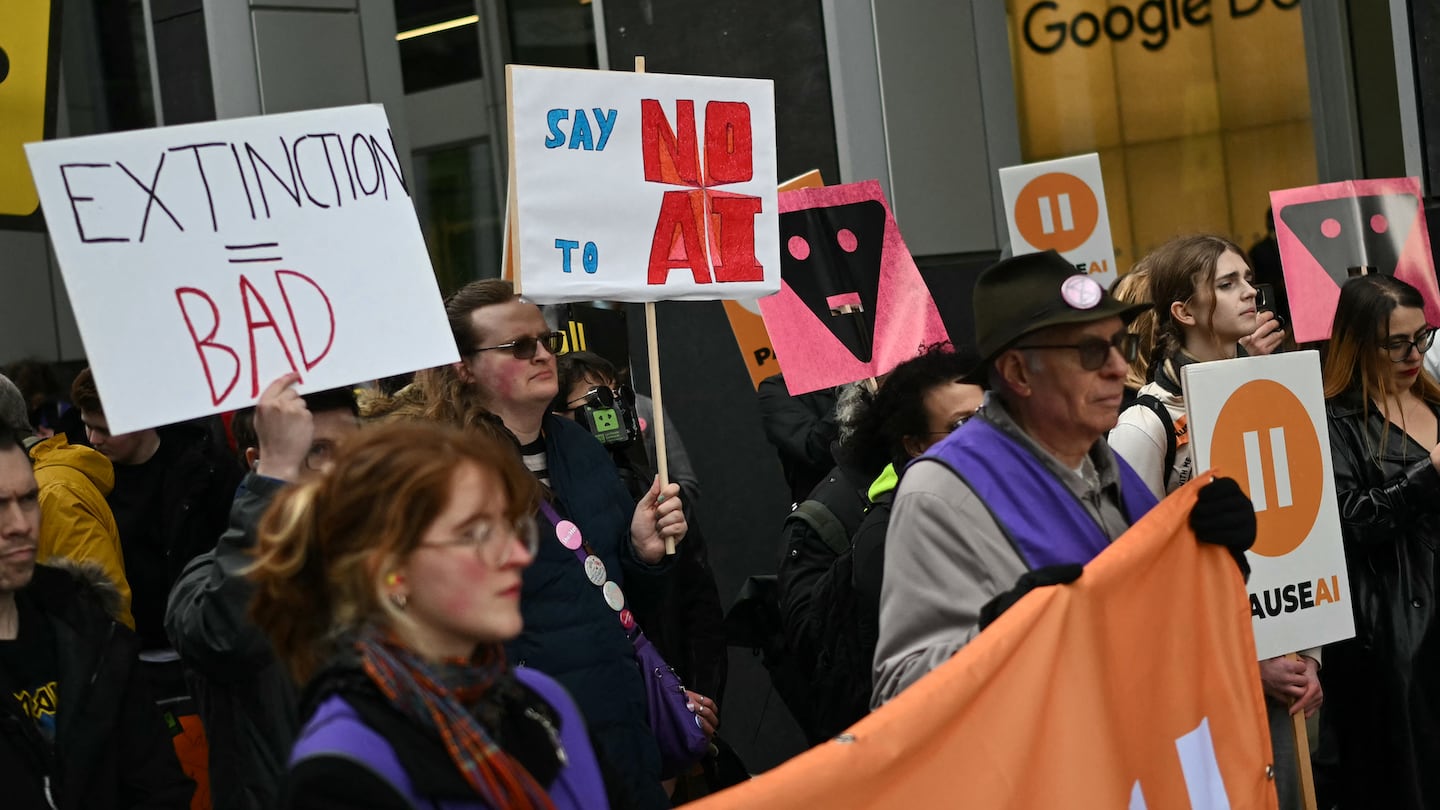
Horner’s internally conflicted feelings towards AI are a common occurrence. Joseph Miller, the UK director of the group Pause AI, which helped organise a protest of about 300 people that marched past the London offices of tech giants like OpenAI, Google and Meta in February, is himself an AI researcher. His field is mechanistic interpretability, which examines what’s actually occurring inside the black box of an AI model.
“AI has been used for good in so many ways,” Miller said, offering medical imaging as one example.
ADVERTISEMENT
His concern, and that of Pause AI, is more about what happens when AI surpasses human intelligence and breaks free of any control. “We’re worried about human extinction,” he said.
Others have joined the group’s protests for a variety of reasons. According to Miller, one volunteer who works as a programmer just got a 30-year mortgage on his first house. He realised that, given AI’s advancing ability to write code, there’s little chance his job will exist in 30 years.
This landscape isn’t easy for brands to navigate. Most fashion and retail businesses today are using AI in some form, including for back-office tasks like analysing sales reports. Brands often say they’re using the technology to supercharge human workers, but people like Horner are sceptical. He said it’s great that companies are able to save time, but not if it potentially means someone’s job is eliminated.
Of course, it’s the customer-facing uses that receive the most scrutiny. In those instances, considering the content alone is not enough, according to Antony Cousins, executive vice president of product at Meltwater, which produced the report on brand trust and AI.
“You have to think about the context in which it is being served,” he said.
For example, AI imagery used on a brand’s website, such as photos showing an item on the digital twin of a human model or product shots with AI-generated backgrounds, might spark little reaction. But on social media, that imagery could be met with outrage and spread widely, since the algorithm prioritises content that grabs attention, often by provoking anger, fear or hate, Cousins said.
If brands use AI to handle customer service, the perception can be that it’s a cost-cutting measure, which will also prompt a negative response. Instead brands need to make clear how the use of AI is intended to improve their experience. Telling a customer it’s midnight where the brand is based and they will receive an AI response until a human is back online is much more acceptable, Cousins noted.
There may be no one-size-fits-all approach. It will vary by brand, and by each brand’s audience. Gordon guessed the intense response to her use of AI was likely influenced by her brand’s customer base, which has a strong political bent because of Selkie’s emphasis on inclusive sizing.
“Size should not be political. Women’s bodies shouldn’t be political, but they are,” Gordon noted.
She thinks AI demands a nuanced conversation. There are positives and negatives. But nuance is difficult to achieve on the internet. She pointed to the recent example of actress Reese Witherspoon, who was attacked for pushing women to learn AI so as not to be left behind.
“I have a really cool audience,” Gordon said. “They fight for the right things, so I should be happy. But it’s hard to not take it personally.”
For now, however, she won’t use AI in her designs anymore, though she emphasised it wasn’t because of the uproar but because she’s gotten bored with the images AI produces.
“Unless generative AI really changed — and it will — I wouldn’t publish it on a piece of clothing again,” she said.
Companies have raced to put large language models to use for jobs from generating images to writing code, but to get the best use of this innovative form of AI, they need to know its limits and how to navigate around them.
The reaction to Prada’s unsettling new campaign reveals an emerging sentiment in online audiences who see AI and luxury as incompatible.
The industry’s top decision makers may know all the AI buzzwords, but too many are lacking fundamental knowledge about how the most consequential technology in a decade actually works.
Marc Bain is the UK Editor at The Business of Fashion. He is based in London and oversees BoF's case studies and executive memos, as well as driving its technology coverage.
Loading recommended reads…
Cooper will succeed David Pemsel as the fashion trade body’s chair effective Oct. 1.
At a time when luxury brands are searching for new sources of meaning and desirability, Off-White invites 10 creatives to unpack what turns an idea into a timeless reference.
They join previously announced speakers including Kering’s Luca de Meo, LVMH’s Sidney Toledano, Levi’s Michelle Gass, Tapestry’s Joanne Crevoiserat and Exemplar Luxury Group’s Geoffroy van Raemdonck at BoF’s annual gathering for big thinkers, taking place Dec. 1-4 in Oxfordshire, UK.
There was almost nothing nostalgic, reverential or expected about the wildly eclectic collection the senior statesman of American fashion showed on Wednesday, kicking off New York Fashion Week.