Agenda-setting intelligence, analysis and advice for the global fashion community.
Agenda-setting intelligence, analysis and advice for the global fashion community.

Last week, some fans who lined up days in advance to get Swatch’s $400 Royal Pop collaboration with Audemars Piguet were there for a product that didn’t exist.
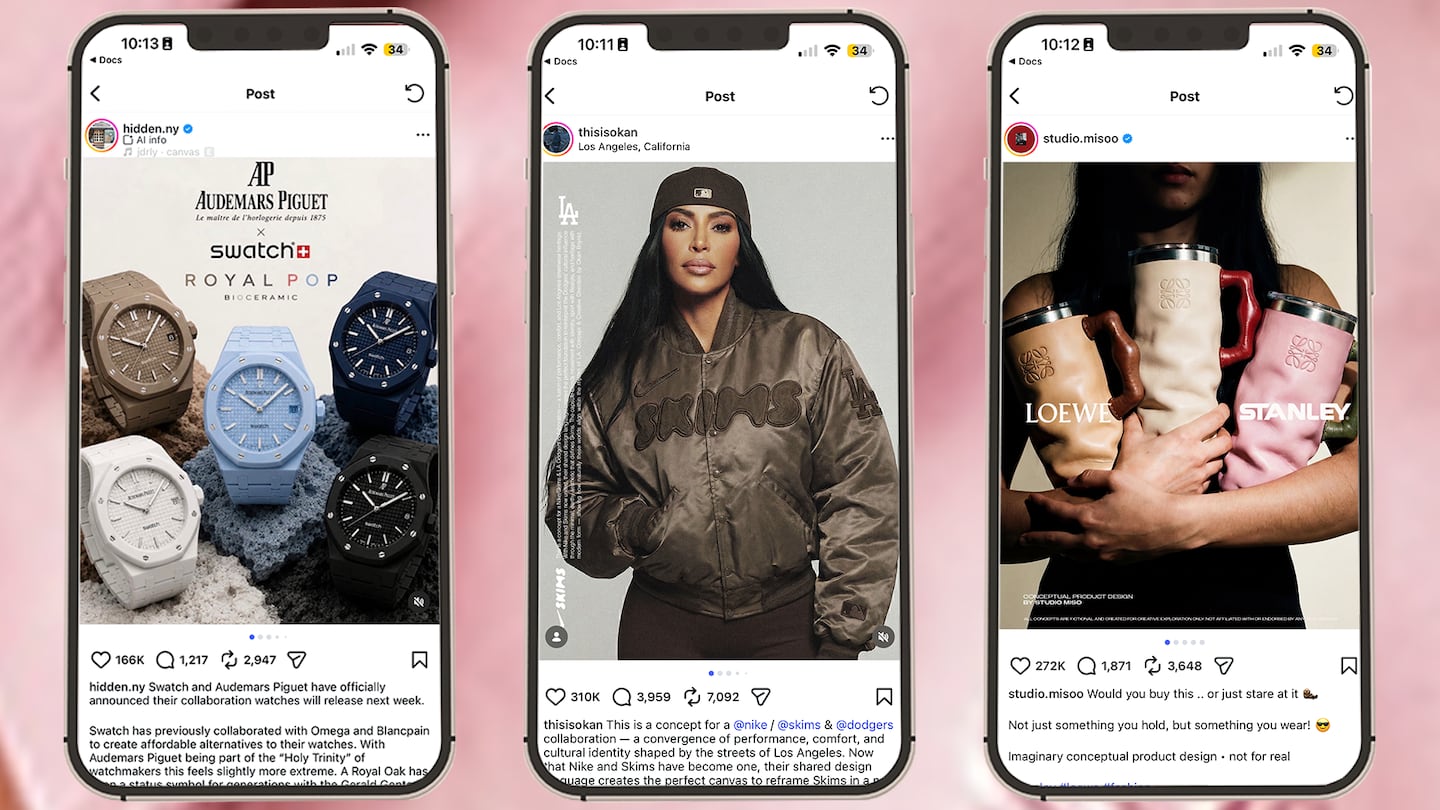
That’s because when Swatch announced the collaboration on May 8 with a vague teaser, online content creators quickly created mockups of the collaboration depicting co-branded versions of AP’s Royal Oak wristwatch, which can run from $20,000 to $100,000.
When Swatch unveiled the official imagery on May 13, and the product turned out to be a bioceramic pocket watch attached to a lanyard, the reveal was met with disappointment by some, and confusion by others. One person waiting on line in New York told GQ he originally turned up for the wristwatch, not the pocket watch.
“Bruh i was about to flex that my watch 4 hunnid Now i cant, Silly AiP images,” Christian Thomas Irving, a British music entrepreneur, commented on Swatch’s unveil post on Instagram.
ADVERTISEMENT
The episode is the clearest example to date of how fake mockups can mislead consumers and cause issues for brands. While fans have been creating images of products they want to see for years, AI has supercharged the trend, making it easier than ever for anyone to whip up a photorealistic render that can be mistaken for the real thing. On Instagram, pages that imagine fake AI-generated collaborations, like Stanley Cups made by Loewe or a NikeSkims apparel line made with the New York Yankees, have garnered significant amounts of engagement.
The situation poses a complex challenge for an industry defined by tightly controlled image-building and carefully orchestrated rollouts for new products, campaigns and collaborations. While fake visuals can spread misinformation or tarnish a brand’s image, they can also create real excitement that brands don’t want to squelch.
“The fan mockups sort of did the marketing,” Frank Seddigh, a lawyer and legal consultant who’s advised brands such as Gucci and Rhode, said of the Royal Pop collaboration. “Swatch and AP got free viral top-of-feed buildup. You can’t even buy that type of organic participation and engagement.”
Creators of these AI-generated design concepts, such as Zeynep Aldemir and Okan Boyraz, who run the Instagram pages studio.misoo and thisisokan, respectively, said large brands have reached out to them about their work — Aldemir said she was even hired by one to produce a video, though she declined to disclose the name.
“What I always say is that there is no bad publicity,” said Aldemir.
For brands on the receiving end of this publicity, the question is how to engage with it.
In other industries ranging from sneakers to automobiles, it’s common for fans to create mockups of newly announced products to generate discussion within their communities. Seddigh believes the anticipation built by this AI-generated imagery is just a part of how consumers react to a product rollout today, and that brands need to anticipate that.
“The thing that you can never really do with any fan audience is you can’t control a fan audience,” said marketing consultant Bimma Williams. “The better move is to figure out a way where you can embrace and collaborate with them.”
ADVERTISEMENT
Williams pointed out that brands such as Lego have embraced fans submitting ideas, which can then be voted on by the broader brand community to become real products. He believes that if brands decide to engage with creators making AI-generated iterations of products with their trademarks, they should lean into positive two-way conversations with them rather than negative interactions.
Some brands are showing their appreciation. In November, Timberland’s Instagram account commented “Uniform’s lookin’ right” on a post where Boyraz imagined the heritage boot brand partnering with the buzzy streetwear brand Corteiz. Adidas left an “eyes” emoji on an AI-generated partnership a creator imagined between the sneaker brand and Olympic figure skater Alysa Liu in March.
Still, the images these creators spread can also give rise to false expectations, which carry their own risks.
“Mockups can definitely help, but how do you manage the fallout when it doesn’t look like the product that people think it’s going to look like?” said Kiron Mitchell, a marketing expert who previously worked for Off-White and Nike.
Williams believes the answer is that brands should be confident enough to deal with whatever expectations customers have about them but still be true to their own vision.
“Sure, they might ruffle some feathers and hurt some feelings in the short term, but it won’t ultimately hurt their brand,” said Williams.
While brands can choose to take legal action against creators of these images on the basis of trademark violations, legal experts believe it’s not worth pursuing litigation in most cases. Seddigh said it’s only advisable to take legal action if the content truly tarnishes the brand’s trademark or is used to sell physical counterfeit goods.
Victoria Schwartz, a professor at Pepperdine Caruso School of Law, said it would generally be hard to stop creators who aren’t actually selling AI-generated design concepts as real products.
ADVERTISEMENT
“They’re only AI mashups; they don’t exist anywhere, ” said Schwartz. ”Trademark law is typically about consumer confusion, and there’s not really a product for consumers to be confused with.”
Even if the AI-generated mockups led many shoppers to believe that Swatch’s Audemars Piguet collaboration would offer something else, it did not dampen the Royal Pop’s release on Saturday. The hype hit a fever pitch when massive crowds forced some Swatch stores to shut down.
Mitchell points out that even though the brands didn’t produce what AI renders anticipated, dedicated shoppers will still find a way to make it a reality. Within the past week, several third-party manufacturers have emerged promising “conversion kits” to turn Royal Pops into wristwatches. One Redditor is even attempting to 3-D print their own wristband.
For brands, these consumer reactions can be educational. They act as free-market research, illuminating what shoppers really want.
But both Williams and Mitchell said they wouldn’t seriously build off AI-generated collaboration concepts that fans have hyped up online. While they believe it’s important to listen to consumers, most of the examples that circulate look cool but are not necessarily novel ideas, similar to how Harry Potter fan fiction would never actually be published as canonical works.
The designs can also be challenging to bring to life for a myriad of reasons, ranging from being physically impossible to create to simply being tough to bring to market because of how many layers of approval they would need to go through. Mitchell also adds that in many cases, these fan-generated concepts don’t really make sense from a brand identity perspective.
“You can make things that look cool, but true collaboration is about solving a problem or a gap in the marketplace, finding a white space and figuring out a way to attack that white space in the best way,” said Williams.
Marketers have moved from experimenting with AI to harnessing it as a structural part of daily operations that can boost productivity and human creativity when used correctly. This case study breaks down the best practices to streamline workflows without sacrificing brand integrity or the human element of marketing.
Anger towards AI is growing as it becomes more deeply embedded in the workplace and daily life. Brands that want to use the technology and maintain customer trust would be wise to understand the reasons.
From content creation to media spend, smaller teams are moving faster — and taking on work once handled by agencies, analysts and engineers.
The mixed response to luxury’s experiments with AI imagery is linked to a deeper question: Is the new technology expanding creative possibilities or undermining the sector’s promise of human artistry?

Lei Takanashi is a Correspondent at The Business of Fashion (BoF). He is based in New York City and covers menswear, streetwear, young consumer trends, and the intersection between fashion and culture.
Loading recommended reads…
The media entrepreneur joins Imran Amed on The BoF Podcast to discuss what it takes to earn readers' trust, and what fashion is missing about the people it most wants to reach.
The ‘sneaker-of-the-year’ conversation has traditionally revolved around models that meet what most people consider a typical sneaker. In 2026, that conversation is shaping up differently.
At New York Climate Week, fashion again pledged to turn its talk into action, with the launch of a new coalition bringing together dozens of brands, manufacturers, retailers and innovators. Real reductions of the industry’s impact, meanwhile, remain elusive.
The veteran makeup artist, who has worked alongside Matthieu Blazy since his debut in 2025, will ‘bring a new perspective, reinforcing the vitality of Chanel Makeup,’ the company said.