Agenda-setting intelligence, analysis and advice for the global fashion community.
Agenda-setting intelligence, analysis and advice for the global fashion community.

Even before the war had officially begun, Jason Wong was bracing for impact.
“We knew the issue was going to be big,” said the founder of packaging manufacturing company Paking Duck. He’d been tracking the brewing conflict in the lead up to the US’ first strikes across Iran. “Though our orders before Chinese New Year were stabilised, we’re now seeing plastic suppliers no longer honouring agreements. They basically said: ‘Hey, the prices that you had before no longer exist. Don’t even bother going after them.’”
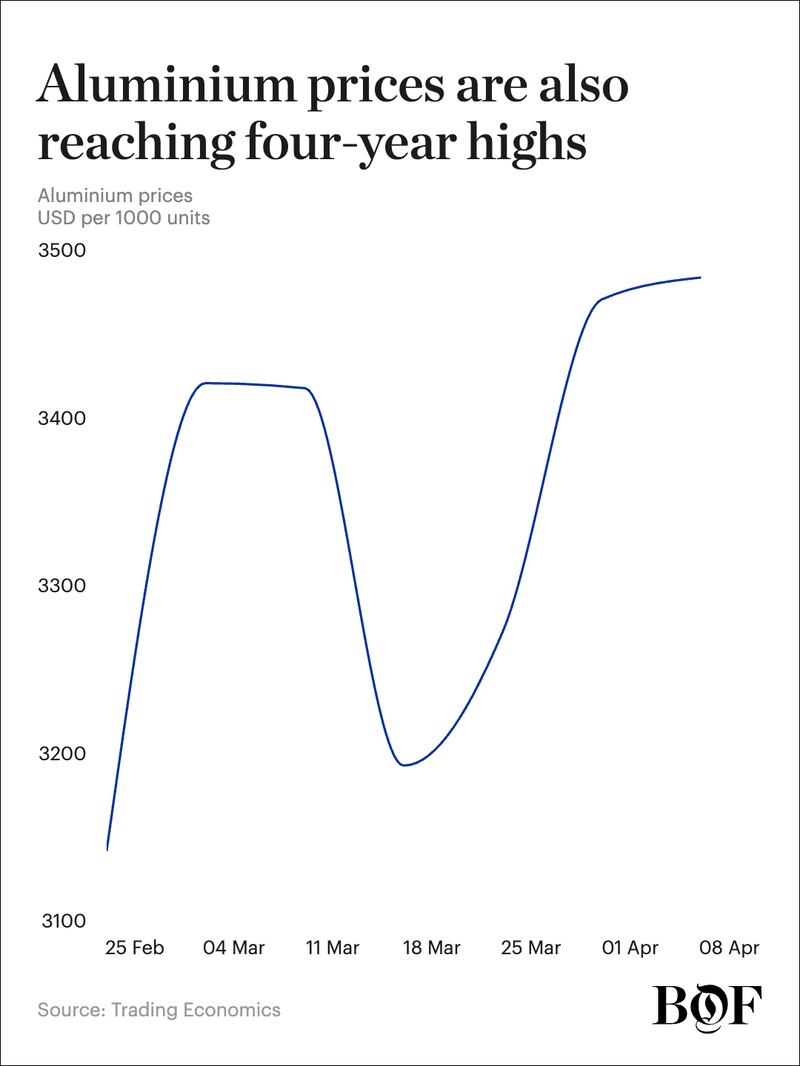
As oil prices soar — stemming from the ongoing conflict between the US-Israel and Iran and closure of the Strait of Hormuz, one of the world’s key trade arteries through which one-fifth of the world’s fossil fuels are transported — the cost of petroleum-based plastics and popular alternatives like aluminium are also hitting reaching four year highs.
“We’re seeing the war affect every single part of it, from the logistic prices, oil prices, to our raw material prices,” added Wong. “At its peak, we saw plastic prices go up about 30 percent.”
ADVERTISEMENT
Currently, manufacturers are feeling the impact, but the aftershocks will ripple throughout the supply chain. “It takes time for it to work through the system,” said Michael Greenberg, chief executive of plastic market data firm The Plastics Exchange. “But ultimately, the consumer pays it.”
The consumers in this case are beauty brands themselves, who are facing a tough decision: eat the costs or pass them on to shoppers. Meanwhile, these brands are already contending with consumer hesitancy, as well as energy price inflation and delivery delays, Kiko chief executive Simone Dominici told Reuters last week.
More immediately, brands must reevaluate and lengthen their product pipelines while they look toward incorporating oil-free alternatives. But with these materials also rising in cost, brands are being urged to consider price hikes — just months after the likes of E.l.f. Cosmetics and The Inkey List announced tariff-related increases.
“We’re talking to our clients, to inform them that they might need to adjust prices for any new products,” said Wong. “Things are also going to take a lot longer to create. Our production timelines are typically six to nine months. That’s not going to be the case anymore.”
For the majority of the beauty industry, plastic is the go-to product for packaging, relied upon for tubs, bottles, jars and components like caps and pumps. But there are also other overlooked, yet crucial, parts in the sector that are made from plastic. “Stretch wrap is a really good example, because you can’t ship units without it,” said Greenberg. “Ironically, the demand for stretch wrap is inelastic.”
Plastic is still the gold standard for beauty products because it’s highly malleable and reliably stable. But, ultimately, it’s cheap. Plastics used for everything from transporting palettes of shampoos to encasing expensive anti-ageing serums are made from byproducts of the oil refining process in massive quantities. As using recycled plastic is far more expensive than buying virgin, for many companies, switching to recycling programmes is simply impractical.
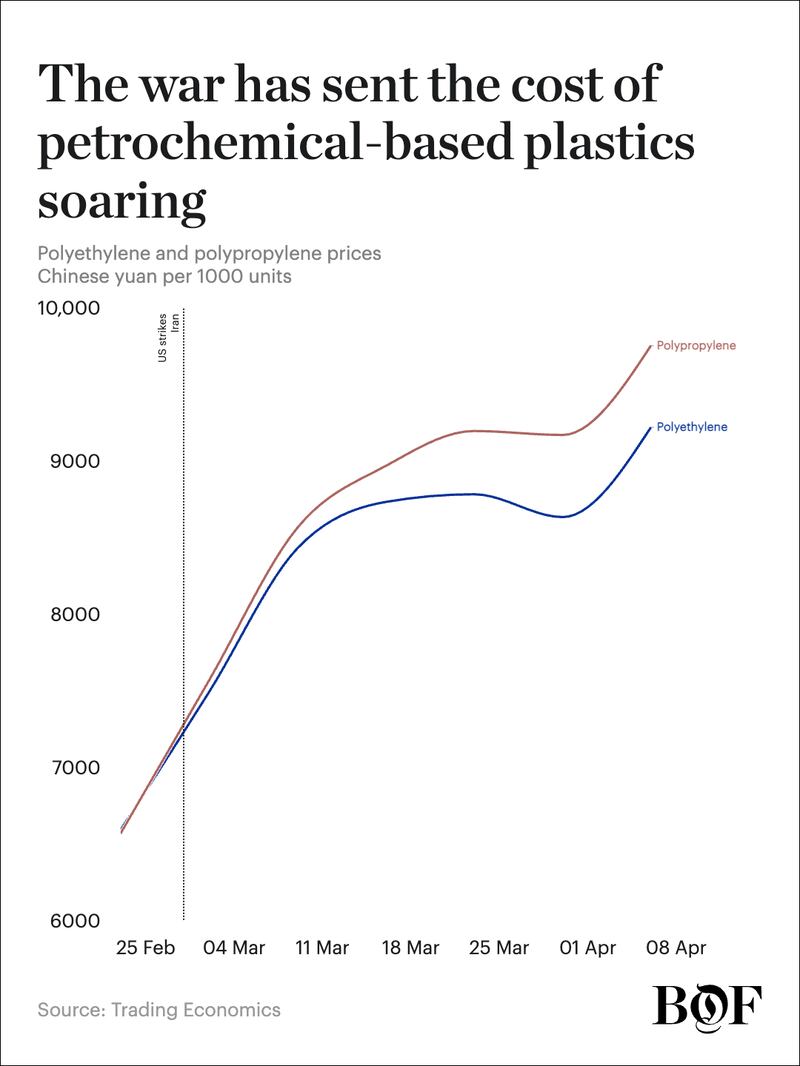
As the closure of the Strait of Hormuz has driven up oil costs, it’s sent the cost of petrochemical-based plastics to soar. Since the start of the war, the price of polypropylene (used for caps and pumps) has shot up by a staggering 48 percent; polyethylene (used for squeezy tubes and dropper bottles) is also up by a 39 percent increase, per Trading Economics. Both materials haven’t seen such a violent jolt in price since pandemic fluctuations in 2021.
Prior to the war, there has been a growing effort to reduce reliance on single-use plastics in the beauty industry — conglomerates like L’Oréal have incorporated refillable formats across skincare, haircare, and fragrance, while indies like Akt and Uni extol the virtues of using aluminium, which they claim can be more effectively recycled than plastic. But these materials are also threatened by conflict, with some of the world’s largest aluminium producers located in the Gulf. Last week, Reuters reported aluminium prices hit a four-year high as a result of Iranian airstrikes hitting two major aluminium producers – Aluminium Bahrain and Emirates Global Aluminium.
ADVERTISEMENT
Right now, the costs are being felt by manufacturers, who are being forced to purchase these raw materials with no idea of when the price soaring will end. But if the conflict stretches on for months, brands will soon have to begin factoring in these higher production costs and expanded timelines to their own balance sheets. Longer term, faced with a new price reality, brands might also be tempted to explore other avenues for their packaging needs, such as sustainable alternatives like aluminium. But those changes can’t happen overnight.
Today, aluminium packaging in the form of tubes, tubs and jars are multiplying across beauty as a sustainable alternative to plastic, largely due to the material’s “infinite” recyclability.
Aluminium is much lower in demand, and thus much more expensive than plastic. As a result, it’s been adopted by premium labels with sustainable and “clean” positioning, such as body care brands Akt London and Uni, skin and hair brand Typology or grooming brand Highland.
“We made the packaging decision before we were formulating,” said Uni founder Alexandra Keating, choosing 100 percent recycled aluminium bottles for a range of her products and ensuring formulas were compatible.
Meanwhile a new wave of “compostable” materials which are slowly getting traction for commercial scale, promising plastic-like performance without the petroleum. The pitch is simple – switch the material, shrink the footprint. The best example might be UK-based company Shellworks, whose co-founder Amir Afshar described its material, Vivomer, as a “completely natural” product made by feeding organic waste to microorganisms. The resulting material is shelf-stable and can be used like plastic but is broken down in compost. Afshar said Shellworks has produced millions of units, and counts the refillable deodorant brand Wild — now owned by Unilever — among its biggest customers.
But these promising new materials have yet to prove themselves perfect solutions. How recyclable a material is depends on local and national programmes for recycling, or on human behaviour like knowing how to correctly compost. Just in the US, recycling infrastructure, awareness and as a result habits vary from state to state.
Moreover, containers made of aluminium often still need to integrate plastics to keep product contents stable and durable, while innovative solutions like Vivomer and Greenworks Bio are yet to scale and are not ready for widespread implementation. In March, Vivomer secured a $15 million Series A investment to help change that.
Packaging experts and founders of brands that have adopted alternatives as their primary packaging say that the issue is less about choosing the “best” material and more about navigating a broken system. Consumer behaviour, manufacturing constraints and uneven recycling infrastructure decide what’s sustainable in practice and can be made affordable.
ADVERTISEMENT
Adam Herriott, a senior packaging sector specialist at Wrap, said there’s “no black-and-white” answer. “The question isn’t whether something is theoretically recyclable, but whether it’s designed for the realities of collection, sorting and reprocessing.”
Plastics are still lightweight, protective and often lower-impact to manufacture than heavier alternatives. If packaging fails and product spoils, the environmental cost of wasted formulation can exceed the footprint of the container itself. The most sustainable package is the one that prevents waste and can realistically be recovered. And in many cases, that’s simply single-use plastic because of its composition and availability.
But recycling plastic is still not cheaper than using virgin, which keeps the cycle of using the latter ongoing — until disruptions expose the cost of overdependency.
Avoiding single-use plastic has become a rallying cry for many beauty brands, and one that affects nearly every aspect of their businesses. Founders Ed Currie and Andy Coxon said they could have launched their brand Akt London, known for its full-body deodorant, “about two years earlier” if they hadn’t committed to being plastic-free.
Consumer preferences for sustainability have shifted in recent years, taking a backseat to other benefits like results or cost. “It’s not our number one USP that we’re plastic-free deodorant anymore,” Coxon said. “We’re a deodorant that actually works, but we also happen to be plastic-free.”
That pivot underscores a central point – packaging has to perform commercially and functionally, not just symbolically. Ultimately, the misconception powering aluminium’s momentum is that packaging is rarely a single material — and in most cases still typically includes some form of plastic.
Still, the plastic price hikes as a result of war show how usually the most economically and chemically reliable material isn’t immune to geopolitical uncertainty. Given this, large beauty players may quickly move to diversify their packaging to include more oil-free materials or make considerations for return and refill models, which reduce production costs.
Bio-based materials, such as Vivomer and compostable products from Greenworks Bio, derived from waste streams and natural sources will be the way forward, said Dr. CC, a materials scientist specialising in sustainable packaging. But ultimately scaling depends on investment and systems adoption.
For now, beauty’s packaging future looks less like a single breakthrough and more like a portfolio approach: refill where feasible, single-material packaging designs that can be recycled easier, investing in scaling up promising innovative materials and a bet from the biggest beauty players into non-plastic solutions.
“There’s no single material that solves everything,” said CC. “The next phase is about designing entire systems, materials, infrastructure and behaviour to work together.”
Sign up toThe Business of Beauty newsletter, your complimentary, must-read source for the day’s most important beauty and wellness news and analysis.
Want to dive deeper into an insight from this article? Check out The Brain of Fashion, BoF’s new generative AI tool where you can unlock BoF’s beauty archive with a single question.
As the conflict enters its second month, brands, retailers and business leaders across the region are leaning on crisis management and contingency plans amid an increasingly volatile security environment.
Monday’s price spike proved short-lived, but volatile markets, supply disruptions, rising freight costs and shaky consumer confidence have put the global fashion industry on edge.
A growing number of consumers want beauty products minus the plastic packaging. Greener options are expensive — but some viable options are emerging.

Rachael Griffiths is a Senior Editorial Associate at The Business of Beauty. She is based between St Helens and London, and covers beauty, wellness and industry news.

Shayeza Walid is Senior Editorial Associate covering Sustainability at The Business of Fashion. She reports on fashion's environmental impact, climate accountability, supply chain and labour issues. Based in London, she also contributes to BoF's Global Markets and UK coverage.
Loading recommended reads…
Energy, shipping and material costs are going up thanks to the conflict in Iran, with consumers likely to start feeling the impacts this autumn.
Join us for our next BoF Professional Masterclass on Monday, September 21, at 17:00 BST / 12:00 EDT as BoF’s Marc Bain and Robert Williams unpack the multi-faceted strategy that reignited desirability and sales, allowing the French couture icon to solidify its position in ‘ultimate luxury.’
How did a 115-year-old brand rocket back to growth amid a downturn in luxury demand? Drawing on interviews with Chanel fashion president Bruno Pavlovsky, artistic director Matthieu Blazy, group CEO Leena Nair and more, this report breaks down the multi-faceted strategy that reignited desirability and sales, allowing the French couture icon to solidify its position in ‘ultimate luxury.’
The 25-year-old designer behind LII has gone from fashion graduate to LVMH Prize runner-up in three years. Now, he’s working on turning the buzz into a business.