Agenda-setting intelligence, analysis and advice for the global fashion community.
Agenda-setting intelligence, analysis and advice for the global fashion community.

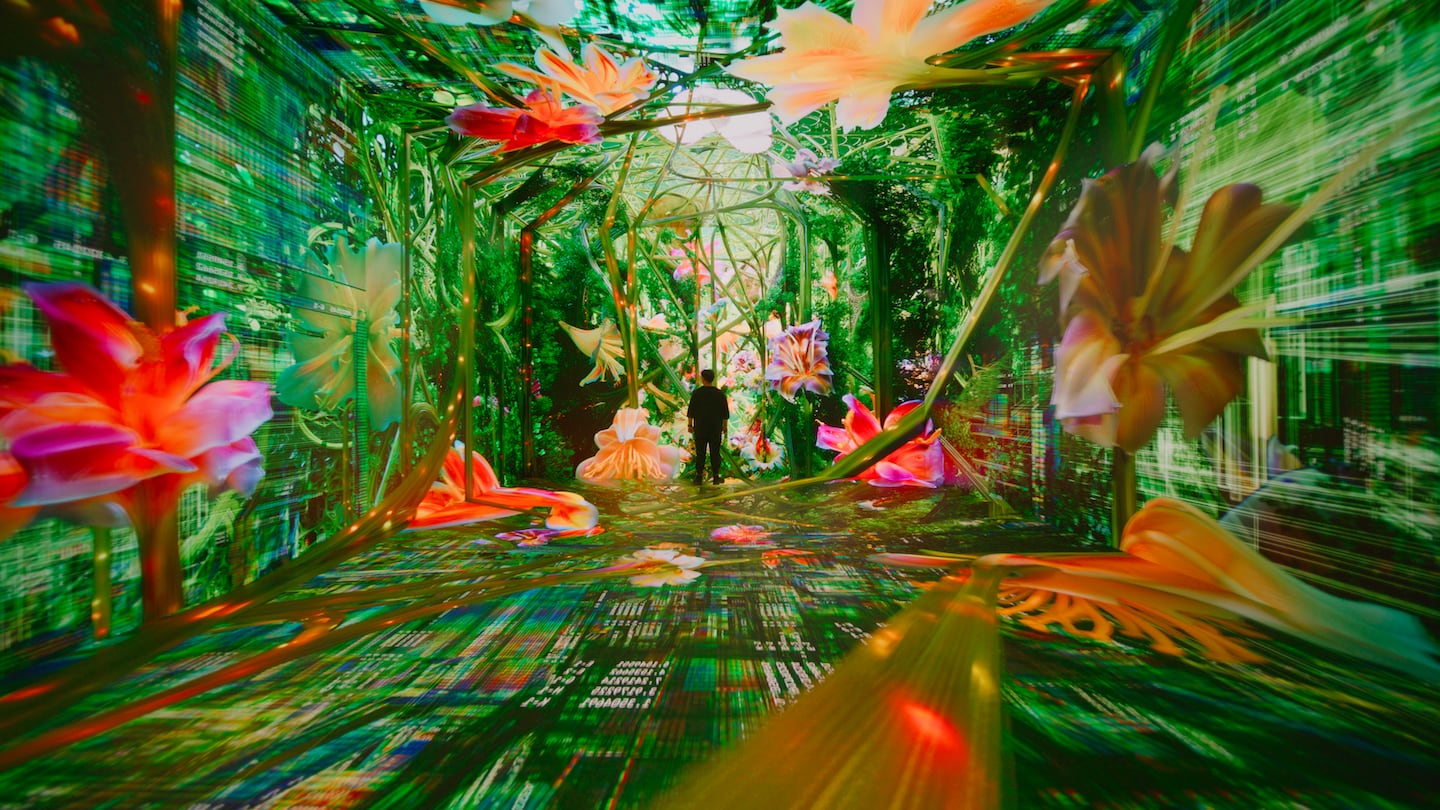
LOS ANGELES – “What happens next has never happened before, and when you leave, it never will again,” a disembodied, android-like female voice intoned over the sound system.
The voice spoke to a dark room lined with wall monitors flashing digital animations of technicolour flowers and nebulous shapes, rotating in patterns evoking computer screensavers. With a QR code scan, a glowing box opened before visitors with sci-fi movie flair, revealing a biometric tracking wristband and futuristic electronic collar. When placed around the wearer’s neck, the device dispensed a puff of perfume.
The experience was part of the first exhibition at Los Angeles’ new museum, Dataland, a 35,000-square-foot permanent space self-described as “the world’s first museum of AI arts” that opens on June 20. The “smart diffuser necklace” was developed for the exhibition, misting custom, not-for-sale fragrances developed by L’Oréal to complement scenes through the immersive experiences. The company serves as the museum’s “founding olfactory partner,” joining a tech-heavy group of collaborators including Nvidia, Google Cloud, Epson, LG Electronics and Scalable.
Located in the architect Frank Gehry-designed mixed-use Grand LA complex, the museum was established by Refik Anadol and co-founder Efsun Erkılıç. A $59 ticket grants access to the Machine Dreams: Rainforest exhibition, which visualises jungle imagery and data in areas including a disorienting show of flowers, trees and mushrooms growing wall-to-wall, floor-to-ceiling in a 30-foot-high room. Visitors can see their pulse, body temperature and “emotion” data in circles that follow beneath their feet.
ADVERTISEMENT
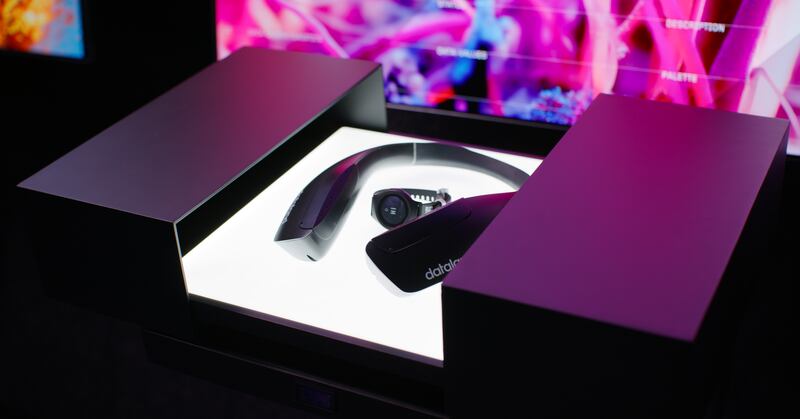
“Your heartbeat, your body temperature, skin conductance is shaping the whole forest,” said Anadol of the images, which have been prompted to change in real time based on the biometric numbers in the wristbands.
L’Oréal’s luxury division provided a collection of 12 different scents, which it calls “olfactive imprints”: “Synthetic Essence,” with notes of ocean musks, aldehydes and woods accompanies Matrix-esque digital animations; “Mycelial Whisper” dispenses a patchouli oil and mushroom accord as mushroom networks develop underfoot. The highlight at the very end is “Lost Flower,” capturing the scent of the Amazonian moonflower, which blooms one night each year.
While the conglomerate has never partnered with an AI creator of this calibre, Cyril Chapuy, the president of L’Oréal’s Luxe division, was impressed with Anadol’s art piece Unsupervised at the Museum of Modern Art in New York in 2022.
“I thought he was a creative genius,” Chapuy told The Business of Beauty.
The idea for the museum was conceived four years ago, and has been under construction for two years, said Erkılıç. Since then, public attitudes toward AI have changed drastically. A Pew Research poll found that in 2026, 50 percent of respondents said they were concerned about AI use in daily life, a number up from 37 percent in 2021, amid backlash to the environmental impacts of data centres and news of AI-driven job loss.
“If you use it properly, AI is going to be fantastic for all of us. It’s not only going to make us a bit faster… but more creative, more disruptive. Refik’s work is a perfect illustration of this,” he said.
Anadol agreed.
“There’s always a bias and objection … I do believe that this is an incredible time to innovate, create and break through art forms, because we are in a renaissance."
ADVERTISEMENT
Brands of all sizes are still negotiating how they use AI in their work, from product development to marketing. Within art specifically, labels typically pick uncontroversial art exhibitions to sponsor, capitalising on institutions’ established prestige. Fragrance-museum collaborations have included the Tate Modern’s Andy Warhol exhibit with Comme des Garçons Parfums and Officine Universelle Buly’s collaboration with the Louvre, where L’Oréal also staged an exhibition about the history of beauty in 2024.
But Chapuy describes the new museum as the “luxury of tomorrow.” He is bullish on AI, despite outcry about how the technology is harming artists and creative fields.
“I’m a very strong believer in AI. I use AI a lot but I use it to augment what I do, never to replace what I do. I use it to augment my creativity. It doesn’t replace your capacity to have a brain, have a vision,” he said.
L’Oréal’s scents are among the human elements that can be found throughout the exhibit, which include an LA Philharmonic-donated recording of Mahler’s Symphony Number 3 played during a rainforest-plant-growing visualisation.
In the exit area, visitors receive a token with their biometric data on it that can be exchanged for a custom-generated perfume in the future; the machine is installed but not yet operating for now. At the other end of the room, a robot wields a paintbrush, applying orange blotches to a canvas based on the “goosebumps” data collected from visitors’ skin, said Anadol. Each day, one $15,000 painting will be made and sold to private collectors.
“For me, [the museum] is very much luxury; this mix of art, emotion, technology,” said Chapuy. “Luxury has to be rooted in culture.”
Sign up to The Business of Beauty newsletter, your complimentary, must-read source for the day’s most important beauty and wellness news and analysis.
Anger towards AI is growing as it becomes more deeply embedded in the workplace and daily life. Brands that want to use the technology and maintain customer trust would be wise to understand the reasons.
The reaction to Prada’s unsettling new campaign reveals an emerging sentiment in online audiences who see AI and luxury as incompatible.
From deepfakes to affiliate links, producers of AI influencers are finding ways to make money even if brands aren’t interested in working with them.
Liz Flora is a Beauty Correspondent at Business of Fashion. She is based in Los Angeles and covers beauty and wellness.
Loading recommended reads…
This week, Europe’s leading luxury groups LVMH, Kering, Hermès and Prada will show who’s pulling ahead in the stubbornly choppy environment.
Sales of gems, precious metals and artwork at Japan’s department stores climbed 19 percent in the first half of 2026 from a year earlier to $2 billion.
Though Adidas dressed both teams in the World Cup finals, the global football tournament still presented some bright spots for Nike, writes Bloomberg’s Andrea Felsted.
From our archive, the creator and host of award-winning podcast “Articles of Interest” joins BoF founder, CEO and editor-in-chief Imran Amed to explore what clothing can reveal about identity, culture, labour and the world around us.