Agenda-setting intelligence, analysis and advice for the global fashion community.
Agenda-setting intelligence, analysis and advice for the global fashion community.

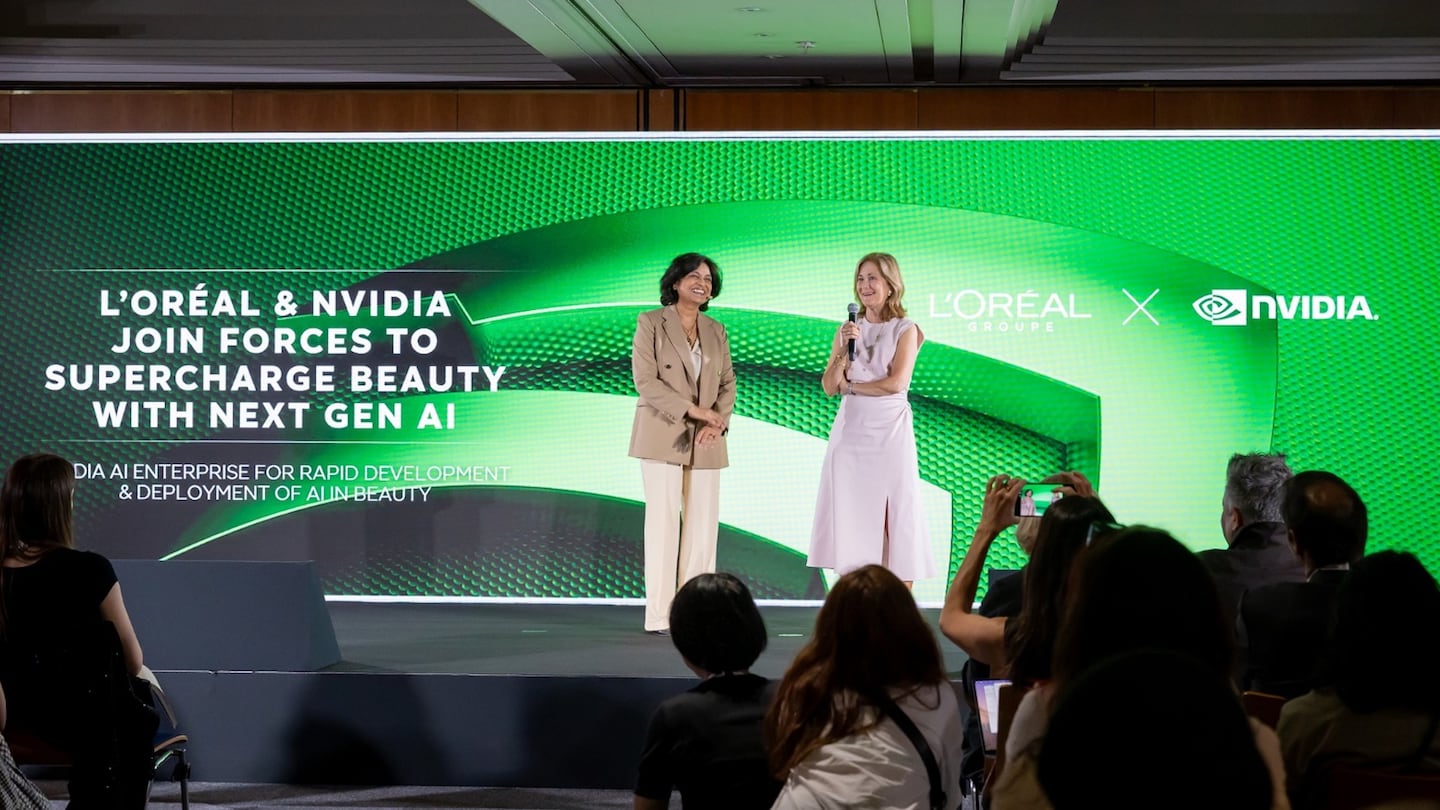
At the corporate level, the hottest trend in beauty these days is a tech AI partnership.
From L’Oréal Groupe to Estée Lauder and Unilever, beauty conglomerates have made significant investments in developing wide-reaching AI programs, partnering with tech companies as they rush to show shareholders they are keeping up with the pace of technology. The latest development came Tuesday morning, as L’Oréal Groupe announced an expansion of its Nvidia partnership, becoming the first beauty company to use the tech company’s tool for research and development of new molecules.
A few weeks before, Unilever unveiled a new AI partnership with Google Cloud. These are just some of the experimental new initiatives across R&D, marketing, productivity, consumer research and customer service that the world’s biggest beauty players have rushed to adopt. Amid talk of a broader “AI bubble” in the tech industry, the pressure is now on to find return on their ballooning tech investments.
“The ROI that we have using these kinds of tools, first and foremost, is speed,” said Guive Balooch, the global vice president for tech and open innovation at L’Oréal Groupe of its latest initiative with Nvidia. “The second is transformation. Transformation means it’s going to need to lead to products.”
ADVERTISEMENT
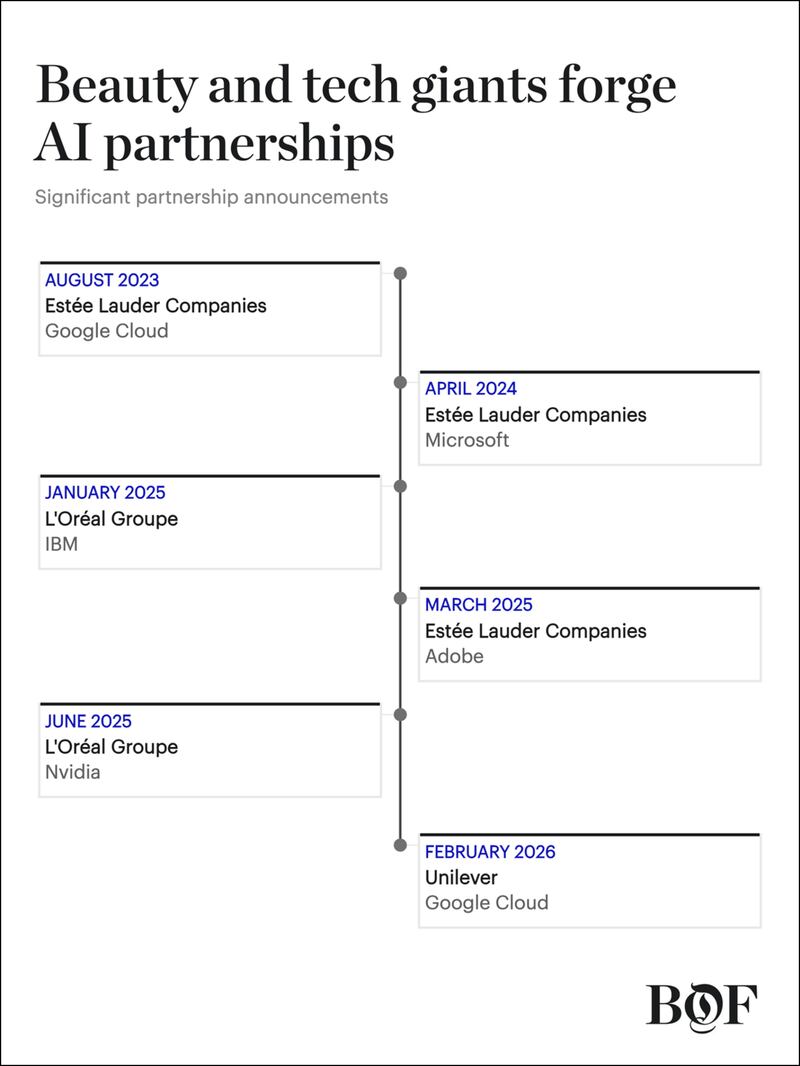
Estée Lauder has been equally active, launching a generative AI partnership with Google Cloud in 2023, an AI Innovation Lab with Microsoft in 2024 and a partnership with Adobe for generative AI in marketing in 2025.
Tech firms are actively pursuing partnerships for AI in both the beauty and fashion spaces – Nvidia also announced the launch of a virtual try-on app in fashion at its GTC AI conference on Tuesday. With L’Oréal’s high-profile involvement, Nvidia could encourage other brands to partner, said Azita Martin, the firm’s vice president and general manager of CPG and retail business. According to Martin, L’Oréal serves as what Nvidia executives call a “lighthouse account,” or a major early adopter with the power to inspire other brands in the industry to follow suit.
“The reason we always partner with the leaders is because they know more than everybody else, and they know how to lean in,” she said.
These initiatives are ramping up at a time when the broader business world is evaluating the financial benefits of AI investments. A July 2025 report by MIT’s Media Lab estimated that there had been between $30 and $40 billion in enterprise investment in AI, while 95 percent of organisations it studied across multiple industries were seeing zero return. A more recent survey by PwC shows a slightly improved, but still challenging, picture, finding that 56 percent of chief executives across sectors have seen no significant financial benefit from AI.
Product development has become a key area for AI investment at large beauty conglomerates. When Estée Lauder opened its Paris-based fragrance atelier in October 2025, it announced that it expected AI in the creation process would help reduce development time by 30 to 50 percent.
L’Oréal Groupe is the first beauty brand to use Nvidia’s Alchemi platform, launched in 2024 to speed up chemistry and materials discovery, working with LLMs trained in quantum chemistry data and simulation tools for new formulations. The beauty giant first announced its Nvidia partnership in June 2025, six months after it inked another product development and sustainability AI partnership with IBM.
“Some of the molecules that we have discovered have taken years, and we want to bring that down to months,” said Balooch. As for L’Oréal, AI has already aided in the product development process in China. After the group’s 2023 investment in Chinese biotech firm Shinehigh Innovation, L’Oréal Paris launched the Supramolecular Liposome RHC Cream in late 2025 with an AI-developed ingredient. This would normally take years, Balooch said, but with AI the entire process took eight months.
Matthieu Cassier, the head of digital research and development at L’Oréal Groupe, said he is confident that time reduction is now within reach, calling the AI partnership “a very big disruption in the way we do formulation,” he said.
ADVERTISEMENT
The first product the company is working on developing with the model is sunscreen, which presents a “very complex situation,” Cassier said, with the need to create products that minimise white cast, have no cakey finish and can be reapplied over makeup. No specific brand has been chosen to be the one to adopt it when it’s ready, although La Roche-Posay and Cerave were noted as possibilities.
Unilever, meanwhile, will be using Google’s enterprise platform Vertex AI for AI-augmented marketing and the creation of “a new model for how consumer packaged goods brands are discovered and shopped.”
“We are seeing a fundamental shift in the consumer journey as it moves toward assisted and agentic experiences,” said Isabel Massey, global head of media and integrated brand experience at Unilever. The company will be using the tech for data on audience behaviour in addition to content production, with the goal of making it possible for “teams to move from a trend to a tailored digital campaign in a fraction of the time,” she said.
Creating in-house LLM-driven chatbots is also an area for investment, as evidenced by Estée Lauder’s Jo Malone. The brand trained the tool to act like its in-store staff using what it calls the “tell, explain, describe” method of explaining fragrance to customers, said Jo Malone global brand president Jo Dancey.
“We worked closely with real advisors,” she said. “The recommendations are much more tailored and relevant to Jo Malone London than what you’d typically get from a general AI platform.”
As beauty companies continue to announce AI programs, some are beginning to acknowledge AI in their earnings reports tied to financial performance.
Prior to its Google partnership, Unilever announced in September 2025 that its efforts to adopt AI resulted in a 30 percent increase in the speed of producing marketing assets, with ad performance metrics like video completion rate and click-through rate more than doubling for brands in its beauty and wellbeing category, including Dove, Vaseline, Pond’s and Clear.
In L’Oréal’s earnings call for its 2025 full-year financial report, the company’s chief financial officer Christophe Babule said that “AI efficiencies” had contributed to a decrease in selling and administrative expenses. Google’s 2025 fourth-quarter earnings noted that Google’s AI Max service, which automates areas like headline writing and bidding in Google Ads, led to a 23 percent increase in direct-to-consumer sales for L’Oréal brands like Nyx Professional Makeup. Stéphane de La Faverie, chief executive of Estée Lauder Companies, said that AI drove a “31 percent increase in ROI from our North American media campaigns,” on its August 2025 earnings call.
ADVERTISEMENT
Beyond earnings calls, specific tools are benefiting brands — according to Dancey, users of Jo Malone’s scent advisor tool are “adding products to their basket and making purchases at about twice the rate of the average visitor.” The brand also collects data on its performance for general LLM visibility, finding that Jo Malone ranks fifth among competitors in the fragrance category, according to tracking tool Brandlight.
If L’Oréal’s Nvidia partnership indicates anything, it’s that AI assistance will continue to show up in every part of its business, down to the products in consumers’ hands. As for the potential of an AI-developed sunscreen on US shelves, “We’re on a time table of 12 to 18 months, if not sooner,” said Balooch. “We will definitely be seeing the benefits of it in the next year.”
Sign up to The Business of Beauty newsletter, your complimentary, must-read source for the day’s most important beauty and wellness news and analysis.
Want to dive deeper into an insight from this article? Check out The Brain of Fashion, BoF’s new generative AI tool where you can unlock BoF’s beauty archive with a single question.
From deepfakes to affiliate links, producers of AI influencers are finding ways to make money even if brands aren’t interested in working with them.
Keywords are just one part of the equation when it comes to showing up in consumers’ highly detailed requests for beauty advice on ChatGPT, Claude and Gemini.
Beauty tech firms and major conglomerates are staking their claims on AI’s next frontier with tools designed to recommend products, book services and streamline back-office operations.
Liz Flora is a Beauty Correspondent at Business of Fashion. She is based in Los Angeles and covers beauty and wellness.
Loading recommended reads…
Sales of gems, precious metals and artwork at Japan’s department stores climbed 19 percent in the first half of 2026 from a year earlier to $2 billion.
Though Adidas dressed both teams in the World Cup finals, the global football tournament still presented some bright spots for Nike, writes Bloomberg’s Andrea Felsted.
From our archive, the creator and host of award-winning podcast “Articles of Interest” joins BoF founder, CEO and editor-in-chief Imran Amed to explore what clothing can reveal about identity, culture, labour and the world around us.
Saunders, the brand’s first creative director in five years and a skilled colourist, promises to give Kate Spade the clarity it has long lacked. Now, Tapestry must apply the same long-term brand-building discipline that fueled Coach’s success.