Agenda-setting intelligence, analysis and advice for the global fashion community.
Agenda-setting intelligence, analysis and advice for the global fashion community.

What's up, down and making news this week in the fashion and beauty businesses.
Who’s up and down in the business of fashion, luxury and beauty this week.
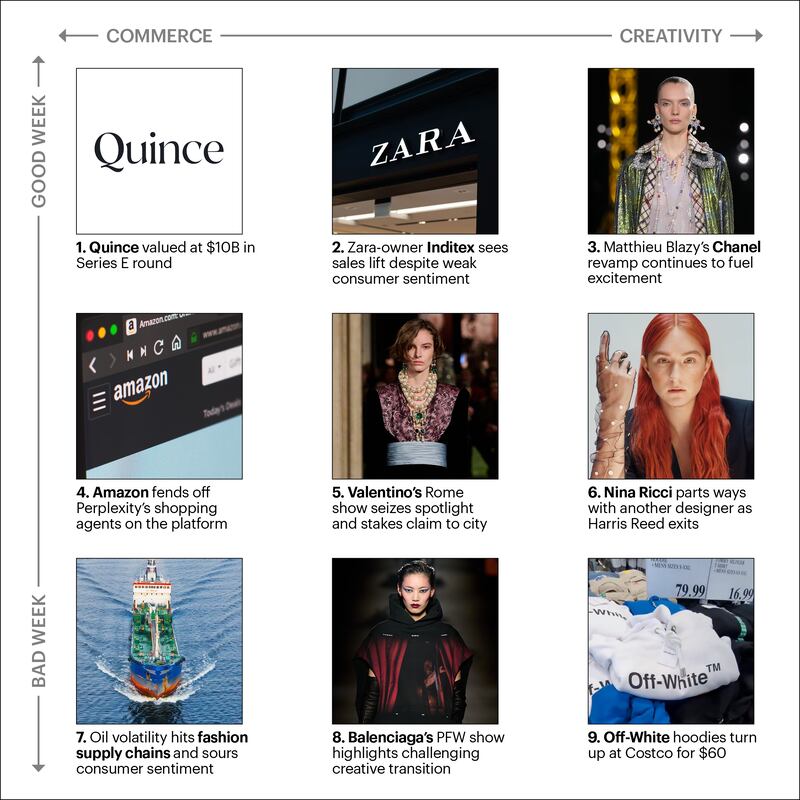
1. Quince is valued at $10 billion in Series E round as its dupe-focused direct-to-consumer model continues to disrupt the mid-market.
2. Inditex posted considerable sales momentum again in the first weeks of 2026 as Zara’s agile model gained steam from value-conscious shoppers despite weak consumer sentiment.
3. Matthieu Blazy’s latest Chanel show wowed fashion insiders days after they mobbed the brand’s Paris flagship to get their hands on his first collection.
ADVERTISEMENT
4. Amazon fended off Perplexity’s shopping agents for now after a judge’s ruling allowed the giant to block AI bots from scraping site data.
5. Valentino’s Rome show seized the spotlight days after the close of Paris fashion week, staking its claim to the eternal city as it aims to balance Alessandro Michele’s vision with its past.
6. Nina Ricci has parted ways with Harris Reed, after cycling through three creative configurations in the last decade, and will “take the time required to define its next chapter” and provide an update “in due course.”
7. Oil volatility from the Iran war hit fashion supply chains and has the potential to sour consumer sentiment while rising logistics costs could squeeze brand margins.
8. Balenciaga’s PFW show highlighted the house’s challenging creative transition as Pierpaolo Piccioli charts a course forward for a brand so heavily imprinted by former designer Demna.
9. Off-White hoodies have shown up at Costco for $60 apiece, raising the risk of brand erosion under new owners Bluestar Alliance.
Catch up on all the news of the week in fashion, luxury and beauty here.

A friend recently showed me a picture of her new couch from Quince. It’s a deep-seated sofa in a dark “java,” complete with a trundle bed and a shiny plush finish. She paid just north of $2,000 for it, including taxes — more affordable than something similar from Pottery Barn but more or less on par with West Elm. Except West Elm doesn’t offer free white-glove delivery.
ADVERTISEMENT
When asked why she took a chance on Quince for a big-ticket item like a sofa rather than go with a name brand, her answer was simple:
“The quality-to-price is high,” my friend says. “You should come try.”
Perceived value is exactly how Quince has built an online retail empire that this week was valued by investors at $10 billion in a $500 million funding round. The company is still mainly known for its dupes of products ranging from candles to cookware and cashmere cardigans. But unlike Shein or Temu — which also offer familiar-looking products at low prices shipped directly from the factory — Quince has a reputation for quality that’s allowed it to transcend its copycat reputation.
This model has proven surprisingly durable, and irresistible to a certain type of affluent, but value-conscious shopper: typically Millennial, aspirationally bougie. Founded in 2018, Quince has in recent years applied its formula in category after category, and reportedly grew annual sales to over $1 billion. In addition to furniture, the retailer now offers luxury skincare, gourmet food, and much more. A $125 tin of caviar has repeatedly sold out.
The latest funding round is an indicator that investors at least believe Quince has cracked a direct-to-consumer formula that has proven difficult to get right. Generalist online retailers like Brandless and Jet.com struggled to keep costs down while offering below-market prices; Quince’s direct shipping model keeps logistics simple and cheap. Everlane promised “radical transparency” by telling consumers how it set prices; Quince gets straight to the point and tells consumers how much they’ll save compared to similar products at rival retailers.
Quince isn’t reinventing the wheel. Perhaps another apt comparison is off-price retailer T.J. Maxx, which undercuts department stores by offering name brands at unbeatable prices within a treasure hunt shopping environment.
But rather than T.J. Maxx’s delightful chaos, there is a specific aesthetic Quince has nailed: a clean, minimalist vibe that signals “quiet luxury” to the average consumer. On TikTok, the “Quince Haul” is the antithesis of the chaotic Shein unboxing. Its products are made from luxe-sounding materials like “100 percent Washable Silk,” “European Linen” and “Turkish Cotton,” a strategy built for a customer who reads the tags.
To be sure, Quince has its detractors. Hundreds of posts on Reddit call its self-proclaimed quality into question — citing durability issues or, in the case of its $125 caviar, a “strong seaweed aftertaste.” Even my friend who bought the couch says she probably wouldn’t buy clothes from Quince.
ADVERTISEMENT
And while Quince is unique, it may have trouble staying that way. Everything about its business model can be replicated by a well-funded rival, just like Temu has out-Shein’d Shein in many markets with even cheaper products and even more ubiquitous marketing.
To avoid a race to the bottom, Quince has its eyes set on becoming a lifestyle authority. It recently hired an Estée Lauder alum to fill a newly created head of brand strategy and narrative role. It’s launched collaborations with A$AP Rocky and stylist Erin Walsh, a calculated move to buy cultural relevance and build the kind of brand equity that price-slashing rivals can’t replicate.
It’s even selling real, branded luxury items now, like Augustinus Bader skincare and Dom Pérignon — the real brut champagne, 2015 vintage.
Maybe $50 cashmere is luxury after all, if you can toast to your savings with a glass of real Dom. At a $10 billion valuation, Quince isn’t just selling sweaters and caviar, it’s selling the ultimate millennial hack — a champagne lifestyle on a seltzer budget.
By Cathaleen Chen
Go Deeper:
Quince Reaches $10 Billion Valuation in New Funding Round
The direct-to-consumer label raised a $500 million Series E as it seeks to continue its rapid expansion.
Can Quince Be More Than a Dupe Brand?
New partnerships with A$AP Rocky and celebrity stylist Erin Walsh signal the retailer’s ambitions to be known for more than selling less expensive versions of other brands’ products.
Loading recommended reads…
After nearly three decades under LVMH, the designer is opening a new chapter at his namesake label with new owners and no guarantees. Ahead of an in-depth BoF 500 cover story by Eric Wilson out next week, Jacobs joins Imran Amed on The BoF Podcast to reflect on the fashion slump and what comes next.
A growing Dutch outcry over the glasses mirrors a broader backlash against smart glasses equipped with cameras.
The ultra-fast-fashion giant’s share price sank to a record low after it released its first results as a public company earlier this week. With sales growth under pressure, the company must find a way to stand out in a hyper-competitive market.
Nike’s comeback timeline just got even longer. The brand announced a new four-year restructure during its first-quarter earnings call that will include more layoffs.