Agenda-setting intelligence, analysis and advice for the global fashion community.
Agenda-setting intelligence, analysis and advice for the global fashion community.


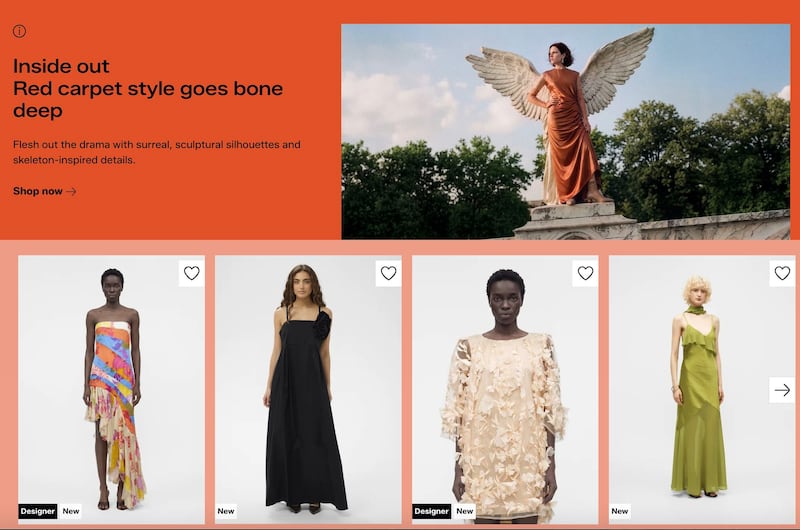
BERLIN — A day after the 2026 Met Gala lit up social media with red-carpet looks, German e-commerce giant Zalando ran its own campaign riffing on the night’s theme, “fashion as art.”
One image featured a model in a copper gown standing in front of a winged sculpture so it looked as if the wings were sprouting from her back. More traditional e-commerce imagery depicted models in a variety of dresses and tops against grey backgrounds. The campaign, which the company said prompted a 60 percent increase in products being added to shopping carts, was made entirely with artificial intelligence.
It’s just one example of the myriad ways Europe’s largest fashion e-tailer has deployed AI to boost its business. In fact, more than 90 percent of the campaigns on Zalando’s website are now AI-generated. Returning customers are met with a product feed tailored to their preferences with AI. If they have questions, they are able to chat with Zalando’s AI assistant, which can provide recommendations, or analyse photos to find similar styles. On product pages, Zalando offers AI-powered size and fit guidance. And once a shopper places an order, AI helps the retailer’s human staff — and growing fleet of robots — to pick, pack and ship it as quickly as possible.
For company executives, AI isn’t an add-on to the core business, it’s fundamental to it.
ADVERTISEMENT
“If you think of a company as a house, AI is like a different construction material,” said Robert Gentz, Zalando’s co-founder and co-chief executive.
Perhaps no other multibrand fashion retailer has built its house with as much AI.
For much of the company’s existence, starting with its founding in Berlin in 2008 by Gentz and David Schneider, who stepped down as co-CEO in 2024 to focus on strategic partnerships, Zalando has used classical machine learning for tasks such as forecasting demand and optimising its supply chain. Over the past two decades, it has expanded its use of AI to fields such as personalisation, and it’s only doubled down with the advent of large language models. It now uses AI in areas ranging from writing code to generating marketing imagery.
As Zalando sees it, the data infrastructure and AI capabilities it has built separate it from the average fashion retailer — even if the company has, at times, had difficulty persuading investors of its uniqueness. “We think Zalando is just a department store with limited differentiation,” Bernstein analyst William Woods wrote in a March research note.
For its part, Zalando says AI is speeding up tasks like software engineering and content creation, while improving customer experience. It said 10 million shoppers have used its AI shopping assistant for everything from getting outfit recommendations to finding out where an order is. The company even offers AI services to brands through Scayle Studios, a platform it recently launched to replace physical photoshoots with AI. There are tangible financial rewards, too. The company says it has slashed the cost of creating on-site content by about 90 percent, for example.
“Our fast-scaling AI capabilities are already delivering measurable benefits in driving both growth and efficiency,” Gentz said in a release announcing the company’s latest results.
In interviews with multiple executives at the company’s German headquarters, The Business of Fashion gained a behind-the-scenes look at the ways in which AI is shaping Zalando’s back-end operations, as well as the shopping experience for its 62.5 million active customers. More than anything, it’s the retailer’s specialisation in fashion and the ways it can use AI to leverage its vast trove of data that the company believes give it a unique advantage in online retail.
In a windowed conference room overlooking Berlin, Graeme Smith, Zalando’s chief technology officer, explained the company’s approach to AI.
ADVERTISEMENT
“Nobody’s invested like Zalando in applying AI to fashion and lifestyle in Europe, and that includes the data that we gather,” Smith said. “By having that data and using it really well, that’s something that a generic AI company can’t compete with.”
The company is assiduous about collecting and cleaning data, a vital component of its business model. It’s what allows the retailer to offer returning customers a homepage that’s starkly different for a 20-year-old woman with a penchant for black clothing and a 50-year-old man who prefers neutrals and tailoring. Each is served a different mix of products and content, intended to create a more engaging and relevant experience.
Zalando’s e-commerce site increasingly resembles a social-media feed, analysing which content users engage with to give them more of what they want to see. In the past, this personalisation was largely based on what people purchased or added to their shopping cart or wish list, along with some data derived from what they clicked on. Now the company is also incorporating information from shoppers’ searches and their conversations with Zalando’s AI assistant. The chatbot lets customers say what they’re looking for in natural language, allowing a back-and-forth conversation that Zalando — and other retailers launching similar agents — believe creates an even more personalised, and therefore more lucrative, shopping experience.
Recently, Zalando also introduced a weekly edit for customers with an AI-curated set of items it believes they will like, which Smith likened to Spotify’s Discover Weekly playlist.
“Personalised content in e-commerce outperforms non-personalised content by an order of magnitude at least,” Smith said. Zalando constantly runs tests and measures “very substantial” revenue gains from its personalisation efforts that more than offset the costs.
According to Deutsche Bank analyst Adam Cochrane, personalisation is the biggest opportunity AI offers the company. While he doesn’t believe it increases the total amount of products a shopper buys, if Zalando can surface the right products from its inventory at the right time, it raises its chances of making a sale.
“Personalisation, to me, is the holy grail,” Cochrane said.
Zalando has ambitions to push things further, expanding into what it calls “lifestyle AI.” The concept moves beyond the usual e-commerce experience, where shoppers scroll and search through catalogues of products. Instead, Zalando envisions an AI-powered platform with a deep understanding of shoppers’ preferences, allowing users to explore trends and outfits and chat with an AI assistant to find — and buy — what they want. This vision doesn’t just entail product recommendations, but marketing as well. Right now, Zalando produces some of that with traditional photoshoots, and some it gets from brands and influencers. Most, however, it generates with AI.
ADVERTISEMENT
In recent years, the retailer has ramped up its use of AI to create imagery ranging from simple backgrounds for product shots to full editorial campaigns that it can produce in response to trends and moments in the zeitgeist, such as its Met Gala campaign, according to Matthias Haase, vice president of content solutions.
“With a traditional process, it takes us six to eight weeks to create a campaign from end to end, and that’s already something we are proud of at Zalando, because usually these campaign run-times are months,” said Haase. But that’s still too long for the complex, mega-scaled e-commerce platform Zalando runs, with its constant quest to promote new products to new customers. That’s where AI comes in. “Basically we revamped everything from scratch, and by last year we went down to four days,” Haase said.
The team, which produced about 6,500 on-site marketing assets in 2025 — triple its previous number — is now targeting turnaround times of as little as 24 hours. It plans to use this speed to create localised marketing across the 29 different European markets Zalando operates in. For instance, the company didn’t previously have the capacity to whip up a dedicated campaign just for Oktoberfest in Germany or a running event in Sweden. Now it can.
The AI isn’t perfect. While the realism such tools can achieve is advancing relentlessly, AI images sometimes look too flawless or have a veneer that makes it clear they’re digitally generated — or the AI can hallucinate and add details that aren’t in the real product. To help, the company built more AI agents, these ones focused on quality assurance to spot and fix issues. It also uses agents for tasks such as casting from a roster of 150 AI-generated models for its product pages and styling looks according to its guidelines.
This explosion of AI imagery is occurring as new regulatory hurdles emerge. On Aug. 2, the EU’s new AI Act began mandating that publishers of AI content label “deepfakes” — images, text or audio of existing people, objects, places and more that could be mistaken for the authentic article. Zalando argues this definition doesn’t apply to most of its content and labelling every AI image creates confusion about whether the products featured really exist, saving it from turning its retail experience into an endless series of disclosures.
It’s currently hard to find a single instance of content labelled as AI-generated on Zalando’s site, despite the fact that 93 percent of its on-site marketing campaigns are now made with AI, according to Haase. (The figure isn’t 100 percent because he said they use the savings to let their team create more high-impact storytelling, like a winter sports documentary the company released last year.)
Beyond marketing and personalisation, Zalando is using AI to help online shoppers find the right size without having to order multiples or make exchanges. It has developed a suite of tools to provide size guidance and features like virtual try-on that it estimates helped prevent 8 percent of size-related returns in 2025, representing significant savings.
The tools work by applying AI to the heaps of data the e-tailer is able to gather, ranging from measurements customers provide using its online body-scanning app to information from brands and data Zalando collects itself.
Part of the job of Zalando’s size-and-fit team is to dress mannequins in jeans, the items most returned for fit reasons, and scan them to capture the denim’s measurements. The team scans 40 pairs of jeans per month, with plans to increase that to more than 100 as it adds new scanners, and uses AI to scale the results across an even larger assortment. The company aims to cover up to 3,000 denim SKUs by the end of this year and could eventually expand beyond denim.
Elsewhere, in Zalando’s massive distribution centres, AI helps the company organise products to make them more easily retrievable, while robots use a form of AI called computer vision to pick products of different shapes and sizes.
Bruno Ramos Caballer, Zalando’s principal manager of intralogistics, said he expects even more opportunities to emerge as automation and robotics advance into “physical AI.” That would go beyond current robotics by “giving a body to AI.” The hope is to make the company more efficient at locating and shipping products, no small task given it manages 1.5 million SKUs in its fulfilment centres. Zalando also offers logistics as a service to brands through a growing business-to-business platform, ZEOS.
But AI can’t solve every challenge for Zalando.
In August, the company’s share price suffered a record single-day drop when the retailer narrowed its profit outlook for the year, as economic headwinds and shifts in consumer appetites outweighed optimistic projections about the financial gains AI projects could bring. Revenue grew 20.8 percent to reach €3.4 billion ($3.9 billion) in the second quarter of 2026 — shy of the company’s expectations as shoppers cut spending, particularly on sneakers. The group said it expected full-year revenue to land in the lower half of its forecasted range of 12 percent to 17 percent.
“Investors are still yet to be convinced and shown the evidence that AI can really drive an uplift in the revenue base, because in the short term, things like weather, promotional environment [and a] weak consumer are much easier to spot,” said Deutsche Bank’s Cochrane.
Zalando’s widespread use of AI also comes at a cost. The company doesn’t disclose its total AI investments, but Smith acknowledged some expenses have gone up, even if the business takes measures to be as cost-effective as possible.
“We are impact-based investors in AI. Let me say it like that. So we do invest more in some places. We obviously spend more on GPUs than we ever spent before,” he said, referring to graphical processing units, the specialised electronic circuits that power AI computing. AI costs have surged for companies as they’ve had to add computing power to sustain their growing use of the technology, while AI platforms have raised subscription fees and introduced usage-based plans.
Zalando will have to fight to demonstrate it has a genuine and sustainable edge as AI’s use in the industry rapidly expands. Perhaps the greater challenge, however, comes not from other retailers, but from consumer-facing AI platforms, such as OpenAI’s ChatGPT, Google’s Gemini and Anthropic’s Claude.
Part of why shoppers come to Zalando is the platform’s ability to help them sift through a huge range of products from thousands of brands to find the right one. As AI platforms improve their shopping capabilities and build agents capable of finding the best products on a user’s behalf, customers could potentially bypass Zalando and go to them instead.
“The threat to the company is, how do you make sure you get the same number of people coming in the top of the funnel in this agentic world?” Cochrane said.
Any answer is likely to take a few years to materialise because AI-assisted and agentic shopping are still so new, but Zalando co-CEO Gentz said he views the development as an opportunity. E-commerce makes up 32 percent of Western European fashion sales, according to Morgan Stanley, leaving room for growth that the company believes it can capture as it builds its own agentic tools and aligns with Google on shared internet protocols to let external agents easily navigate its site.
Gentz’s contention is that while a general purpose LLM might be able to help shoppers find the right washing machine, that’s very different to buying a dress, which is about emotion as much as reason.
“It requires a very different dataset and understanding of the domain, specifically in fashion lifestyle, where it’s not about objective answers but about subjective answers,” he said. “I’m very passionate that we should be able to solve it more elegantly in the future than general purpose large language models.”
Zalando’s plan is to keep investing in data and AI as it tries to stay ahead of the competition and provide Europe’s most personalised online fashion shopping experience.
The industry’s top decision makers may know all the AI buzzwords, but too many are lacking fundamental knowledge about how the most consequential technology in a decade actually works.
Investment in artificial intelligence promises to help fashion companies work faster, smarter and more efficiently, but one key obstacle stands in the way of good returns.
Online retailers are looking to algorithmic personalisation as a way to carry a vast inventory but still show shoppers products that match their individual tastes. It’s the same idea that powers Spotify and TikTok, but pulling it off in fashion isn’t easy.

Marc Bain is the UK Editor at The Business of Fashion. He is based in London and oversees BoF's case studies and executive memos, as well as driving its technology coverage.
Loading recommended reads…
Master perfumer and founder Roja Dove will remain with the brand in a new consultancy role.
The push into football, fronted by superstar Kylian Mbappé, could provide a new growth avenue for the Swiss sportswear label.
Warm weather and a brighter national mood helped lift spending on clothing and household goods despite rising energy bills.
Shares in the eyewear giant, one of Europe's best-rated blue chips, have dropped 55 percent since November, while concerns are mounting over slowing growth and privacy issues for its AI glasses with Meta.