Agenda-setting intelligence, analysis and advice for the global fashion community.
Agenda-setting intelligence, analysis and advice for the global fashion community.


Zalando is reaping the benefits of AI.
The company forecast a jump in operating profit earlier this year thanks to AI-driven boosts in productivity and cost savings in areas such as reducing returns. It estimates its various size-and-fit solutions, including virtual try-on and the AI-powered sizing guidance it offers on a large number of products, prevented 8 percent of size-related returns in 2025, allowing it to cut costs and improve the customer experience.
Behind that AI success lies what the company’s chief technology officer, Graeme Smith, called the “best data in fashion and lifestyle in Europe.”
“We have whole teams who work on just assortment data, data about items in the catalogue,” Smith said. “Data is at the heart of what we do.”
ADVERTISEMENT
Zalando’s example underscores how getting a return on AI investments is often grounded in the hard work of collecting good data. Just to provide its size recommendations, it creates 3D scans of thousands of items of clothing, collects data from brands to understand how their clothes are shaped and how they might hang on the wearer and analyses product returns due to fit. Roughly 20,000 customers also add their body measurements in Zalando’s app every week to get guidance on which size of a garment they should order, generating a large pool of data on its customers’ measurements and the sizes they need. By applying AI to all that information, Zalando believes it can steer customers towards the size likely to work best for them.
Data engineering is not a skill the fashion industry more broadly is known for, however. It’s one arena where many fashion businesses are often lagging, according to Balaji Balasubramanian, president and chief product officer of the customer experience division at SAP, a provider of data-management software.
“Based on what I see in the market, and as I talk to more customers, no, they have not figured it out,” he said.
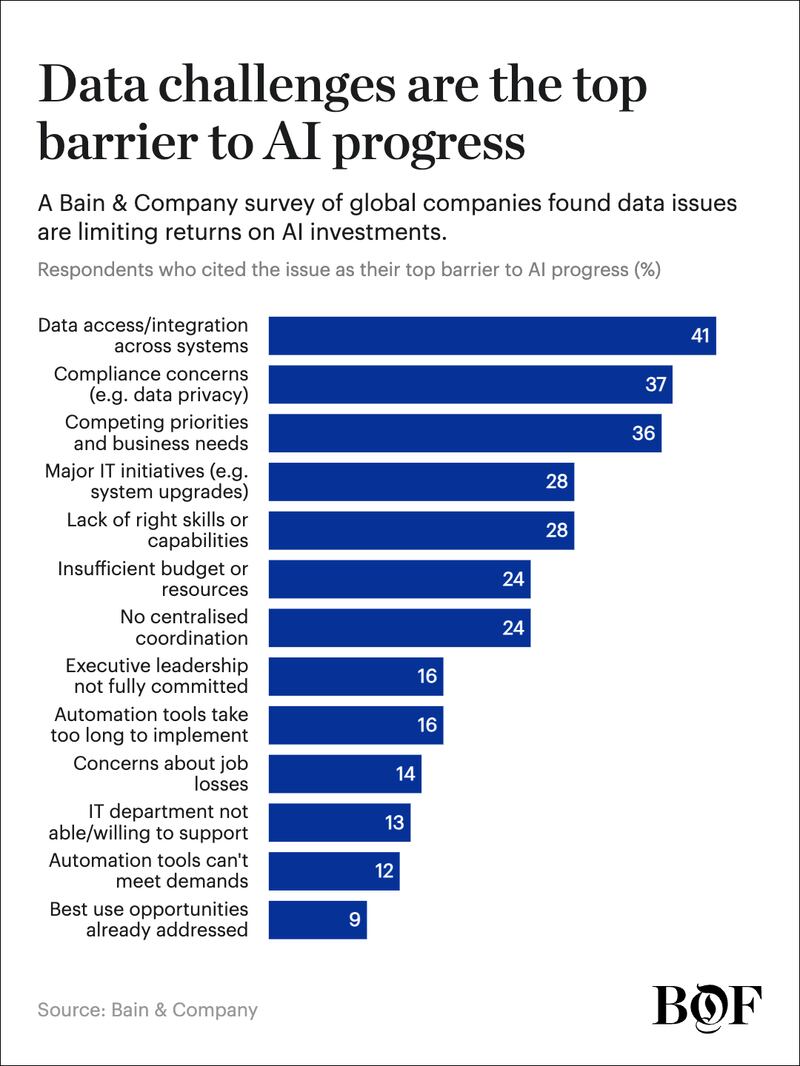
Fashion isn’t alone in this respect. A lack of aptitude with data is preventing businesses of all kinds from getting the most out of the hefty AI investments they’ve made in recent years, particularly since the boom in generative AI. A recent survey of 951 global companies by Bain & Company found that, even as they ramped up AI budgets, nearly 40 percent of those measuring AI-related cost savings got actual savings of less than 10 percent, despite their targeted savings being as high as 20 percent.
The main barrier to AI progress was data access or integration, cited by 41 percent of companies, ahead of other challenges such as competing business priorities or insufficient budget.
Collecting data isn’t the issue. The amount of data in the world is growing at an explosive rate, leaving many brands and retailers feeling overwhelmed, even as they have more information than ever at their disposal. They can also run into organisational obstacles and cultural hurdles that make it difficult to build the systems necessary to ensure the data they have is properly cleaned and organised.
But with AI proficiency growing as a competitive advantage, the urgency around data is only growing.
Among the most promising capabilities of large language models, for example, is that they could make data-backed answers to business-related questions easily available across a company. If a team planning for next season wanted to know how well a particular style sold among high-income customers and get details like what the margins were, which colours performed best and the specific stores where sales were highest, rather than having to ask another department to run an analysis — and facing an extended wait for a response — they could simply type their question into an internal chatbot.
ADVERTISEMENT
AI agents that can perform actions autonomously could, in theory, take the idea even further, executing tasks like automatically reviewing the collection plan and compiling purchase orders for all the raw materials to be approved by a human.
The large language models underlying these technologies still have their own issues with reliability, but even if a company built such a tool, it might not be able to access all the information it needs to work. Much of the data might be managed by different departments and housed in different systems. While fashion companies are already widely applying AI to those datasets for more narrow insights, that application misses one of AI’s greatest strengths.
“The magic of AI is really bringing together all of these disparate data sources into an integrated view to tell the full story around whatever question you’re trying to answer,” said Michael Heric, a senior partner at Bain who works with its performance improvement practice.
Companies are trying to break down those siloes and build data solutions that can merge information from across the organisation, according to Sander Ardinois, founder of advisory business Ardinois, but doing so is not easy.
Ardinois has been on the frontlines of dealing with these issues, first as a director of AI at Nike and then as part of the data and AI leadership team at H&M, which he departed earlier this year to start his firm. One challenge fashion companies face is eliminating inconsistencies in data across the business. The same shopper might buy one item in store and another online, but the company could recognise that person as two distinct customers.
The issue can crop up in other ways, too, like the sourcing team labelling the colour of an item as “red” while the merchandising department uses the term “scarlet,” causing one product to appear as two different items in different datasets.
“If you’re in banking or insurance, you had regulatory pressure to get your data straight and you get audited on it,” he said. “In retail and fashion, there has never been any pressure regulatory-wise to get things straight.”
To manage these types of challenges, Zalando is assiduous about documenting its data and uses Databricks, third-party software that offers a unified governance layer for data. Other companies just starting to get a handle on their data may not be able to fix all their issues at once, but they don’t necessarily need to in order to start seeing results.
ADVERTISEMENT
“Unfortunately, there’s no such thing as perfect data,” said Bain’s Heric. “We’re very practical, and I think most fashion companies need to be as well. The idea of, ‘I can’t start AI until my data is perfect,’ I’m not sure you ever get to a place where data is going to be perfect, because your business is constantly evolving.”
Companies should consider their main business objectives, think about where AI will have the greatest impact and focus on the data with the highest value for tackling that challenge. At Zalando, Smith said they track all the key performance indicators the company is using AI and data to improve.
For most fashion businesses, the highest value targets will come in areas like forecasting, planning and replenishing inventory, according to Ardinois. But wherever they begin, they should start with a clear focus and build out their data capabilities from there.
“You create a data layer which is integrated and connected and available step by step, project by project,” he said. “As you do so, the newer projects which will come along will have a smaller relative cost, and thus it will unlock those, rather than starting with the things which are not super huge in terms of value that will have a high cost at the beginning to start up.”
Companies have to be diligent about keeping their data unified and organised at every step of the process, since data is a constantly changing asset that can quickly become out of date. Balasubramanian said the goal is for it to be like running water: When you need it, you open the tap and get a clean, usable stream.
Artificial intelligence is changing how businesses operate as employees become more self-sufficient and routine work is increasingly automated. To build companies that thrive in this new paradigm, fashion executives must rethink leadership structures, talent pipelines and decision-making processes.
Even as AI marketing grabs headlines, agents powered by the technology are transforming fashion's back-office jobs at a moment when corporations are laying off staff to be leaner and more efficient.
Companies have raced to put large language models to use for jobs from generating images to writing code, but to get the best use of this innovative form of AI, they need to know its limits and how to navigate around them.

Marc Bain is the UK Editor at The Business of Fashion. He is based in London and oversees BoF's case studies and executive memos, as well as driving its technology coverage.
Loading recommended reads…
Adidas’ preliminary earnings report shows that the brand is still growing at record rates. How long can it keep it up?
Bath & Body Works’ is the US’ most ubiquitous fragrance company. But to regain relevancy, a facelift — in more ways than one — is incoming.
The recovery long promised by luxury brands seems nowhere in sight, as the expansion of war in the Middle East, along with China’s tax crackdown on the wealthy, piled further pressure on the world’s biggest luxury conglomerates in the third quarter, and executives buckled in for a tough winter.
Sales fell in September as above-average temperatures hit demand for autumn clothing.