Agenda-setting intelligence, analysis and advice for the global fashion community.
Agenda-setting intelligence, analysis and advice for the global fashion community.

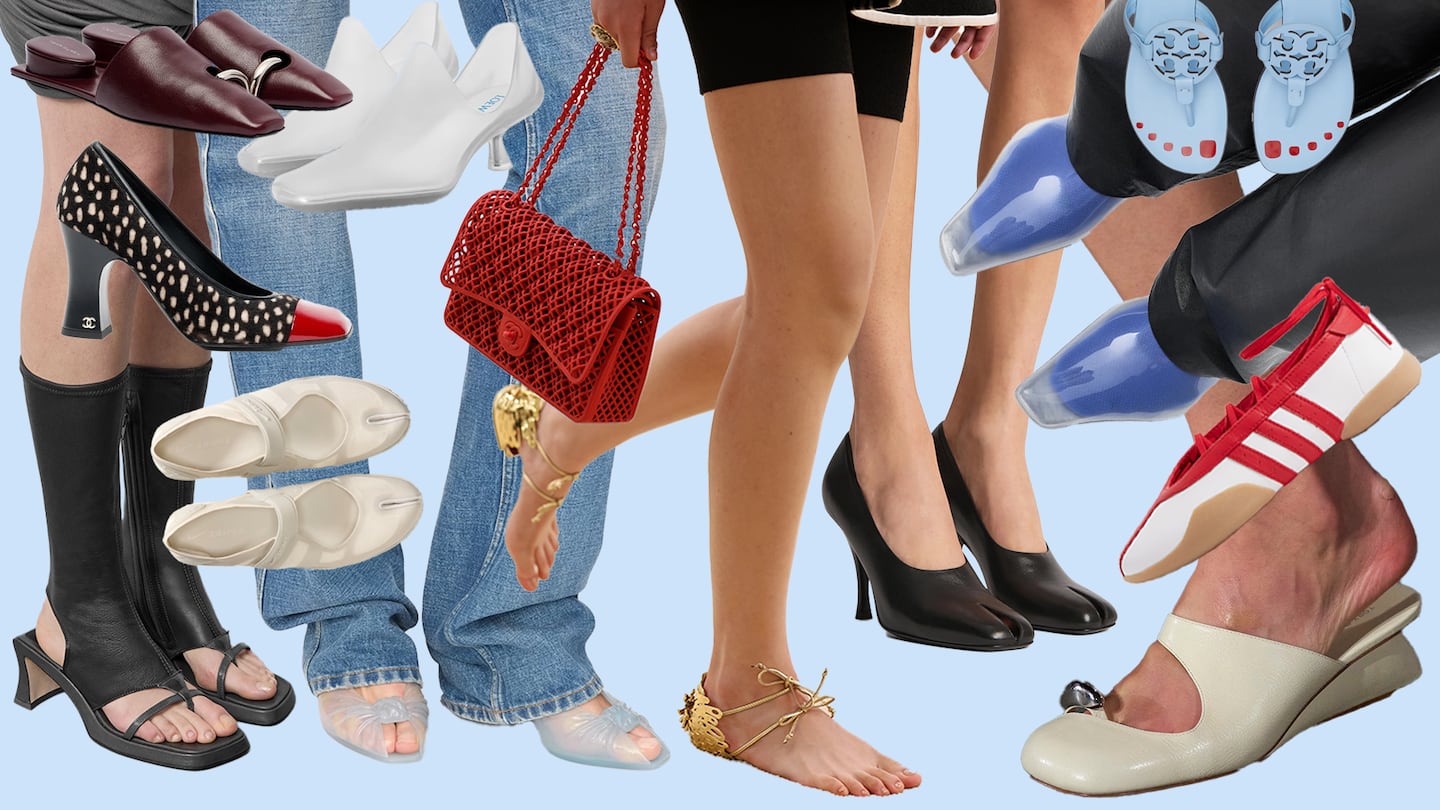
At its Cruise show in April, Chanel stretched the very definition of a shoe.
The French megabrand sent models down the runway wearing a soleless sandal, with a slim heel covering tethered to their ankles, leaving their arches and toes exposed. The look quickly went viral, sparking hot debate among those who loved it, hated it — and were just plain confused.
Chanel’s may be the most boundary-pushing, but it’s just the latest in a line of experimental shoes to break onto the market. Countless brands are riffing on the increasingly popular sneakerina (a combination of a ballet flat and sneaker): there are Celine’s lace-up ballet flats, Miu Miu’s velcro version and Ralph Lauren’s pair with elastic laces. Loewe, meanwhile, is selling “aqua booties,” a pair of structured and see-through PVC heels and Maison Margiela’s once-culty Japanese-inspired Tabi shape has gone mainstream, with brands including Steve Madden and Nike riffing on the split-toe style. Across brands like Jil Sander, Phoebe Philo and Saint Laurent, toes are long and vamps are high. Bold colours and fabrications like cow print and pony hair are also on the rise.
The trend has been building for years as out-there styles like toe shoes, mesh flats and barely-there sandals dominated the summer trend cycle. Online, tastemakers like the writer Liana Satenstein and content creator Mandy Lee (@oldloserinbrooklyn on TikTok) have been advocating for what they call “freaky shoes,” which range from Khaite heels that show a splice of toe to Frankensteinian Sandy Liang ballet flat-boat shoes.
ADVERTISEMENT
“People are tired of perfection and obviousness and are drawn to things that feel unexpected. Shoes can have that tension,” said Tory Burch, designer of her namesake brand, which has introduced more offbeat shoes like the pierced mule (featuring an inverted heel) and sporty mary janes, as well as reworked its classic Reva flat to show toe through translucent cut-outs on the medallion.
For the same reason they’re reaching for more accessories, consumers are often opting for bolder shoes to supplement a more simple outfit. Fun shoes feel like a low stakes pick-me-up at a stressful moment — echoing beauty’s lipstick effect.
“There’s so much darkness around in the macro environment, debt is rising, groceries are up, gas prices are up, we have the wars,” said Jessica Ramírez, co-founder of consultancy Consumer Collective. “There’s this sentiment of the consumer wanting to express themselves.”
For the brands, it’s good business. As the luxury industry resets, it’s paying more attention to shoes after a sharp decline following the pre-pandemic streetwear boom, according to Bain. In 2025, the category was down an estimated 5 to 7 percent.
Often less expensive than handbags and typically more high-use and versatile than clothing, shoes are a frequent entry point for budding luxury shoppers. Many brands are rebuilding the mix and recalibrating pricing, either injecting creativity but keeping prices stable, or in some cases even lowering them, according to Bain. As even affluent shoppers become more selective, luxury shoes “are increasingly positioned as a ‘smart’ investment category, offering both longevity and utility,” said Fflur Roberts, head of luxury goods at Euromonitor International.
It’s also a place ripe for fashion’s crop of new creative directors to create new signatures, using distinct shapes and silhouettes to distinguish themselves rather than logos. Plus, unusual shoes tend to pop on social media.
“Shoes are a category where you can do branding,” said Claudia D’Arpizio, luxury lead at Bain. “It’s easier to create a shape and something that can last more than a season.”
Today, people are craving uniqueness in a fashion world that has felt saturated, said Laura Villasenin, founder and designer of London-based brand Miista, known for its unqiue shoes. She said that in recent years, Miista has seen more momentum around its most dramatic shoes, like its lace up boots with elongated toes and chunky-soled brogues.
ADVERTISEMENT
“[People are gravitating toward] styles that when we started they wouldn’t touch,” she said, adding an overarching shift is that today fewer women are concerned with making their feet look small, which has historically been seen as more feminine.
The emphasis on bolder, sharper shapes echoes what’s happening across the wider fashion landscape, said Basile Lapray, founder of sneaker brand Village PM, whose 1 PM skateboard sneaker made with a climbing rubber sole ranked among the top ten products on the Lyst Index in the first quarter of 2026.
“Streetwear evolved from hoodies and big logos to more tailoring and function. Footwear is going in that direction as well,” said Lapray. “People are more educated on silhouettes, lines, and volumes.”
Much of the sneaker market is being driven by shoes that are designed for performance or a particular function — whether trail running or rock climbing. Many of Burch’s innovations start from wanting to make a flattering cut in the shoe, or more comfortable sole.
The shift has been sweeping: nearly every brand in Canadian retailer Holt Renfrew’s portfolio has played into the turn toward weirdness in some way, whether through shape or colour, said Nicola St. George-Hyslop, senior buyer of footwear. Footwear that was once considered fringe is now standard. Sneakerinas, for example, represent 20 percent of the retailer’s sneaker sales “which is staggering, considering it was a virtually non-existent category last year,” she said. Even the New Balance 1906 L, a snoafer — sneaker loafer hybrid — is gaining steam, she said. The retailer regularly sells out of Margiela Tabis and quickly sold out of the Chloe jelly mule, which, with their ultra-girlish shape and plasticy pink and blue hues, look like the play princess slippers found at the Disney store.
Many of Tory Burch’s newer shoes, like the pierced mule, get attention from the editorial world first, but then start to really sell the next season, Burch said. Strange shoes are an easy way for shoppers to introduce complexity into their outfits, and because of social media, there’s a shorter pipeline from embrace of a shoe by a few individuals to adoption by a broader group.
“People have so much access and people are obsessed with the runway,” said Burch.
Fashion’s weird shoe craze is just getting started.
ADVERTISEMENT
Shoes in-stock online were up about 32 percent year-over-year in the luxury market, led by brands including Prada (up 346 percent) Chloé (up 287 percent) and a broader pivot toward colour rather than black shoes, according to retail intelligence platform Edited. Pumps and flats featuring high vamps, bold colours and materials like pony hair were a main (and beloved) feature of Mattheiu Blazy’s Chanel accessories. As the customer continues to show an appetite for newness, retailers are placing larger orders of bolder shapes and dedicating more space to them on the retail floor, too.
In its New York flagship, Printemps dedicated prime real estate — the historic mosaic-clad Red Room — to footwear because it felt shoes could bring “energy to the space,” said Silvano Vangi, creative and merchandising director of Printemps International.
After the Samba sneaker fuelled sales in 2024, Adidas remixed it, introducing the Samba Jane in 2025. That and Puma’s Speedcat ballet shoe have been popular on StockX, said Brendan Dunne, senior director of customer community and engagement. It shows “clearly brands have realised if they take a classic and put a spin on it, they can be successful,” he said.
If you look at the US footwear market though, sales are lagging a bit behind the investment — modest first-quarter sales growth of 1 percent was primarily driven by price increases, not units, according to market research firm Circana.
Still, footwear is a highly resilient category, meaning shoppers are more likely to purchase shoes even if they feel pinched, data intelligence firm Morning Consult found.
“Shoes wear out. Even if it’s more of a discretionary purchase you do still have a purpose for it when there are economic tensions or elevated price sensitivity for apparel overall. It’s a more justifiable purchase,” said Kayla Bruun, head of economic analysis at Morning Consult.
From Labubu charms to stacked bracelets, shoppers are using accessories to personalise minimalist wardrobes, boosting small labels and hinting at a lasting behavioural shift. Diana Pearl joins The Debrief to unpack this trend.
Thinner, more minimalist — naked, even — shoes are driving growth from sandals to sneakers.
Sneakers have dominated the footwear business for years, driven by constant growth from industry leaders like Nike and Adidas. Now, questions are rising about how much further that growth can go.

Joan Kennedy is Correspondent at The Business of Fashion. She is based in New York and covers beauty and marketing.
Loading recommended reads…
Sales of gems, precious metals and artwork at Japan’s department stores climbed 19 percent in the first half of 2026 from a year earlier to $2 billion.
Though Adidas dressed both teams in the World Cup finals, the global football tournament still presented some bright spots for Nike, writes Bloomberg’s Andrea Felsted.
From our archive, the creator and host of award-winning podcast “Articles of Interest” joins BoF founder, CEO and editor-in-chief Imran Amed to explore what clothing can reveal about identity, culture, labour and the world around us.
Saunders, the brand’s first creative director in five years and a skilled colourist, promises to give Kate Spade the clarity it has long lacked. Now, Tapestry must apply the same long-term brand-building discipline that fueled Coach’s success.