Agenda-setting intelligence, analysis and advice for the global fashion community.
Agenda-setting intelligence, analysis and advice for the global fashion community.

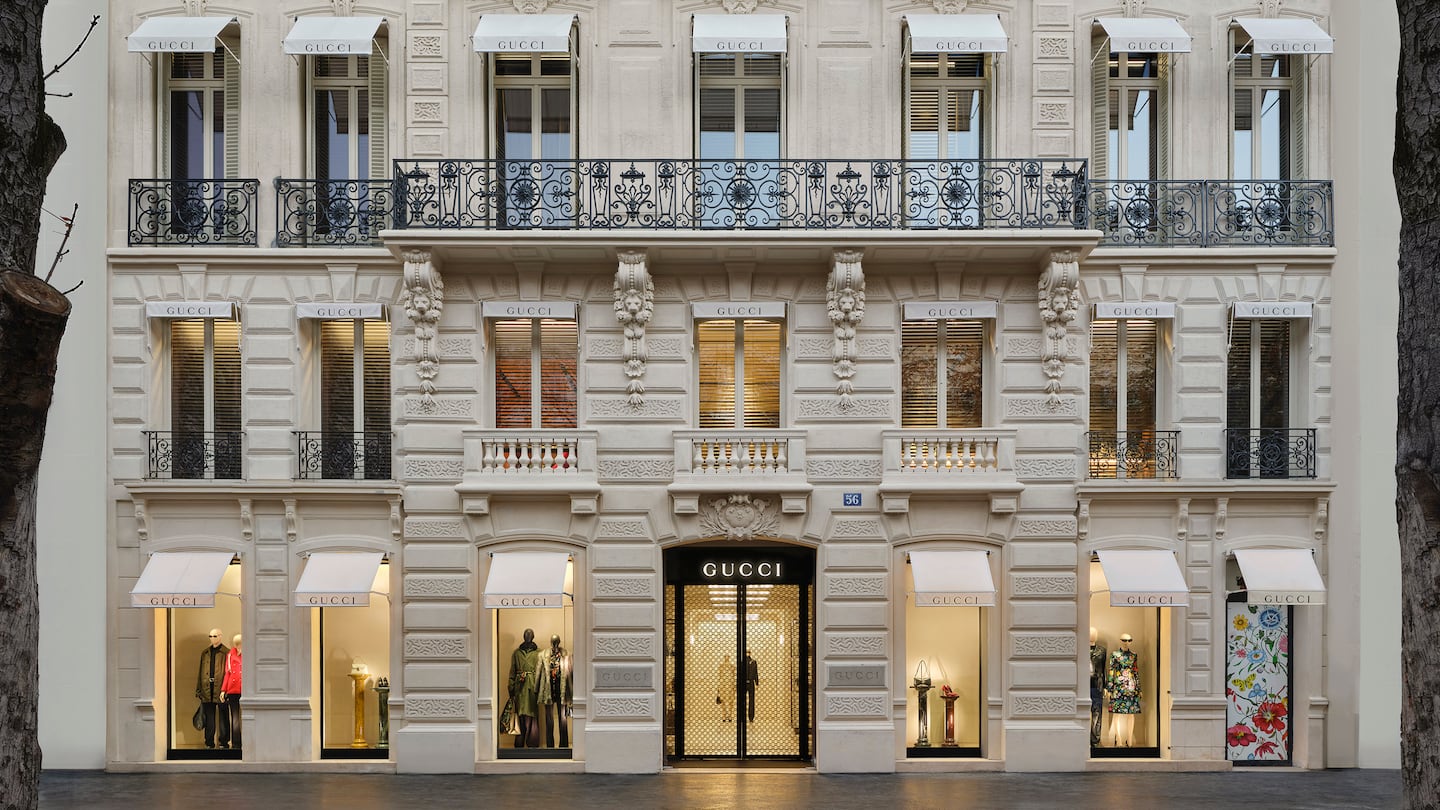
PARIS — Multi-coloured travertine reminiscent of Italy’s great monuments, a sweeping staircase meant to recall a Florentine Renaissance palazzo, touches harking back to the heyday of Milanese 1930s architecture and a private top floor reserved for high-spending clients are all part of Gucci’s bet for its new flagship on Avenue Montaigne in the French capital.
“First and foremost, we are Italian so the concept had to scream Italy in its references,” said Francesca Bellettini, the Italian fashion house’s chief executive, during a tour of the 1,480-square-metre store ahead of its opening on Friday. “And like in a private house, you enter where there are salons that everybody sees, but then the more you become part of the family, the more you get access to more intimate and familiar spaces.”
The new flagship opens at a crucial time for Gucci and embodies the brand’s new retail concept, which will be rolled out around the globe as part of a broader turnaround plan.
The Italian fashion house, which accounts for the bulk of profit and sales of owner Kering, has struggled to pull out of a multi-year slump, with initial signs of improvement hitting a setback over the summer. Slow store traffic, especially in China, weighed heavily on the business.
ADVERTISEMENT
Gucci’s investment comes as Europe’s leading fashion houses plough millions into sprawling retail destinations – Dior’s Avenue Montaigne flagship, which includes a restaurant and a museum, is just down the street while Chanel has taken over a stretch of the Rue Cambon. In Milan, Prada recently opened its refurbished and expanded historic store in Galleria Vittorio Emanuele II.
Gucci’s new Avenue Montaigne address will be followed by the opening before the end of the year of a revamped Shanghai store using the new concept. All new stores going forward will be built within the confines of the new look.
The concept draws on a typical Italian villa, where the entrance and public salons give way to increasingly private quarters. Its architectural references include the rationalist buildings of 1930s Milan, particularly the work of Piero Portaluppi, alongside the warmer, eclectic interiors of the 1950s, 1960s and 1970s. The result is a mixture of stone, wood, metal, vintage furniture and carefully controlled lighting, rather than an all-encompassing aesthetic.
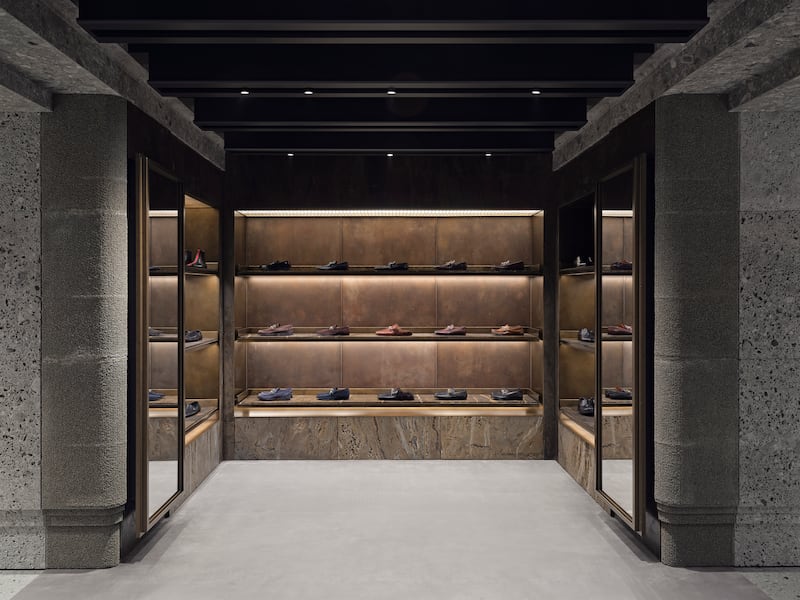
The progression from public to private starts on the ground floor, which combines the main entrance, handbag displays, travel pieces and a lounge for ready-to-wear, silk goods and eyewear. One floor down is the men’s collections in a restrained, stone-clad setting evoking a historic Milanese bank. The level above the ground floor is dedicated to women’s shoes, ready-to-wear and jewellery, with flexible displays while the top-floor “appartamento” offers a more intimate, open residential setting, with sliding walls that can create three salons for private appointments
“It’s not one person’s store concept,” said Bellettini. “It’s the store concept for Gucci, which we designed all together.”
The emphasis on a shared identity comes as Gucci aims to restore its fashion authority under Demna, who became creative director last year, while reconnecting with the Italian heritage and sensuality that Bellettini wants customers to recognise. The new store is intended to give those ambitions a physical form that can endure beyond any one designer.
On Thursday morning, as sales staff familiarised themselves with their new tailored uniforms, a few clients were already browsing. More appointments were scheduled for the afternoon, with the official opening set for Friday.
Kering has been reducing Gucci’s store network, closing weaker locations while investing in more prominent addresses and improving presentation. Gucci, founded in Florence in 1921, had 497 stores at the end of 2025, about 30 fewer than in 2024, and so far this year has shuttered more than 25 more. The challenge will be to draw more people into fewer stores — while increasing conversion rates.
ADVERTISEMENT
Gucci closed two specialised stores in Paris last year, Gucci Valigeria on rue Saint-Honoré and the high jewelry boutique on Place Vendôme, as well as the spaces at the La Samaritaine department store.
The new Avenue Montaigne flagship replaces a store nearby. Another new flagship will open in Paris on Rue Castiglione, just off Place Vendôme, late next year or early in 2028.
Bellettini declined to disclose how much Gucci invested in the Montaigne project, which has taken a little over a year to realise.
The flagship is also a test of how Gucci can create a distinctive retail identity without tying it too closely to Demna’s particular aesthetic. The designer played a significant role in selecting the architectural references and materials, Bellettini said, while she focused on the layout and customer experience and the store-planning team contributed to the lighting and flexibility. She used a similar collaborative approach at Saint Laurent, where she was chief executive from 2013 to 2023.
Demna’s September show in Milan, staged in an expansive space designed to look like a store with different rooms and materials, offered an introduction to the concept.
“Yes. Absolutely, yes,” Bellettini said when asked whether the store environment was a way to communicate that Gucci is evolving.
From the tree-lined Avenue Montaigne, the store immediately opens onto a broad corridor that once served as a passage for cars entering the building’s courtyard. The property, built early last century in the Haussmann style, is protected as a historic building, which led to some limitations on the redesign that were parlayed into design features being reproduced in other new stores such as the series of smaller rooms on the ground floor that create easily adaptable individual atmospheres.
The rooms on the ground floor — defined by travertine walls, suede-lined display niches, and lacquered wood — have drawers under the merchandise containing additional stock that allows sales associates to show customers different colours and variations without leaving them to retrieve merchandise from elsewhere. The aim, Bellettini said, is to turn sales staff into client advisers who can discuss the broader Gucci universe rather than simply hand over a requested product.
ADVERTISEMENT
The ground floor offers staff a chance to delve into Gucci’s history. A room devoted to prints highlights the flora pattern, designed by Vittorio Accornero for Grace Kelly in 1966, while another showcases luggage and the brand’s travel heritage. Gucci’s crest, worn as a pin on the staff uniforms, offers another entry point into that history. The Gucci family commissioned the crest so it would have its own heraldic symbol.
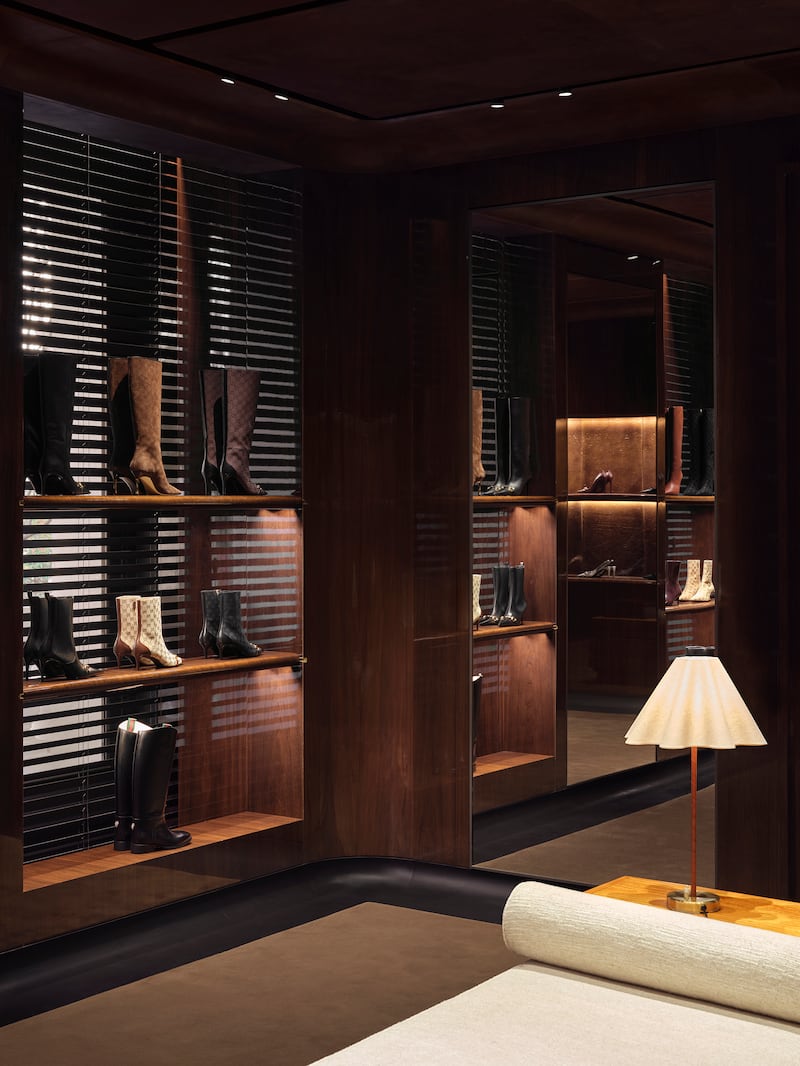
Upstairs, the more intimate space devoted to women’s collections revolves around a six-metre curved walnut display fixture designed to be easily adaptable, a centre theme of the entire store. Shelves can become hanging rails, or be replaced with displays for shoes and handbags, depending on the collection and the message the store wants to convey.
That flexibility is a major departure from Gucci’s previous store concept, which Bellettini described as rigid, with fixtures and walls that could not easily be changed. The new system is meant to accommodate shifts in merchandise and selling practices without requiring costly renovations.
“It was very important for us to design a store concept that evolves with us,” she said, adding that this flexibility will allow the stores to grow and adapt alongside the brand over time.
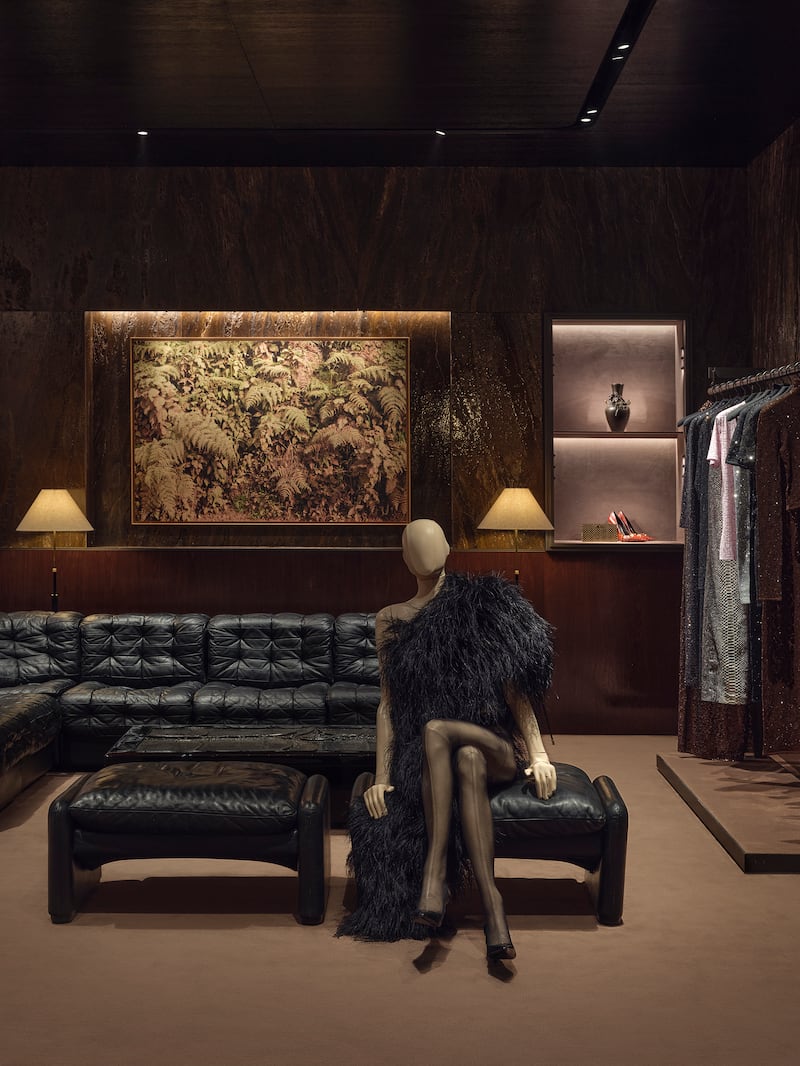
The top floor, comprising two former apartments, is accessible by appointment or at the discretion of a sales associate, who may spontaneously invite clients upstairs. Movable walls allow the space to be divided into three rooms or opened for breakfasts, dinners and other client events. Curtains can create additional privacy, and discreet access to stockrooms and changing facilities allows staff to prepare each room for an individual customer.
“Now we need to roll our sleeves and be move as fast as possible, balancing cost and time to restyle most of our store network,” Bellettini said.
For the last twelve months, the designer has played therapist to the brand’s ‘multiple personality disorder.’ This latest session for Spring/Summer 2027 was a breakthrough.
This week in luxury, Art Basel Paris was cut short by lingering civil unrest and Gucci owner Kering scrapped its guidance for a return to growth in 2026.
The fashion house’s recent Times Square takeover thrust Gucci back under the microscope, but Kering’s annual shareholders’ meeting on Thursday gives investors a chance to press CEO Luca de Meo on his plans to reenergise the French group’s wider portfolio.

Eric Sylvers is Milan Correspondent at The Business of Fashion. He is based in Milan and leads BoF’s coverage of all things Italian.
Loading recommended reads…
The Gulf region is no longer the luxury bright spot it was at the start of the year. But brands and retailers are finding ways to navigate the complex and volatile terrain.
The inaugural Fashion Week Asia, staged by Manila-based media group AGC Power Holdings Corp., brought together established brands, emerging designers and creative voices from across the continent for five days of runway shows, cultural exchange and industry conversations. BoF reports from the Filipino capital on the creative energy and ambitions shaping Asian fashion’s next chapter.
The label’s new Avenue Montaigne flagship offers a first look at how CEO Francesca Bellettini and designer Demna plan to reinvent Gucci’s retail network as they seek to reverse a prolonged sales slump. ‘We are Italian so the concept had to scream Italy in its references,’ Bellettini told BoF.
Revenue growth outpaced the previous quarter in the Korean conglomerate’s domestic market, but slowed internationally.