Agenda-setting intelligence, analysis and advice for the global fashion community.
Agenda-setting intelligence, analysis and advice for the global fashion community.

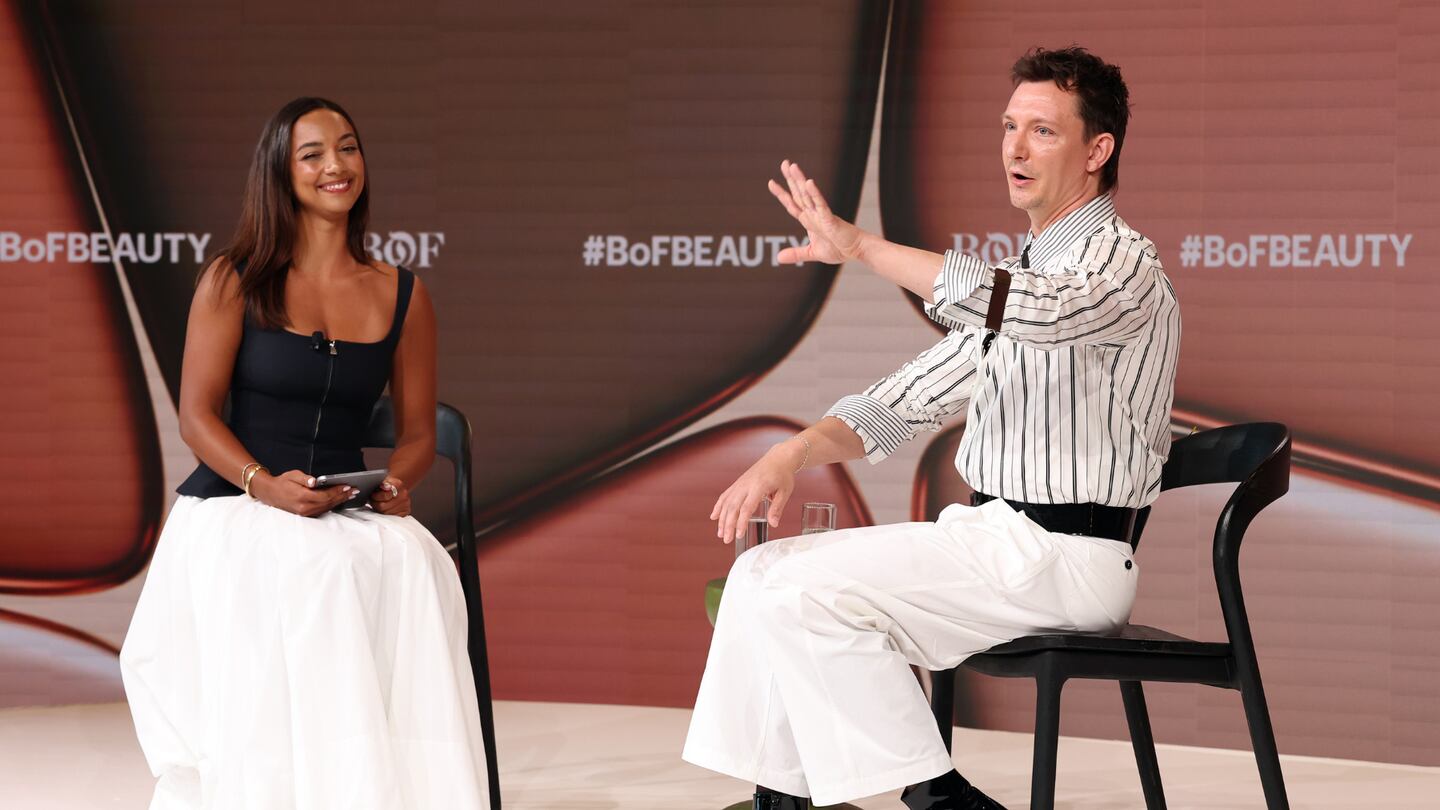

NAPA, California — At The Business of Beauty Global Forum 2026, the annual beauty industry gathering at Stanly Ranch in Napa Valley, Front Row’s co-founder and chief revenue officer Christopher Skinner joined The Business of Fashion’s content strategist Yasmine Dahlberg onstage to unpack what it actually takes for beauty brands to treat their channels as one connected system rather than separate silos.
Beauty’s purchasing journey has rarely been more fragmented. Online beauty sales are forecast to exceed 30 percent of the category globally by 2030, according to BoF and McKinsey & Co.’s The State of Fashion: Beauty 2025 report, pulling more of that journey through touchpoints brands don’t fully control.
Shopping-related searches on generative AI platforms grew 4,700 percent between 2024 and 2025, according to BoF and McKinsey & Co.’s The State of Fashion 2026 report, and TikTok Shop has grown into the fourth-largest beauty retailer in the US by sales — together reshaping how consumers find, consider and buy.
Brand power serves as the ultimate connective tissue. In today’s market, the leaders are those who achieve such seamless channel coherence that brand recognition naturally matures into customer preference well before the point of purchase.
Front Row is a global commerce accelerator whose beauty, health, and wellness clients include Ouai, Glossier, Summer Friday, Neurogum and Flavcity. Its premise is simple: brand, demand, content, digital flagships, search and marketplaces deliver more value together than they do as separate functions run by separate teams.
Skinner framed the cost of that disconnection in simple terms on stage: “The mismatch between channels, that lack of orchestration, is costing growth,” he said, comparing a well-run commerce ecosystem to a symphony where no dividing walls exist between sections.
During the fireside chat, Skinner and Dahlberg unpacked where demand is built versus where it is captured, why the gaps between channels are where most brands lose ground and what it actually takes to build a brand that performs across all channels.
Now, BoF shares key insights from the conversation.
Skinner argued that brands can’t dictate how customers move between marketplaces, specialty retail, direct-to-consumer (DTC) and social commerce. “What they can do is show up the best where they need to be, ultimately orchestrating how those [channels] play off one another, so that the [customer] is left wanting more.”
That orchestration means measuring not just where a sale happened but where the demand that produced it was created — a dynamic already reshaping how the industry thinks about distribution.
Sun care brand Vacation’s recent move from Target and Costco onto Sephora, becoming the first beauty brand to launch there after establishing wide distribution at competitors, is one signal of that shift: brands are increasingly prioritising presence over exclusivity and finding that new channels often reinforce, rather than cannibalise, existing ones.
The data Skinner shared on stage confirmed this strategy. According to the company’s analysis of a hair care brand partner with 1.2 million customers selling through both marketplaces and DTC channels, shoppers who purchased across both channels were significantly more valuable than those who only bought through marketplaces.
The cross-channel customer, according to the analysis, generated an average annual value of $250, compared with $50 for the marketplace-only customer. They also converted 60 percent more frequently and spent 90 percent more per transaction, suggesting that engaging customers across multiple sales channels can substantially increase customer lifetime value.
Skinner suggested viewing a brand through the customer’s eyes and mapping their journey across every channel, from discovery and research to purchase and loyalty. To him, businesses should identify where customers move between channels, look for gaps in the experience and ensure there is clear ownership of those touchpoints so messaging, creative and branding remain consistent throughout.
In both physical and digital retail, a brand can build emotion around its story, but in large-language-model search, the rules change. “You have to be consistent, clear and ultimately problem-based in your thinking through the lens of how your audience would actually engage with the problem,” Skinner said.
The distinction between a brand’s internal language and a customer’s search language is where most brands lose ground. Skinner pointed to Front Row’s work with NuFace. The skincare device brand had built its content around microcurrent technology — the mechanism behind its products — rather than the skin concerns that were actually driving customers to search for it. “As soon as that flip in content generation happened, they were surfacing much more frequently,” he said.
By describing a customer problem their product or service solves and entering that into an AI search platform, Skinner said, leaders can see whether their brand appears in the results. If it doesn’t, they should analyse which competitors do appear, the type of content they are producing, and why those brands are being surfaced instead. If the brand does appear, it should identify the factors contributing to that visibility and continue building on those strengths.
The same unifying logic applies internally. “If you have brand marketing, content creators and DTC teams interpreting a new product launch in different directions, that means you have ten differentiated answers to the same question,” Skinner said. “The ten consistent answers are what large language models see as valid proof that you are the one structured answer.”

Dahlberg cited research from WPP showing that 84 percent of purchases are biased towards no more than three brands before a customer starts shopping — meaning the consideration set is already closed before a consumer opens a search bar, visits a marketplace or walks into a speciality retailer.
For brands still allocating the majority of their investment to conversion-stage activity, it means competing for the remaining 16 percent is a far more expensive and far less winnable position than earning brand preference before the shopping journey begins.
A positioning statement or a launch tagline, in Skinner’s view, is only an exercise. “Brand is that thing that gets your heartbeat racing; it’s painful and it is a true process of reflection and distillation.”
Brands that show up consistently, across enough touchpoints, to earn a place in a consumer’s shortlist before the moment of purchase are the ones whose channel and marketplace investments compound. Without that upstream equity, even a well-orchestrated commerce system is competing on someone else’s terms.
As a closing piece of advice, Skinner said a compelling brand should inspire excitement, spark new ideas and create an emotional connection. If it doesn’t, he said it’s worth revisiting the brand strategy before investing further in marketing, as that emotional resonance is what encourages customers to engage, return and build long-term loyalty.
This is a sponsored feature paid for by Front Row as part of a BoF partnership.
As beauty shoppers move fluidly between screens, stores, and AI-powered search, the brands pulling ahead are the ones connecting the dots — across data, channels and the full customer journey. This playbook explores how to implement this connected strategy.
Loading recommended reads…
Beauty brands have long paid to be featured in ‘Get Ready With Me’ videos. Now, they’re designing their products and tools for maximum screentime.
As she prepares to hand power to the next generation, the doyenne of Italian fashion contemplates what makes Prada Prada and what she’ll leave behind, as well as more immediate matters like absorbing Versace.
As the beauty industry evolves to cover new frontiers, global beauty giant Unilever is proactively shaping its talent strategy to meet the new business realities.
Michele goes deep, Miuccia gets happy.