Agenda-setting intelligence, analysis and advice for the global fashion community.
Agenda-setting intelligence, analysis and advice for the global fashion community.
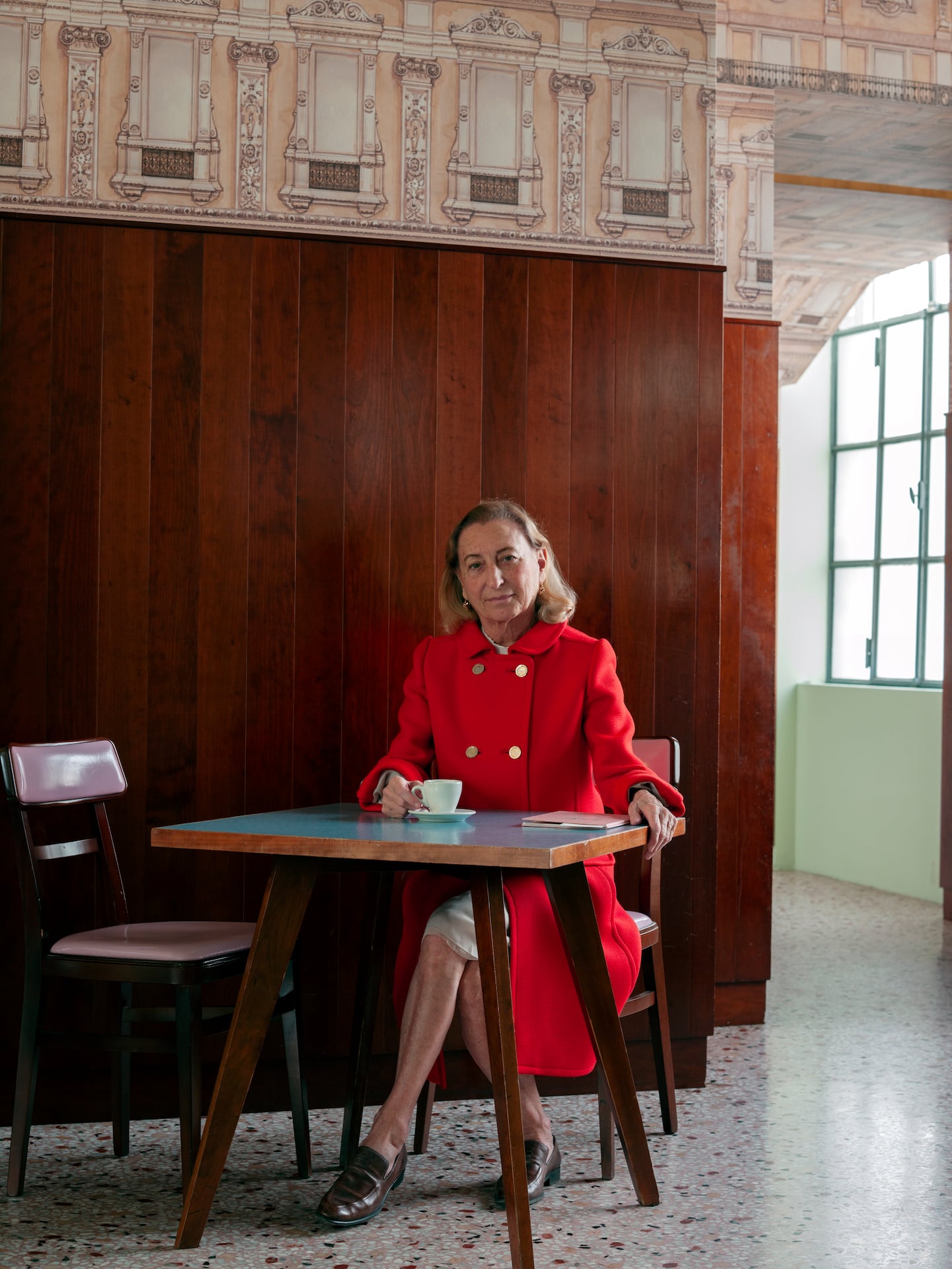
MILAN — Earlier this year, Miuccia Prada and I were talking about her brand’s old ad campaigns, particularly my favourites, the ones that Glen Luchford photographed with Amber Valletta in 1997 and 1998. She remembered Luchford waiting all day for the perfect light, then taking one picture. That reminded her of the month she spent in 1988 working on Prada’s very first collection catalogue with her close friend and fashion confidante Manuela Pavesi and photographer Albert Watson. “A month! Imagine that!” she marvelled. Such different times. “We lived in an open and creative world, but also it was much smaller. Now the world is all.”
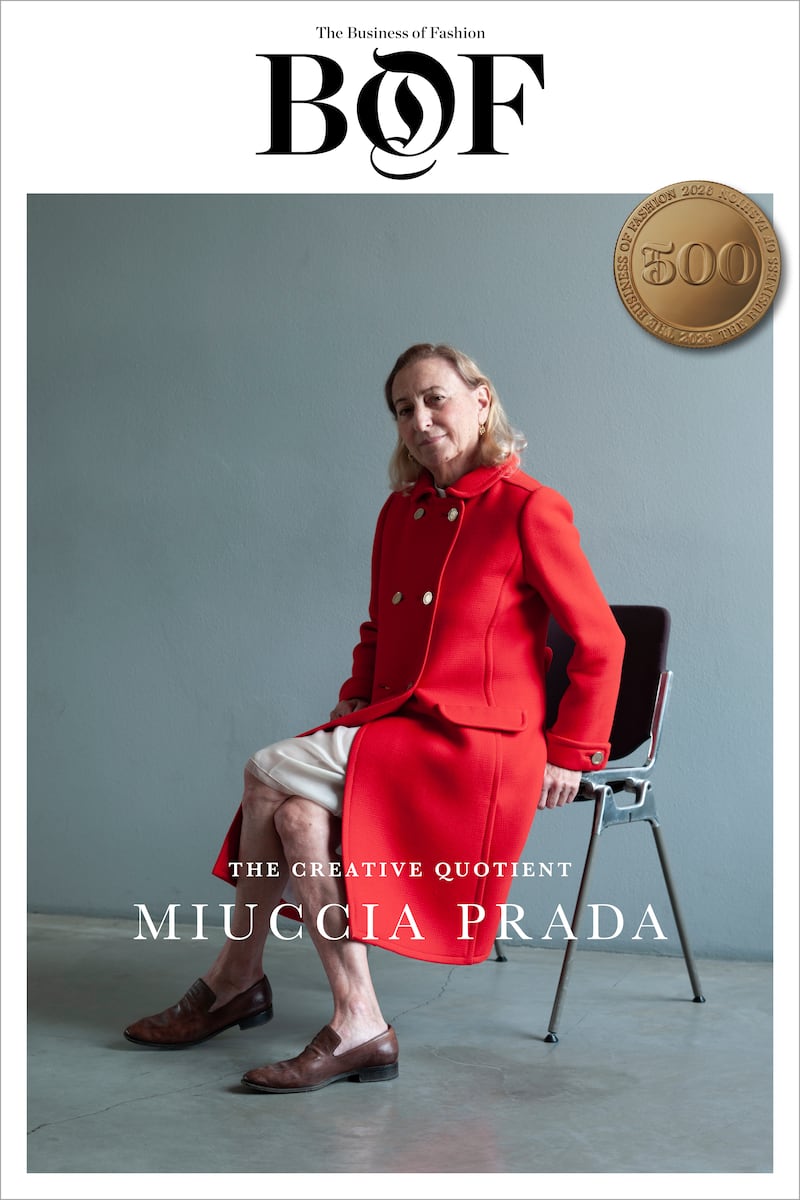
Now we’re in Milan, stewing in the heatwave of the century, which is even more incentive to wonder if Miuccia misses those early days, especially in the wake of Pavesi’s death in 2015. “This is always the question,” she says. “First of all, not in principle, because your life and your work is to understand the present and live with it and engage with it, but for sure, nostalgia can be strong. You recognise the good things of that moment, the free spirits. The world was small, now the world is all around you, so you have to understand, respect and accept everybody. This moment is as exciting because it’s so difficult, so different, so new. But for sure, it’s not easy.” So that is the warp and weft of the modern world which we find ourselves reviewing for a couple of hours. From the outset, she is an extraordinarily good-humoured interviewee with the most contagious chuckle, which arrives with gratifying frequency.
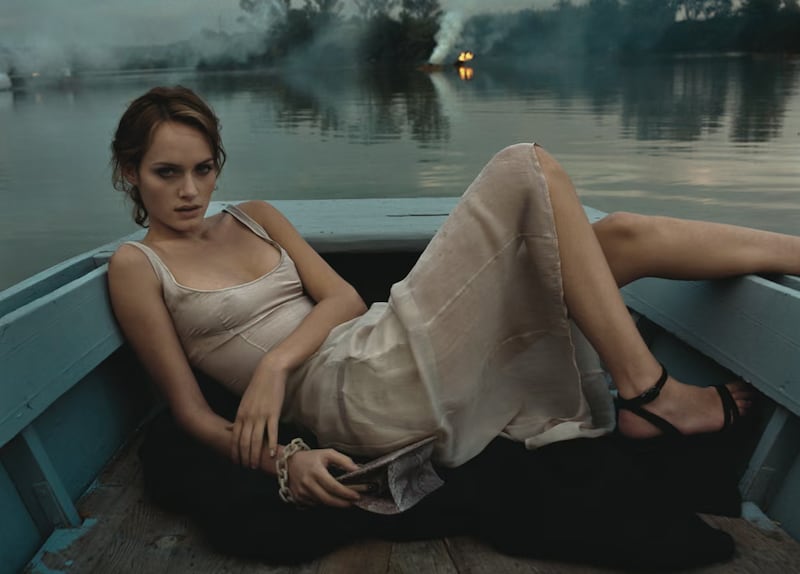
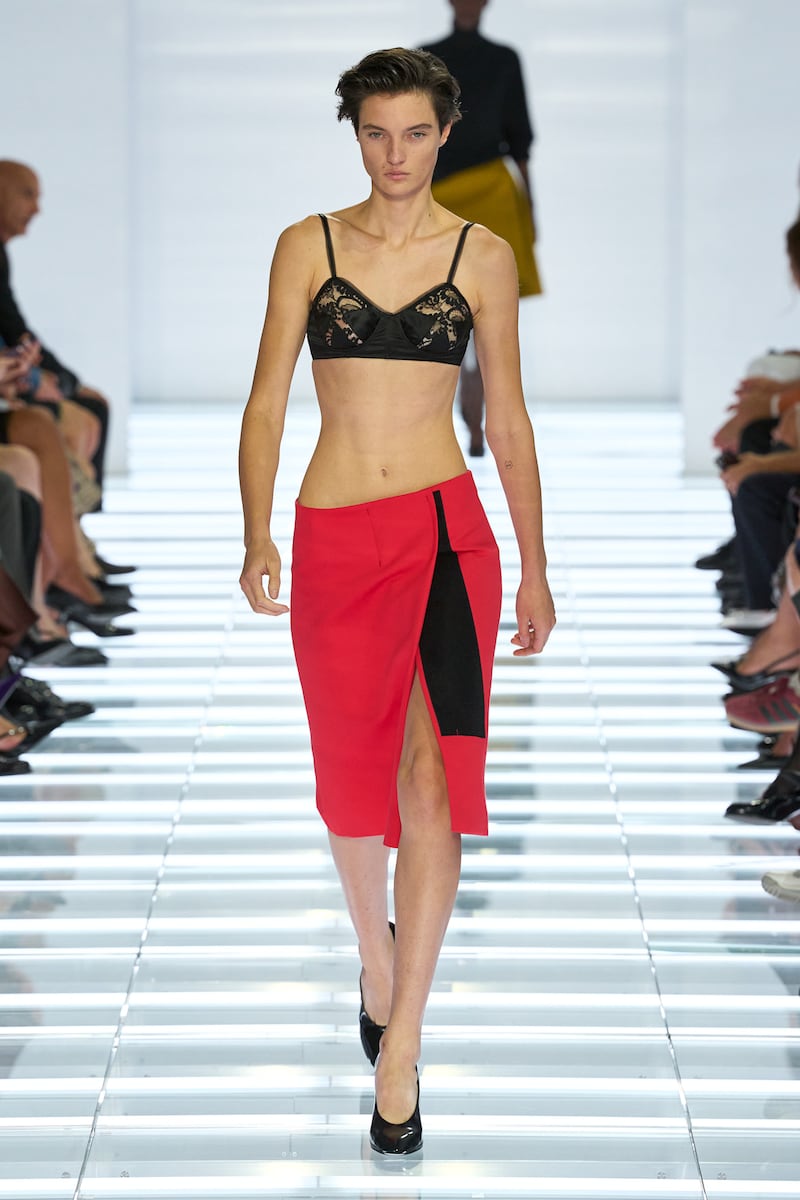
Think of the most famous Italian fashion brands — Armani, Versace, Valentino — and the designers’ faces come to mind. They are their own brand’s identity. But Prada is an anomaly. It may be the most desirable of them all, growing from an IYKYK cult in the 1980s to a global group that now includes the flagship Prada brand, Miu Miu and, as of last December, Versace, and has a market capitalisation of more than $12 billion. But how many of its millions of customers could pick Miuccia out in a line-up? When I suggest to her that Prada’s identity is not hers, she mock-bristles. “Good, that means they can live without me.” She laughs. Of course, Prada’s core aesthetic is very much hers (just look at the latest Prada women’s collection with its 63-look celebration of her beloved skirt), and the brand carries significant cultural weight because of the Fondazione Prada’s activities in the art world, which are again driven by her and her husband Patrizio Bertelli (the Fondazione was originally his idea). But what I mean is that it isn’t her face that comes to mind when people think about Prada.
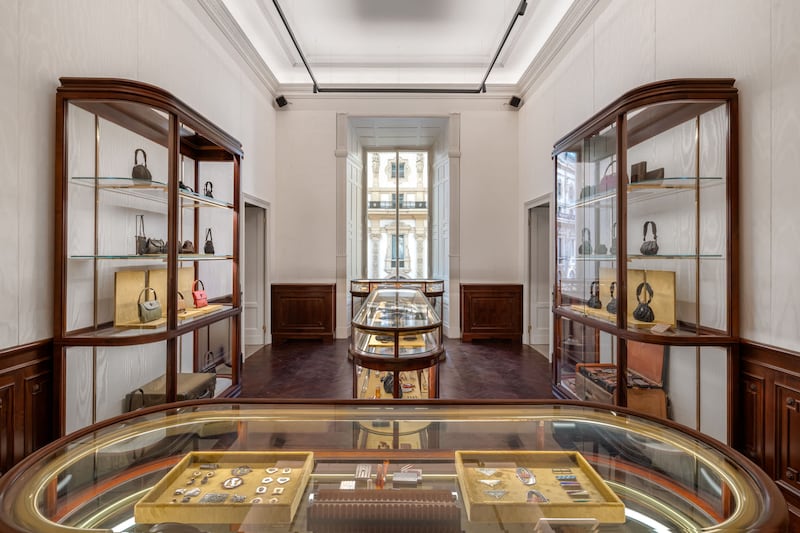
Still, as she says modestly, “The company is very much informed by me,” and that means she finds herself in a position as she gets older that issues like succession and legacy inevitably surface. Her eldest son Lorenzo has joined the group as designated heir. And during Milan Fashion Week, the Prada brand launched a permanent exhibition in the Galleria Vittorio Emanuele II where Mario Prada and his brother Martino opened their first shop, Fratelli Prada, in 1913. “Pradasphere” is a significant part of a spectacular eight-floor immersion into every aspect of the corporate story, from the main collection and Miu Miu to the Fondazione and the pasticceria Marchesi via all the glorious little details that colour a family saga. “It’s basically a kind of history of Prada,” says Miuccia. It’s also a journey to the centre of her mind. “For the first time I wanted to put together what I always wanted to keep separate — the art, the architecture, fashion, movies — because I realised that without putting all of them together there wouldn’t be Prada. They were always together in my mind, but I wanted to keep them separate because I want to be respected in a singular field. But now, if I need to explain, the reason Prada is Prada it’s because it was always open to so many other fields, and without all those connections it doesn’t exist.” Maybe that helps to explain Prada’s relative resilience during a wider slowdown in luxury sales.
ADVERTISEMENT
For all these new initiatives, she claims she feels herself withdrawing, not self-protection, more an attempt to give herself the time and space to make sense of all the change. “It’s a political discussion with myself. Many things that I maybe want to do, I sometimes feel a kind of shame, given the fact that I’m thinking about utility and honesty. That’s the other point that is very important to me in this moment: intellectual honesty. How can I do my job in a world full of tragedy and poverty when I run a company that makes super-expensive luxury products? To be correct, I think the most important thing to bear in mind is that. It’s what I do, so I can’t pretend to be different. I have to behave coherently with it, even if it’s not my personal interest. It’s difficult to explain. But intellectual honesty is crucial.”
The notion of usefulness is equally crucial to her. In February, she couched the Prada men’s show for Spring 2027 as a reaction against “useless fashion.” On reflection, she feels her criticism might have been more conceptual than actual. “I said ‘useless’ because it’s an easy word. I mean things that don’t go to the core of the problem, things that don’t give a serious answer, or even a direction for an answer so you can try to understand what is happening, what you are doing.” She wants things to matter, which means irrelevance is one of her blackest bêtes noires. “What matters is progress, democracy, respect,” she declares. “The big ideals.” In her eyes, irrelevance clearly fits fashion’s pursuit of newness for newness’s sake like a glove. “Everybody wants a revolution in fashion, but great change in fashion is always made by political change. The miniskirt was invented because there was a women’s revolution. Louis Quatorze invented court dress to oblige people to stay at Versailles so he could control them. But if revolution cannot happen in this ‘free’ society, what do you invent?”
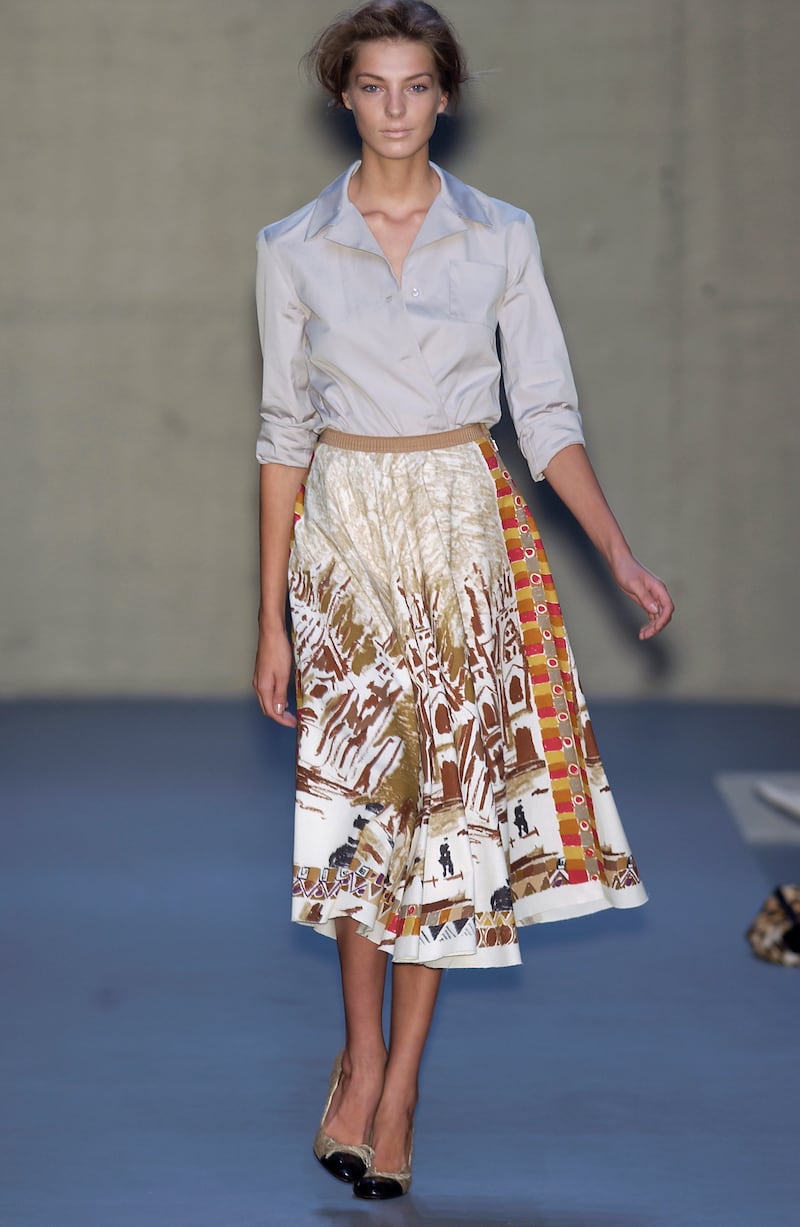
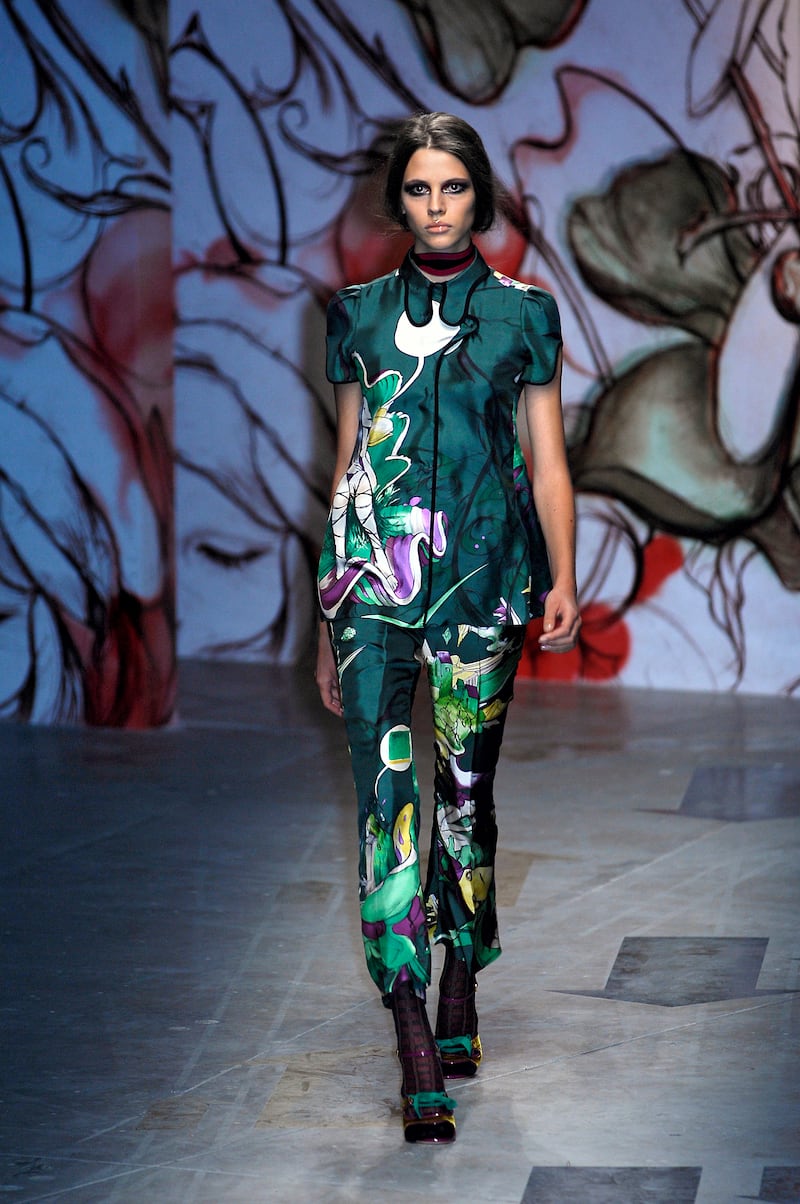
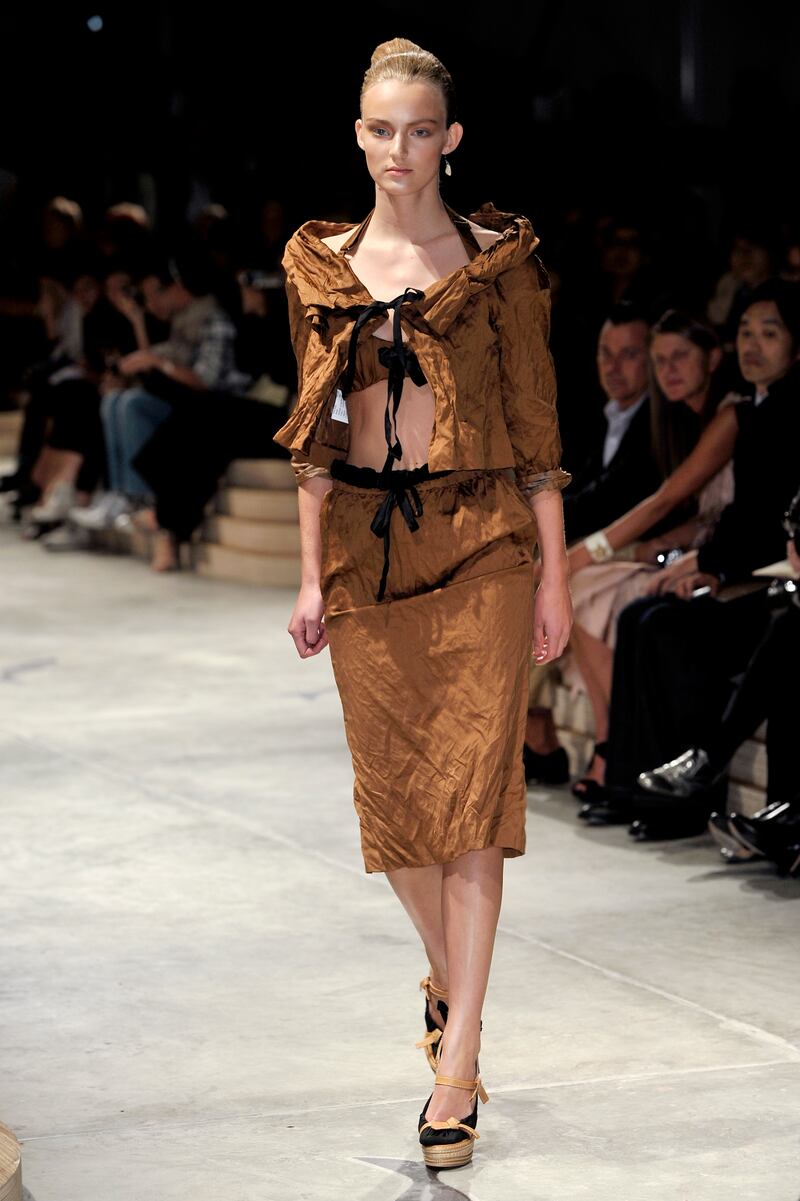
It’s the kind of existential headscratcher that could only be posed by someone who is as familiar with political activism as she is with its fashion variant. She also fully appreciates the fact that the problems which face the world that fashion is a part of are so many and so vast they far exceed fashion’s ability to solve them. “So you have to work in a much smaller realm of possibility. But you still need to reflect what you see because of course fashion is part of the wider world. It can’t be closed off. You choose which movies to see, which house you want, which kind of chair you buy, which vacation to take… they’re all part of your life, and so is fashion. I have never understood, for instance, how a great architect dresses really badly, without any awareness, because if you’re interested in culture, if you’re interested in aesthetics, you have a wider eye, and fashion is part of that.”
It’s quite possible that choice is a chimera conjured up by a matrix-like algorithm to distract us from politics and climate change and the cost of living, more things that matter. Miuccia still believes we have at least some choice, though she also agrees that mass manipulation is real, too. “The thinking also seems to be that without religion or a political party or an ideology, people don’t have ideas or vision. And you want to be part of a vision or an idea, so you’re kind of lost. I am lucky, because I had so many ideologies, but if you don’t have a guide, someone to think about the future, how can you make people passionate?” Or hopeful! There are flickers of hope when what we really need is blazing beacons. “This is the fault of the so-called intellectual and cultivated people who should push more, talk more,” Miuccia suggests. Why aren’t they doing that? I ask her. “That I ask everybody every single day, Why?” she answers. “I really don’t understand.”
You might imagine that question has some urgency for her given that she has two grandchildren, one a newborn. “Not really, not really. Because in theory I already knew even without her that you had to work for the future. I hope to live long enough to really try to educate her though.” She laughs her Miuccia laugh. On the syllabus? “Principles, ideals, behaviour, goodness, badness, anything else I think is good.”
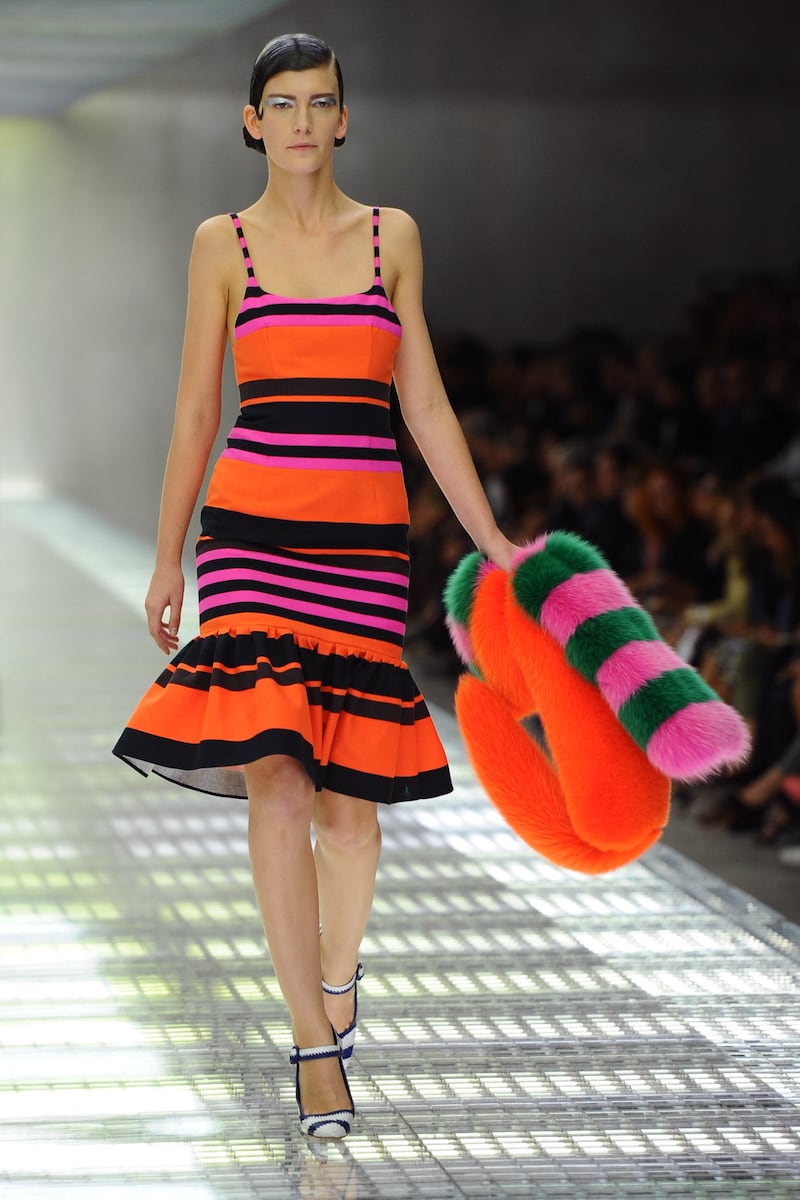
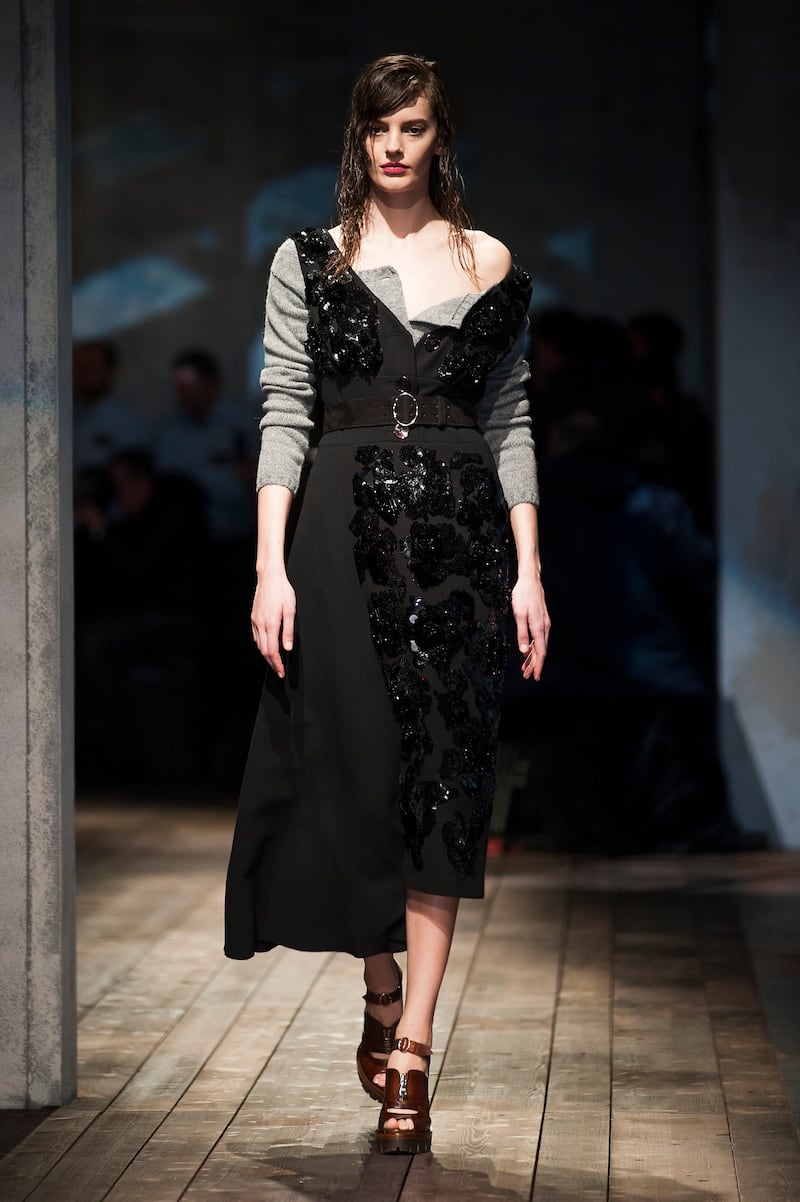
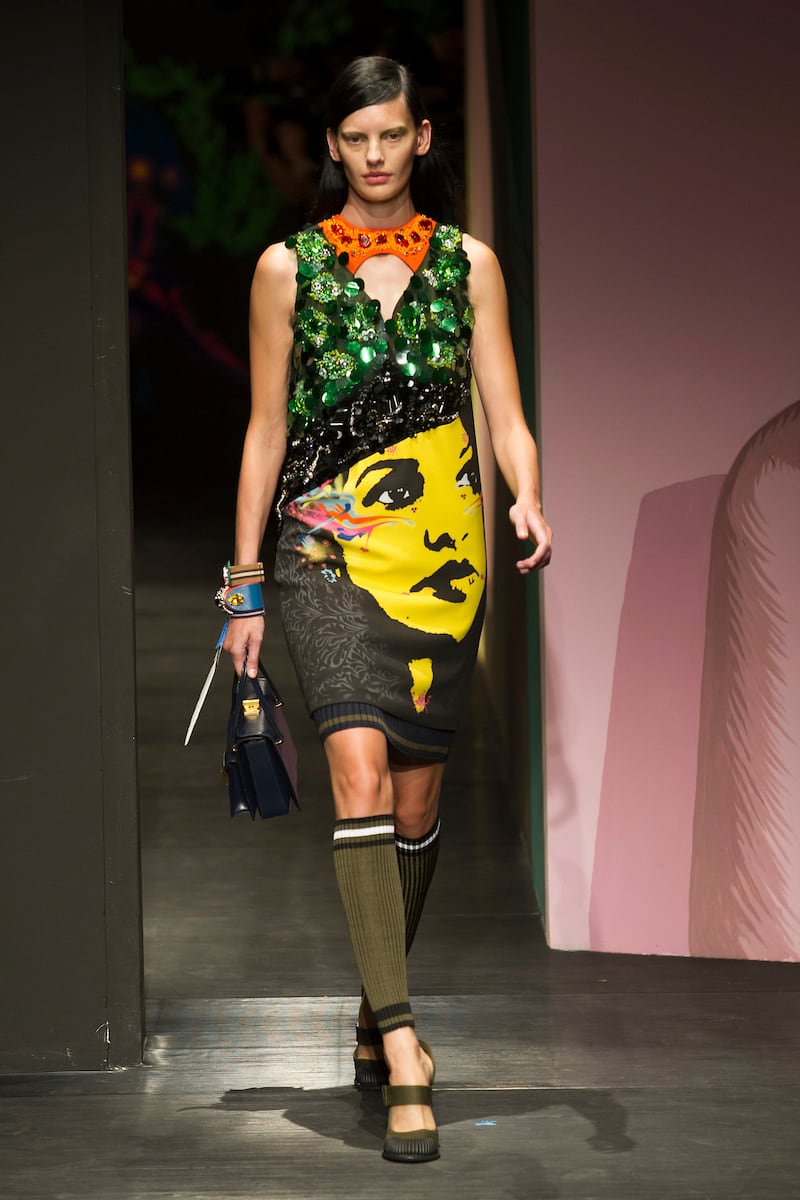
For the past six years, Miuccia has shared design duties at Prada with erstwhile Belgian wunderkind Raf Simons. There was an inevitable shift in dynamic when he arrived. The creative urgency that bounced the brand from season to season shifted to Miu Miu. “A little,” Miuccia agrees. “I decided to work with him so we share a common interest, but of course, my real point of view, alone, is Miu Miu.” The distinction she makes is straightforward. “Prada was always more the thinking part, so more rigorous, more intellectual. The base of my thought is the same, but in Miu Miu I always try to be more instinctive and more fun.” The cliché was always that Miu Miu was Prada’s little sister, a notion Miuccia is keen to put to rest, especially now that the perverse sense of humour and sly sexuality that underpinned Prada for years has taken roost in Miu Miu.
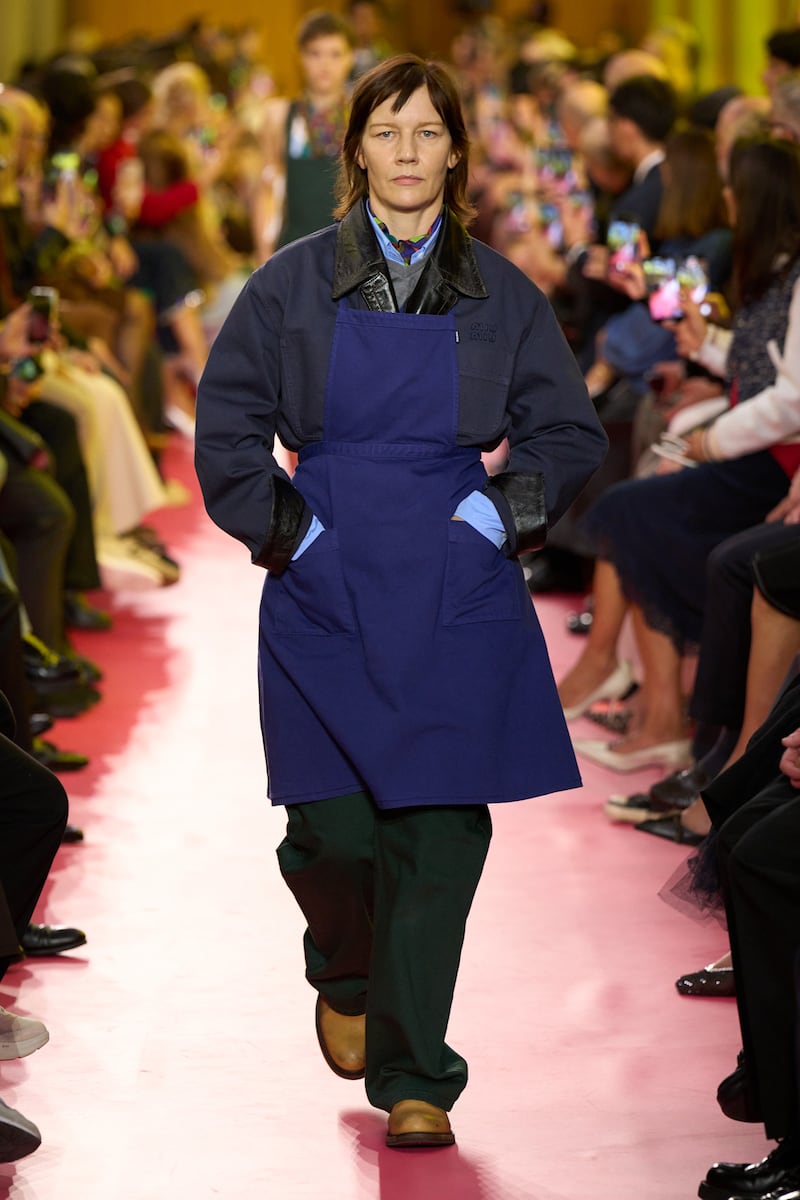
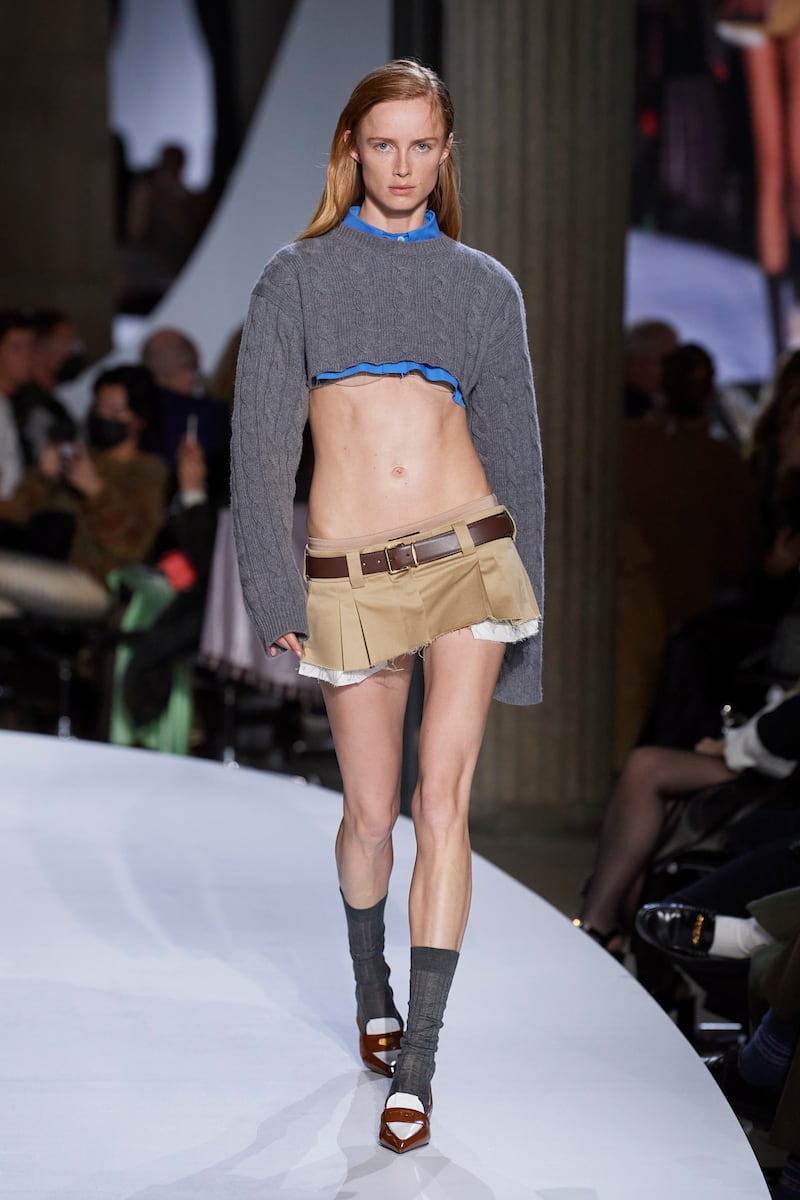
Miu Miu’s Spring 2026 collection, the one which opened with Sandra Hüller in an apron, looking like a worker bee on a Soviet assembly line, was a paean to “women’s work, women’s fatigue, women’s pain.” Miuccia knew it was a difficult proposal. “It was so directive in a way. And it wasn’t totally a success commercially,” she says with a wry chuckle. That mattered after Miu Miu’s extraordinary run over the past four years, since the Spring 2022 collection with its bare midriffs and hip-slung micro-mini skirts. “I always thought that what I started doing when I got into fashion was basically introducing the bad, because fashion was only about glamour and beauty. But which kind of beauty for which purpose? You didn’t know why, especially when art, the movies, the world cinema are full of badness. The scandal of ugly chic was incomprehensible for me, because bad is the reality, or at least a part of it. But fashion always excluded that reality, at least for me.”
Autumn/Winter 2026 extended the challenge, with a collection so reduced it made me think of the Arte Povera movement in the 1970s which used the most humble materials to make a radical statement. “The only thing I had in mind was that whatever happens, we have our body, we have our mind, and it’s a lot,” she said after that show. “It’s enough. Even if everything is taken away, still we have ourselves.” The concept was so fundamental that the direction felt much more about something interior, a way to be, as much as a way to dress. “Absolutely,” Miuccia says vehemently. “But you know, I always did that, more or less. It was never appreciated. Fashion for living in real life. But the fashion system is still anchored to a certain preconcept of beauty and glamour, an abstract concept for I don’t know who, or somebody that doesn’t interest me, in any case.”
ADVERTISEMENT
It comes back to her faith in utility. “People need to have something more useful for their life, even making you sexy or making you beautiful, but in a real context, not imagined. There is one word I really don’t like. I hate the word ‘dream,’ because if you believe in something, you try to make it real, to do it or get it. ‘Dream’ most of the time for me is completely stupid, but that is a part of women’s education if all they want is to be beautiful as they grow.” (Later in our conversation, she says, “I don’t think I ever did a dress that was offensive to a woman, or something that was making a woman just a sexy, beautiful object.”)
She’s aware of her own dreams. She even likes them sometimes. “Whether they are good or not, you’d have to ask a psychologist.” Either way, she insists they’re not useful. “Never! To be a woman dreaming of being a beautiful princess, trying to find a man on the white horse? In your life, you have to see the reality, deal with the reality, try to make the reality good, not invent a world of dreams. There’s still too many people saying fashion is a dream. So fashion doesn’t achieve what it should achieve.”
One untrammeled joy of the years that Miuccia was sole designer of Prada was the brand’s no-season-the-same fluidity. Some of those collections had the surreal vividness I associate with my best dreams: the characters, the colours, the cinematic atmospheres, the sounds of music. “Yes, because, of course, women are many,” Miuccia rationalises. “Your mind has many variations, and so each time I told a different story. But I’ve been fed up with stories for a while. In any case, everybody does them now, so of course I won’t [a burst of laughter]. But who knows? Maybe I’ll go back to them.”
I wonder how much her change in attitude has to do with ageing. “Not so much. I believe more or less in the same thing, formulating it probably in a different way. It’s not that I changed a lot. I don’t know if it’s a good or a bad thing. I call it progressing. Or seeing things from another perspective. I have to do exhibitions at the Fondazione, and I progress. I have to do shows, and I progress. I have to have a vision of the world, and I always try to go forward. I try to update, progress, look at things always in a way that adds something to the past. I’m not saying new, but something that adds new interest. For instance — and now I’m only talking about stupid stuff — furniture. Okay, now I’m only interested in antique furniture, because I don’t know about it. I’m always attracted by something I don’t know. That is an important point of my life. You follow something, and once you know it, you become interested in something else.”
Progression sounds a lot like simple curiosity, one trait I plan on exercising till my last breath. Miuccia clearly feels the same way. She remembers when she and her husband launched the first exhibitions at their Fondazione in 1993. (As it happens, the first artist to show at the space was the Arte Povera sculptor Eliseo Mattiacci.) “We asked artists to make their dream exhibition. Back then, no galleries or museums did that, so we offered them something that didn’t exist. But after seven or eight years, it started to become a thing. I said, ‘No, let’s change direction’. I always wanted to progress, or add a different point of view. ‘Ok, how can I think about another curious show?’”
She claims she is very much motivated by boredom. “I think it’s probably one of the most important things in my life, because when I get bored, I want to change.” She goes so far as to suggest that the moment boredom stops working is the moment she’ll have to stop too. “Or I hope I will stop. Until then I am motivated.” Another of her motivations is hate, or at least what she calls “hate in concept,” as in, “I hate large trousers.” Or, “I hate corduroy.” Or, “I hate lace.” More in the vein of “pet hates” then. She’s made whole collections out of them. Maybe it’s like director Luca Guadagnino, an old friend, said recently: “Sometimes you need to hate things in order to understand them.” It sounds like her disinclinations have almost become a game between her and Raf. “I know you like what you hate, what about this?” he’ll suggest to her. Fortunately, I don’t see her running out of things she doesn’t like any time soon.
The men’s collection is a completely different proposition. Raf’s roots are in menswear, after all. But historically, the Prada man was always an adjunct to the Prada woman. “You mean I imagined myself as a 15-year-old boy,” Miuccia says [another hoot of laughter]. But Spring 2027 stands out for its fixation on a single stark silhouette. “For sure, Raf loves skinny boys,” she continues, “but it’s kind of a fashion thing, defining a silhouette that’s not oversized. It was a fashion choice to simplify because for a few seasons we offered variations, different characters, endless possibilities, endless combinations. We got fed up, so we said, ‘Let’s be precise.’”
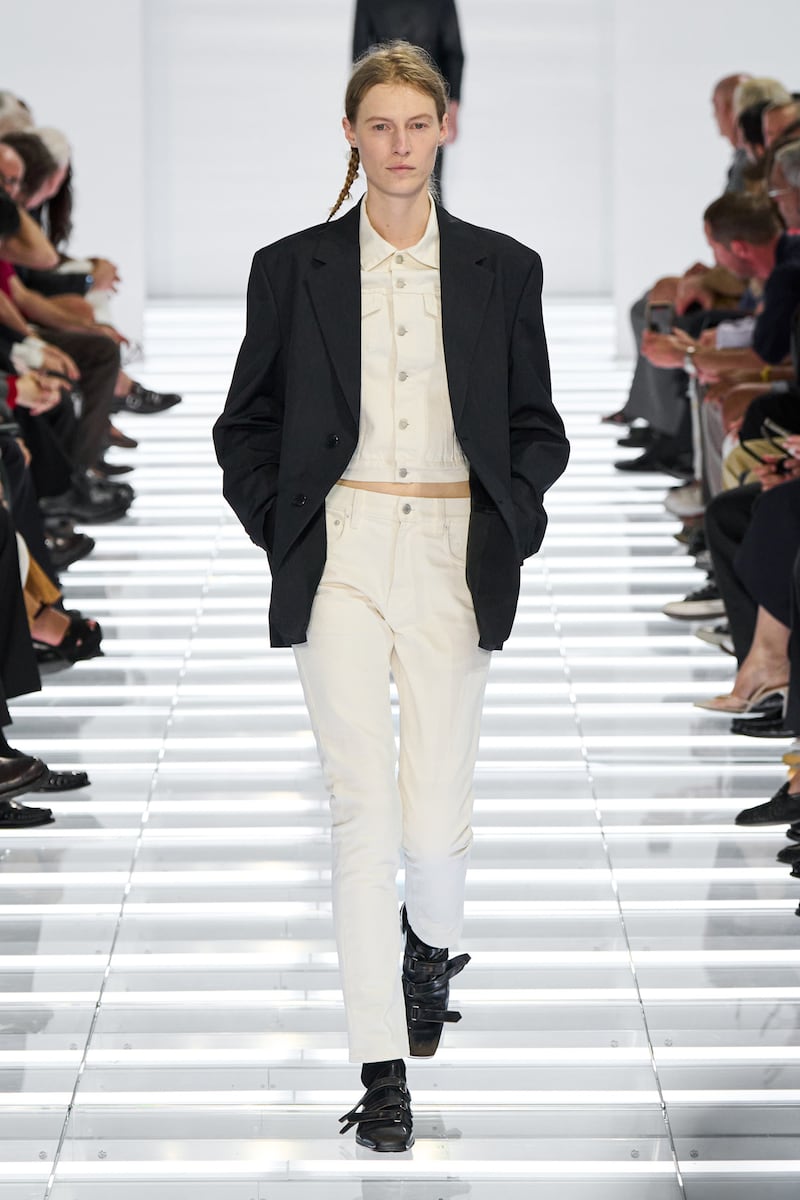
“I wouldn’t do this thinking for Miu Miu,” she adds. “There is sometimes a theory of fashion. Maybe it doesn’t come out as I would do it, but I do it with him.” She pauses for a significant moment. “It’s also difficult. Unless I have an interview, I never think about my job in theory, I just do it, but it’s also good because it’s one of the few moments I get to think about myself, and I really do a little theory about the show. Because I want to be advancing theoretically in fashion, even if the advance is just to change the silhouette. That’s not a revolution, of course, but fashion doesn’t do any revolutions at the moment. Nor does art, nor movies, nor design. We are not in a great moment for them. But I know why. The world is so complex and so difficult to read that you don’t have a direction to follow, so you have to follow much more the history of fashion. If you go out and you want to be more cool or more in fashion, maybe you don’t use red, you use black, maybe you use a print, or no print. Fashion in its really simple formulation, which I think is very important, is the sense of fashion that I thought I always had. I was the first to wear the long skirt, the first to wear the miniskirt. I wanted to be the first in Milan.” The miniskirt was by Pierre Cardin, by the way.
ADVERTISEMENT
All of which suggests there is some truth to Miuccia’s claim she spends at least half her time thinking about fashion. “It’s important, first of all, because the money gained from fashion is useful for other activities, so there is a practical reason why I want to be good. I am ambitious in that sense. Actually, I would like to be the best [laughter], and it’s not like in three seconds you are good. You have to work a lot.”
I’m not blowing smoke when I say she is the best. Is that how she’d want to be remembered? “I have no idea, I don’t reason like that,” she replies. “Me as a person, I don’t care. This is strange now. I remember once I said to a very good friend, ‘I’m not ambitious,’ and he said, ‘You’re a monster of ambition.’ Why? Because I don’t think I am. In my life, I’m interested in the people that I love, my friends, my family. So, the way I’m ambitious in the work comes from something outside of me. There is the me of work… and I’m trying to understand, I’m trying to formulate, because I never thought about it. Before, when I said I am ambitious, it’s because I know that professionally I am, very. But personally, I’m not interested. I’m more interested in love.”
She’s never written anything down, never kept a diary. “I have a record of nothing,” she insists. She has, however, been working on a history of the Fondazione. “But I’m not happy with the results, so I probably won’t do it. But at least they have more than 10 hours of recording of me talking about it. And Lorenzo wants to organise many sessions of interviews, because he wants to record things.”
She claims it was never the plan for Lorenzo, her eldest son, to sign on. He was happy racing cars. “That’s still his dream, but at some point he said that was not enough for life, and he decided to join the company. He described it as the best choice he could have made.” I ask if she fancies creating one of those dynasties that define Italian fashion. “Said like that, no!” A gurgle of laughter. “That was a good provocation,” she says approvingly. “There’s nothing wrong with it in any case, but dynasty is not the first thing that comes to my mind thinking about it. I always wanted my sons to do what they wanted. That was the absolute priority.”
Lorenzo’s current role is executive chairman of Versace, recently acquired by Prada. “The most famous brand on earth,” his mother calls it. “Of course I was born against Versace, against Armani, against the designers of that period, but many years ago, I saw an exhibition at the Met about Gianni’s clothes and, my God, they were beautiful. Looking at his book, and what he did with Avedon, it was a different philosophy from mine, but he did a very important job.”
“People ask me why, because they know it’s much the opposite of Prada, but I think it’s a very important brand, and instead of being in anybody else’s hands…” She leaves that prospect dangling. “We thought that it was a good idea.” Years ago, Prada attempted a co-joining of compatibles, Jil Sander and Helmut Lang. That wasn’t a good idea. “Back then, the designer thought that after the company buys you, they wanted nothing to change, just to have some money coming in. They wanted to do whatever they wanted, so that didn’t work, even if we were so democratic. But it was too early. No one had bought anything. And now the whole of fashion is just about buying brands.”
I remember her once saying she doesn’t think about the future. Maybe I imagined that because now she insists she thinks about it all the time. And what’s her conclusion? “That I’m very old.” She blames the numbers, though reassuringly, those numbers so far haven’t added up to much difference to what came before. “But at some point it’s going to be worse. So I have a new kind of point of view. It’s kind of teaching. Leaving a better company for my son and for the future. I’m working on a subject that I never worked on, the most boring small subject, because I want to teach that the difference is also in small things, and people have to be serious in every single stupid thing.” In other words, you’ve got to sweat the small stuff.
Good lord, Miuccia is workshopping with hundreds of her employees. “Because I want to leave a good company, I’m teaching all my people how you have to be serious. I say, ‘Do you like this? Are you happy? No? You’re right, so why do you present it?’ Then they come back. I am teaching! Because I want to teach the dedication, the seriousness. And not to be content. Too many things are done in a superficial way. You can imagine it’s not the most exciting thing to do, but I believe it’s very important, so I do it.”
That makes me wonder what Miuccia does for herself, to keep the flame alive. I’ve come to enjoy gardening. So, apparently, has she. She has been buying houses all over Italy. “Respecting a world,” she says. “Really working to preserve pieces of earth, pieces of architecture that already exist.” She does all the research for her projects herself. And she loves to plant trees. Lots of them.
The 35 year-old former racecar driver — son of designer Miuccia Prada and chairman Patrizio Bertelli — is restructuring the Milanese group from the inside out. ‘Everything’s changing so that everything can stay the same,’ said the BoF 500 cover star about readying Prada for its next chapter.
What's 'polyhedric brand equity'? Chief executive Andrea Guerra breaks down how Prada and Miu Miu — luxury’s ‘cultural brands’ par excellence — continued to outperform the market last year, and his outlook for 2025.
How did Miu Miu grow by 58 percent last year? CEO Benedetta Petruzzo breaks down the plan that’s powered eye-popping acceleration in a slowing luxury market.
Tim Blanks is Editor-at-Large at The Business of Fashion. He is based in London and covers designers, fashion weeks and fashion’s creative class.
Loading recommended reads…
In this week’s High Margin, a search for images that cut through our visual fatigue — with leads from M/M Paris, Ferdinando Verderi and stylist Emilie Kareh. Plus: Tod’s designer exit; Burberry’s resilient sales.
The producer price index rose 6.5% from October 2025, an acceleration from the prior month, according to Bureau of Labor Statistics data out Friday. On a monthly basis, the PPI increased 0.3%.
The creative director and strategist joins Imran Amed on The BoF Podcast to discuss the evolution of his career, the realities of shaping artist narratives and why long-term collaboration outperforms short-term marketing.
The former Nvidia CEO was central to an AI boom that has propelled the US stock market and fueled the country’s unmatched luxury spending. After his exit, nobody is sure what happens next.