Agenda-setting intelligence, analysis and advice for the global fashion community.
Agenda-setting intelligence, analysis and advice for the global fashion community.


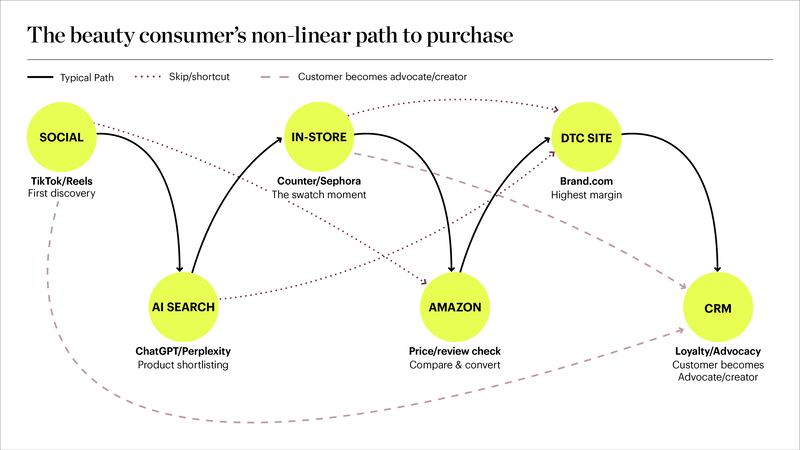
In 2026, a beauty shopper might find a product on TikTok, research it on the brand’s DTC site, test it at a Sephora counter, and complete the purchase on Amazon. For most brands, each of those channels sits with a different internal team and is measured against different metrics. The problem is not the number of channels, but that brands still manage them in siloes.
For beauty brands — in a category defined by tactile purchasing, long consideration cycles and hard-won loyalty — the cost of failing to integrate is rising rapidly. Online beauty sales are forecast to grow to over 30 percent by 2030 globally, according to BoF’s and McKinsey & Co’s The State of Fashion: Beauty 2025 report. Meanwhile, Circana has reported that as of 2026, Amazon has overtaken Walmart as the largest US beauty retailer.
Front Row is helping businesses to connect these dots. The global commerce accelerator defines connected commerce as the integration of a brand’s data, media and sales activity across brand, demand, content, search, digital flagship and marketplaces — ensuring each touchpoint informs the next and that upstream clarity drives downstream conversion.
The second playbook from BoF, Beauty Retail in the Age of Connected Commerce — created in partnership with Front Row — examines how beauty brands can turn connected data and channels into measurable growth.
“The first reality is that most brands are working with disconnected data,” says Rina Yashayeva, senior vice president of brand strategy at Front Row, whose clients include Ouai, Colourpop, Malibu C and more. “Instead of looking at performance purely by platform, the focus must shift to connecting the dots: understanding the consumer and category with breadth, but measuring with depth.”
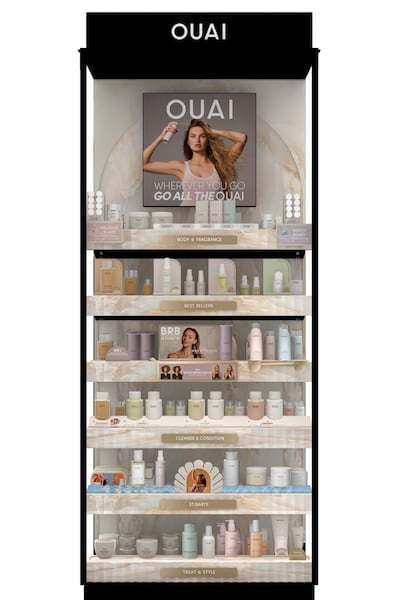
The connected approach has benefitted client Ouai — paying off in how the haircare brand reads and responds to Amazon data today. Ouai’s new-to-brand and repeat customer rates grow in equal measure, a signal of steady acquisition and retention on-platform rather than one outpacing the other.
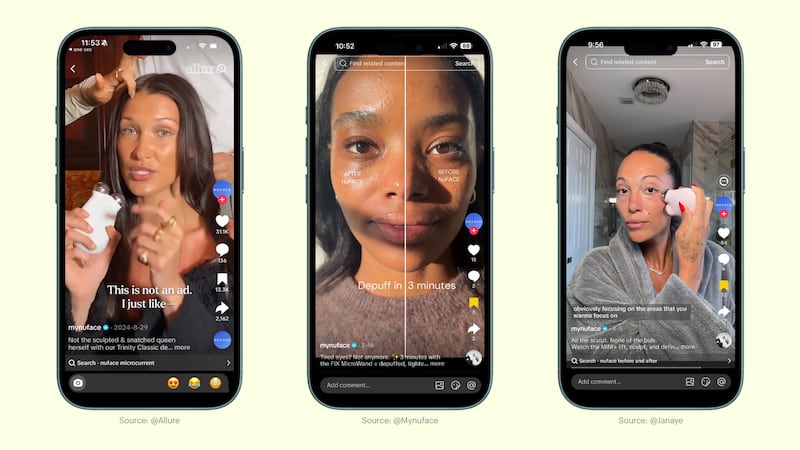
At microcurrent beauty tech brand NuFace, viral moments and celebrity endorsements are treated as accelerants. When Bella Hadid revealed she uses the NuFace Trinity Facial Toning Device on Vogue’s YouTube series “Beauty Secrets”, the moment created opportunities for amplification across channels — particularly on marketplaces, where demand signals can be captured and converted, then reinforced across the wider brand ecosystem.
“Front Row focuses on supporting outperformance in the channels where we’re seeing conversion — and right now, that is marketplaces,” says Christopher Skinner, co-founder and chief revenue officer at Front Row. “But marketplaces are only successful through connected capabilities. Brands need the full understanding of the system.”
AI-powered discovery tools are intensifying the pressure further. Adobe reports that shopping-related searches on generative AI platforms grew 4,700 percent between 2024 and 2025, and 53 percent of US consumers who used generative AI for search also used it to help them shop. Brands whose product data is unstructured or inconsistent are losing visibility in these environments.
Connected commerce, Yashayeva adds, also requires alignment and “a shared view of the business.” The brands outperforming today understand that $1 spent in one channel can generate $10 in another.
This BoF Playbook shows brands how to:
This is a sponsored feature paid for by Front Row as part of a BoF partnership.

Annabel Bolton is the Content Strategy Senior Associate at The Business of Fashion (BoF). She is based in London and executes commercial partnerships, knowledge reports and writes careers advice.

Yasmine Dahlberg is Content Strategist at The Business of Fashion (BoF). Based in New York City, she delivers high-impact written, visual, and live content for BoF’s industry partners.
Loading recommended reads…
The comments by chief executive Giuseppe Marsocci come as the brand reportedly considers the possibility of LVMH, L’Oreal and EssilorLuxottica sharing the stake.
Drew Henry’s first show for Courrèges will be closely watched, as will Saint Laurent and Balenciaga for any signs that creative change is on the way. Plus, Celine and Margiela.
Louise Trotter’s Bottega Veneta was lighter and more clearly expressed the designer’s signature. Also: Angelo Flaccavento reports on Ferragamo, Dolce & Gabbana and Act No. 1.
For the last twelve months, the designer has played therapist to the brand’s ‘multiple personality disorder.’ This latest session for Spring/Summer 2027 was a breakthrough.