Agenda-setting intelligence, analysis and advice for the global fashion community.
Agenda-setting intelligence, analysis and advice for the global fashion community.

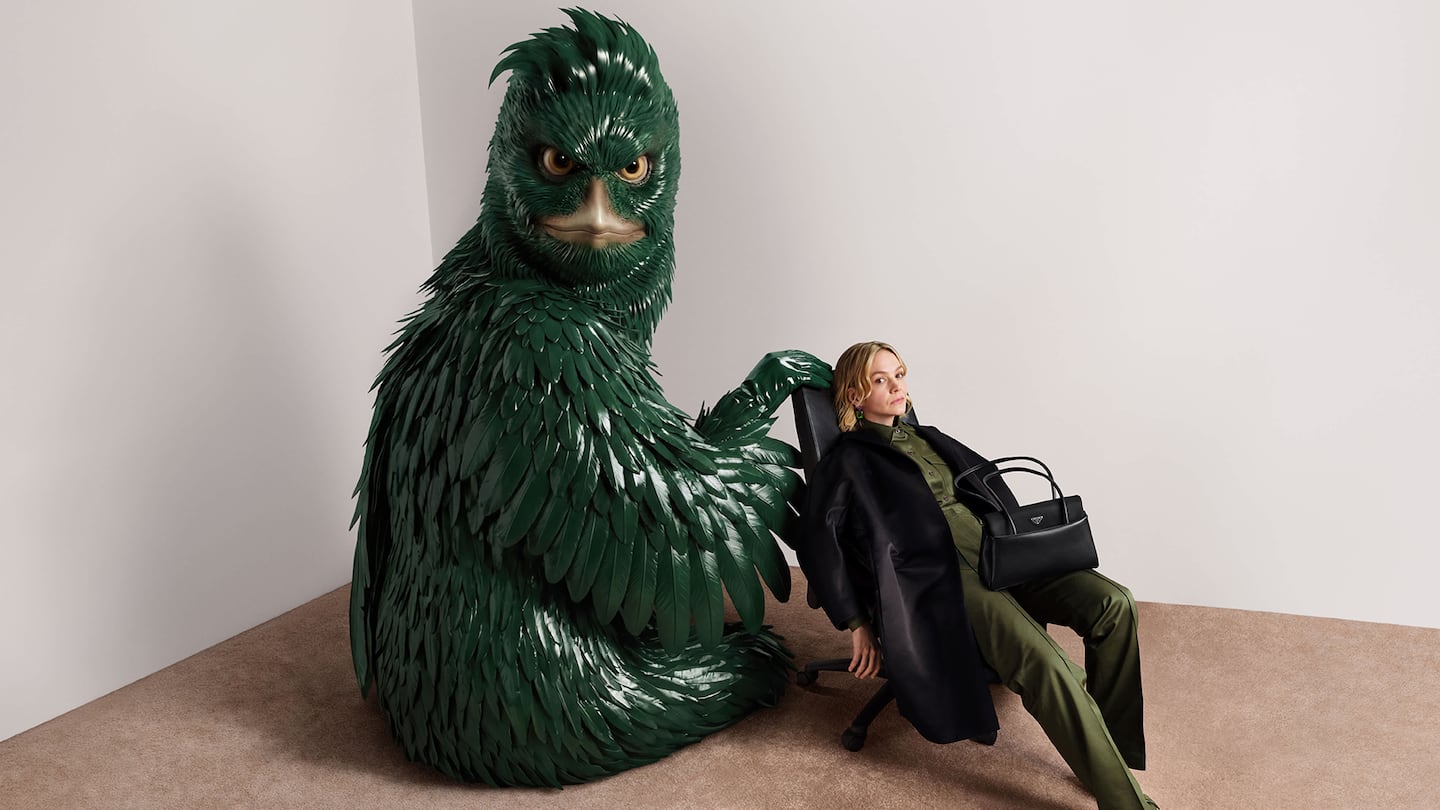
Prada never set out to use AI in its latest advertising campaign, “I, I, I, I AM… PRADA,” an unsettling but mesmerising set of images conceived with artist Jordan Wolfson that went viral this week. AI was used only in post-production, representatives for Prada told The Business of Fashion, noting that artificial intelligence is heavily embedded in today’s CGI process.
That hasn’t stopped the ads — featuring actors Nicholas Hoult, Carey Mulligan and others alongside giant feathered birds and scaly humanoids — from adding fuel to a vigorous debate on whether imagery generated with AI has a place in a luxury fashion sector that trades, in no small part, on its links to creativity and craftsmanship.
Online critics point to the uncredited art used in the datasets that train generative AI tools like Midjourney and DALL-E, as well as the risk that artificial intelligence could threaten the livelihoods of human photographers, stylists, models, hair and makeup artists, production crews and others who have traditionally been key to the creation of fashion imagery.
From Valentino to Gucci, no major fashion campaign that’s visibly employed AI has gone unscathed by internet protests, even when the intent is satirical, as was the case with Gucci’s video game-inspired intentionally lo-fi images promoting its Milan fashion show last month.
ADVERTISEMENT
In the eyes of these critics, Prada’s campaign is the latest offender. But the details matter.
The brand says much of the production process was executed in a traditional manner: Human professionals, shot in a London studio with a 50-person crew, were part of the process used to create the interactions between the campaign stars and their feathery alter egos; the creatures themselves were rendered and sketched by Wolfson prior to filming; and more than 20 people were involved in post-production.
Wolfson, for his part, has likened AI tools to an electronic “synthesiser,” once seen as a threat to music the same way that Daguerreotypes were once seen as a threat to painting. Panic about the use of technology in art goes back centuries.
Prada says it took steps to ensure its AI-generated creatures were not derived from existing artwork. But the argument that AI is irredeemable because it’s trained on unlicensed imagery begins to soften when seen through a historical lens: Andy Warhol and Barbara Kruger built entire practices on appropriation, lifting and recontextualising familiar images to generate new meaning.
One hopes the way Prada has integrated AI into the creation of the Wolfson campaign will help advance the conversation on artificial intelligence and fashion imagery beyond a simplistic debate over “should you or shouldn’t you” to a more nuanced discussion.
AI can be used as a substitute for creativity — or a conduit for it. The slop its critics deride is a real problem. But in the hands of an artist, AI can be something closer to a musical instrument and we all know that synthesisers didn’t dilute the power of music as much as expand its vocabulary, just as the advent of photography added richness to visual language.
Pioneering fashion image-makers like Nick Knight and Simon Foxton have begun adding AI to their practices, not to replace authorship but to extend it. “For me, AI is not about replacing one’s vision, it’s about expanding it. It offers choices, much like the tools we’ve always used in more traditional workflows,” Knight told System magazine in an interview last autumn.
Seen that way, AI stops looking like a mere shortcut and starts looking like a new medium — one that, at its best, doesn’t flatten creative output but opens up new terrain for exploration.
ADVERTISEMENT
That’s not to say that AI imagery doesn’t come with dangers. It does. But it’s not whether a fashion brand uses AI — but how — that matters most.
By Cathaleen Chen
Go Deeper:
The reaction to Prada’s unsettling new campaign reveals an emerging sentiment in online audiences who see AI and luxury as incompatible.
Who’s up and down in the business of fashion, luxury and beauty this week.
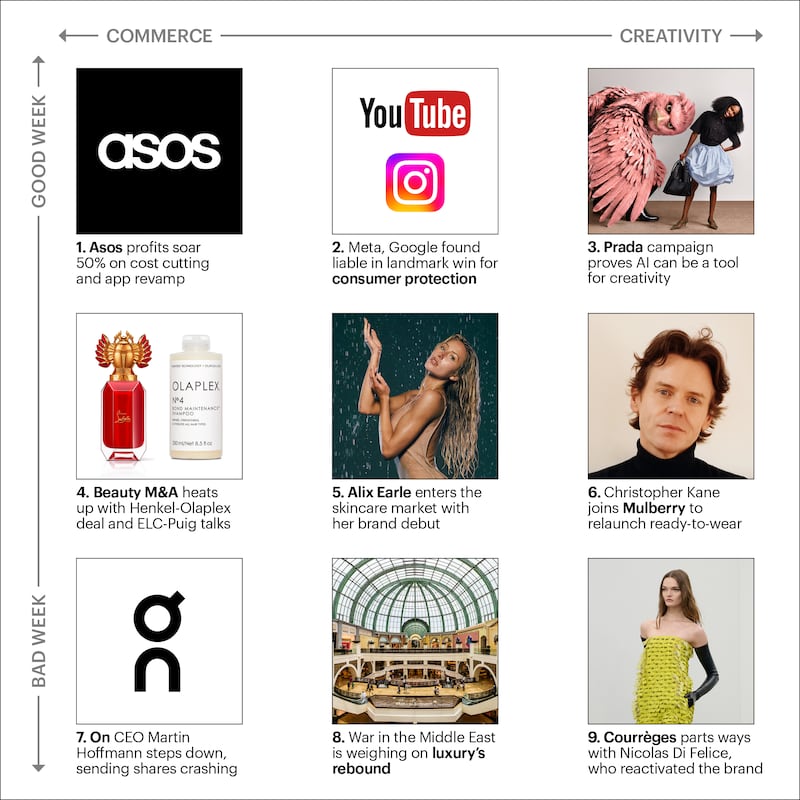
1. While rivals H&M and Next issued warnings over rising costs, Asos reported a 50 percent lift in underlying profits for the six months period ending March 1, 2026, driven by customer growth and a focus on cutting costs.
2. Instagram-owner Meta and YouTube-owner Google were found liable for harming the mental health of a 20-year-old young woman in a landmark win for consumer protection advocates. The verdict opens the door for thousands of similar lawsuits currently underway and potential new safeguards against social media addiction.
ADVERTISEMENT
3. Prada’s latest campaign, created with artist Jordan Wolfson, added fuel to the debate on luxury brands’ use of AI-generated imagery while helping to move the conversation beyond “should they or shouldn’t they” to a less simplistic and more nuanced discussion.
4. In a big week for consolidation in the beauty space, Puig and Estée Lauder Companies confirmed merger talks that could result in a combined entity with a market capitalisation of around $40 billion. Meanwhile, German CPG giant Henkel reached a $1.4 billion deal to acquire haircare brand Olaplex.
5. After promoting brands like Tarte and Drunk Elephant, mega-influencer Alix Earle introduced her first beauty venture: a skincare line called Reale Actives for acne-prone skin.
6. Mulberry has hired subversive Scottish designer Christopher Kane to relaunch its women’s ready-to-wear line as it accelerates its efforts to ‘evolve from a leather goods brand into a culturally relevant British lifestyle brand,’ said CEO Andrea Baldo.
7. On announced the exit of CEO Martin Hoffmann less than a year after he took the helm, sending shares crashing. The brand’s co-founders David Allemann and Caspar Coppetti will step back in to lead the company as it navigates a period of slowing growth.
8. The ripple effects of the war in the Middle East — disrupted tourism, oil-price volatility and shaken consumer confidence — are weighing on prospects for a luxury rebound, but analysts are sticking to their forecasts for now, projecting 4 to 6 percent global organic revenue growth.
9. Nicolas Di Felice is exiting Courrèges after a five-year tenure that reactivated the storied Parisian label with a clubby energy and collections that breathed new life into its Space Age DNA. The house is expected to announce a new designer next week.
Catch up on all the news of the week in fashion, luxury and beauty here.
Want to dive deeper into an insight from this article? Check out The Brain of Fashion, BoF’s new generative AI tool where you can unlock BoF’s technology archive with a single question.
Loading recommended reads…
Sales of gems, precious metals and artwork at Japan’s department stores climbed 19 percent in the first half of 2026 from a year earlier to $2 billion.
Though Adidas dressed both teams in the World Cup finals, the global football tournament still presented some bright spots for Nike, writes Bloomberg’s Andrea Felsted.
From our archive, the creator and host of award-winning podcast “Articles of Interest” joins BoF founder, CEO and editor-in-chief Imran Amed to explore what clothing can reveal about identity, culture, labour and the world around us.
Saunders, the brand’s first creative director in five years and a skilled colourist, promises to give Kate Spade the clarity it has long lacked. Now, Tapestry must apply the same long-term brand-building discipline that fueled Coach’s success.