Agenda-setting intelligence, analysis and advice for the global fashion community.
Agenda-setting intelligence, analysis and advice for the global fashion community.

The Business of Beauty's executive editor unpacks how shifting ideals, new players and cultural movements are transforming the global beauty and wellness industries.
Subscribe to Full Coverage by Priya Rao: unpacking how shifting ideals, new players and cultural movements are transforming the global beauty and wellness industries.
Hello and welcome back to Full Coverage. It’s the right amount of chilly in New York (and an opportunity to wear my less practical but more fashionable jackets; think suedes, embossed leathers and plaids accented with a touch of fur). I’m also surrounded by a cornucopia of Halloween decorations (the cute kind, not the scary kind), both in my own home and on the Upper East Side, where I live. I really love this time of year.
After weeks of viral takeovers (Yse vs. Jones Road), news (Isamaya Ffrench departing her namesake brand) and teases (Jennifer Lawrence’s haircare line — I’ll have more on that next week), things in beauty are settling a bit. Well, unless you count that old rumour that LVMH is selling off Sephora. My sources say that’s absolutely not true; it is one of the biggest revenue generators of LVMH up there with Louis Vuitton and Dior. See another reason why below.
Speaking of LVMH, last week’s lacklustre results kicked off earnings month. Even its perfume and cosmetics division was flat in the third quarter, but Sephora, its golden child, boosted its selective retailing division. Puig and L’Oréal are up next and I’m eager to hear how the former is going to outline its plans for growth post-Estée Lauder deal collapse. We’ll also get some insight into Hermès, which has lost some of its resilience; beauty isn’t the biggest part of the company, but I wonder if we’ll hear more about the upcoming skincare launch we’ve been baited with. On the totally other side of beauty’s pendulum, I’ve been thinking a lot about E.l.f., which is my main topic for today.
ADVERTISEMENT
Earlier this month, E.l.f. announced its foray into fragrance and body care with its new E.l.f. Pop line. Its first drop, with scents like “Spicy Bundt Nice”, adhere to the saccharine, gourmand trend that we’ve been enveloped in the last few years. (I wonder if the youth know what Bundt cakes are; they make me think of Midwestern grandmas.) On its own, this debut, which includes just three products — a body mist, body cream and travel kit — isn’t big news. But, when you think about E.l.f.’s overall strategy, it absolutely is.
Now, I’ve been covering E.l.f. for the better part of a decade — I vividly remember one of my first meetings with chairman and chief executive officer Tarang Amin about the brand’s reset after closing its standalone stores — and I like to think I’m one of the few journalists who really knows the ins and outs of the business. But after 30 consecutive quarters of net sales growth, E.l.f.’s brand performance has moderated. Yes, Rhode is all anyone can talk about, but E.l.f. is still its most prized and biggest property.
So how does a brand that big grow?
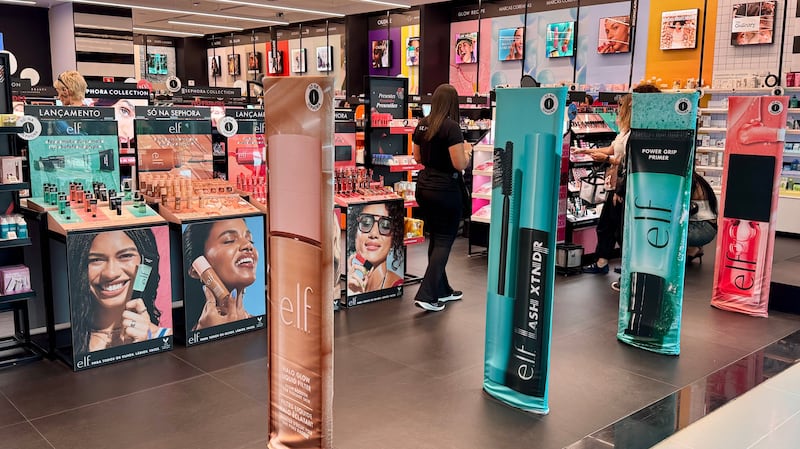
The classic playbook is more distribution, more categories and more products. E.l.f. is doing all three: It recently launched in Sephora Brazil, a rare move for a brand that sells at Walmart and Target in the US. It continues to boost cosmetics by bringing back limited-edition hits like its pickle-flavoured Glow Reviver Melting Lip Balms. And, yes it is building up its offerings, including fragrance and hair, the latter of which launched in June.
I’m not going to spend too much time talking about distribution, as the entire company. has a ways to go to be more global, global (its penetration in international territories is around 21 percent compared to competitors’ average of 70 percent), but I am thinking about how its hero brand is stretching its limits.
Every label in beauty wants to be a multi-category brand, but few have had real success. The only true powerhouse is L’Oréal Paris, which plays big in makeup, skincare and haircare. Usually brands dilute themselves when they’re overextended (think of Glossier’s core cosmetics offering once it went into fragrance) or they simply don’t have the money to compete.
To talk it through, I called up Kory Marchisotto, president of E.l.f. brands.
“We are a publicly traded company. We are a for-profit institution, and growth is very important to us,” said Marchisotto. “I wouldn’t say that we’re waking up every day and saying what specific [category should we go into], it’s more about what are the ways in which we can service a growing consumer base and how do we test the limits of this brand … where it’s like a rubber band.” She also reminded me that E.l.f. sells virtual backpacks on Roblox and has released music tracks.
ADVERTISEMENT
L’Oréal Paris is essentially a century older than E.l.f., and it belongs to a group with a much bigger market cap. But E.l.f. is a top 10 makeup brand in the US. It has also made inroads in skincare, which seems to prove its multi-category thesis. While skincare products have been part of its portfolio since 2015, the company made E.l.f. Skin a brand of its own in 2022. Back in early 2023, I reported that skincare accounted for less than 10 percent of net sales and that E.l.f. Skin was a top 18 skincare brand, according to Nielsen. Marchisotto told me that now the line has surpassed $200 million in retail sales and is ranked number 11.
Out of all of its new categories, skincare will be one of the most lucrative opportunities for E.l.f. Customer loyalty is strong in the segment. For now, however, it will ride fragrance’s momentum, even if growth is moderating and its launch was later than others. As for haircare, the real winners in that category have won in innovation (K18), price (Pantene) or styling (L’Oréal Paris). E.l.f. has thus far dabbled in wash and styling, an extension of its franchise Power Grip collection, but my bet is on shampoo and conditioner. It’s still a segment that is driven by price, where E.l.f. excels, and has a long runway for growth.
E.l.f. doesn’t want to be categorised, Marchisotto said. “Who said a brand has to live in a box with a label?”
To secure her brand’s place in hair care routines, Cardi B is starting at the supply store. Daniela Morosini went along for the ride. [The Business of Beauty]
On the topic of Cardi, who else has been watching her Tiny Desk Concert on repeat? [NPR Music via Youtube]
There is an emerging discourse about phone cases with beauty product attachments, which I’m taking as another argument to put the phone down altogether. [Allure]
Beauty is having boy troubles. Sephora thinks it can solve them. [The Business of Beauty]
“Dark nutrition”, a fringe diet of mostly raw meat and dairy, is gaining steam in the tradwife community. [The New York Times]
ADVERTISEMENT
Thank y’all,
Priya
Loading recommended reads…
After the retail empire’s initial takeover bid failed, the company raised its holding to 50.08 percent in a move that will turn the German apparel brand into a subsidiary of Frasers.
The settlement, equivalent to 44 percent of the ultra fast-fashion company’s second-quarter profit, is the latest blow amid regulatory and tax crackdowns in Europe and the US that have hampered Shein’s growth.
Among the takeaways from the latest round of quarterly reports from European luxury groups: China’s hurting, industry growth in the US has slowed and quiet luxury is having a moment.
Bloomingdale’s chief executive Olivier Bron joins Imran Amed on The BoF Podcast to discuss how a name every American knows is re-earning its place in luxury and why he sees Europe’s biggest houses wrestling with the same problem.