Agenda-setting intelligence, analysis and advice for the global fashion community.
Agenda-setting intelligence, analysis and advice for the global fashion community.

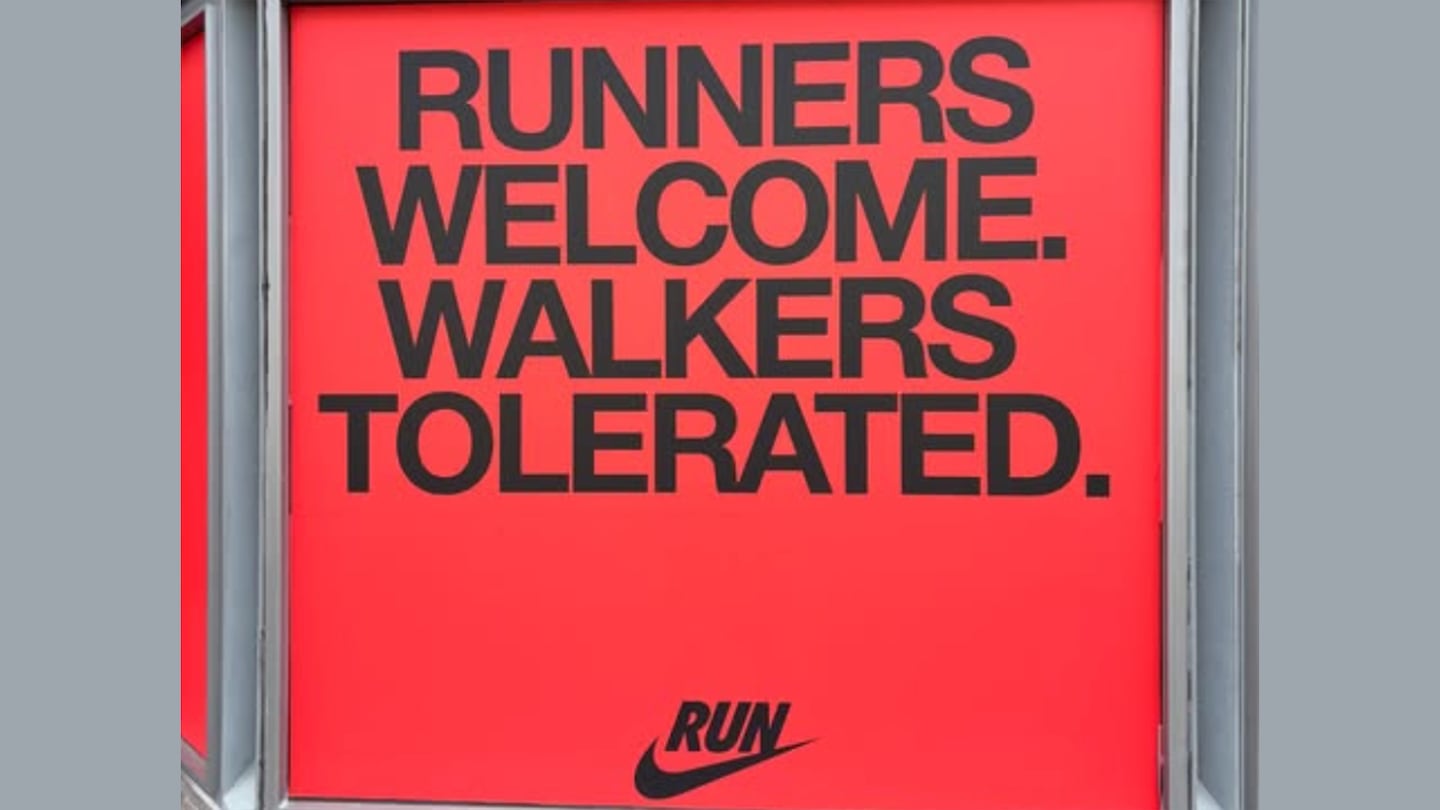
Among the bright orange signs Nike planted along the punishing route of the Boston Marathon in April was one in particular epitomised classic Swoosh bravado: “Runners Welcome. Walkers Tolerated.”
In another moment, the line might have landed like its much-celebrated 2025 Super Bowl campaign, “So Win” — a bold, defiant ode to women athletes that spotlighted stars like Caitlin Clark, Sabrina Ionescu and Sha’Carri Richardson in a cinematic brand anthem.
But this time, there was swift and loud backlash — including from the very runners it sought to champion — forcing the sportswear giant to pull the ad. (In a statement, the brand said it was listening to “the voice of the athlete” when it opted to take down the signage.)
“We should be building a more inclusive community — not isolating or belittling people that are a part of it,” one TikTok user said in a video that captured the thrust of the blowback and drew thousands of likes. “This is offensive.”
ADVERTISEMENT
In some ways, the dust-up recalls the controversy surrounding American Eagle’s Sydney Sweeney “great jeans” campaign, which ignited debate in a politically-charged US market. The reality of that climate has meant marketers face fresh challenges in how they package and sell aspiration — or desirability — to mass audiences. The discourse around Monday’s Met Gala is the latest sign of the times. Buzz around this year’s event has been weighed down by criticism over backing from Jeff Bezos and Lauren Sanchez Bezos, who have come to symbolise the yawning gulf between the country’s billionaire class and the everyday consumers brands like Nike rely on.
“The Met is off target with the economy this year. It should have been the theme of minimalism,” wrote one user on X.
It’s in this context that brands face a growing dilemma: how to signal aspiration without alienating the very consumers they’re trying to reach.
Selling aspiration — the promise that buying the product gets you closer to a certain identity or status — has long been part of fashion’s playbook, from Abercrombie & Fitch’s “cool kids only” era of the early aughts to Brandy Melville’s one-size-fits-some minimalism, not to mention luxury’s enduring mythology of distance and inaccessibility. The allure, implicitly or not, has been the same: buying in means you’re part of the club.
But that playbook doesn’t travel as easily as it once did. In the TikTok era, even the most rarefied corners of fashion are effectively public. Few people will ever have a seat at a reported $300,000 table at the Met Gala yet social media has erased the distance, giving audiences a sense of proximity to moments that were once tightly controlled.
That visibility has also eroded the audience segmentation brands once relied on — where you could say one thing to one group and something else to another. Two decades ago, only the mostly elite athletes on the Boston Marathon route would have seen Nike’s signage.
Still, insiders say brands can strike a balance. Those that thread the needle best tend to be clear on who they’re for, consistent in that positioning and deliberate about the trade-offs. Segmentation still works, but only when it reflects “different flavours” of the same core ethos, not a brand contradicting itself or shapeshifting to please everyone, said Scott Sutton, chief executive of influencer marketing agency Later.
“I love Patagonia — even though … they don’t really speak to me,” said Bimma Williams, a marketing strategist. “But I love them because they stand on the principle of what they set out to be … some of these other brands, they’re constantly trying to people-please, and it’s the reason that it doesn’t go well.”
ADVERTISEMENT
In the end, the creative has to do the heavy lifting, experts say. At the Met Gala, a single look that delivers on the “Fashion Is Art” brief for a brand like Chanel or Saint Laurent can wash over much of the noise about who paid for what.
Drawing the line between aspiration and alienation often comes down to a simple rule: first, do no harm. In other words, elevate your target audience without taking aim at anyone else.
“Exclusivity shouldn’t be about shutting people out, but calling the right people in,” said Hannah Cranston, founder and chief executive of public relations agency, Hannah Cranston Media.
For instance, Nike’s “So Win” campaign centred women athletes at a moment when pay equity in the WNBA and broader women’s rights were under pressure, but didn’t cast anyone as a villain. By contrast, the marathon signage read to some as punching down, taking aim at casual runners rather than elevating its core audience.
Done well, marketing doesn’t have to reflect every consumer group. In fact, too much access can have the opposite effect. Criticism around Bezos’ involvement in this year’s Met Gala — and the sense that access can be bought — underscores another risk: at a certain point, letting the “wrong” people in can also dull the appeal.
The other lever is the work itself: clear visuals, sharp messaging and a coherent brand ethos, experts say. It’s an approach that has long worked in luxury, but can translate across categories.
Nike’s stripped-back marathon signage — block letters on a bright orange background, likely intended for a narrow audience — struggled to hold up under broader scrutiny in a way its cinematic, star-driven Super Bowl work does.
“You have to do it through story and narrative strong enough to cut through, not just being controversial or edgy for the sake of it,” Cranston said. “That’s where smart PR comes in.”
ADVERTISEMENT
Smaller, niche brands and ultra-luxury houses have a far easier time signaling exclusivity without much pushback, some marketers say. At price points in the tens — or hundreds — of thousands, labels like Patek Philippe or Loro Piana don’t have to say much to make clear who they’re for.
Consumers also tend to hold a lower bar for inclusion when it comes to brands they can’t access — or that have never pretended to have mass appeal. In some cases, they’re less likely to call out perceived missteps at all, simply because there’s no expectation of outreach to begin with.
“Why some get away with it is because that’s what we expect of them,” Williams said. “You don’t see outrage about The Row [needing to be inclusive], because I genuinely don’t believe people think they would get a response.”
The more accessible a brand’s pricing, the less room it has to play with that line. That pressure is even sharper in categories like wellness and beauty, where inclusion is part of the promise, Cranston said.
“The moment you signal that someone doesn’t belong, you’ve undermined the very reason you’re in business,” she said.
Mass brands like Nike — which sells everything from pricey limited-edition collaborations to walking shoes at Kohl’s — still have to segment their audiences. An ad meant to build hype around a coveted sneaker drop will look very different from one selling performance cleats. But the underlying brand codes have to translate across both — and hold up no matter who sees the campaign.
“Where you get in trouble is if in one breath you take down walkers and in another you try to sit with them,” Sutton said. “That is where the fundamental flaw lies.”
And aspiration has to extend beyond campaigns and storytelling. In luxury, brands like Hermès or Louis Vuitton reinforce their mythology by sweating the details — craftsmanship, service, the in-store experience.
In performance-driven categories like health, wellness and sportswear, it shows up as a culture of sport: brands like Nike alongside challengers like On Running and Saucony emphasise teams and talent steeped in that world — people who run, train and live the lifestyle — while building communities around it.
“The promises you’re putting into market will need to be delivered by the entirety of the company … [that means] operationally, in the way you hire, and the benefits you offer,” said Sutton.
Editor's Note: This story was amended on May 4, 2026 to clarify that tables at the Met Gala cost $300,000.
With the bold marketing like the "So Win" campaign, a revamped leadership team under new brand president Amy Montagne and star power from A’ja Wilson, Nike’s long-promised women’s push is starting to stick.
The retailer plans to capitalise on the buzz around its Sydney Sweeney and Travis Kelce campaigns for the rest of the year. “This is a moment to take big swings,” said CMO Craig Brommers.
The Gala, taking place on May 4, will be co-chaired by Beyoncé, Nicole Kidman, Venus Williams and Anna Wintour.
Sheena Butler-Young is Senior Correspondent at The Business of Fashion. She is based in New York and covers workplace, talent and issues surrounding diversity and inclusion.
Loading recommended reads…
Join us for our next BoF LIVE on Wednesday, Sept. 16, at 15:00 BST / 10:00 EDT as the authors of our latest report ‘Inside Fashion & Sports E-Commerce’ unpack what really matters to customers when shopping online today.
The sneaker retailer is shaking up its North American leadership as it looks to reverse soft sales and an extended slump in the stock market.
Shares in the South African discount clothing retailer fell the most in more than three years, as an expansion into banking weighed on profit forecasts.
From Proya to Florasis, Chinese beauty brands are looking for opportunities abroad amid an uneven domestic market. Retailers around the world are eager to stock them.