Agenda-setting intelligence, analysis and advice for the global fashion community.
Agenda-setting intelligence, analysis and advice for the global fashion community.

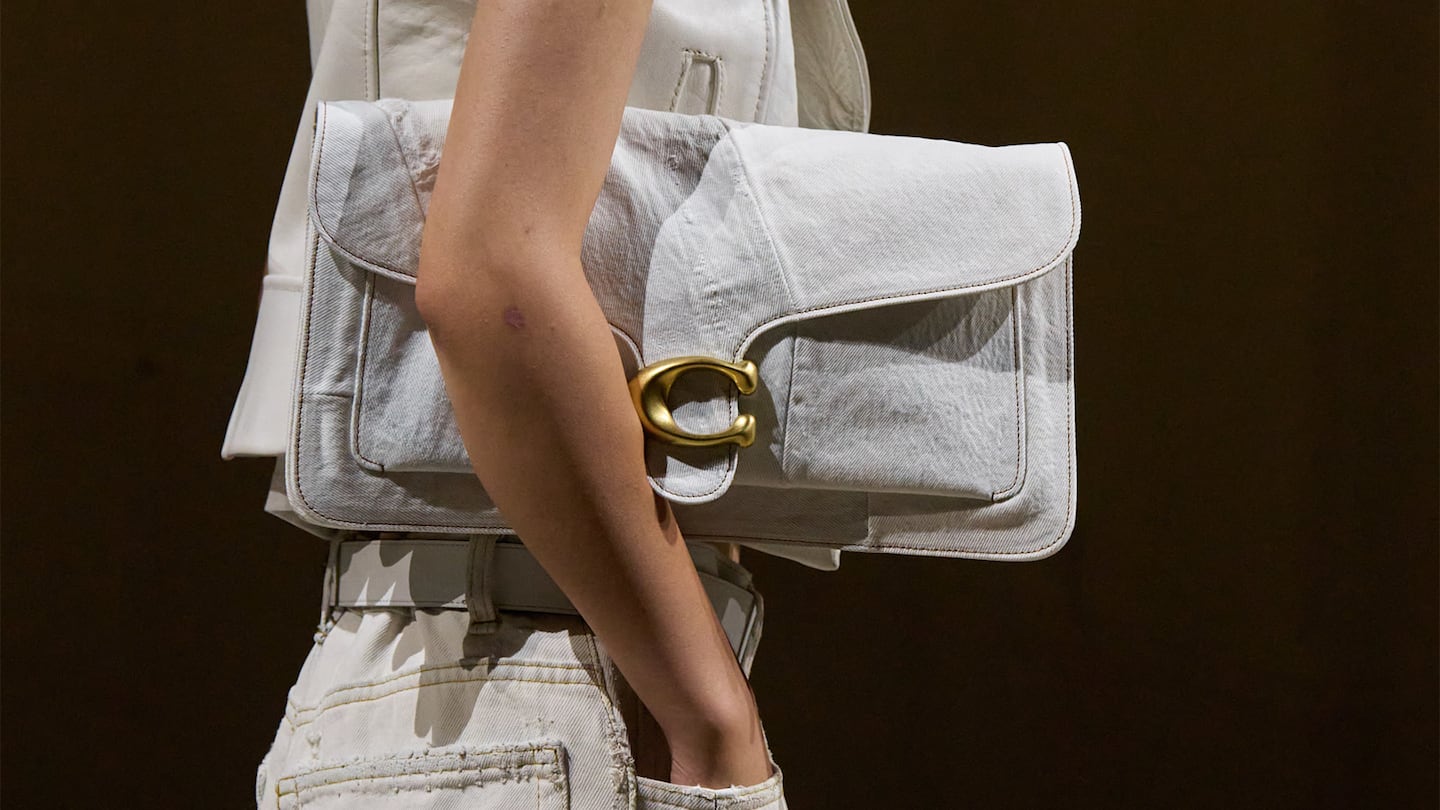
Gen Z may be “feeling Gucci,” but they’re buying Coach. Investors are too.
The gap between Coach owner Tapestry’s market capitalisation and that of Gucci parent Kering is at its narrowest in at least 15 years: On Thursday, investors valued Tapestry at $27 billion to Kering’s $36 billion, after the US group beat third quarter revenue estimates and raised annual guidance for the third time this year.
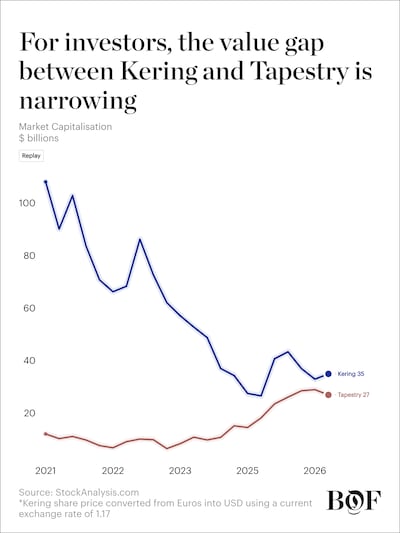
That markets would value the two companies this way would have been almost unthinkable five years ago when Kering, still riding high off Gucci’s success under designer Alessandro Michele and CEO Marco Bizzarri, was worth more than 10 times its US rival. As recently as 2024, Tapestry was valued at about one-third Kering.
Their current valuations reflect a shifting fashion market as well as the progression of their respective turnarounds. The past year has seen luxury’s pecking order shift in the eyes of investors amid a prolonged sector-wide sales slump.
ADVERTISEMENT
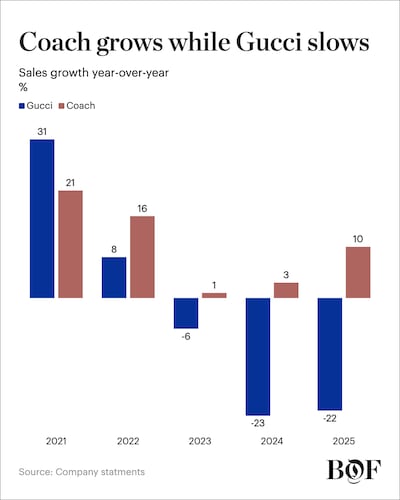
Kering has been hit hard. Sales at flagship Gucci, which accounts for around 40 percent of group revenue, have plummeted by more than 40 percent from their peak in 2022. And the brand’s latest turnaround effort under designer Demna and CEO Francesca Bellettini has yet to take off: sales fell 8 percent in the last quarter.
Over the same period, Tapestry’s flagship Coach has reaped the rewards of a successful turnaround that was years in the making: 2025 sales were up 14 percent versus 2022. In its latest quarter Coach sales surged 29 percent year-on-year.
Market capitalisation is a snapshot of investors’ outlook for a company, and a blunt one. Kering and Tapestry differ in structure, price point and priorities: the European luxury conglomerate owns over 10 brands, including some of the world’s best known luxury labels, like Gucci and Saint Laurent, while the American Tapestry has just two accessibly-priced brands, Coach and Kate Spade, after the sale of shoemaker Stuart Weitzman last year. And the closing gap between how investors value the two groups could be temporary. Signs of a Gucci rebound would likely provide a significant boost to Kering; the arrival of new CEO Luca de Meo in late 2025 was already enough to rally investor enthusiasm and lift shares.
Still, the closing valuation gap hints at where the momentum lies in today’s fashion market. Years into the luxury slump, which has seen aspirational shoppers in particular pull back sharply following price hikes and creative stagnation, many European players are recalibrating, investing in major designer revamps and rethinking their pricing mix. At the same time, many American labels with stronger value propositions — anchored in more palatable prices — are thriving as US shoppers prove most resilient amid wider macroeconomic pressures. (America’s leading luxury brand Ralph Lauren has notched 20 straight quarters of growth and the company’s annual revenue is now higher than Gucci’s).
“For years [the market was] driven by pinnacle European luxury and we looked up the hill at their valuation and said ‘wow, that would be nice,’” Scott Roe, chief financial officer and chief operating officer of Tapestry, told BoF this week, as the company reported earnings. “But what we started doing was playing a different playbook – our playbook.”
Between 2020 and 2023, luxury brands like Gucci raised prices 36 percent on average, according to Bernstein, often without corresponding product innovation or improvements to quality, turning off aspirational shoppers by the millions.
Gucci is now among brands suffering from a “misalignment between price and perceived quality,” Kering chief executive Luca de Meo acknowledged at the brand’s investor day in April.
Customers, squeezed by rising cost of living and exhausted by price hikes, have been trading down to lower-priced brands like Coach and Ralph Lauren.
ADVERTISEMENT
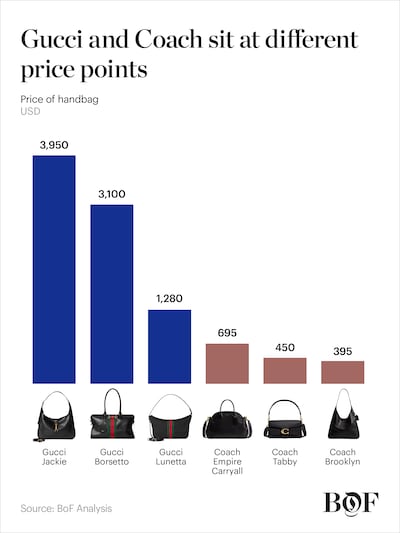
For young shoppers making their first handbag purchases, the prices are better suited: a Coach Brooklyn Bag (starting at $295 for the small) costs less than a Gucci logo ring ($430), among the least expensive pieces in Demna’s Primavera collection which dropped in March. Gucci only sells a few canvas pouches under $1000.
According to Roe, Coach continuously tests price elasticity to “make sure we’re not encroaching on that value perception.”
Though Coach is benefitting from shoppers trading down, the brand’s success is also in large part due to a well-executed, yearslong turnaround strategy after unwieldy distribution and discounting had led to Coach’s waning cachet in the 2010s.
Coach focused on Gen Z, namely 18-year-old shoppers moving from a backpack to a handbag, said Roe. Seeking to increase desirability, it offered affordable handbags like the Tabby shoulder bag priced at $450, while bolstering its fashion cred with irreverent, fashion-first marketing and partnerships with Lil Nas X, Emily Ratajkowski, Charli XCX, Bella Hadid, Charles Melton and the WNBA. Marketing spend has increased each year.
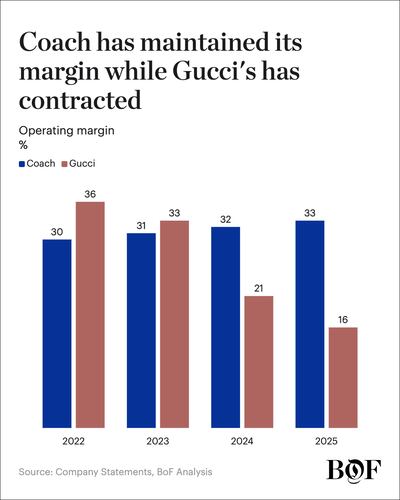
Beyond growing sales, Coach has expanded its margins and grown the average selling price of its products. Kering, meanwhile, has seen profitability decline.
“In contrast to their product, there is nothing ‘aspirational luxury’ about Coach’s margins. Coach margins are full-fledged luxury, sitting in rarified air with the best of their European cousins,” said Simeon Siegel, analyst at Guggenheim Partners.
Coach is also benefitting from high exposure to the high-margin category of handbags and leather goods that make up over 80 percent of sales. Around 50 percent of Gucci’s business is leather goods.
As Gucci reviews its pricing architecture and creative director Demna seeks to build on the renewed interest he has generated at the brand, Coach’s challenge will be to keep up the pace — while avoiding the ubiquity trap that ensnared it in the past or pushing too far on prices.
The American handbag brand is reaping the rewards of a years-long comeback plan. Keeping up the momentum is the next challenge.
The French conglomerate is reorganising key functions as part of a strategic overhaul unveiled by new CEO Luca de Meo in Florence Thursday.
This week, Dior tapped Jonathan Anderson to lead men’s fashion, Hermès briefly topped LVMH in terms of market share, and the ultra-wealthy solidified their status as the industry’s most effective driving force.

Joan Kennedy is Correspondent at The Business of Fashion. She is based in New York and covers beauty and marketing.
Loading recommended reads…
Sales of gems, precious metals and artwork at Japan’s department stores climbed 19 percent in the first half of 2026 from a year earlier to $2 billion.
Though Adidas dressed both teams in the World Cup finals, the global football tournament still presented some bright spots for Nike, writes Bloomberg’s Andrea Felsted.
From our archive, the creator and host of award-winning podcast “Articles of Interest” joins BoF founder, CEO and editor-in-chief Imran Amed to explore what clothing can reveal about identity, culture, labour and the world around us.
Saunders, the brand’s first creative director in five years and a skilled colourist, promises to give Kate Spade the clarity it has long lacked. Now, Tapestry must apply the same long-term brand-building discipline that fueled Coach’s success.