Agenda-setting intelligence, analysis and advice for the global fashion community.
Agenda-setting intelligence, analysis and advice for the global fashion community.

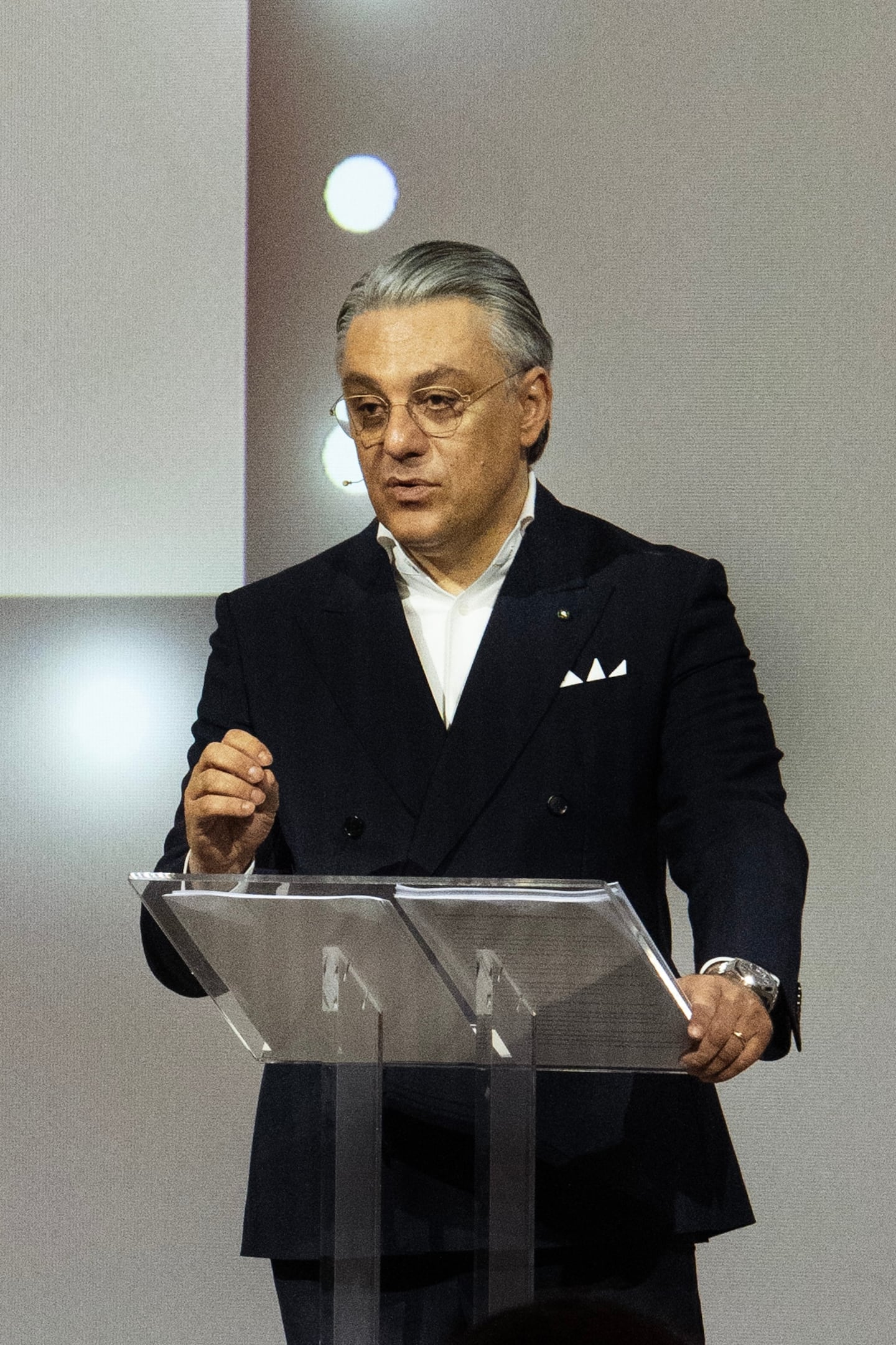
FLORENCE — Kering aims to more than double its operating margin, bringing profitability to over 22 percent mid-term. A return to outperforming the wider luxury market in terms of revenue growth will be “gradual,” the French group added in a statement ahead of a presentation to investors in Florence Thursday.
Shares opened down 6 percent, suggesting some investors had been hoping for a more bullish forecast.
Capital expenditure will remain stable at 5 to 6 percent of sales to “support sustainable organic growth of our houses,” with the group targeting a return on capital employed (ROCE) above 20 percent mid-term.
Kering’s new targets were announced as part of a broader strategic overhaul under chief executive Luca de Meo, who joined the group from carmaker Renault last September.
ADVERTISEMENT
Kering said it would improve “speed and efficiency” by regrouping key functions at the company level, seeking synergies in industry, client relations, technology, sustainability and support functions.
At the brand level, Kering said it will seek long-term growth by putting desirability first. “Desirability remains our north star, guiding every decision and helping us balance short term imperatives with long term ambition,” de Meo said.
Plans for Gucci are being closely monitored, as the label continues to account for around 40 percent of group sales and 60 percent of its operating profits.
Kering’s first-quarter revenues, announced Tuesday, were flat on an organic basis but missed estimates at Gucci, where sales fell 8 percent.
Kering said the priority for the brand is “reigniting desirability by refocusing the brand around what makes it unmistakably Gucci.”
“Gucci is not vanilla ice cream. It is spicy,” de Meo said. “The essence of the brand is to feel good, attractive, optimistic, upbeat. It’s a feeling, not just a logo.”
Gucci had previously made the mistake of trying to be everything to everyone, de Meo added. Now the focus is on pursuing, “fewer narratives, but ones that are sharper, stronger and more coherent.”
The brand has suffered in recent years from a “misalignment between price and perceived quality,” de Meo acknowledged. Under new CEO Francesca Bellettini, the brand is reviewing its price architecture as well as its industrial processes to improve both quality and speed to market.
ADVERTISEMENT
At Saint Laurent, management will focus on “magnifying what already makes the house iconic: strong fashion authority, clear codes and a highly desirable silhouette. The ambition is to broaden the brand’s expression across an expanded daywear wardrobe, a reinforced men’s offer and a more elevated leather goods proposition, while accelerating its geographic reach with a particular focus on Asia.”
Bottega Veneta will focus on “scaling its deeply distinctive vision of luxury, rooted in discretion, restraint and self-confidence, while preserving the house’s uncompromising essence.”
Balenciaga is “leveraging its unique fusion of couture mastery and cultural relevance to reinforce its role as an innovation engine and a key bridge to the next generation of luxury consumers.” The brand will focus on growing womenswear and leather goods after several years during which menswear outperformed. Balenciaga’s handbag sales are up 20 percent year-to-date thanks to surging demand for the Rodeo and relaunched City styles, de Meo said.
Tailoring brand Brioni will focus on its made-to-weasure business. Fresh targets were also set for Kering’s eyewear division (which has grown into a sizeable unit with revenues exceeding €1.5 billion) and its newly formed jewellery unit (intended as a pillar of more stable growth). Tableware brand Ginori 1735, formerly a subsidiary of Gucci, will now act as a “design-led incubator for lifestyle and experiential activities across the group’s brands.”
Kering pledged that 2026 would mark the end of its “reset” phase. All brands except McQueen — which is closing 50 percent of stores as part of a deep restructuring — will return to growth this year.
“Kering will have completed a structural reset, restoring financial discipline, operational efficiency and strategic clarity across the group,” the group said. By the end of 2028, “Kering will be in a phase of renewed, sustainable growth… This will translate into structural improvements in profitability and returns.”
Underperforming brands need to break even “within two years at the latest,” de Meo said, “or else I eject them from the system.”
Kering said its M&A strategy would be “highly selective” going forward, consisting of “bolt-on” acquisitions aimed at “strengthening craftsmanship, vertical integration and raw material security.”
ADVERTISEMENT
The group has pushed out its full acquisition of Valentino from Mayhoola to at least the end of 2028. “We’re preparing in a disciplined way for Valentino’s integration towards 2029 or 2030,” de Meo said. “Which could really complement our portfolio.”
Kering said it would take a stake in Icicle owner ICCF as part of a plan to support the international expansion of Shanghai-based ICCF’s flagship label Icicle while drawing on ICCF’s expertise in the critical China market.
Loading recommended reads…
Gourmet grocers have become an unlikely marketing partner for fashion and beauty brands looking to deliver novelty and experience in a crowded marketing landscape. BoF marketing correspondent Haley Crawford joins Sheena Butler-Young to unpack what’s driving the trend — and where it risks becoming just another photo op.
$50 bone broth and $20 smoothies have made the likes of Erewhon and Happier Grocery status symbols and buzzy marketing channels for fashion and beauty brands aiming to engage affluent shoppers on their local turf.
Models Alton Mason and Adot Gak, designers Robert Wun, Edeline Lee, Saul Nash, Sinéad O’Dwyer and Patrick McDowell, and Alighieri founder Rosh Mahtani joined BoF and Aldar to celebrate London Fashion Week and the city’s creative community.
James herself and her organisation, the Fifteen Percent Pledge, are the subject of a lawsuit from a Brooklyn-based creative agency alleging $1 million worth of missed payments for production on the nonprofit’s 2026 gala.