Agenda-setting intelligence, analysis and advice for the global fashion community.
Agenda-setting intelligence, analysis and advice for the global fashion community.

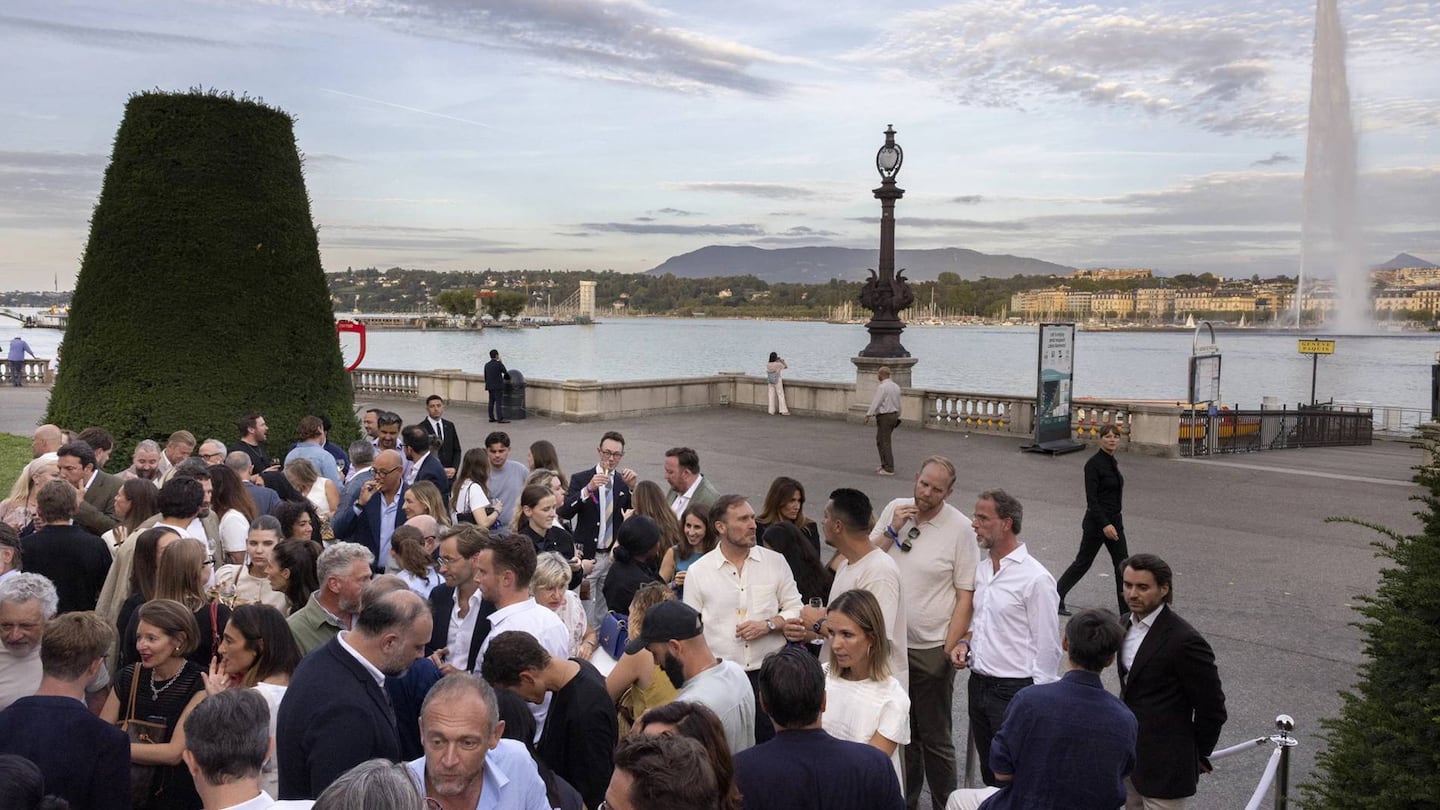
GENEVA — Swiss watch industry leaders are warning that a decade of declining volumes is finally catching up with the sector and that the state-run short-working hours compensation scheme used to protect jobs has run its course.
“Decline in volumes is not good,” said Bulgari board chairman Jean-Christophe Babin, speaking at Geneva Watch Days last week, one of the industry’s largest annual gatherings. The industry veteran is also president of the event.
The topic dominated discussions. Last year, Switzerland exported 14.6 million watches, down from 28.6 million in 2014, according to the Federation of the Swiss Watch Industry. “Volumes make the difference between bankruptcy and success,” Babin added.
The pain is being felt most by a network of largely invisible suppliers who manufacture the precision components used by Swiss watch companies to make their watches. While some large-scale brands such as Rolex have invested heavily in verticalising production, most rely on third-party specialists for parts. The fear is that if suppliers fail, brands could follow.
ADVERTISEMENT
Babin said brands need to act to protect suppliers by bulking up production volumes. “It is our responsibility to relaunch the volumes, because what the suppliers need is not the value, it’s volumes,” he said. “Margins are much lower for suppliers than brands so if a supplier loses volumes, they’re dead. To restart a brand is possible, as long as there are suppliers. To restart a supplier, it’s impossible.”
There have been some signs of a rebound. Richemont reported watch division growth of 8 percent in its last quarter, and in July, the FHS recorded monthly Swiss watch exports were up, bucking the annual trend.
But behind the headline figure the picture appears increasingly polarised. Demand for watches priced above 50,000 Swiss francs is up, while the core segment where watches retail for between 2,500 to 50,000 Swiss francs is receding, with only Rolex and Cartier performing well in this segment. Analysis released in August by the Swiss consultancy LuxeConsult indicated that 75 per cent of the industry’s value growth was attributable to just 1.3 per cent of its volumes.
Few are forecasting volumes will recover. However in Geneva last week, a private-equity backed group behind the watchmaker Breitling reintroduced Gallet, an old dial name that has been defunct since the early 1980s – with plans for higher volumes. The entry-level brand’s owners expect it to sell upwards of 10,000 watches a year within a year or two, with vintage-style pieces that start from $2,900.
“The problem is psychological,” said Georges Kern, chief executive of House of Brands, which brings Gallet together with Breitling and Universal Genève. “You have many people who don’t buy because they’re not in a buying mood. So you need to give people something new and they have to be in a positive state of mind to spend their money. But the money is there.”
One seasoned executive said the industry was in the middle of a transformation that was already seeing it become “more elitist” and “more intellectual.”
“There’s an existential discussion to be had, but there’s not an easy answer,” said Antoine Pin, who left TAG Heuer earlier this year and in July was named chief executive of De Bethune, which makes around 400 high-value watches a year.
“There is a refocus on the essence of luxury,” he continued. “Where I see the recovery is in the ignition of concepts by the independents, and not by big brands stuck in a heavy structure. The revival will be about crafts, art and creativity.”
ADVERTISEMENT
Pin’s assessment drew on the mix of 71 brands exhibiting at Geneva Watch Days. With the exception of Bulgari and Breitling, only a handful make more than a few hundred watches a year. Instead, most were artisanal makers targeting collectors with high-value pieces.
The market is becoming swollen with small players, Pin continued. “There are probably too many brands,” he cautioned. “If the proposal is sexy enough, there is always money, but you have to be very careful that when you make a very expensive piece, the price remains super justified.”
Another Geneva exhibitor said he had no plans to increase volumes. “We’re not about volumes,” said Federico Ziviani, chief executive of the luxury watchmaker Gerald Charles. “For us, watchmaking sits in the space between art, cars and jewellery. This is what collectors want.”
Wealthy buyers still appear ready to spend. “In the first seven months of this year, we sold three times more grandes complications for close to three times the value, compared to last year,” said Marc Michel-Amadry, chief executive of the historic watchmaker Girard-Perregaux, which was also exhibiting in Geneva last week. At the event, his company introduced a watch with a steel case, an enamel dial and an automatic tourbillon movement with a $100,000 price tag.
But Michel-Amadry added that while his high-end watches were selling, he had no plans to expand volumes either. Instead, he decided to cap annual production to 6,000 watches a year. “I’m pretty pessimistic about our ability to maintain volumes in the industry,” he said. He pointed to the rise in Chinese appetite for cheaper luxury products produced in China, such as cars, as another long-term threat to Swiss watchmakers.
With volumes shrinking, some brands and suppliers have fallen back on a state-run short-time working compensation scheme called RHT (“Réduction de l’horaire de travail”) in a bid to protect jobs and conserve skills. Speaking at a press conference to open the Geneva event, Delphine Bachmann, head of the Canton of Geneva’s department of economy and employment, said her department had observed “a little bit more” of an uptake in RHT over the summer, particularly among those third-party suppliers.
But patience is running short. Some executives grumbled that it was hard to fulfil watch orders because staff at component suppliers had opted for the scheme – and weren’t working.
RHT was extended to two years – normally, it’s meant to last up to 12 months – to help the Swiss manufacturing sector ride out the economic storm. Bachmann suggested the extension had now served its purpose. “We are at the end of the cycle and I’m not sure that extending the end date for another six months is going to save jobs concerned by RHT today,” she said. The extension is due to expire in January.
ADVERTISEMENT
Volumes are also compromised by growth in the pre-owned watch market. “The reality for Rolex, Omega, TAG Heuer and Breitling is that their main competitor is the secondary market,” said Pin, who suggested the industry should view primary and secondary watch sales as a single market. “But nobody looks at this, because if you do, you have to stop producing yourself – but your model is based on production capacity.”
Three years ago Rolex moved into the pre-owned market. According to analysis by Morgan Stanley and WatchCharts, in the second quarter of this year, Rolex CPO posted record sales of $186 million, accounting for around 9 per cent of all secondary market Rolex transactions. As a privately held company, Rolex doesn’t communicate annual production figures, but Morgan Stanley estimates they’ve fallen from 1.25 million to 1.15 million units over the same period.
But Pin, who is also a former head of Bulgari’s watch division, said the challenge for most brands seeking to move into the secondary market is the cost. Authentication, refurbishment and aftersales costs add up. “When you are public, who is going to give you time to make the changes?” he asked.
Audemars Piguet, a family-owned company, is expected to introduce a certified pre-owned scheme later this year, but Patek Philippe is among a majority that has so far ruled out entering the market.
Babin said brands have to figure out what shoppers want, and fast. “We have to work hard to bring to the market people who can afford our watches,” he said. “And not only collectors and clients who like to buy a new watch every year.”
Despite talk of crisis, few brands have yet closed their doors. “For the past 10 to 15 years, we’ve been asking ourselves who will disappear among all the brands in the watchmaking landscape,” said Michel-Amadry. “And yet still new brands, still brands spending.”
Kern said it will be survival of the fittest. “This is a level we have to get used to,” he said of the industry’s current performance. “It’s not a bad level, it’s a good level. Companies have to adjust capacities, and then you have to take market share.”
Loading recommended reads…
Brands such as J.Crew, Tuckernuck, and Pacsun are collaborating with sports labels and organisations to create products for women that look more like fashion than your standard sports merchandise with a team logo.
Global environmental non-profit The Nature Conservancy has launched a new industry coalition to help apparel companies tackle microfibre pollution across their supply chains.
Fenty Beauty’s first 12-hour online shopping event, featuring Rihanna, shows how a new generation of brands are embracing the practised art of live selling.
The policy bars ads from ByteDance, which remains in charge of key parts of TikTok, and extends to third-party advertisers running campaigns that link to TikTok.