Agenda-setting intelligence, analysis and advice for the global fashion community.
Agenda-setting intelligence, analysis and advice for the global fashion community.

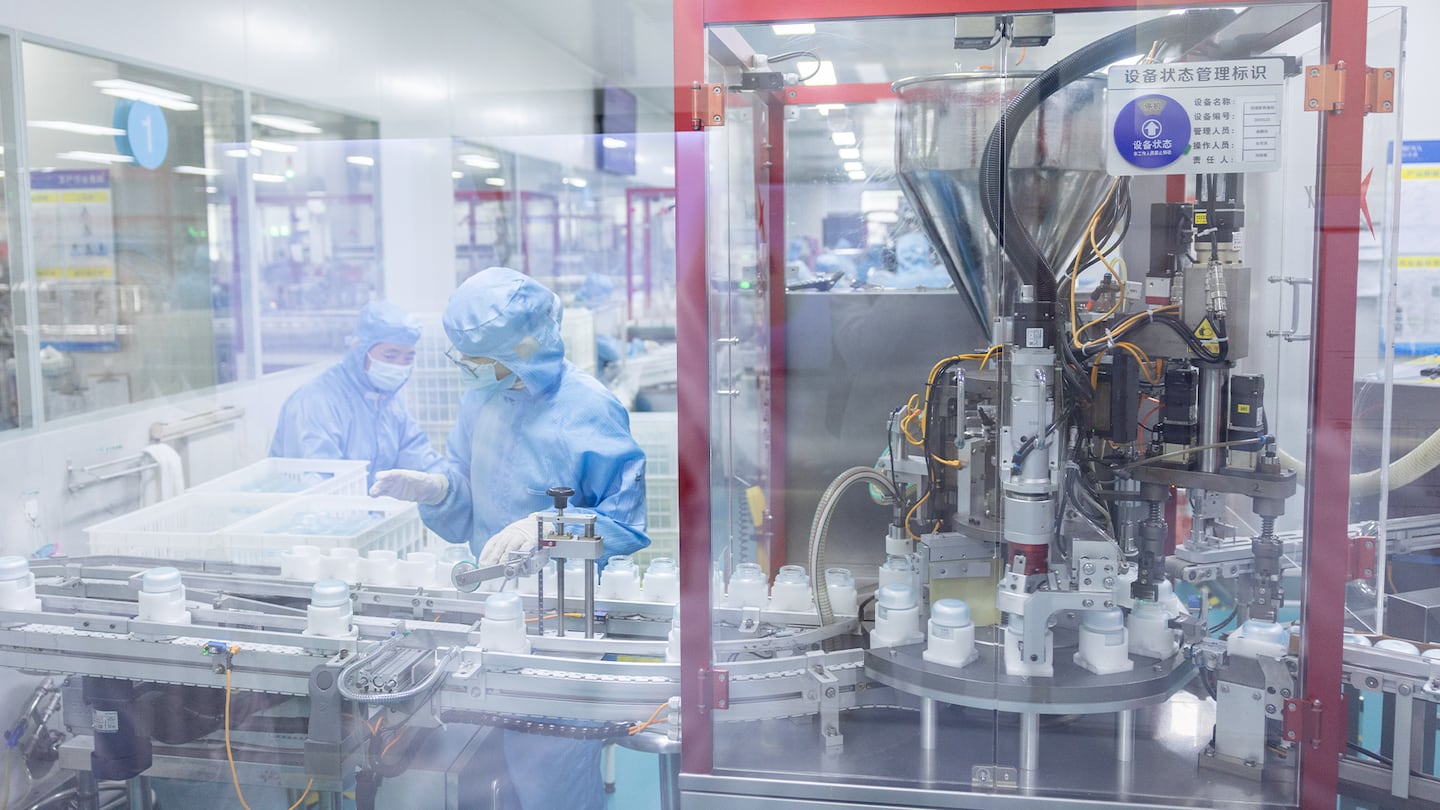
CHINA - Shortly before China’s Singles’ Day shopping festival last fall, beauty company Yatsen Holding Ltd. launched a new serum featuring PDRN, one of skincare’s hottest regenerative ingredients.
What shoppers didn’t see was how quickly it reached shelves. Yatsen used artificial intelligence to compress a development cycle that typically takes more than two years into just six months, including helping researchers narrow more than 50 ingredient candidates to three in a single week.
AI is rapidly reshaping China’s beauty industry by shrinking every stage of product development. Local companies are using it to sift through millions of social media posts for emerging trends, discover new cosmetic ingredients with biotechnology partners and bring products to market in months, rather than years.
As growth slows in the world’s second-largest beauty market, domestic brands are turning to AI to close the innovation gap with global rivals. Mainland companies account for 57 percent of China’s cosmetics sales, according to the China Association of Fragrance Flavour and Cosmetic Industries, but still trail foreign brands in the premium segment.
ADVERTISEMENT
“Western brands currently bring more AI horsepower to discovery and validation,” said Adam Knight, co-founder of YASO, a platform helping Western beauty brands enter China. “Chinese brands bring more speed from lab to shelf.”
China’s uniquely digital consumer market is accelerating that transformation. Livestreams, e-commerce platforms and social media generate a constant stream of consumer data, allowing brands to quickly identify emerging demand and rapidly feed those insights into product development. One of the most prominent is colour cosmetics brand Florasis, which uses AI to analyse customer interactions and online reviews after each of its livestream broadcasts to refine marketing and product development.
The race to innovate comes as China’s beauty boom loses momentum. After years of rapid expansion driven by discounting and online shopping, local brands are under pressure to find new ways to differentiate themselves. Its largest beauty company Proya Cosmetics Co. reported its first annual revenue decline since 2016 last year, while Yatsen remained unprofitable despite narrowing losses. Cosmetics transaction value across China rose just 2.8 percent in 2025, according to the cosmetics industry association.
Chinese shoppers are increasingly seeking scientifically-backed formulations featuring novel ingredients that promise brighter skin, fewer wrinkles and other measurable results. Ingredients have become one of the biggest purchase drivers: About 35 percent of Chinese consumers research cosmetic ingredients before buying beauty and personal care products, according to market research firm Mintel Group Ltd. — a higher proportion than in the US or UK.
“Chinese consumers now compare cosmetics against Botox, GLP-1s, and cosmetic surgery, demanding clinical proof of results,” said Cheng Jing, Yatsen’s chief scientific officer.
At Proya, AI-enabled molecular screening has uncovered dozens of promising hair-loss prevention ingredient candidates for laboratory testing, cutting the screening process to as little as a hundredth of the time required by conventional methods.
The Hangzhou-based company is increasingly using AI to discover and screen new active ingredients, and plans to introduce AI-identified peptides into its flagship skin-care product. AI is helping optimise formulations by predicting how ingredients work together before products enter the lab, said Chief Research & Development and Innovation Officer Sun Peiwen.
Many beauty companies are finding they can’t build these AI capabilities alone. Instead, they’re increasingly partnering with Chinese biotechnology startups that combine the technology with synthetic biology to discover and manufacture cosmetic ingredients faster — and cheaper.
ADVERTISEMENT
L’Oréal-backed Beijing company Veminsyn uses AI to identify promising cosmetic ingredients, predict how they’ll perform and optimise them before laboratory testing begins.
In the past, “you would need to screen a million candidates to find one ingredient,” said co-founder and chief scientist Ray Chen. “The time and cost means it was impractical.”
The company says it supplies more than 350 domestic and international beauty brands, including Proya and L’Oréal. Using AI, Veminsyn narrowed more than one million collagen fragments to seven promising candidates in about two months before commercialising three ingredients that are now among its best sellers, Chen said.
Hangzhou-based Bota Biosciences similarly begins projects by querying an internal AI platform that analyses DNA sequences, predicts ingredient properties, ranks candidates and proposes experiments, which are then validated in automated labs using AI-generated protocols. Its facilities run up to 1.5 million strain experiments a year, with the data then fed back into AI models for further iteration.
Chief Executive Officer Cheryl Cui estimates AI can cut the cost of developing a new cosmetic ingredient from tens of millions of dollars to just a few million. Scientific reports that once took researchers weeks to compile can now be generated in minutes.
“China has a major advantage in the cost-efficiency of data generation,” she said.
In one example, a lab grown human elastin used to firm skin took about a year to go from target to production, compared with three to five years using conventional methods. The elastin is now used in a Proya serum, and Bota is working with the company on new ingredients and data collection for future products.
The faster pace of innovation has been aided by regulation. China overhauled its cosmetics ingredient approval system in 2021, replacing years-long reviews with a filing process that takes days. Since then, about 500 new cosmetic ingredients have been filed in China, with domestic companies accounting for the majority, according to regulatory data tracker CIRS Group. Just 14 ingredients were approved between 2004 and 2021.
ADVERTISEMENT
Still, whether China’s AI-generated ingredients can produce globally recognisable blockbuster brands remains an open question. So far, mainland brands have yet to produce the kind of globally viral ingredients and beauty trends that have made cosmetics from neighboring Japan and South Korea popular well beyond Asia.
Global cosmetics rivals are also doubling down on AI, with decades of data to build on. L’Oréal has partnered with IBM to develop an AI model for beauty formulation and with Nvidia Corp. to simulate ingredient performance. Estée Lauder Cos. has teamed up with Microsoft Corp. on marketing research and trend forecasting, while Unilever Plc has launched AI-assisted skin and haircare products under labels including Pond’s and Dove.
“The market is no longer growing the way it was,” said YASO’s Knight. “So growth now comes from taking share in an intensely competitive field, and AI-driven speed is how you take it.”
By Bloomberg News
Sign up to The Business of Beauty newsletter, your complimentary, must-read source for the day’s most important beauty and wellness news and analysis.
Skin boosters made from donated human tissue are booming at clinics across South Korea as patients seek new treatments to restore facial volume.
As consumers seek better performance from their skincare formulas, and biotech firms produce next generation ingredients faster than ever, brands have to invest at lightning speed — or risk getting left behind.
RedNote’s 350 million users have helped make it a powerful force in China’s beauty market. Here’s how to stand out.
Loading recommended reads…
This week’s round-up of global markets fashion business news also features Qatar’s resilient jewellery market, South Korean e-tailer W Concept and Brazil’s newest department store.
Shares in the Tata Group-owned business rose nearly 11 percent on Tuesday as the success of a rapid store expansion project boosted confidence in the company’s growth outlook.
Last month, The Business of Beauty and Front Row gathered beauty executives and investors in New York to discuss how content, the evolving channel mix, brand consistency and AI search are reshaping the path to purchase.
A Charli XCX cover, a Sofia Coppola documentary, a guest appearance on Broadway… America’s star designer is still all over pop culture as he opens a new chapter for his namesake label under new owners WHP and G-III after decades at LVMH. Can lightning strike twice?