Agenda-setting intelligence, analysis and advice for the global fashion community.
Agenda-setting intelligence, analysis and advice for the global fashion community.

During a call with analysts and investors in April, the chief executive of the world’s biggest beauty company wondered how fast giants can move.
“You have to have agility…being big is not always compatible with being agile,” said Nicolas Hieronimus, CEO of L’Oréal.
It’s a prescient observation. Big firms dominate the beauty industry — in 2025, only five companies (L’Oréal, The Estée Lauder Companies, Beiersdorf and P&G and Unilever’s beauty arms) generated more than $10 billion in revenue. These companies get bigger rapidly as they acquire upstart brands or mull consolidation. But in a cooling climate, they find themselves working harder than ever not only to compete with indies on mindshare and virality but to outpace their own previous successes.
“The innovation and speed of response is so quick now,” said Filippo Falorni, a managing director at Citi’s consumer investment bank. “Brands need to be a lot faster.”
ADVERTISEMENT
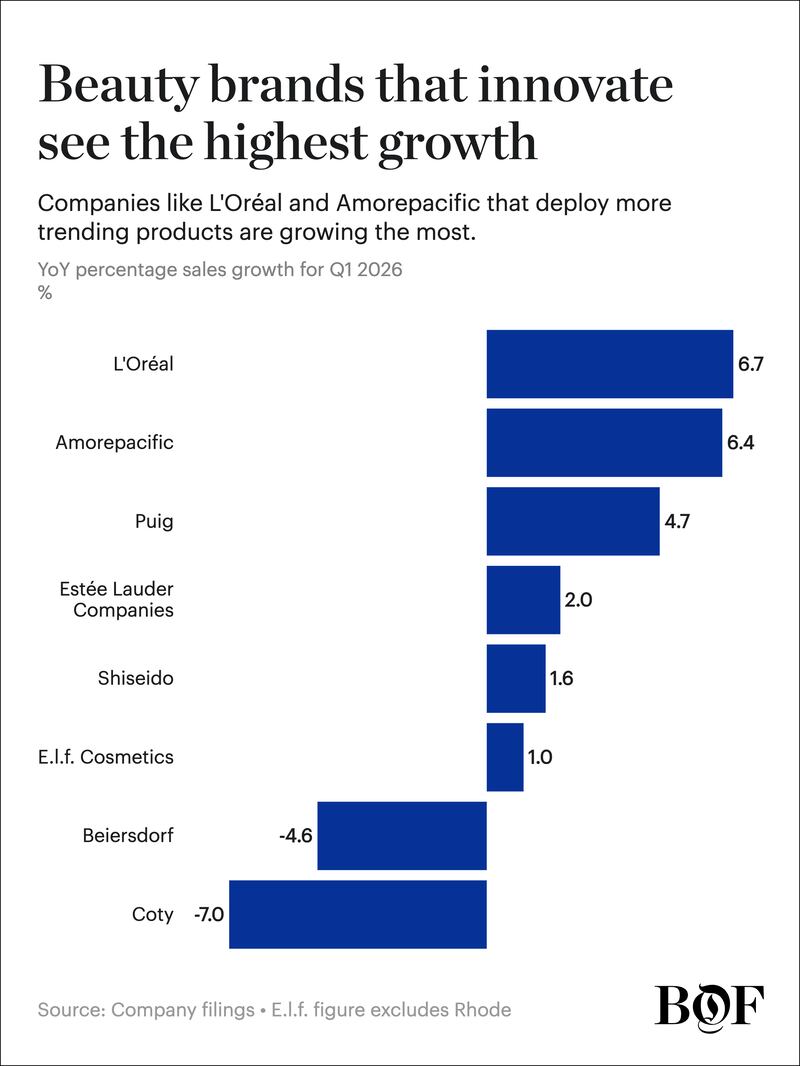
In this most recent earnings season, agility and innovation set the winners apart from the losers. L’Oréal sales rose 6.7 percent, Puig grew 4.7 percent and the strength of skincare line Rhode led E.l.f. Beauty to 35 percent growth. But others, like Beiersdorf and Coty, saw sales slide, while E.l.f. Beauty’s core brand sales cooled. While the war in the Middle East has caused upsets for almost every firm as raw goods spike in price and customers curb spending, dynamism is still strong and demand for beauty is resilient.
But conglomerates are fighting to eke out growth in a saturated market, and contending with splintering across channels and bifurcation in spending habits. Wealthier shoppers, especially in the US, continue to spend freely, while lower-income customers are tightening their purse strings dramatically. At E.l.f. Beauty, its core line of mass makeup was flat, with chief executive Tarang Amin telling analysts on a call on Wednesday that there was “a pretty big fall off on units” after it nudged up prices in 2025.
Conglomerates are moving quickly to regain ground. Estée Lauder increased its planned job cuts from 5,800 to 7,000 to around 10,000 as it divests further from department stores; Shiseido announced the closure of a Taiwan plant as it pulls manufacturing back to Japan, while Coty said it will put new emphasis on top-performing, non-speciality channels like Amazon and Walmart. But all firms made product innovation a cornerstone of their prepared remarks, and the goal posts will keep moving.
“Beauty is dynamic,” said Jeremy Fialko, senior global consumer staples analyst at HSBC. “The reason for the dynamism is the innovation and new content. The more that’s produced, the more demand it creates.”
Customers’ growing value sensitivity is putting pressure on brands to make their products feel more worth it than ever.
For some mass brands, this creates extra pressure. Many, like Nivea and E.l.f. Cosmetics have increased their prices in recent years to offset the impacts of tariffs or to support more premium claims. Now, both brands’ growth has cooled: Nivea declined 7 percent, while E.l.f.’s core business only grew 1 percent, following a 2 percent increase in the previous quarter. Coty’s mass cosmetics division, which includes brands like Sally Hansen and Covergirl, had another muted quarter, slowing 10 percent.
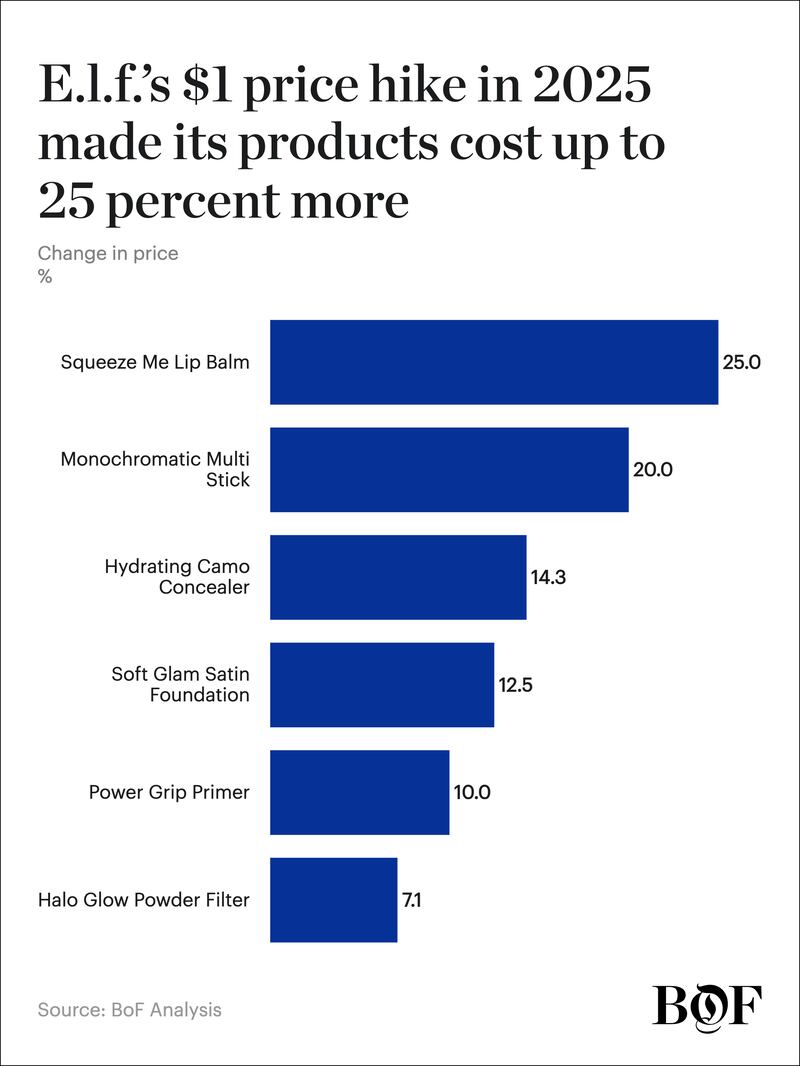
While E.l.f. Cosmetics’ increases were as low as $1, and it remains markedly cheaper than peers, even a small price increase closes the gap between its products and premium lines, said Falorni. A $1 price increase could represent a price tag being as much as 25 percent higher than before. On Thursday, Amin confirmed the brand will look to selectively lower some prices: a trial decrease in the price of its Halo Glow Skin Tint from $18 to $14 saw a 36 percent sales bump lift across all retailers.
“If you’re lower income, it hurts,” said Falorni. “[The innovation] has been a little bit underwhelming… They are doing a lot, but there’s also more competition, and it’s harder to get those really home runs on innovation.”
ADVERTISEMENT
“Doing a lot” doesn’t necessarily mean winning customers. At Nivea, Fialko said some of the decline is owed to excessive emphasis on “big bang” innovations like an anti-ageing serum at the expense of maintaining focus on core products like moisturising creams and lip balms. When the new items didn’t resonate as much as hoped, it was doubly exposed.
Brands that continue to deliver trending new products or lower-priced, competitive alternatives to premium options are still winning: L’Oréal Paris’ viral $12.99 double-tipped brow pen and $14.99 setting spray as well as on-trend launches from Nyx and Maybelline helped lift the overall mass unit up 4.1 percent for L’Oréal, while science-led launches from Estée Lauder-owned The Ordinary like its Growth Factor and Volufiline serums, both under $22, were called out as top performers.
“In this industry, you can’t hope for [products] to take care of themselves. Everything needs a lot of attention and constant marketing,” said Fialko.
As world economies shift, companies are looking to rebalance their global footprints.
“More conceptually, we’re revisiting what’s going to be sexy in terms of global growth opportunities,” said Oliver Chen, a managing director at investment bank TD Cowen. Companies are placing a new focus on emerging markets like Latin America and India, but also modernising their presence in China, still the world’s second-largest market.
In the most recent quarter, China showed positive signs — retail sales edged up 2.8 percent, slightly above expectations, and Estée Lauder, Puig and Coty grew their Asia-Pacific businesses 6, 26.1 and 5 percent respectively.
There’s also fresh opportunities for global premium brands in the Chinese market, as local customers seem to have had their interest in Western labels reactivated. Fialko said that the prestige tier has begun to recapture market share from the mass tier in late 2025 and early 2026, benefiting global names like La Mer and Lancôme. Western brands are also enjoying greater share of voice on Douyin, the Chinese version of TikTok, as local companies slightly pull back their marketing spend due to its unpredictable return on investment. Travel retail in the Asia-Pacific region, a long-term drag on revenues, has likely now bottomed out, said Fialko.
But blockbuster growth is still off the table. Amorepacific’s Chinese business declined 13.5 percent, which it chalked up to changes in its distribution structure as it withdraws from some local department stores, while APR, the Korean owner of brands like Medicube, saw just 5 percent of its growth come from China, compared to 11 percent in 2025.
ADVERTISEMENT
Korean players like Amorepacific and APR have a bigger map to play: according to market data firm Circana, in the US, prestige K-beauty sales increased 24 percent in the first quarter of 2026. Other companies like Estée Lauder and L’Oréal have put their focus on Latin America, Southeast Asia and India to help rebalance their global growth opportunities. Estée Lauder CEO Stéphane de La Faverie said Korea and Japan are particularly buoyant markets.
But none are buoyant enough to make China a lower priority.
“Companies are trying to diversify, but [China] is so big and the growth potential is so high…” said Falorni. “China is the new China.”
The dominance of speciality retail and e-commerce has ossified into an entirely new “omnichannel” way of doing business for beauty companies.
The Estée Lauder Companies’ aggressive withdrawal from department stores and pivot to Sephora and Amazon; Amorepacific’s decision to close some doors in China; Coty shifting to more lucrative channels like Walmart and Amazon for its mass brands; L’Oréal and E.l.f Beauty’s continued gains on TikTok Shop, which the latter claims has a halo effect for its other channels: All these changes show conglomerates trying to catch customers’ dollars wherever they may be spent.
All come with their own challenges. Speciality stores like Sephora and Space NK are costly and competitive to enter; any on-site advertising on Amazon is usually subtracted from gross revenue; TikTok Shop is not yet proven at selling a range of products rather than a viral SKU, or even full-priced premium products.
These changes require global companies to consistently reevaluate their channel strategy, and adjust their expectations and focus as platforms evolve. Fialko noted that changes to channel mix can cause short-term pain as closing doors or adjusting shipments can drag down revenues and increase excess inventory, but not moving quickly enough will leave brands in the dust. “You’ve got to bite the bullet,” he said.
On the call with analysts, Hieronimus said customers still use beauty as “compensation for stressful climates and a psychological buffer.”
That mechanism is still true. But driving growth comes back to product innovation and performance, which can entice shoppers to spend that little bit more.
“It can turn that $50 they planned to spend to $55 or $60,” said Fialko.
Sign up to The Business of Beauty newsletter, your complimentary, must-read source for the day’s most important beauty and wellness news and analysis.
This week, Priya Rao goes into it all: apolitical beauty brands, Armani sale rumours, Skky Partners’ undoing and more.
In an age of content oversaturation, brands are spending more to make their events and environments stand out — even if these moments are more fleeting than ever.
Beauty lines rarely struggle to generate buzz when they launch. A famous face, a splashy marketing stunt and a single viral product can generate headlines and fast revenue. This success is often fleeting. This case study explores how to create, scale and execute an enduring, future-proofed beauty label.

Daniela Morosini is Senior Beauty Correspondent and Special Projects Editor at The Business of Beauty at BoF. She covers the global beauty industry, with an interest in how companies go to market and overcome hurdles.
Loading recommended reads…
Satoshi Kondo and Sarah Burton show us why they’re BoF 500 cover stars.
After nearly three decades under LVMH, the designer is opening a new chapter at his namesake label with new owners and no guarantees. Ahead of an in-depth BoF 500 cover story by Eric Wilson out next week, Jacobs joins Imran Amed on The BoF Podcast to reflect on the fashion slump and what comes next.
A growing Dutch outcry over the glasses mirrors a broader backlash against smart glasses equipped with cameras.
The ultra-fast-fashion giant’s share price sank to a record low after it released its first results as a public company earlier this week. With sales growth under pressure, the company must find a way to stand out in a hyper-competitive market.