Agenda-setting intelligence, analysis and advice for the global fashion community.
Agenda-setting intelligence, analysis and advice for the global fashion community.



What's up, down and making news this week in the fashion and beauty businesses.
After four years of false starts, regulatory hurdles and aborted listing plans in the US and London, Shein is finally on the cusp of going public after receiving regulatory approval from Chinese authorities this week for a Hong Kong listing that could take place as early as next month. Now the company faces a different problem: convincing investors it deserves a blockbuster valuation.
According to Reuters, the fast-fashion giant is seeking a valuation between $40 billion and $50 billion for its Hong Kong IPO. That’s equivalent to what Shein generated in sales last year. If achieved, a $40 billion market capitalisation would represent a steep markdown from the roughly $100 billion valuation it earned in a 2022 funding round and the $66 billion valuation it received the following year.
Investors are placing a lower value on a company whose once-meteoric growth has begun to cool. According to data analysed by Bloomberg, Shein web traffic growth decelerated from 60 percent year-on-year in the second half of 2025 to single-digit growth this past June. App downloads and credit card transactions in the US have also fallen, according to the report.
Some of that slowdown reflects broader pressures across e-commerce and a difficult consumer environment overall. Shein competitor Temu and Amazon have seen slowing engagement as well.
ADVERTISEMENT
But for Shein, regulatory pressure from Europe, which accounts for a third of its sales, represents another obstacle. Earlier this month, the European Union introduced a €3 fee on low-value e-commerce imports under each customs declaration, increasing costs for retailers that rely on shipping inexpensive goods directly from China. The move follows similar pressure from in the US, where the Trump administration ended the de minimis exemption for low-value parcels, forcing Shein to absorb or pass on the higher costs. The European policy poses a greater sales risk, however, because shoppers in these markets have proven to be more price-conscious than their American counterparts.
Nonetheless, Shein remains a lucrative business. The company generated nearly $2 billion in net profit last year, according to Reuters, citing people familiar with its financials. But as it’s headed to the public markets, investors today will question whether Shein’s best days of expansion are behind it. One thing is clear: Shein is no longer the hyper growth darling it once was.
Who’s up and down in the business of fashion, luxury and beauty this week.
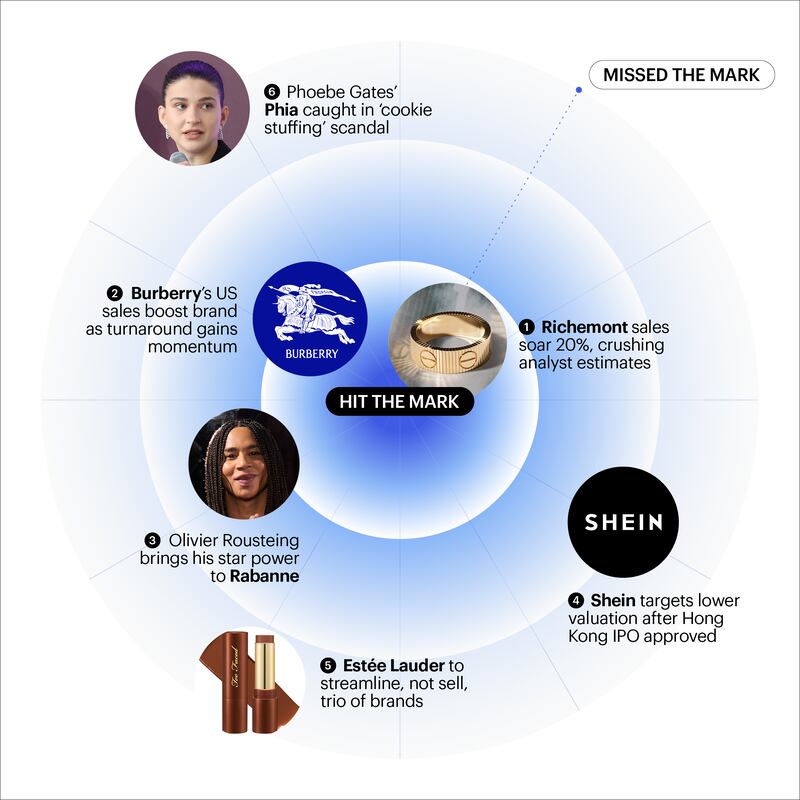
1. Richemont grew sales by 20 percent last quarter on the back of soaring demand for Cartier and Van Cleef & Arpels, smashing analyst expectations and setting a high bar for luxury rivals.
2. Burberry sales jumped 12 percent in the Americas in the latest quarter after the British stalwart completed the first stage of its long-awaited turnaround.
3. Puig-owned Rabanne is betting on former Balmain designer Olivier Rousteing’s star power to re-energise its fashion offering, creating a brand halo for its much larger beauty division.
4. Estée Lauder Companies will keep but significantly streamline Too Faced, Smashbox and Dr. Jart after exploring a sale process for the trio of brands.
5. Shein is targeting a $40 billion to $50 billion valuation in a long-awaited Hong Kong listing, significantly down from a peak valuation of $100 billion in 2022.
ADVERTISEMENT
6. Phoebe Gates’ buzzy AI-powered price comparison startup Phia was caught using “cookie stuffing,” a fraudulent affiliate marketing tactic, to claim credit for sales it didn’t earn.
Catch up on all the news of the week in fashion, luxury and beauty here.
Loading recommended reads…
The media entrepreneur joins Imran Amed on The BoF Podcast to discuss what it takes to earn readers' trust, and what fashion is missing about the people it most wants to reach.
The ‘sneaker-of-the-year’ conversation has traditionally revolved around models that meet what most people consider a typical sneaker. In 2026, that conversation is shaping up differently.
At New York Climate Week, fashion again pledged to turn its talk into action, with the launch of a new coalition bringing together dozens of brands, manufacturers, retailers and innovators. Real reductions of the industry’s impact, meanwhile, remain elusive.
The veteran makeup artist, who has worked alongside Matthieu Blazy since his debut in 2025, will ‘bring a new perspective, reinforcing the vitality of Chanel Makeup,’ the company said.