Milan’s most promising upstarts are emphasising custom orders, embracing cross-cultural dialogue and adopting a high-tech angle on ‘Made in Italy.’ Plus, Lanvin’s new CEO, Gucci’s F1 deal and Ferrari’s EV launch debacle.
Subscribe to High Margin by Robert Williams: perspectives on creativity and business in the world of luxury.
Hello from sweltering, sticky Milano, where a general strike is throwing plans for the Festa della Repubblica holiday weekend into disarray. I trust you’ll make it to Capri or Cortina somehow.
Crossing fingers that my flight to Paris will manage to slip past the picket line. I’m on my way back from yesterday’s jury for the Camera Moda Fashion Trust, where I was honoured to help allocate this year’s young designers grants.
In this edition:
ADVERTISEMENT
This week’s news: Lanvin’s new CEO, Gucci’s Formula 1 deal, Ferrari’s EV backlash.
The main course: How Italian fashion start-ups are reimagining the path to success.
Lanvin’s New Chief
(Lanvin; Spotlight/Launchmetrics.com)
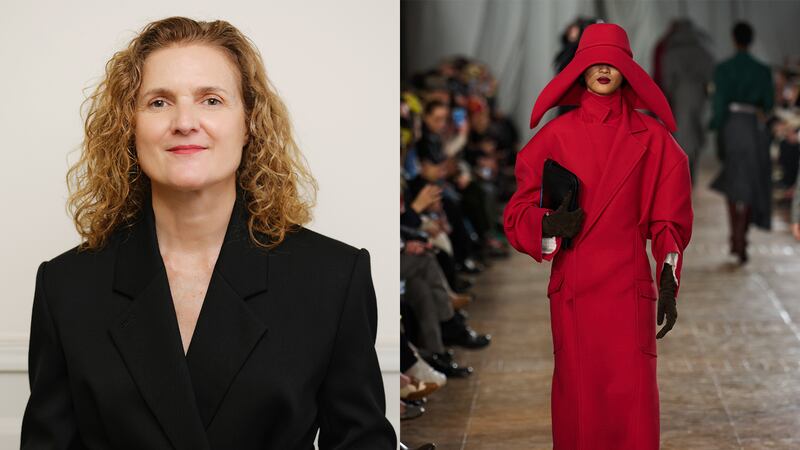
Barbara Werschine — the former CEO of Bompard — is stepping into the CEO role at Lanvin. Werschine quietly joined the company earlier this year to advise on restructuring the cash-strapped couture house, which was already in a fragile position going into luxury’s slowdown.
Lanvin Group, now helmed by Andy Lew, touted a pacey post-pandemic growth rate to raise around $150 million in a 2022 SPAC deal. It’s since burned through that cash, as it was already loss-making before sales fell 23 percent in 2024 and a further 18 percent last year, pushing out plans to get back in the black.
With no signs that controlling shareholder Shandong Ruyi plans to meaningfully recapitalise the business, Werschine will need to move quickly to shore up free cash flow. I would expect further store closures, as well as cash-producing brand extensions leveraging the Lanvin name: a deal to launch Lanvin homeware was announced alongside Werschine’s appointment.
Gucci’s Formula 1 Tie-Up
(Gucci)
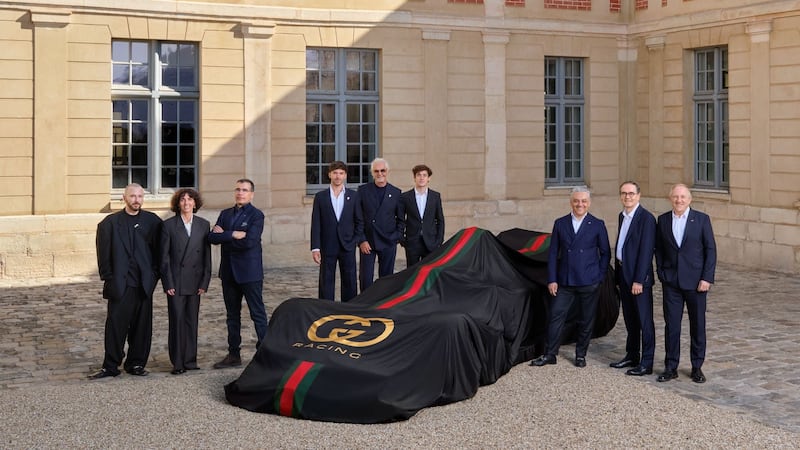
Kering’s Gucci has cut a deal to become the title sponsor of Alpine’s F1 team, which will be rebaptised Gucci Racing Alpine Formula One.
Watch and fashion brands have piled into F1 since the league revamped its approach to distribution rights and digital communications strategies, welcoming new audiences with initiatives like the Netflix series “Drive to Survive.” LVMH inked a 10-year partnership with the league in 2024.
Alpine is the high-performance subsidiary of Renault Group, where Kering boss Luca De Meo used to be CEO. “With these people, we are not guests,” De Meo told reporters on the margins of the group’s annual assembly Thursday. “We see it as a unique platform for a luxury brand to push boundaries, spark meaningful connections and build long-term value and brand desirability, while delivering measurable and lasting impact,” de Meo said.
I rather like the way Gucci is communicating in different registers under its revamped leadership, interspersing fashion-focused moments like Demna’s February runway show with broader brand-building initiatives like this racing deal, or putting Tom Brady on the runway at the brand’s cruise show in Times Square last week. (Launchmetrics said Brady walking the Gucci show generated $7.3 million worth of media impact in less than 48 hours.)
Ferrari and Jony Ive’s EV Design Debacle
(Ferrari)
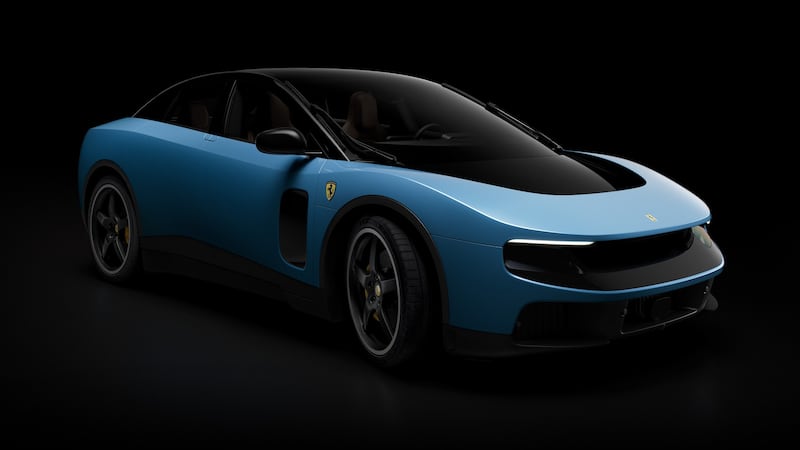
Ferrari shares tumbled 8 percent in Milan after the reveal of the iconic carmakers first EV, the Luce.
Sir Jony Ive’s LoveFrom advised on the design, whose ultra-polished, smoothed over take on Ferrari’s classic design codes came across as emotionless and underwhelming to critics who likened it to an iPhone (once revolutionary, now commonplace). Ferrari purists felt the launch risked undermining the red-blooded thrill Ferrari is known for. A former Ferrari chairman even warned of “the destruction of a legend.”
On the other hand, having a separate design language for the push into EVs could actually help protect the core business. An EV that looked more like a typical Ferrari without the vroom-vroom would have come across as ersatz, hollow. The €550,000 price tag could signal Ferrari plans to target a niche of Silicon Valley tech collectors, the kind who snap up Marc Newson watches and Jony Ive yacht lanterns.
The problem is that Ferrari hasn’t telegraphed its push into EV’s as a niche undertaking: the company has said it plans to make 20 percent of revenue from the category by 2030.
Taking the Temperature of Fashion Creativity in Milan
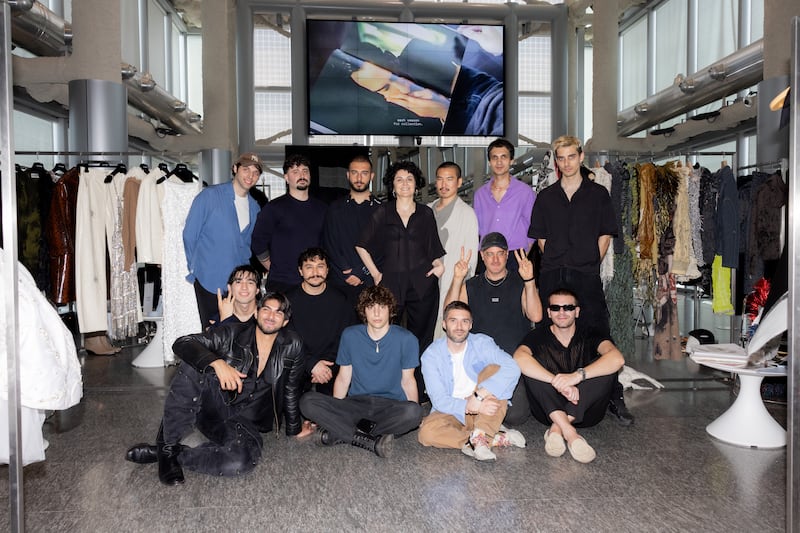
CNMI held the sixth edition of its grant programme for emerging designers, the Camera Moda Fashion Trust. (CNMI)
Yesterday Italian fashion lobby CNMI held the sixth edition of its grant programme for emerging designers, the Camera Moda Fashion Trust.
CNMI’s effort to bring more young and exciting names to a Milan Fashion Week calendar heavy with staid heritage names has seen its ups and downs, with several buzzy designers popping on and off the calendar in recent years. Labels like Satoshi Kuwata’s Setchu and Francesco Murano have continued to build momentum in Milan while others like Magliano and Nicolò Pasqualetti decamped to Paris. Sunnei’s co-founders exited the brand last October in a decidedly un-promising sign for the label.
Camera Moda Fashion Trust is on a clearer upward trajectory, having drawn new underwriters like the Lombardy regional government as well as adding more fashion and luxury heavy-hitters to its jury: Moncler Group CEO Leo Rongone (formerly the boss of Bottega Veneta), former Gucci CEO Marco Bizzarri, Anna Della Russo and designers Antonio Marras and Sabato de Darno were some of this year’s panelists, bringing industry gravitas and visibility.
Galib Gassanoff’s Institution won for the second time. The designer came into the competition with taste, originality, momentum and a clear plan for using the funds.
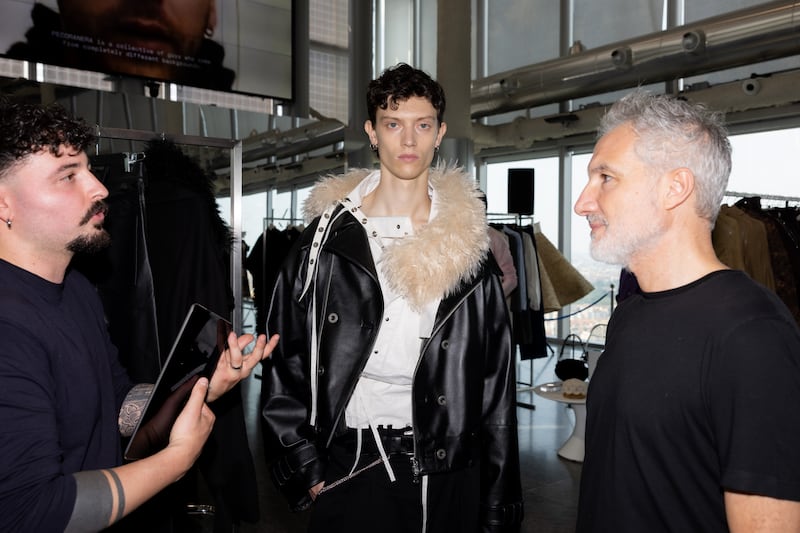
Moncler Group CEO Leo Rongone speaks to designer Domenico Orifice. (CNMI)
Act No.1, a project formerly tied to Gassanoff which is being carried on by co-founder Luca Lin, was another repeat winner. Accessible fashion concept Materia also secured a grant for its collection of tech- and sports-wear, designed to be more ergonomic for persons with disabilities who want to dress themselves without assistance.
As a new generation of Italian fashion creatives presented their projects, I noted a few common threads:
Cross-cultural dialogue: Merging Italian craft and heritage with influences from other countries was a theme for several designers. Gassanoff’s Institution incorporates craft techniques referencing his Georgian and Azerbaijani heritage (sometimes sourced from those communities). Act No.1’s Luca Lin referenced his family’s Chinese ancestry, while Lutchmiah fused the codes and craft from Italian and Indian dress. “We all carry several identities inside us, my goal is to transform them with an aesthetic language,” Lutchmiah founder said.
Rethinking Distribution: With the fashion market in the doldrums, independent fashion brands are finding it harder than ever to survive. The collapse of intermediaries like Farfetch/ New Guards Group and fashion incubator and distributor Tomorrow Ltd. are the latest signs that the old formula for building a fashion business — pushing hard for wholesale orders in a race to fund the next season’s fashion show — is no longer relevant.
Many of today’s young designers are thinking differently. Galib Gassanoff talked about wanting to grow mainly through custom orders, notably targeting art collectors as top clients. He said he needed the €70,000 grant to secure an appropriate space for fittings. Andrea Brocca, who showed a collection of lacy, body-sculpting gowns, is also focused on custom orders. Des Phemmes, wholesale-driven until now, wanted to use the grant to rebalance toward DTC, too.
A High-Tech Angle on ‘Made in Italy’: Several designers were focused on how technology can be used to make Italian fashion more innovative (and innovation more affordable). Knitwear collective Pecoranera works with next-generation knitting machines out of a space in downtown Milan, operating as both a brand and a platform for experimentation and education. Andrea Grossi, a former Diesel staffer, embellished much of his collection with digital laser-cutting techniques.
Woman Designers, M.I.A: Only one of the 10 finalists was a woman. “We do not have the same possibilities, unfortunately,” finalist Lika Kubaneishvili (whose brand is called Unknown Artisan) said. “Fashion is full of female workers. Artistic directors, not so much.” The organisers of the grant said this was a reflection of the application pool, with only around 10 percent of submissions having come from women. This was a head-scratcher that sparked some concerned discussion into the evening. The student bodies of elite fashion schools skew heavily female. So what was happening between graduation and this early-stage grant programme? What should — and what will — be done?
As shoppers swap “sustainable” for “healthy,” BoF senior editorial associate Shayeza Walid joins senior correspondent Sheena Butler-Young to unpack why fabric content has become fashion’s newest flashpoint — and why Gap just found out the hard way.
Brands are embedding ChatGPT-like tools directly into their e-commerce sites, with AI platform Daydream spurring adoption as it opens up its technology to third parties.