Agenda-setting intelligence, analysis and advice for the global fashion community.
Agenda-setting intelligence, analysis and advice for the global fashion community.

The Business of Beauty's executive editor unpacks how shifting ideals, new players and cultural movements are transforming the global beauty and wellness industries.
Subscribe to Full Coverage by Priya Rao: unpacking how shifting ideals, new players and cultural movements are transforming the global beauty and wellness industries.
Welcome back to Full Coverage.
What a week. Before we move on to the Puig and Estée Lauder Companies news of it all, I have to talk about this morning’s report that Henkel will acquire Olaplex for $1.4 billion. In the end, this is the best possible outcome for all parties.
Although Olaplex had been mid-turnaround, its stock is still down about 90 percent since going public in 2021. It never quite recovered to its pandemic highs after questions about product safety led to lawsuits and new entrants like K18 began taking share. Henkel, which just bought haircare label Not Your Mother’s, gets to boost its consumer business through the deal and Advent, the main shareholder in Olaplex with 75 percent ownership, finally gets to exit. (It just purchased Salt & Stone this week and will have more money to play with going forward. I’m still not convinced that its Orveon business will pull through, but that’s another story for another day.) What an ending for the haircare brand’s saga.
ADVERTISEMENT
Anyway, let’s get on with it. Read on for:
Estée Lauder Companies and Puig confirmed on Monday that they are in discussions to build the next global beauty giant. For some, the news came as a shock. It shouldn’t have.
I have it on good authority that the ELC x Puig talks were first floated a decade ago, but conversations started in earnest around four years ago. Following Leonard Lauder’s passing in the summer and the news that L’Oréal was buying Kering’s beauty business for $4.6 billion last fall, things accelerated. As one insider put it to me, “It’s a matter of survival.” Estée Lauder and Puig did not respond to requests for comment.
The deal makes strategic sense, and not just because these are both family-owned businesses with similar prestige positionings. Estée Lauder is overly concentrated in Asia and not as strong in Europe, where Puig is, and needs help growing its fragrance business (again, Puig has the upper hand here). Puig, meanwhile, doesn’t have the R&D capabilities that Lauder has and can’t go on a buying spree to fill its holes in makeup and skincare. (Remember, the Spanish firm’s acquisition of Barbara Sturm’s skincare label hasn’t quite panned out yet.)
But there are questions. Some people close to the companies have told me the deal is less beneficial to Puig from an equity standpoint, as it has proven to be smarter at M&A and better at building brands. The prospective merger also feels a bit old-fashioned as both companies are still reliant on department stores and are only now getting their grips on specialty reality and Amazon. But the Puig family, which didn’t tie the latest generation into succession planning, is likely to get a big payday as it remains the largest shareholder of the company. I’m not so sure about the Lauder family.
Merger talks sent both conglomerates’ stocks moving in opposite directions on Monday in after-hours trading, with Puig’s climbing 12 percent and Estée Lauder’s falling nearly 8 percent. Sources tell me that investors are frustrated because the Puig merger suggests that Lauder’s much-talked-about turnaround plan was never actually meant to be executed.
Chain Reaction
Some have proposed that Puig is now a target for Unilever, which has said it is making a bigger play for beauty and personal care; it is hoping to shed its entire food division after selling off its ice cream business in December. (Puig is said to have had conversations with Kering and Richemont in the past.) I would argue that ELC and Puig could both be Unilever targets. If the food spin-off deal goes ahead, Unilever will have plenty of cash to spend.
ADVERTISEMENT
The deal is rumoured to be locked by Monday, but is far from done, according to multiple insiders I’ve spoken to. Months or even a year is more likely, as this affects the whole beauty ecosystem. Neither Lauder nor Puig is poised to engage in near-term M&A activity — ELC really did get Forest Essentials done under the wire — meaning lines that are currently in a holding pattern may be waiting for longer. It’s a sad state of affairs for brands like Kosas, Merit and Makeup by Mario that are still hoping for their anticipated exits.
Consolidation is happening across beauty, as it should: No one can compete with L’Oréal. But besides the L’Oréal and Kering deal, we can’t forget what just happened with Kimberly-Clark and Kenvue. LVMH also wants to streamline; it hopes to cut ties with Make Up For Ever and Fenty. But where does this leave Shiseido, Amorepacific, Coty or Procter & Gamble? What do these conglomerates mean now and what kind of leverage will they have? The beauty world order is changing, perhaps faster than anyone anticipated.
But then again, this could be an opportunity for these firms and independent labels, as they will have the focus to win market share. Lauder and Puig will need plenty of time to work out the details.
Coming to you from Los Angeles, I’m beauty correspondent Liz Flora. I see my fair share of influencer brand launches each month, but it’s safe to say Reale Actives might be the biggest of the year.
Whenever we hear of a beauty product that went so viral it sold out, the spike can often be attributed to a handful of influencers — namely Hailey Bieber, Mikayla Nogueira or Alix Earle.
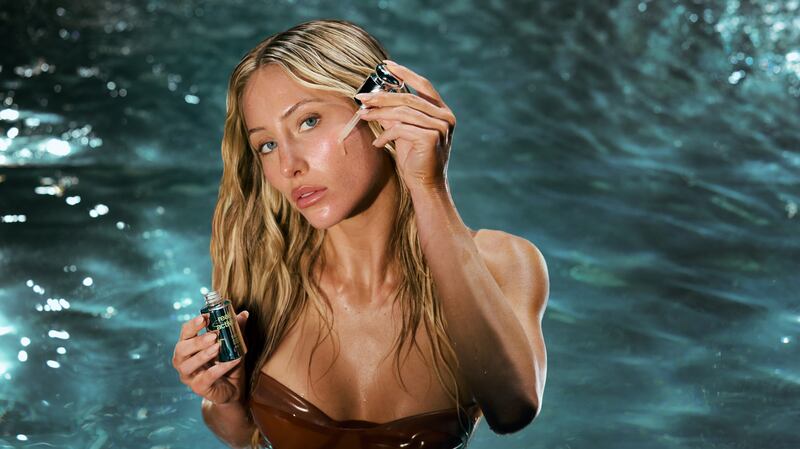
It should come as no surprise, then, that Earle is now the final member of the trifecta to become a beauty founder, announcing her skincare line Reale Actives this week.
Earle has shown a knack for creating beauty crazes on a regular basis in a phenomenon widely known as the “Alix Earle effect.” She has caused sales surges (and resulting stock issues) for Drunk Elephant’s D-Bronzi Drops, Tarte’s Shape Tape Concealer, Mielle’s Rosemary Scalp Oil and Patrick Ta’s Major Headlines Double‑Take Crème & Powder Blush Duo — to name a few. According to CreatorIQ, Earle generated over 42.2 million social media engagements in 2025, earning more than Rhode founder Bieber.
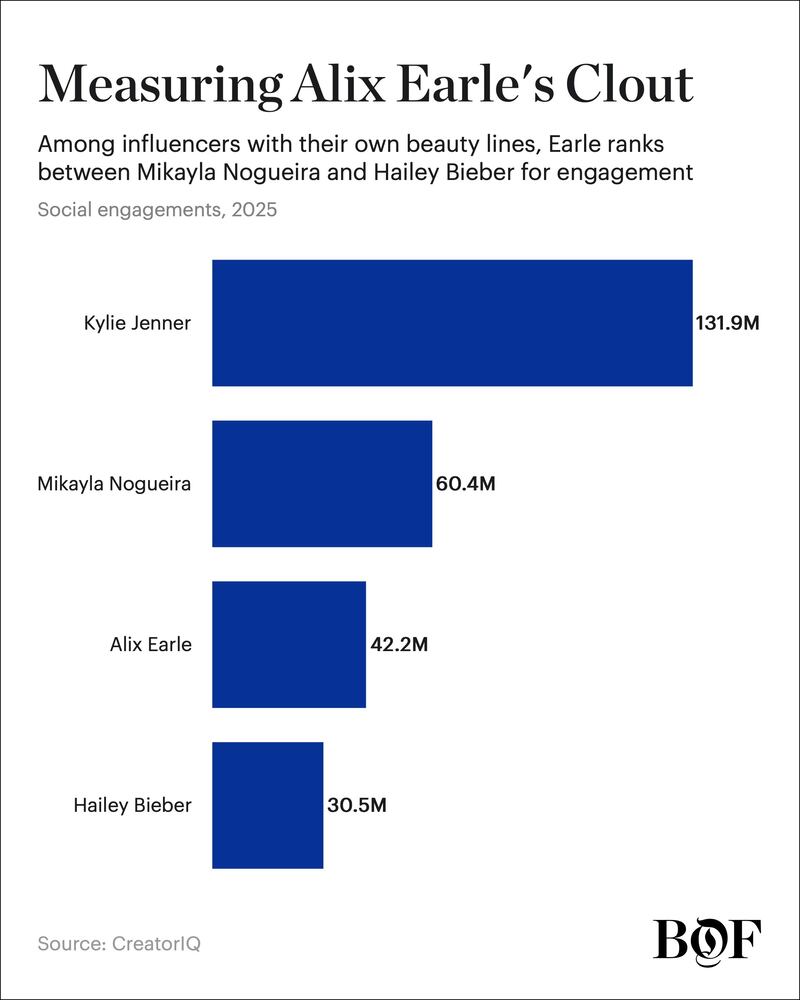
And she’s one of the few TikTok stars that is crossing over into celebrity territory, with a Netflix reality show set to debut this year. Earle also joined the likes of Cardi B, Karol G and Pedro Pascal during Bad Bunny’s February 2026 Super Bowl performance, and promoted Reale Actives on primetime television, with Jimmy Fallon on “The Tonight Show” on Tuesday.
ADVERTISEMENT
When we first heard an Earle brand was happening, The Business of Beauty team spent some time hypothesising what direction she’d take with the line. I speculated that it might nod to Earle’s party-girl persona, but Priya’s guess that it would be an acne-care line proved to be spot-on (no pun intended). The line draws on Earle’s extensive content around her battles with breakout-prone skin, with four products including its Go Deep mandelic acid serum and Pore Power exfoliating LHA and BHA gel cleanser; it debuts on the brand’s e-commerce site on March 31.
And although Earle loves a party — her other ventures include an investment with the ready-to-drink cocktail brand SipMargs — the tone of the brand is serious and science-y, with her dermatologist Kiran Mian lending expertise and the use of proprietary active ingredients, much like Bieber’s Rhode. There’s also the sexy founder launch campaign and minimalistic packaging (Nogueira’s designer Established NYC also worked on branding and creative for Earle’s label) that feel familiar. Reale Actives and Noguiera’s POV Beauty share an investor in Imaginary Ventures — the VC firm behind Skims, Reformation and Glossier.
Earle is entering into beauty at a tough time — for every influencer or celebrity beauty brand that succeeds, there are dozens that fizzle out. But Rhode’s billion-dollar exit last year has laid out a new influencer-to-founder blueprint; let’s see if Reale Actives is something we’re talking about in a few months. — Liz Flora
A depressing stat: Size inclusivity dropped to its lowest in three years during fashion month. [Vogue Business]
Meanwhile, beauty standards of TV stars also feel less accessible than ever. [Dazed Beauty]
As costs soar and shoppers tighten their belts, mass beauty brands get creative with their marketing. [The Business of Beauty]
Denise Richards’ candid facelift journey went viral this week. I think she’s always looked great! [Allure]
Violet Grey sets its sights on international expansion. [The Business of Beauty]
Are you familiar with the vacant, disaffected stare of the “Gen Z pout”? [Vanity Fair]
Thanks, y’all,
Priya
Want to dive deeper into an insight from this article? Check out The Brain of Fashion, BoF’s new generative AI tool where you can unlock BoF’s beauty archive with a single question.
Loading recommended reads…
The Chinese designer won the grand prize for her airy, sculptural pieces at the 41st edition of the festival, which is undergoing a revamp under new leadership.
The move, which was facilitated by Jean Arnault, comes as Hublot undergoes a repositioning in a bid to reignite sales.
LVMH’s sales dropped in China while Luca de Meo clears out Kering’s creative ranks. Plus, Kim Jones' new venture.
In the third instalment of The BoF Podcast’s Ask Me Anything series, Imran Amed takes on listener questions about Gucci’s unresolved turnaround, why brand-measurement metrics deserve more scrutiny, and what AI can — and can’t — replace in fashion.