Agenda-setting intelligence, analysis and advice for the global fashion community.
Agenda-setting intelligence, analysis and advice for the global fashion community.

When Korean beauty packaging manufacturer Samhwa’s US sales director laid eyes on its newest innovation last year, he was floored.
Samhwa’s first-to-market pack was a plastic jar with room for two skincare-infused gel chunks; a twist of the cap sliced off a fully formed undereye mask. While masks are typically housed in messy bulk containers or wasteful single-serve packets, the invention is cleaner, easier and most importantly, fun to use — or watch on TikTok. “Honestly, it’s one of those one-in-10-year type innovations,” said Vincent McCarthy, whose job it is to secure orders from beauty brands for one of South Korea’s largest packaging manufacturers.
But he couldn’t anticipate what happened next. This week, Samhwa’s product — officially called the “Fresh-Slice Hydrogel Eye Patch Dispenser with Grind-Cut Twist Mechanism” — showed up in the collections of megabrands Fenty Beauty, Huda Beauty and Glow Recipe, who all debuted their new eye patch products on social media Sept. 17 and 22. The episode was rare for the number of category-defining beauty labels at its centre. Most observers wanted to know how, exactly, it happened.
Each company offered its own formula within, and applied its own branding to the pack, even if the distinctive jars look similar. Packaging was “just one part of the equation,” said Christine Chang and Sarah Lee, co-chief executives of Glow Recipe, in a joint statement shared with The Business of Beauty, noting that their product focused on a unique ingredient formulation using watermelon and caffeine. Spokespeople for Huda Beauty and Fenty Beauty declined to comment.
ADVERTISEMENT
According to McCarthy, Samhwa began pitching the product in South Korea in October 2025. The first to bring it to market was the K-beauty brand Wonder Bath, which launched its Slice Serum in July 2026.
As photos and videos of the new launches flooded feeds over the past week, the beautyverse spoke out — with brands addressing the situation humorously, like Fenty Beauty’s repurposing of the “Spider-Man pointing at Spider-Man” meme, or acknowledging their shared supplier, as Huda Beauty founder Huda Kattan did in a comment and subsequent post.
At its core, though, the issue points to intense pressure to keep ahead of the beauty trend cycle, and its acceleration thanks to K-beauty’s growing manufacturing power.
“The beauty space is incredibly fast-moving,” said Chang and Lee. “When an innovation is great, we see multiple brands doing their best to deliver their version to the customer, as we’ve seen with sheet masks, cushion compacts, red light masks and many other formats over the years.”
McCarthy, who has worked for Samhwa for seven years, knew he had a hit on his hands. Through late 2025 and early 2026, he traveled across the country, pitching in Los Angeles and New York. His inkling proved correct: the product received a flood of interest from brands, who were enchanted by the photogenic slicing action and texture of the resulting eye patches.
“Everyone has had the same reaction — ‘I want it. I want it now. How soon? Here’s my PO [purchase order]. Let’s go,’” said McCarthy, who declined to share which brands placed their orders the earliest.
That enthusiasm was what led to the current wave of launches, according to McCarthy, as Fenty, Huda, and Glow Recipe raced to release their versions.
“They were waiting, and waiting and waiting until we said, ‘Now’s the time,’” said McCarthy. Currently, only Wonder Bath’s product is available for purchase online. Glow Recipe’s will go on sale in the fall, said a representative, while Kattan wrote in a public Instagram comment that her brand “is not launching it anymore.”
ADVERTISEMENT
It is not uncommon for brands to debut products in similar packaging with different design and colours, but consumers generally don’t think twice about the same spray bottle or jar, said Lisa-Marie Assenza, founder and chief executive of Impacked, an online packaging marketplace.
Samhwa’s jar is a “stock public mould,” said Assenza. “In those cases, brands take on the risk that other brands will also launch in them.”
What was notable about the eye patch pack was its novelty, and the fact that each brand took to Instagram and TikTok to share the new format. By midweek, the jars had taken over social media feeds, and the issue became impossible to ignore. “In this case, the format and functional innovation within the component itself was a massive differentiator,” said Assenza.
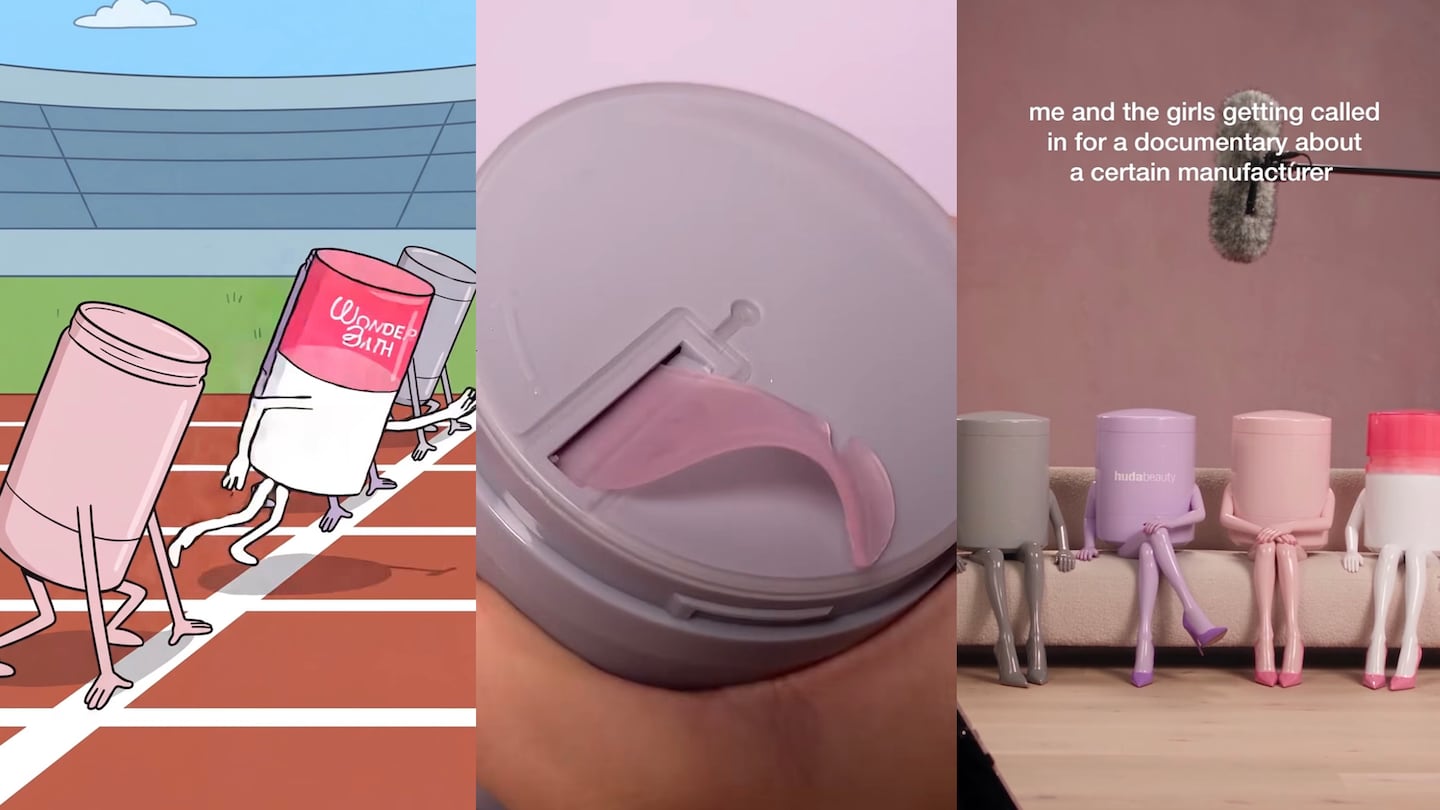
On Sept. 23, Huda Beauty posted an AI-generated animated video of personified jars sitting down on a long couch, with the caption: “me and the girls getting called in for a documentary about a certain manufacturer” and tags of the other brands involved. It received 6.9 million views, and support from beauty influencers and founders like Jen Atkin.
In an earlier Instagram comment, Kattan said she and the other brands were “screwed over by the same packaging supplier,” implying her team was not aware that others would be launching the same format.
McCarthy said that no brands had exclusivity on the format. Wonder Bath had an advantage of shorter shipping times as a Korea-based company, helping it launch the product first. Huda Beauty, Fenty Beauty and Glow Recipe were “all interested in and touched on exclusivity,” McCarthy added, but the company “couldn’t grant” it.
Another advantage for Wonder Bath was the fact that it worked with Samhwa on a custom version of its package, which helped fast-track its development.
Beauty brands can negotiate exclusivity on packaging components, but they generally need to start those conversations early, maximise their order quantities or build relationships first, said experts.
ADVERTISEMENT
“A lot of manufacturers, when they first come out with an innovation or they’re pursuing a patent on a particular component, will share that innovation with select brands or customers before they actually put it out publicly,” said Assenza. According to McCarthy, larger order sizes also sweeten the deal.
Mid-size brands can find partnerships with smaller manufacturers, or at least secure custom versions of key components. But like all investments, brands need to choose their custom packaging wisely. Original bottle shapes may benefit some categories like niche perfumes, but stock packaging designs can also be modified extensively to ensure they are tailored to a brand’s signature aesthetic.
Another key differentiator is the formula inside. Now that the jokes have subsided, the brands involved in the episode are back to their regularly scheduled programming, emphasising their products’ unique benefits. Wonder Bath, which created its own animated joke meme depicting its product leading the others in a race, has since posted several videos showcasing the manufacturing process, ingredients and efficacy.
Glow Recipe is trying a similar message. “The packaging got your attention. But the formula will do all the talking,” read the text on its latest video.
Sign up to The Business of Beauty newsletter, your complimentary, must-read source for the day’s most important beauty and wellness news and analysis.
Marcelo Gaia, the owner and creative director of New York-based brand Mirror Palais, frequently publishes candid, casual videos to call out fast-fashion imitations.
Mcobeauty’s newest launch, crafted with precisely the same formula as its pricier forebear, Urban Decay, showcases an evolving strategy for ‘dupe’ brands.
TikTok’s K-beauty obsession has inspired brands like Glow Recipe, Then I Met You and Peach & Lily to embrace their Korean beauty origins as international retailers renew their interest in the category.

Liz Flora is a Beauty Correspondent at Business of Fashion. She is based in Los Angeles and covers beauty and wellness.
Loading recommended reads…
For the last twelve months, the designer has played therapist to the brand’s multiple personality disorder. This latest session for Spring/Summer 2027 was a breakthrough.
Gucci, Moschino, Tod’s, Institution and The Attico each offered their vision of fashion for the people as commercial pressures put the customer squarely in focus, Angelo Flaccavento writes.
A Bank of America analyst downgraded shares of the sportswear maker to underperform from neutral, pushing back expectations of a sales turnaround to 2028.
The manufacturer of the gel eye masks that broke the internet weighs in on why Fenty Beauty, Huda Beauty, and Glow Recipe announced the same product within a week.