Agenda-setting intelligence, analysis and advice for the global fashion community.
Agenda-setting intelligence, analysis and advice for the global fashion community.

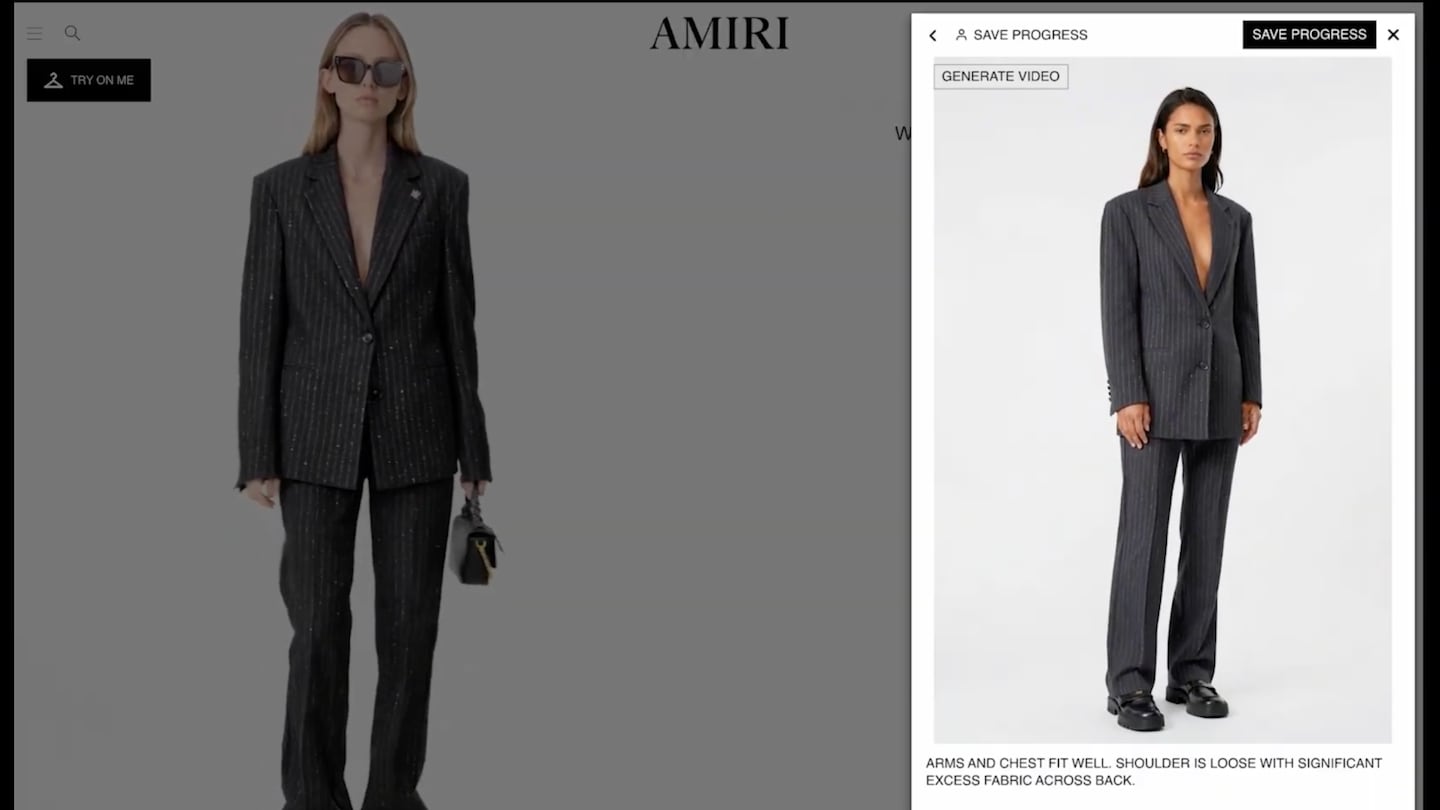
One of the biggest players in artificial intelligence is betting that it can finally make virtual try-on work.
At its annual Nvidia GTC conference on Monday, the AI powerhouse announced it was partnering with AI company Catches on RealFit, a platform that claims to provide “real fit, sizing and drape for fashion e-commerce.” Nvidia, whose chips power much of the world’s AI infrastructure, is powering the tool’s technology, and Catches is the company’s official independent software vendor for the fashion industry.
Catches also secured $10 million in funding from high-profile investors like LVMH director of image and environment Antoine Arnault and partner supermodel Natalia Vodianova; Gary Sheinbaum, the former CEO for Tommy Hilfiger and Sarah Willersdorf, former head of luxury for Boston Consulting Group.
It’s the latest attempt to find an answer to what has long been fashion’s white whale. Since the late 2010s, countless startups have launched with the promise of giving shoppers the ability to digitally impose garments onto their bodies. The potential upsides for apparel brands are huge: if they get it right, virtual try-on could minimise online return rates, which majorly drag on their bottom lines. But the results were never good enough to get consumers to adopt the systems en masse, so retailers frequently abandoned them too.
ADVERTISEMENT
Generative AI has improved the technology, allowing for imagery that allows users to more realistically see how a garment appears on the body. That’s opened the doors for a new cohort of start-ups to attempt to capitalise on the opportunity.
Ed Voyce, the founder and chief executive of Catches, said — besides the heavyweights attached — that RealFit’s differentiating factor is that its AI incorporates physics to make a more lifelike image. Most virtual try-on, even those that use AI, simply merge two images together — the photo of the person and the garment itself.
“It’s just painting an image onto an image. It doesn’t have any knowledge of all the important stuff, the draping, the textures, the cut,” said Voyce.
Using physics, he said, allows the technology to account for those factors, as well as show a user how the garment moves in real life and how it would fit on their particular body, accounting for changes in size, body shape and more.
“When buying online, you want to know that it’s going to cut you under the arms, if it pinches or it’s way too big,” said Voyce. “You want those imperfections to stay. That’s where we come in.”
Of course, having the technology is one thing — getting customers to use it is another. Despite all the attempts, virtual try-on is still far from being the norm: In an eMarketer survey, only 1.4 percent of 1,000 shoppers aged 18 to 65 use it regularly.
Voyce said that part of the reason for the slow uptick is because “a lot of these platforms have asked the consumer for too much,” requesting a long list of specific measurements or taking a detailed video, while RealFit asks for a selfie and size. However, plenty of the latest group of AI-powered try-on startups have similarly lowered the barrier to entry.
Despite the crowding in the space, Voyce feels the incorporation of physics to improve their technology will set RealFit apart. The company’s funding, too, will go towards further improving the technology to make it as easy as possible for consumers to use, without sacrificing results.
ADVERTISEMENT
“AI has largely lived in the digital world, trying to imitate reality without truly understanding it,” said Vodianova. “Catches changes that by anchoring AI to the laws of physics, so it doesn’t guess how a garment drapes or fits, it knows.”
Before then, though, Catches has to convince brands to hop on board. He said that initial scepticism melts away after they show brands the product. Already, they’ve signed on brands like Amiri and Nanushka; the technology is already live on Amiri’s website. More — both in luxury and mass-market retail — will be announced in due course.
“It’s the biggest reason for cart abandonment and returns. When you remove that, you’re not just talking about $900 billion of spending going to $950 billion,” said Voyce. “The whole industry grows.”
Want to dive deeper into an insight from this article?Check out The Brain of Fashion, BoF’s new generative AI tool where you can unlock BoF’s technology archive with a single question.
The arrival of direct checkout in AI search engines like ChatGPT is being called the biggest innovation in online shopping in over a decade. BoF breaks down how brands and retailers are getting ready for the disruption.
Open-sourced large language models have made it easier to create realistic images of online shoppers in outfits before they buy them. The next challenge is getting people to actually use the technology.
BoF highlights 17 AI-powered startups that have raised more than $400 million in the last five years by offering design, operation and shopping services that promise to help brands and retailers reduce costs and increase innovation.

Diana Pearl is US Editor at The Business of Fashion. She is based in New York and drives BoF’s marketing and media coverage.
Loading recommended reads…
As fashion dives deeper into sports, it can find valuable takeaways the backlash against Sydney Sweeney’s controversial new ad, which is drawing criticism from Olympic athletes.
Join us for our next BoF LIVE on Wednesday, Sept. 16, at 15:00 BST / 10:00 EDT as the authors of our latest report ‘Inside Fashion & Sports E-Commerce’ unpack what really matters to customers when shopping online today.
The sneaker retailer is shaking up its North American leadership as it looks to reverse soft sales and an extended slump in the stock market.
Shares in the South African discount clothing retailer fell the most in more than three years, as an expansion into banking weighed on profit forecasts.