Agenda-setting intelligence, analysis and advice for the global fashion community.
Agenda-setting intelligence, analysis and advice for the global fashion community.

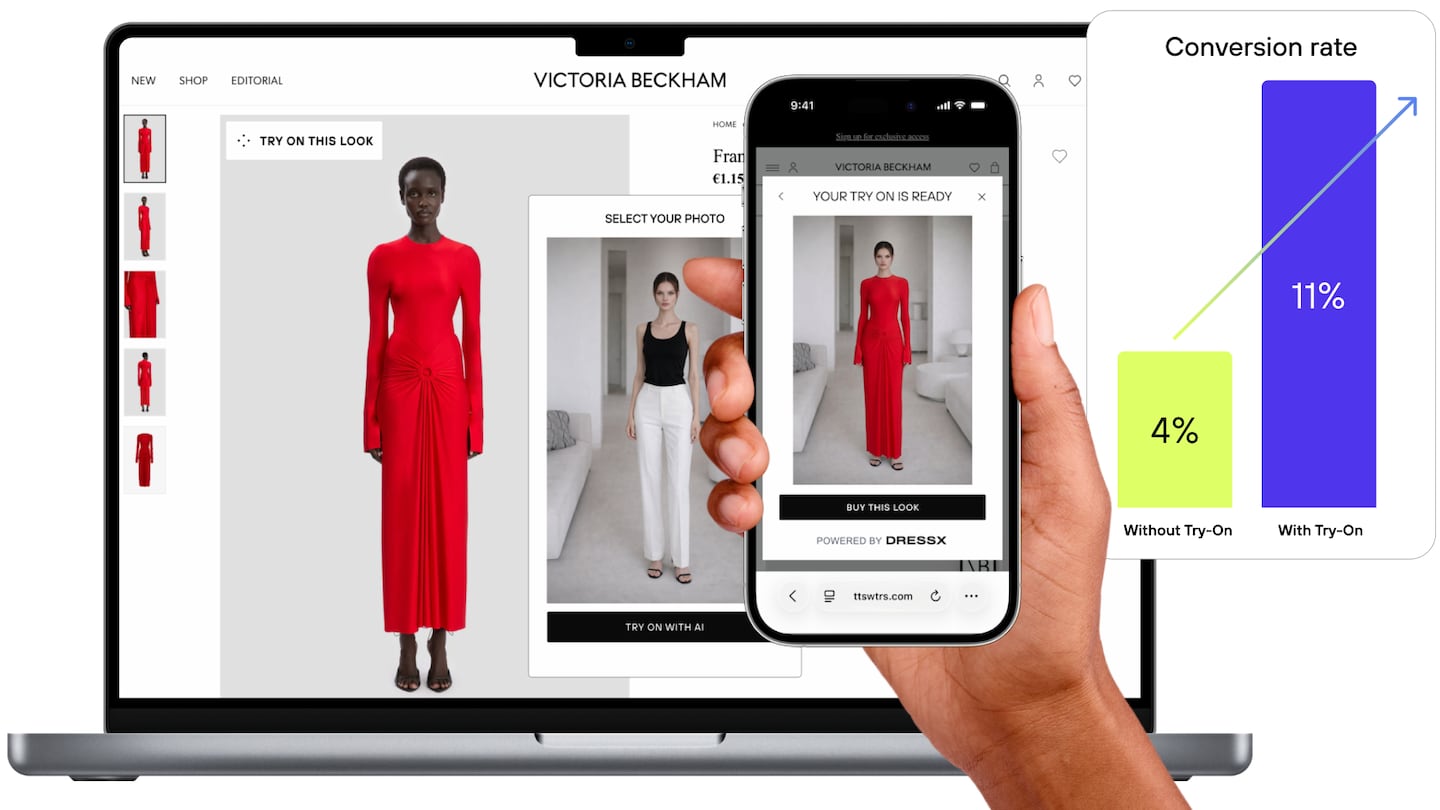

Digital e-commerce is expanding and undergoing a major technological transformation, with annual growth projected at 6-11 percent in Europe and 7 percent in the US between 2022 and 2030, according to The State of Fashion 2026 report.
This steady baseline growth is accelerated by a massive shift towards artificial intelligence in product discovery, evidenced by a 4,700 percent surge in shopping-related searches on generative AI platforms between 2024 and 2025.
While AI agents are disrupting how customers discover, select and purchase goods, AI-powered virtual try-ons could be the antidote to e-commerce’s conversion, retention and return rates.
Data from Mastercard Dynamic Yield states that fashion performs lower (2.81 percent)than many other e-commerce verticals, such as food and beverage (5.29 percent) and beauty and personal care (4.71 percent). The median conversion rate for menswear is only 0.8 percent, according to a study of 500 fashion brands by the e-commerce software company Centra.
Retaining fashion e-commerce shoppers has also become more difficult. Raising prices and inflation fatigue have made shoppers more selective and more willing than ever to abandon a brand for a better deal elsewhere.
Regarding returns, a 2025 study by the National Retail Federation shows total annual returns for the retail industry reached $849.9 billion, while an estimated 19.3 percent of online sales were returned. In fashion, return rates continue to drag on profitability — with 20 to 30 percent of online purchases returned, according to The State of Fashion 2025.
Practices like “bracketing” — where customers buy multiple sizes or styles and return most of them — are driving high return rates and increasing costs for retailers. Some, like H&M, have introduced return fees that customers may be unwilling to pay.
In its latest intelligence report titled “Driving Conversion and Retention Through Virtual Try-On,” fashion technology company DressX states that AI try-ons could help online retailers solve high return rates, record high customer acquisition costs and stalling conversion rates.
The digital try-on provider conducted a study analysing the behavioural patterns of 1.2 million global shoppers across premium and luxury e-commerce platforms — including Victoria Beckham and Loulou de Saison, among others.
The dataset tracks performance across 216 countries and 83 languages. Users from France and Spain show the highest average number of try-on engagements. In the US, nearly one in three try-on engagements is for shoes.
Below, The Business of Fashion shares extracts from DressX’s report alongside analysis anchored in BoF’s latest reporting.
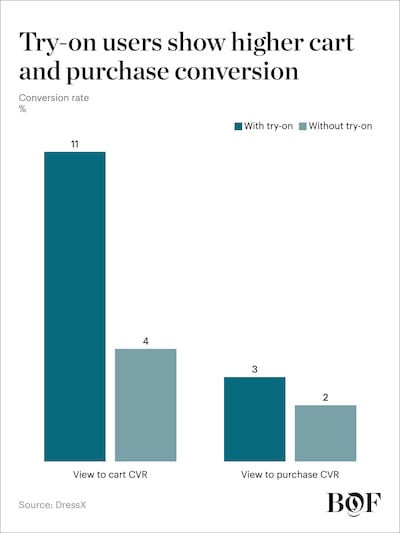
DressX: The findings show that try-on users were about three times more likely to add items to their cart, had a 50 percent higher purchase conversion rate, higher rates of retention by the very next day and viewed seven times as many product listings as users who never engaged with try-on. They also converted from view to cart at roughly 11 percent, compared with about four percent for shoppers who did not use try-on.
The technology can help fill a clear gap in the online fashion experience: shoppers need more confidence before buying — 73 percent of them feel overwhelmed by the number of products available, according to Accenture’s Consumer Pulse Survey 2024 — while online brands need more shoppers to move from browsing to purchase. Meanwhile, product pages need to do more than show static images.
AI try-on addresses this gap by making online shopping more interactive and personal. It gives shoppers a better way to evaluate products before they buy, especially when fit, style and confidence matter most.
BoF: The virtual try-on landscape in fashion and luxury has rapidly evolved from clunky, rudimentary avatars into hyper-realistic, AI-driven digital twins. New players in the field include Google, Amazon Web Services and Nvidia.
Early results show that virtual try-on successfully addresses the returns crisis while boosting sales. Zalando reported a 40 percent reduction in returns during early tests of its software. Software provider Swap noted a 20 percent drop in returns and more time spent on site, thanks to virtual try-on.
Similarly, fit-guidance technology has helped reduce return rates by 30 percent, increase conversion rates by up to 70 percent and grow average order values by 10 to 15 percent, according to sizing startup Saiz.
Despite strong operational results, consumer adoption remains the primary hurdle. An October 2025 eMarketer survey found that only 1.4 percent of 1,000 adults aged 18 to 65 use virtual try-on regularly.
However, when integrated seamlessly into social platforms, engagement skyrockets. As featured in BoF’s Building Brand Resonance With Gulf Consumers knowledge report, a Snapchat AR try-on for Gucci sneakers was used 20 million times, and a Dior sneaker lens generated 2.3 million views and a 6.2x return on ad spend. According to Geoffrey Perez, global head of luxury at Snap Inc., “Generative AI gives luxury brands an entirely new way to tell stories.”
The next frontier for the industry is to make virtual try-on an invisible, ubiquitous layer of everyday online shopping to supercharge the online customer experience.
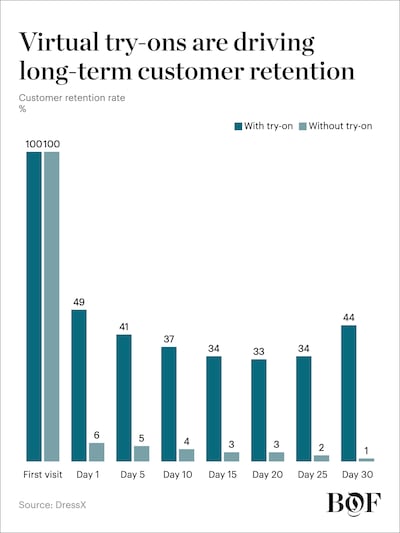
DressX: For many fashion e-commerce companies, the first purchase is not profitable. Some brands lose money on the first transaction and only find a customer profitable if they come back and buy again.
Shoppers who engage with the try-on feature demonstrate significantly higher retention and brand loyalty compared to those who do not.
While non-users rapidly disengage after their first visit — dropping to a six percent retention rate by day one and effectively disappearing over time — nearly half of try-on users come back the next day, maintaining a strong 44 percent retention rate by day 30.
Try-on users are consistently more likely to become repeat customers, with 5 percent coming back more than 10 times compared to a mere 0.4 percent of non-users, proving that the tool is highly effective at fostering lasting customer engagement.
Brands that adopt AI try-on early are also building valuable first-party data about shopper preferences, fit behaviour, product interest and style intent. Rich try-on data can help products be better understood, better matched and better recommended by future AI shopping agents.
BoF: The integration of virtual try-on technology and AI agents is triggering what has been called the rise of “agentic commerce.”
The industry is moving away from static web pages towards GEO-optimised websites and “agentic storefronts” — interactive interfaces on owned sites resembling generative AI platforms like ChatGPT.
Instead of scrolling through endless feeds, shoppers use a conversational mode to ask an AI agent for tailored outfit recommendations. Users then instantly visualise these suggestions on digital twins or virtual avatars.
According to Swap, which recently launched an agentic storefront model, combining guided AI discovery with virtual try-on technology can help brands convert at roughly twice the rate of a standard dot-com.
AI agents are also data collectors and aggregators. Retailers have been using AI for years to recommend products tailored to shoppers’ preferences, but large language models have also introduced a new form of shopping in which customers can converse with chatbots to get even more personalised suggestions.
According to Marc Bain, BoF’s editor of the Tech Mode newsletter, algorithmic personalisation in fashion still falls short of what users experience with a service like Spotify, but that’s because retailers face a more difficult challenge. “There are limits on the inventory available and they also need to factor in characteristics such as sizes and colours to find the right match.”
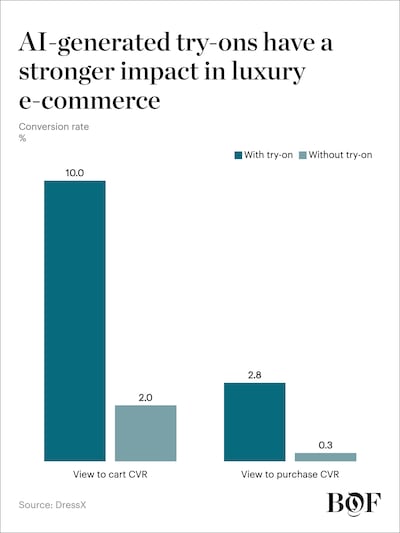
DressX: Shoppers are more likely to use AI try-on when considering higher-priced products. According to the study, luxury e-commerce experiences a fivefold increase in cart additions and a more than ninefold increase in final purchases.
Kate Hurrell, head of e-commerce at Victoria Beckham, said in the report that DressX’s technology allows clients to visualise fit, silhouette and styling before making a purchase, bringing the boutique experience closer to digital platforms. “Virtual try-on technology helps to reduce uncertainty around sizing and fit and supports more considered purchasing choices.”
DressX AI try-on is trained to preserve all details in the rendered output, ensuring the customer sees a faithful representation of the creative work rather than a simplified approximation. For brands whose product positioning is built on the specific materials they choose to work with, this is a critical differentiator.
“Our video-based training layer allows us to capture how garments behave in motion, not just how they look in a static image,” said Natalia Modenova, chief operating officer and founder of DressX. “That means how a jacket sits on the shoulders, how fabric falls when someone moves or how a silhouette holds its shape. [This is] a standard essential for luxury.”
BoF: Across the global luxury fashion sector, innovators are deploying AI virtual try-on technology in an attempt to replicate the exclusive “white-glove” boutique experience for the digital age. The challenge for brands is to capture fabric drape and fit accurately.
At New York Fashion Week in February 2026, L’agence collaborated with Google AI to let guests instantly visualise themselves in runway looks, enabling immediate pre-orders.
Even Depop has brought AI-powered virtual try-on technology to the secondhand fashion market. In a collaboration with DressX, unveiled in June 2026, Depop debuted an interactive “AI Mirror” at Gov Ball in New York.
The activation allowed attendees to mix and match and instantly purchase a curated collection of 300 unique items from real Depop sellers. This collaboration showed that secondhand clothing can be scaled into interactive virtual experiences without the need for traditional, studio-shot brand catalogues.
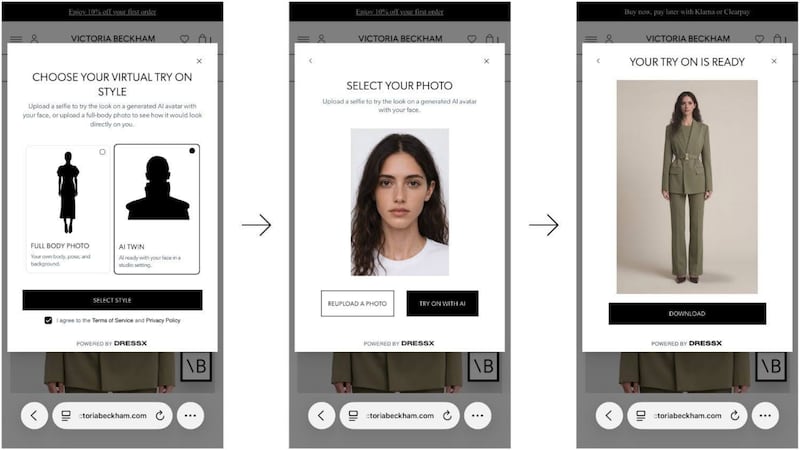
DressX: Mobile devices now account for approximately 70 percent of all e-commerce traffic, according to Boston Consulting Group. The desktop remains a significant channel, but the primary experience is mobile.
Virtual try-on must be optimised for mobile first and desktop second. Brands that treat try-on as a desktop feature or allow mobile friction to go unaddressed are leaving the majority of the commercial opportunity unrealised. Every additional second of loading time and every extra step in the photo upload flow is a direct cost to try-on completions and, therefore, to revenue.
DressX data shows that 70 percent of shoppers engage with try-on via mobile, while the technology convinces 12 percent more shoppers to complete a purchase on their handheld.
Mobile devices anchor the try-on experience in the immediacy of mobile shopping, meaning consumers are more likely to engage with interactive features at the moment of discovery. When a customer sees a Victoria Beckham or Loulou de Saison piece in their Instagram feed and taps through to the product page, the try-on feature is available immediately, in the moment of highest intent.
BoF: The rise of mobile-first markets is capturing a growing share of the retail ecosystem, particularly in regions with young, digitally-savvy populations. In the Gulf Cooperation Council (GCC) region, smartphone penetration now exceeds 97 percent in countries like the UAE, and more than half of residents shop on their mobile phones. Southeast Asia is also emerging as a powerful market driven heavily by mobile-first consumers.
Short-form visual feeds on mobile apps like TikTok and Instagram have successfully conditioned users to scroll and immediately buy what they see. This trend is pushing brands to adapt all over the globe. In May 2026, Chinese e-commerce giant JD.com integrated its new AI virtual try-on feature directly within the JD app, allowing shoppers to upload a selfie and get personalised fit images in about 10 seconds.
During her Fall 2026 New York Fashion Week presentation, emerging designer Kate Barton partnered with Fiducia AI to unveil the SpeedShotX Visual AI Lens try-on technology. This allowed event attendees and online shoppers to snap a picture and instantly visualise themselves wearing hyper-realistic, digitally generated garments from her collection. Barton said the feature “works best on mobile” — demonstrating how AI can supercharge the mobile shopping experience without taking away from the clothing’s craftsmanship.
The way consumers search for products on mobile is also shifting. Big tech players like Apple and Samsung plan to integrate AI search directly into mobile browsers, further transforming how mobile users discover and purchase products.
For further insights on the commercial opportunities of AI-powered virtual try-on, download the report here.
This is a sponsored feature paid for by DressX as part of a BoF partnership.
Loading recommended reads…
Louise Trotter’s Bottega Veneta was lighter and more clearly expressed the designer’s signature. Also: Angelo Flaccavento reports on Ferragamo, Dolce & Gabbana and Act No. 1.
For the last twelve months, the designer has played therapist to the brand’s ‘multiple personality disorder.’ This latest session for Spring/Summer 2027 was a breakthrough.
Gucci, Moschino, Tod’s, Institution and The Attico each offered their vision of fashion for the people as commercial pressures put the customer squarely in focus, Angelo Flaccavento writes.
A Bank of America analyst downgraded shares of the sportswear maker to underperform from neutral, pushing back expectations of a sales turnaround to 2028.