Agenda-setting intelligence, analysis and advice for the global fashion community.
Agenda-setting intelligence, analysis and advice for the global fashion community.


Read “How to Redesign Your Organisation for AI,” BoF’s special memo for executive members on how companies are adapting leadership structures, talent pipelines and decision-making processes for the AI era.
In the few years since generative artificial intelligence tools like ChatGPT, Claude and Gemini entered the workplace, fashion companies have rethought everything from hiring plans to management models.
Now, another corner of the industry is getting a second look: the outside advisers brands rely on.
Jennifer Shipe, marketing chief at luxury bridal boutique Kleinfeld, told The Business of Fashion in April 2026 that her four-person team was already depending less on agencies for everything from SEO to copywriting as AI tools made it easier to bring those capabilities in-house. “We rely less on external talent to offset where we may not be experts,” she said. “We’re more self-sufficient.”
ADVERTISEMENT
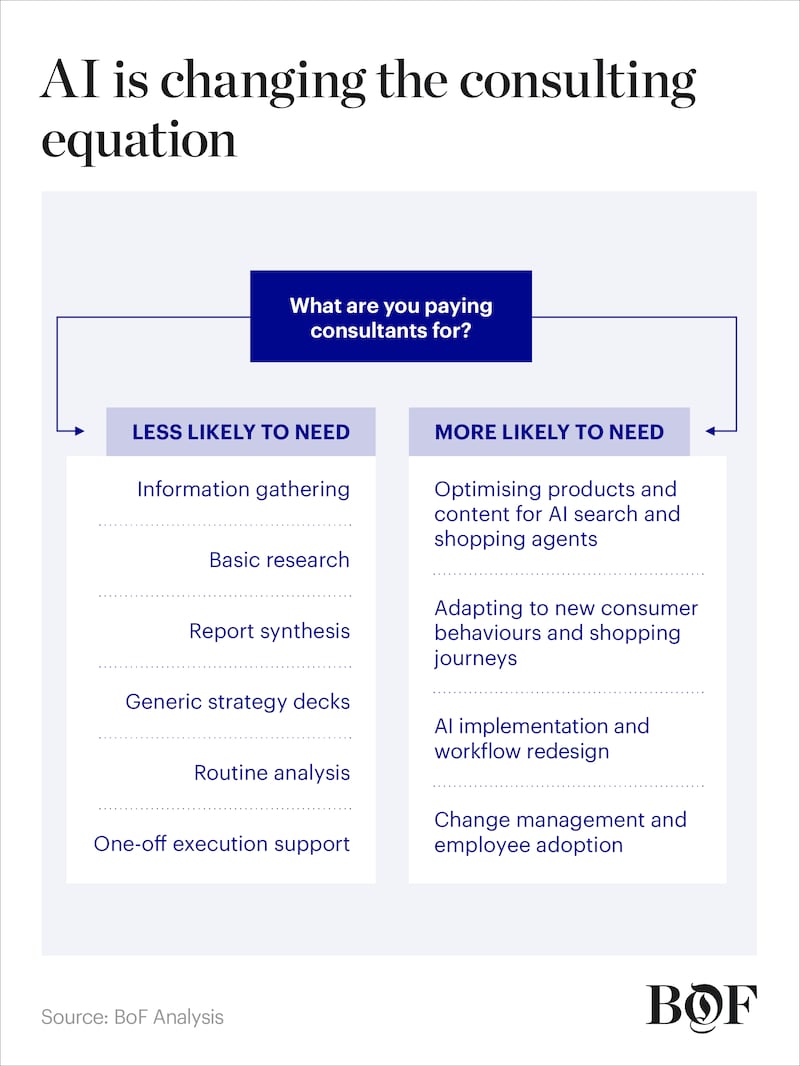
As AI makes it easier for employees to conduct research, draft content, analyse data and fully handle work that once required outside support, many fashion companies are reassessing which capabilities truly need to sit outside the organisation. Tasks that once justified agency retainers or specialist consultants are increasingly being handled in-house.
This shift is forcing fashion brands to reassess which situations still require outside expertise, and how much they’re willing to pay for it.
But companies also shouldn’t expect to slash consulting budgets wholesale. Sander Ardinois, managing partner at Ardinois Consulting, who describes himself as an “executive AI & data advisor” and works with fashion, finance and other industries, said consultants will continue to offer value by focusing on strategy rather than execution, since companies will be able to hand over more of the latter to AI.
Executives should regularly assess whether the expertise they need today is the same expertise they needed three years ago. As AI reshapes how consumers discover and purchase products, for example, companies may find they require entirely new types of outside support.
“If you’re going to have less and less human shopping, you have whole new channels of ‘how to market to bots, and how to work with AI shopping agents, and how to optimise your site and your Instagram, and how to use TikTok,’” said Ari Bloom, founder and chief executive of brand development company A-Frame Brands, which has helped develop brands including Naomi Osaka’s Kinlò and John Legend’s Loved01.
Brands may need to re-evaluate their use of consultants whose primary value proposition is synthesising information that AI can increasingly provide on demand. Bloom said experts who charge $10,000 a month to provide the same information AI can now offer in seconds are becoming harder to justify.
Want to dive deeper? Check out “How to Redesign Your Organisation for AI,” BoF’s executive memo on how companies are adapting leadership structures, talent pipelines and decision-making processes for the AI era.
Artificial intelligence is changing how businesses operate as employees become more self-sufficient and routine work is increasingly automated. To build companies that thrive in this new paradigm, fashion executives must rethink leadership structures, talent pipelines and decision-making processes.
Sheena Butler-Young is Senior Correspondent at The Business of Fashion. She is based in New York and covers workplace, talent and issues surrounding diversity and inclusion.
Loading recommended reads…
The cosmetics group became France’s most valuable listed company on Tuesday, the first time since 2017 that a non-luxury company has claimed the top spot at the end of a trading day.
The licensor could pursue an IPO as early as the first half of next year.
The industry veteran is joining Latino-focused media platform Avance Global to establish a new lifestyle brand that will span fashion, design, travel, food, culture and entertainment.
The group is hoping the renovated eight-level complex can generate €100 million in annual revenue, chief executive Andrea Guerra told Reuters.