Agenda-setting intelligence, analysis and advice for the global fashion community.
Agenda-setting intelligence, analysis and advice for the global fashion community.

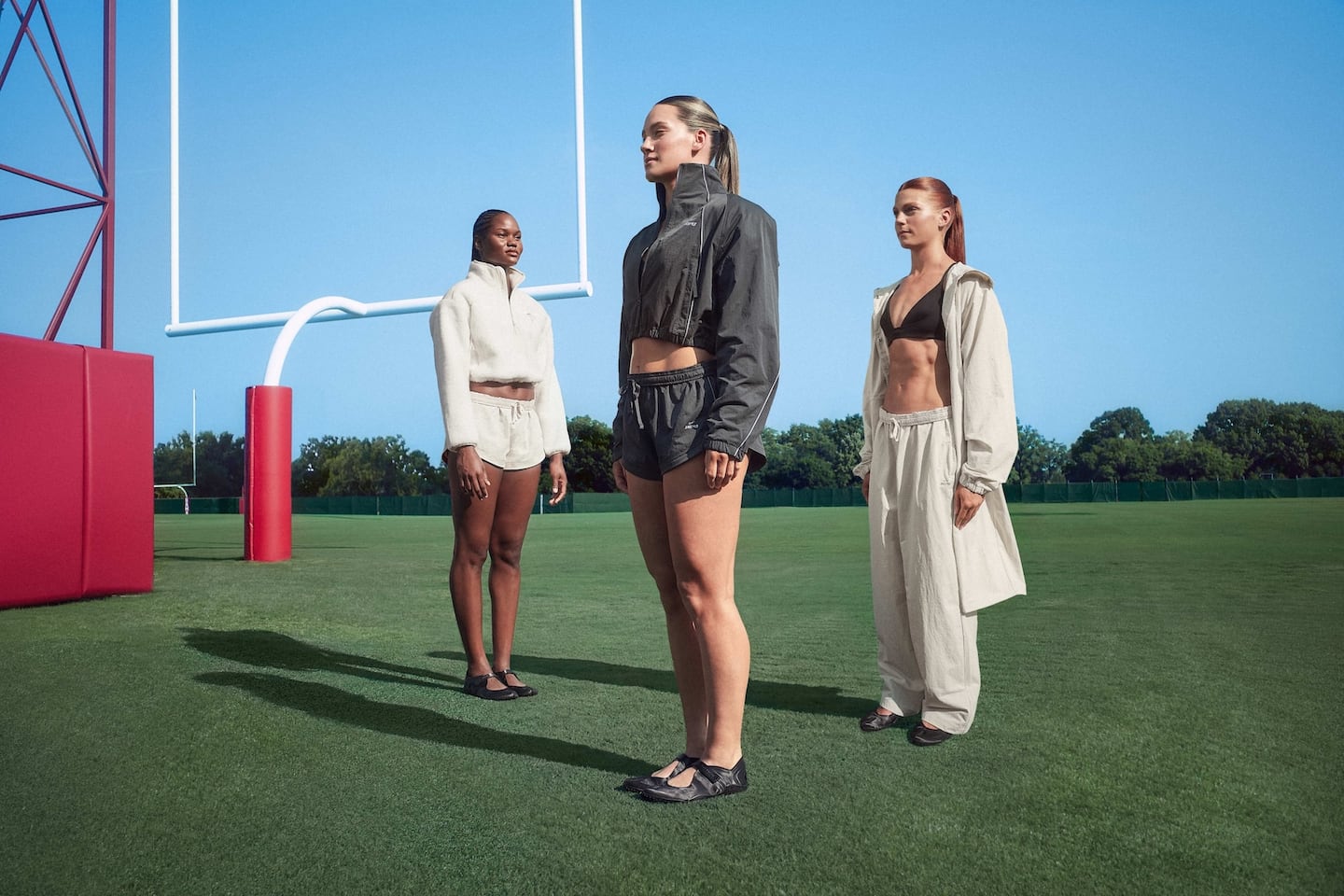
It’s time for Nike to break up with Kim Kardashian.
At his investor presentation this week, Nike chief executive officer Elliott Hill may well set out plans to further develop the partnership with the star’s smoothing and sculpting apparel line, Skims.
This would be a mistake. Hill should end the collaboration announced less than two years ago.
As with his efforts to revive Converse, a brand which I have argued should be sold, developing NikeSkims is a distraction for an executive team struggling to implement a broad turnaround. Building the athletic shapewear line at a time when fashion has turned against its slinky silhouettes would take significant time and investment, with little hope of moving the needle much for the sportswear giant. Even if the joint venture became a $1 billion business, that would still only be about 2 percent of Nike’s sales.
ADVERTISEMENT
Hill would be better off devoting his energy to solidifying his “sport offense” strategy, which centres on clothing and footwear designed to help wearers run faster, play harder and lift heavier, or stepping up the company’s overall approach to fashion.
When Nike announced the multi-year tie-up with Skims in February 2025, it looked promising on several fronts. The line was designed to offer a stylish range of performance wear for women, whose participation in sport is increasing. It also offered the potential for Nike to become a more potent force against athleisure players such as Lululemon Athletica and Alo Yoga.
And of course, Skims is fronted by one of the most famous women on the planet, guaranteeing acres of press coverage and ton of social media chatter.
But the partnership was challenged from the start.
Due to arrive in spring 2025, it didn’t land in the US until the autumn, with the international debut following in spring 2026. Skims’ range has also been inconsistent. While the joint venture wisely leaned into casual fashion footwear, with a sneakerina (a hybrid between a trainer and a ballet flat) and a new, low-rise waffle shoe, its tiny bra tops and leggings with visible thong-like contouring stitched onto the backside look more niche.
The brand has been popular in Asia; NikeSkims’ first standalone store opened in Shanghai in September. Yet the tie-up received only a passing mention in Nike’s last analyst call in October, and did not feature at all in the previous call in June — surprising given the venture was announced with great fanfare. Nike declined to comment when I asked about the brand’s sales.
Growth in women’s sportswear is outpacing that of men’s, according to analysts at RBC Capital Markets. But Nike has other, better ways to reach female athletes. Hill told analysts in October that the first shoe to be produced under Nike’s $28 million contract with basketball star Caitlin Clark was the largest women’s signature shoe launch in company history.
The Skims deal was brokered by Hill’s predecessor John Donahoe, so the current CEO could easily walk away without too much loss of face. Skims potentially could buy out Nike’s share in the venture and bring that piece of the business fully in-house. Or perhaps Nike could acquire all of Skims, giving it broad access to the company’s successful shapewear business. But Skims was last valued at $5 billion, and Nike’s balance sheet has been weakened by three years of underperformance.
ADVERTISEMENT
Nike had $2.2 billion of free cash flow in the year ended May, a third of what it generated two years earlier, according to Bloomberg data. With Nike committed to its dividend, which according to Morningstar analyst David Swartz costs more than $2 billion a year, a sizeable acquisition looks unlikely.
The danger for Nike, if it chooses to back away, is that Skims takes its activewear offering to a rival such as Adidas, where CEO Bjorn Gulden has developed buzzy sneakers and apparel, particularly for women. On is building its non-running business, too, and could be another potential partner.
For Nike, these risks are worth taking.
The investor day is expected to outline a path to growing sales again and rebuilding the operating margin to 10 percent, up from an expected 5.5 percent this year, according to the Bloomberg consensus of analysts’ estimates.
Achieving these goals is already hard enough. Nike doesn’t need anything that makes it harder to shape up, including Kardashian’s Skims.
By Andrea Felsted
The sportswear giant has much to explain at its first capital markets day in almost a decade as it works to reignite demand and restore investor confidence.
Kim Kardashian’s shapewear brand is preparing to enter many new markets in the US and, increasingly, globally. CEO Jens Grede spoke with The Business of Fashion about his vision to create ‘the Apple store of apparel.’
After dominating wardrobes for more than a decade, leggings are no longer the go-to bottom for younger shoppers. Activewear brands are scrambling to adapt.
Loading recommended reads…
As the much-anticipated video game’s sales outpace even Hollywood’s biggest blockbusters, savvy fashion brands are embracing gaming’s growing audience offline.
Hooper talks to Imran Amed on The BoF Podcast about what it really takes to make it as a model today, the growing expectation that models double as content creators, and why she’d rather not “sing about it on Instagram.”
Despite the confidence put on display at Nike’s investor day by chief executive Elliott Hill, the company still has to prove itself to investors and consumers as it sets a new cultural standard for itself.
Investors will turn attention to the strength of consumer spending in hopes signs of a solid economy can stabilise a market shaken by unease about the AI trade.