Agenda-setting intelligence, analysis and advice for the global fashion community.
Agenda-setting intelligence, analysis and advice for the global fashion community.


When Swiss sneaker brand On reported its latest results last week, the company couldn’t help boasting about its profitability.
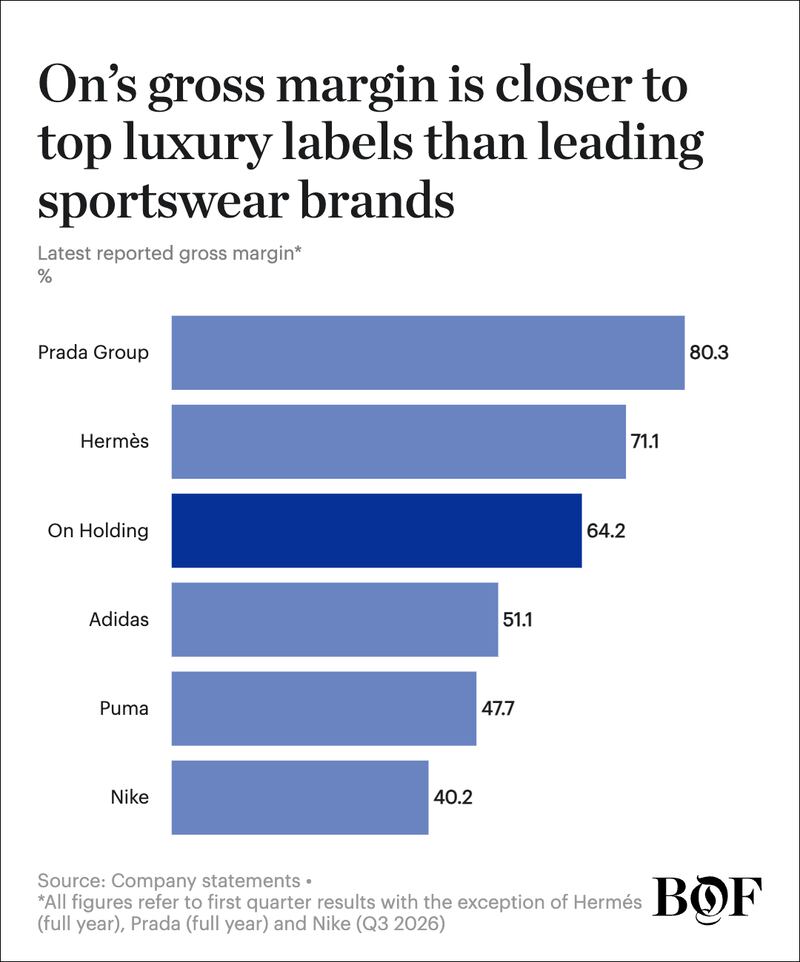
Despite tumultuous macroeconomic circumstances, including the Trump administration’s volatile tariff policy and the US-Israel war in Iran, it hit a new record for the first quarter of the year. Gross margin — a measure of how much profit a company makes on sales of its goods after subtracting production costs — reached 64.2 percent, up from 59.9 percent the year before.
That figure far outpaces the margins of larger, established rivals such as Nike and Adidas, who reported gross margins of about 40 percent and 51 percent, respectively, in their latest quarters. In fact, it doesn’t look much like the margins of other sneaker brands at all.
“You can argue that On sits at or near luxury levels,” said Simeon Siegel, a senior analyst and managing director at Guggenheim Partners. On’s reported gross margin sits closer to top luxury companies like Prada at 80.3 percent and Hermés at 71.1 percent.
ADVERTISEMENT
Profitability has remained as much a priority for On as sales growth as the brand’s popularity has exploded in recent years. On a call with investors and analysts last week, outgoing chief executive Martin Hoffmann said the brand’s “vision to be the most premium global sportswear brand has driven one of the highest gross profit margins in the industry.”
“This isn’t a one-time peak,” Hoffmann added. “It is driven by the fundamentals of the brand and our business model, and we consider this new level as our new baseline for the year.”
But sustaining that level longer term won’t be easy. On’s sales growth has slowed significantly in the Americas, its largest market. In a May 12 note to clients, Jefferies analyst Randal Konik predicted it will turn negative in 2027. Once that happens, “margin outperformance will end & declines begin,” he wrote.
On’s philosophy on pricing is what drives its margins. The company is widely known for selling premium products with premium price tags. It works to avoid discounts and promotional events — especially for its newest items.
That strategy has proven to be effective. Hoffmann said On’s average selling price in the first quarter increased from $145 to $170. Despite that price hike, the company’s net sales still grew by 14.5 percent to CHF 831.9 million ($1.06 billion). Wholesale and direct-to-consumer sales increased by 13.3 percent and 16.4 percent, respectively.
“Very simply, people are buying their shoes at full price,” Siegel said.
The margins of the footwear industry’s titans have struggled to come close. Nike has hovered around 40 percent over the last few years as the company continues to churn old inventory, which requires a lot of discounting. The same can be said for Puma. Adidas’ margin is healthier, around 50 percent, but still falls short in comparison.
One of the company’s advantages in maintaining its strong margin is its relatively narrow product assortment. Brands like Nike and Adidas have far broader product ranges that include more affordable items, not just premium ones, which tend to offer higher margins.
ADVERTISEMENT
On’s consistent full-price sales allow it to reinvest more money into innovation and improving its products, adding more details for example, in order to drive greater desirability, new co-CEO and company co-founder Caspar Coppetti said on the company’s earnings call.
Coppetti also noted that On has started to see more efficiency from scale and from measures it has taken to keep supply costs in check, both of which are also helping its margins.
Not everyone is convinced that On’s margins can remain sky high forever.
Jefferies’ Konik noted the company’s slowdowns in multiple regions, particularly the US, where its sales for the quarter only grew by 3.1 percent year over year. On its current trajectory, On’s sales growth in the region is set to turn negative next year.
Konik, who stuck the brand with an “underperform” rating, also looked at On’s EBITDA margin, which includes a broader view of the company’s operating performance, including costs such as stores. The company’s outperformance on that measure is on “borrowed time,” he wrote, as On’s growth slows and expenses like new stores in São Paulo, San Francisco, Stockholm and Sydney arise. He also questioned the company’s reinvestment strategy.
“Management noted they are reinvesting GM gains back into product costs,” he wrote. “These structural expenses layer in while growth slows, creating a margin trap.”
There are ways to navigate growth that might still keep margins strong. Brands can introduce lower-priced items and entry-level products that maintain brand value while keeping costs down, Siegel said. As long as the promotions and price reductions are proactive instead of reactive, the brand can be in a good place.
“At some point, to grow, you will need to lower your price. You will need to promote,” he said. “Where that ‘some point’ hits can be well into the future.”
It’s not a simple feat to keep up a high share of full-price sales indefinitely, particularly for businesses like sports brands that appeal to a mass audience rather than just the 1 percent. On faces a challenge many of its rivals would envy.
On Holding AG raised its profit outlook after a robust start to the year that saw consumers snap up the Swiss brand’s growing range of apparel and new sneakers.
The Swiss brand raised its annual revenue forecast for the third time this year.
On finished its 2025 fiscal year with 30 percent sales growth. Despite its successful run last year, the company isn’t getting ahead of itself for 2026. Co-founder David Allemann explains that and more in today’s newsletter.

Mike Sykes is the Sports and Fashion Correspondent at the Business of Fashion. He is based in Washington, D.C. and is laser-focused on covering the sportswear world where it intersects with fashion, tech and more.
Loading recommended reads…
Sales of gems, precious metals and artwork at Japan’s department stores climbed 19 percent in the first half of 2026 from a year earlier to $2 billion.
Though Adidas dressed both teams in the World Cup finals, the global football tournament still presented some bright spots for Nike, writes Bloomberg’s Andrea Felsted.
From our archive, the creator and host of award-winning podcast “Articles of Interest” joins BoF founder, CEO and editor-in-chief Imran Amed to explore what clothing can reveal about identity, culture, labour and the world around us.
Saunders, the brand’s first creative director in five years and a skilled colourist, promises to give Kate Spade the clarity it has long lacked. Now, Tapestry must apply the same long-term brand-building discipline that fueled Coach’s success.