Agenda-setting intelligence, analysis and advice for the global fashion community.
Agenda-setting intelligence, analysis and advice for the global fashion community.

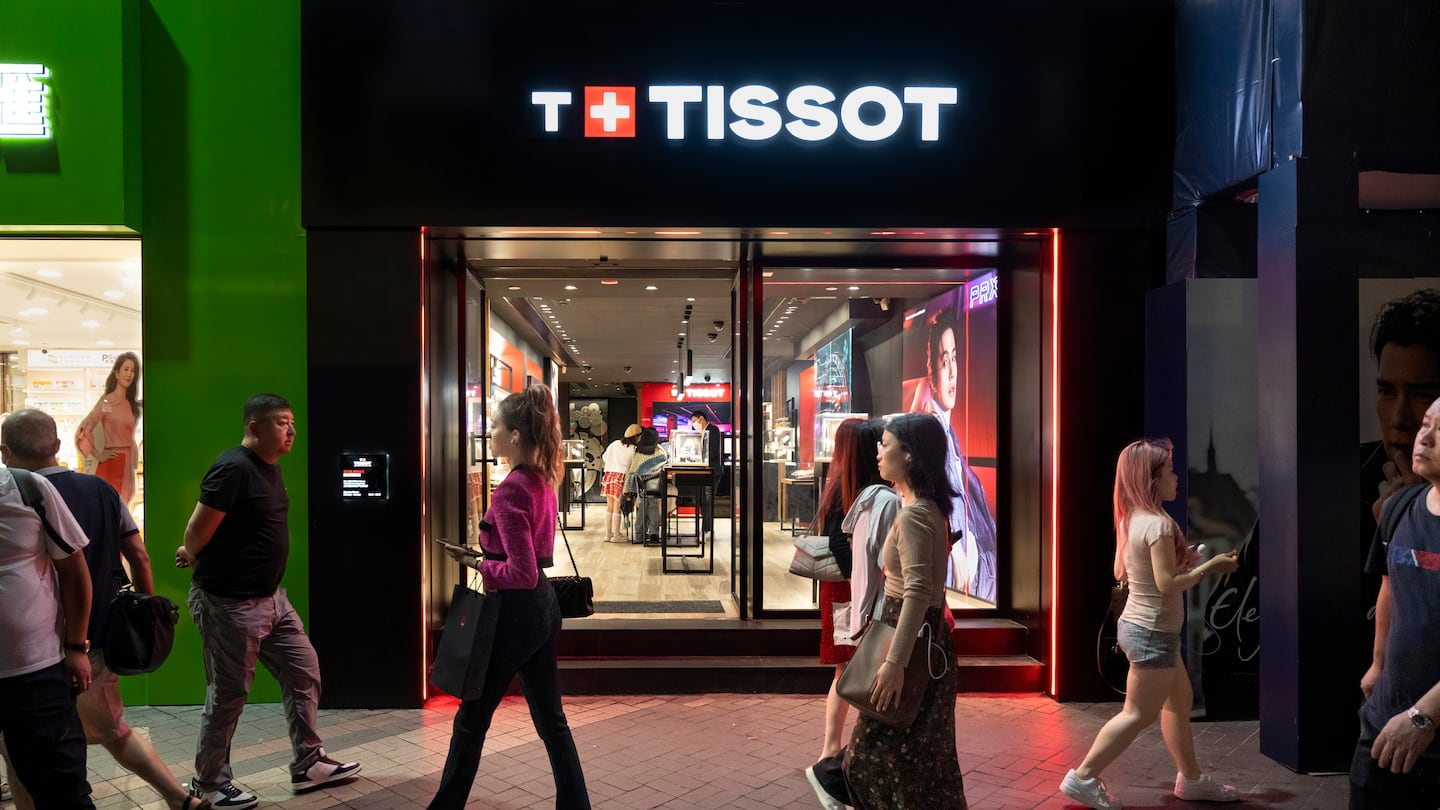
In Swiss watchmaking, a crisis looms? Over the past decade, the industry has shifted from a focus on volumes to a value model — part of a wider luxury trend known as premiumisation. Export volumes have roughly halved since 2015, with the loss of around 13.5 million units annually. This has put dozens of manufacturing businesses and thousands of jobs at risk. Inside the sector, calls are growing for urgent restructuring.
“I think this is damaging for the industry because an industry needs quantity,” said Patrik Hoffmann, CEO of Favre-Leuba. “I can see small suppliers going under and at some stage their know how and capacity will be missing.”
Some relief has come from RHT, a Swiss short-time work compensation scheme, also known as Kurzarbeit, that has been extended from 12 to 24 months to help protect skills and jobs during the downturn. But some analysts and brands are describing the measure as a fig leaf that disguises a broader crisis, ultimately slowing down the hunt for solutions.
“RHT avoids triggering a tsunami, which would be the loss of thousands of supplier jobs,” said Oliver Müller, founder of the Swiss specialist watch industry consultancy LuxeConsult. “But it also avoids what needs to be done, which is a restructuring of the whole industry.”
ADVERTISEMENT
The RHT extension was due to end this month, but in May, the Swiss Federal Council quietly voted to let it run for at least another six months, through to next January.
The measure was adopted “against a backdrop of significant uncertainty in the global economy and in international trade,” said Fabian Maienfisch, a spokesperson for Switzerland’s State Secretariat for Economic Affairs, or SECO, speaking to The Business of Fashion. He pointed to conflict in the Middle East and unresolved US tariffs, which are expected to be revised again in August.
Meanwhile, Swiss watch exports continue to fall, down 3.1 percent by value, year-to-date according to the Federation of the Swiss Watch Industry (FHS), although volumes are marginally up, boosted by the US market – likely due to stocking ahead of a new tariff announcement.
Müller estimates 34,000 Swiss watch industry jobs are tied to manufacturing — roughly 40 percent of the total — with as many as 7,000 of them under threat. Low-skilled jobs are most vulnerable.
“Unless you’re specialised in high-end surface treatment or the machining of special materials, you will have a very hard awakening once RHT disappears,” Müller said.
In the first quarter of last year, around 4,500 watch sector employees had enrolled on the RHT scheme according to data provided by SECO, although by the end of the year, the figure had fallen to around 2,800. While the 2026 figures are still provisional, use of the scheme has continued to decline, Maienfisch said.
Brands at the higher end of Swiss watchmaking have proved most resilient, with many including Rolex, Patek Philippe and Audemars Piguet, pursuing vertical-integration strategies, to ensure control of their own production.
The industry’s total revenues have climbed to record levels during the volume decline, driven by rising prices. Some high-value, low-volume brands have doubled down on their strategy.
ADVERTISEMENT
“We don’t believe that a business model driven by volumes is relevant for us,” said Girard-Perregaux chief executive Marc Michel-Amadry. The brand is owned by Sowind Group, which is known to have used RHT in the past. Michel-Amadry said that since the re-release of its Laureato sports watch model in June, he had decided to limit production of a $24,500 time-only version with a blue enamel dial to just 300 pieces (the outgoing model is $15,000). The brand now targets total annual volumes of between 6,000 and 8,000 pieces, after previously exceeding 10,000.
The shift to more complicated watches with higher values was bringing results, he said. “Year to date, we are selling three times more grandes complications by volume and 2.5 times more in value.” Girard-Perregaux’s collection includes a piece at $590,000. “Our average price is growing substantially,” he said.
Still, the executive sees volumes as playing a vital role in sustaining the sector.
“Value-only has its limits,” he said. “At some point, the supply ecosystem, which is critical for the whole industry, will suffer too much.”
Swatch Group, Switzerland’s largest watch manufacturer, has said it is not using RHT, betting on a pick-up in volumes. The group owns a number of high-volume brands, including Swatch and Tissot, as well as a network of suppliers that manufacture movements and other watch components.
While the group does not break down its performance by brand (it also owns Omega and high-end maker Breguet), according to Morgan Stanley estimates, it accounts for more than 60 percent of Switzerland’s volumes. Swatch and Tissot alone are believed to account for around 6.8 million units of the country’s annual total of 14.6 million.
While Swatch’s popular collaborations with Omega and Audemars Piguet — MoonSwatch and Royal Pop respectively — have added millions of units, some say they have artificially inflated Switzerland’s export volumes.
“People in the Swiss watch industry are only interested in the very high luxury and they don’t see the profitability and volume the sub-$1,000 brands can generate,” Tissot’s chief executive Sylvain Dolla told BoF earlier this year. “Our volumes increased last year and we enjoyed a fantastic profitability increase,” he added.
ADVERTISEMENT
Illustrating Swatch Group’s struggles, net profit fell to 25 million Swiss francs in 2025, a decline of almost 90 percent — and marking a steep drop from 748 million in 2019.
While Swiss watchmakers have cited product improvements, the rising cost of materials and the strength of the Swiss franc to defend their price hikes, the drop in volumes is also making watches more expensive, according to Oris chief executive Rolf Studer.
“Our suppliers give lower volumes as a reason for the rising prices of components,” he said. Oris, which sells watches mostly priced between $2,000 and $3,000, is a traditional “établisseur,” or assembler, that outsources manufacturing.
Lower demand has not made accessing components easier. “Quite the opposite,” he said. “We have delays. If volumes do pick up, the delays will be even longer.”
But a spiral risks developing. With brands selling fewer watches and sourcing fewer components, and with RHT removed, some businesses will go bust. With fewer suppliers available, costs will rise further, placing even more pressure on brands to deliver value for buyers.
Still, some brands are finding ways to benefit from Switzerland’s volume-to-value shift.
Christopher Ward, which is based in the UK but has Swiss suppliers, became the first British watch company to enter Morgan Stanley’s ranking of the top 50 Swiss watch companies this year, with sales of 51 million Swiss francs against 39,000 watches, indicating an average selling price of around 1,300 Swiss francs, before sales taxes.
“The increase in average selling price of mid-tier brands like TAG Heuer and IWC has given us more headroom,” said Mike France, Christopher Ward’s co-founder and chief executive. “We’re filling a gap left by others.”
Fluctuating orders following President Trump’s Liberation Day tariffs have further complicated matters, creating an order vacuum late last summer, said Fabien Schirmer, chief executive of the Swiss movement supplier Ronda.
“We were forced to have RHT,” he said. “But only for three and a half months.”
Last month, the company, which is known as one of Switzerland’s leading quartz movement suppliers, introduced a new mechanical calibre, the R01, intended to support the business through a volatile season.
“When a crisis hits and you have economic instability, lower tier watches are affected much more than the higher end,” said Schirmer. “Mechanicals [movements] are quite stable through a crisis,” he added.
Christopher Ward’s France said brands would only survive if they restructured. “A direct-to-consumer model like ours has the advantage of being demand-led, whereas the watch industry has almost always been supply-led,” he said. “This is a paradigm shift that needs to occur in the watch industry.”
The current RHT extension period is set to run until the end of January next year, but Maienfisch at SECO said it could yet be extended to the end of 2028.
Some industry figures said that would be foolish. “RHT is meant to overcome cyclical uncertainties,” said Müller.
Studer, who said he had used the scheme only briefly because it quickly damaged morale, agreed. “It’s not here to foster our structures that are not competitive any more,” he said.
Few were ready to predict the return of volumes.
“If we can raise relevance, volumes will rise again,” said Studer.
Müller predicted volumes would continue to decline. “Switzerland will be down to 12 million units by 2030,” he said.
“We could miss the opportunity of admitting we need to change the structure of the whole industry,” he continued. “We need to stop thinking we can preserve all the jobs. The issue becomes, who is going to survive?”
Loading recommended reads…
The Italian label has continued to enjoy solid growth in China, defying a wider downturn in demand for European luxury. The June 11 presentation of its summer collection will be the latest in a series of travelling shows.
Despite struggles in the sportswear industry, Asics has maintained its momentum so far in 2026. Asics president and chief operating officer Mitsuyuki Tominaga explains how the company turned things around over the last decade and how it’ll keep moving forward.
This week’s round-up of global markets fashion business news also features a crackdown on workplace harassment at Indonesian garment factories, South African Fashion Week and Musinsa’s deepening ties with Japan’s Zozo.
Amid mounting pressure in the West, global titles including Vogue, Harper’s Bazaar and Elle are launching multi-country editions from the Baltics to the Balkans, tailoring their business models to the economics of smaller markets.