Agenda-setting intelligence, analysis and advice for the global fashion community.
Agenda-setting intelligence, analysis and advice for the global fashion community.

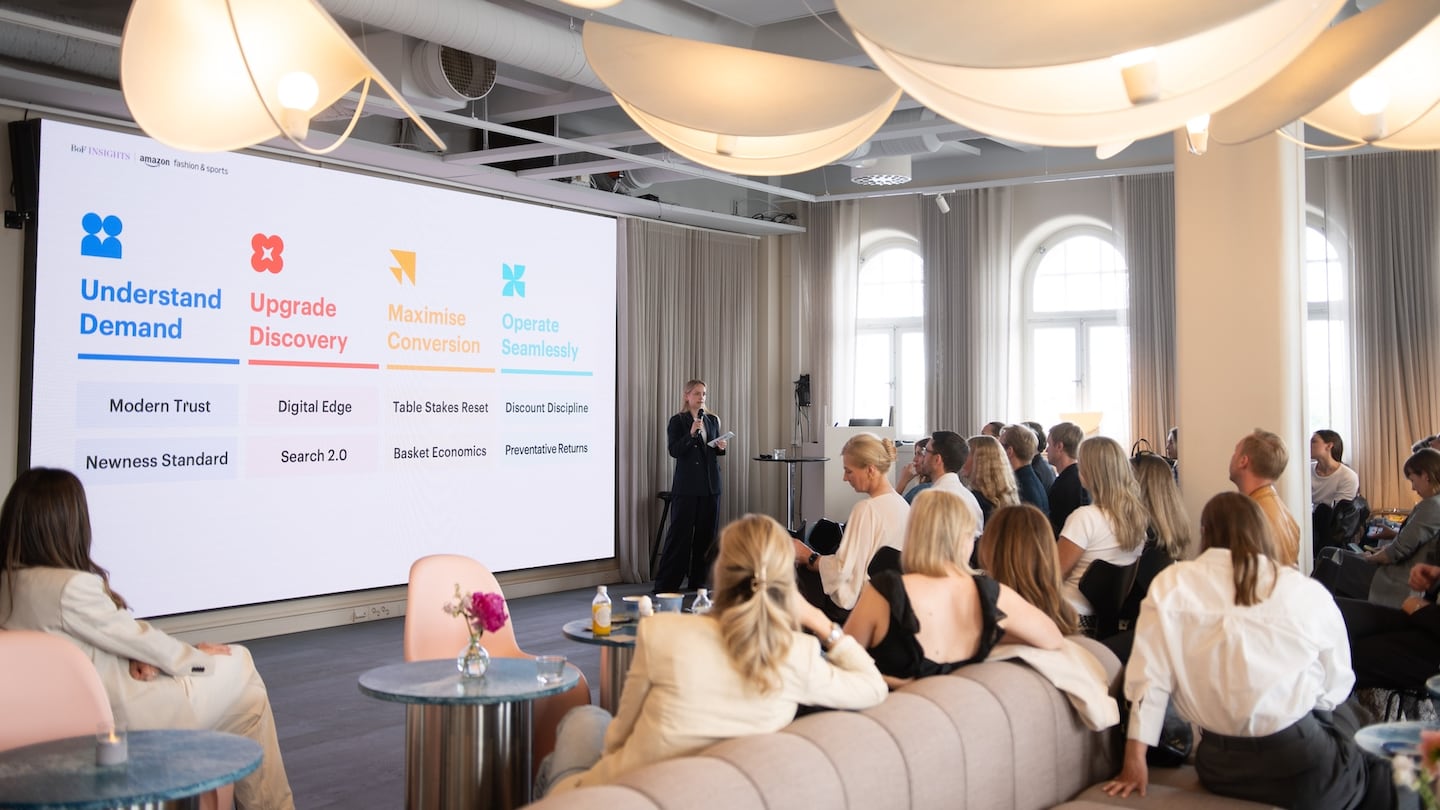

STOCKHOLM — On Thursday 11 June 2026, as Stockholm Fashion Week drew to a close, leaders across fashion and sports in Sweden gathered for an exclusive presentation exploring the latest evolutions in fashion and sports e-commerce — and how brands can deftly navigate an increasingly complex digital landscape.
Hannah Crump, director, BoF Insights, shared an exclusive preview of BoF Insights and Amazon Fashion and Sports’ upcoming e-commerce report, due to be released this September. The report examines the key challenges, opportunities and strategic moves brands should consider to remain competitive.
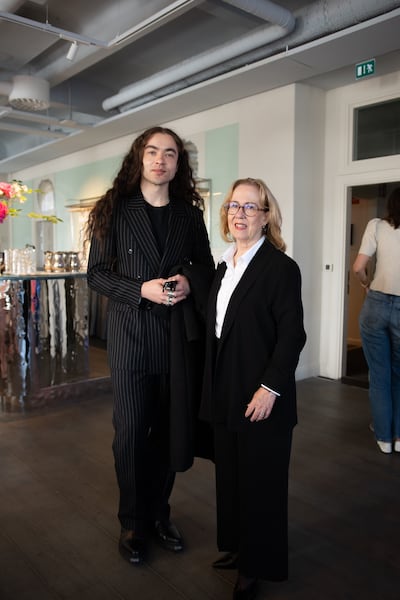
The event kicked off with a toast from Madeleine Sjöstedt, director general of The Swedish Institute and John-Jamal Gille, director of The Association of Swedish Fashion Brands and director of Stockholm Fashion Week.
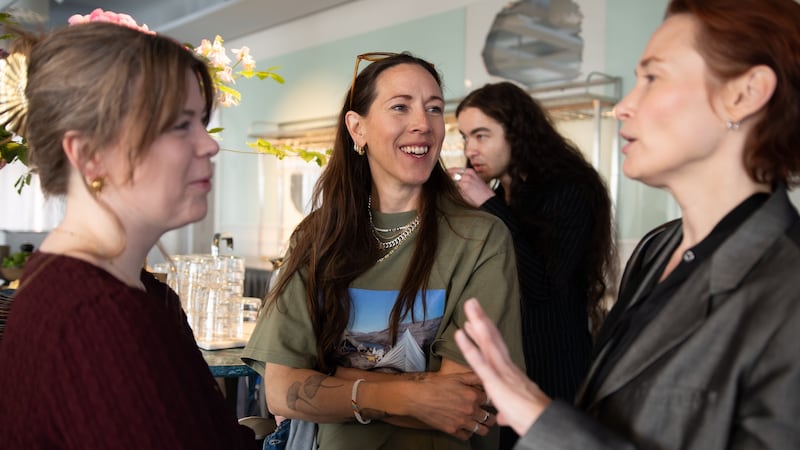
Executives from the country’s major players — such as H&M, Arket and Fjällräven — and leaders from regional and global brands, including House of Dagmar, Morjas, Stand Studio, Filippa K, Totême, Flattered and more, attended the presentation.
Sweden’s fashion and sports e-commerce market is a sophisticated one. “Swedish customers are adopting e-commerce at great rates. They are also preferring to shop online,” said Crump. “In many ways, it actually provides us with a glimpse of how the rest of the world will follow.”
According to Boston Consulting Group, Sweden is one of Europe’s most digitally mature markets. More than 90 percent of Swedish consumers go online at some stage of the purchase journey, while a third use online platforms as their primary channel for buying apparel — placing Sweden among Europe’s most digitally engaged fashion markets after Germany and the UK.
Speaking to BoF in advance of the event, Gulfem Toygar, country manager of Amazon Sweden, described the country as one defined by “clarity of design, commitment to quality and an ability to build brands that resonate globally.”
During the presentation, Crump unpacked the state of global consumer sentiment — and the strategic levers brands can pull to prepare for the next era of online shopping. Following the presentation, Jasmin Kossmann, head of business development at Amazon Fashion and Sports, joined Crump for a Q&A to detail how the platform is enabling fashion brands to leverage its ecosystem to act as a “proxy of trust” for new customers.
Below, BoF distills some of the key insights from the event.

Today, recommendations from family and friends remain paramount for building brand trust. However, the pillars of purchasing influence are shifting.
Brands are increasingly looking beyond celebrity endorsements to professional athletes and sports stars, whose use of products in demanding real-world conditions lends greater credibility to recommendations.
Nearly one-third of all EU5 consumers state they are likely to buy a product based on a recommendation from a sportsperson, according to insights from BoF and Amazon Fashion and Sports’ proprietary research. Meanwhile, 17 percent of celebrities inspire consumers to purchase.
“Celebrities were once the traditional mouthpieces of brands, but now customers are actually looking to sportspeople instead. It’s suggesting a change of the tide in who people are looking to for admiration, but also for consumption,” said Crump on stage.
For instance, following the London Marathon — in which Kenyan Sabastian Sawe clocked a sub-two-hour time in Adidas’ Pro Evolution 3 running shoes — a limited inventory of the shoe sold out in 10 minutes, despite the $500 price tag.
Alongside this comes a shift in content creation dynamics. Consumer attention is increasingly shifting from macro influencers (those with a large following, often in the millions) to micro-influencers (those who average between 10,000 to 100,000 followers). According to BoF’s reporting, “micro-influencers have a knack for creating the sort of content that convinces followers to spend.”
“Thirty-eight percent of Gen Z are looking to micro-influencers for recommendations. Micro-influencers are particularly powerful and valuable to brands and retailers because they can generate social proof around products and brands,” said Crump.
Brands that employ cross-channel engagement strategies therefore achieve significantly better results than those relying on a single-channel approach. Research from customer engagement platform Braze found that coordinated multi-channel campaigns can drive significant improvements in purchases, customer lifetime value and retention, including 73 percent higher purchases, 4.2 times higher customer lifetime value and 58 percent higher retention.
Yet creating a seamless experience across a fragmented landscape is becoming more difficult.“Experts are increasingly saying that this is near impossible to achieve,” said Crump.
Rather than attempting to deliver the same experience across all channels, brands should focus on defining the unique role each channel plays within the customer journey.
“Actually, what brands should be looking for is to create digital destinations and specific destinations that are tailored to those particular channels without one cannibalising the other,” said Crump. “Online, that means creating a ‘digital edge’.”
Research from BoF and Amazon Fashion and Sports shows that industry leaders currently view e-commerce as a core platform for product discovery and brand building, rather than just a sales channel.
The opportunity is particularly evident in Sweden. According to Toygar, “80 percent of Swedish SMEs selling on Amazon already reach customers internationally, generating more than 2.6 billion SEK ($277 million) in export sales.”
Today’s retailers are focused on building highly engaging and richer digital destinations that enable consumers to grow more and more comfortable making high-consideration purchases online.
“You really need to be here when the customer is making the decision,” said Gustav Lidén, founder and CEO of Flattered.

The shift reflects a broader change in consumer expectations. Increasingly, people expect brands to inspire before they sell.
“We are really trying to get the best website experience… so customers can choose the best product,” said Marie Forssenius, CEO of Filippa K, following the presentation.
This is also reflected in marketing spend, with 67 percent of brands prioritising brand marketing as top-of-funnel media increasingly compresses the marketing funnel and drives conversion, according to BoF Insights and Amazon Fashion and Sports.
In recent years, consumers have been experimenting with using artificial intelligence in their shopping journey. Findings from Riskified, an e-commerce fraud protection service, anchored in a survey of 5,000 shoppers globally, show that nearly three in four are already using AI in their shopping journey, whether consulting ChatGPT for product ideas or to summarise reviews and compare prices.
As consumers adopt new tools, the nature of search itself is evolving.
“People aren’t searching for keywords anymore, they’re searching for occasions. And what’s really interesting for us is, we’re a brand whose philosophy is about a wardrobe that should take you seamlessly from occasion to occasion depending on how you style it, layer it and make it look nice,” said Amelia Sciard, vice president of marketing and communication at Filippa K.
“For us, this presents an incredible opportunity to be able to answer the needs of our customers in a better way,” she added.
Indeed, according to Amazon’s Kossmann, “the majority” of fashion searches on Amazon don’t include a brand. “Customers are searching for ’90s cream jeans’ or ‘high-waisted jeans’ and are open to being shown products that fit their needs. [...] Amazon is helping to democratise opportunities for brands to be discovered by new customers.”
The shift is allowing smaller labels to reach new audiences beyond their native markets. As Toygar noted, Amazon can be “a place where a Swedish label can find its audience in thirty countries while staying true to everything that makes it remarkable.”
At the same time, tech companies like Google and OpenAI are experimenting with AI-powered shopping agents that can make purchases on a consumer’s behalf — prompting retailers to prepare for this future.
“It’s still the early days of experimentation. Agentic AI shopping is not widely adopted yet, but experts expect it to be commonplace in the years to come,” said Crump.
Earned consumer trust may be one of the most important levers as this new era of shopping unfolds.
“We asked consumers in our survey: If you were to instruct an AI agent to purchase fashion or sports products on your behalf, which type of company would you feel most comfortable entrusting with that task? Online retailers emerged as the clear preference,” said Crump. “They’re the ones that have spent many years building relationships with customers. So, they are really well positioned to really make use of this shift.”

Yet, the challenge for brands extends beyond simply being present in AI-powered shopping environments. Brand expertise and values must be portrayed in these emerging systems.
“The consumer is super interested in our credibility and knowledge,” said Therese Maurin, brand marketing director of lifestyle at Fjällräven. “To be able to work with AI but still understand that a lot of our knowledge comes from community aspects and forums is important to the brand and our customers.”
At Amazon, AI is being used to broaden product discovery. “AI allows us to fulfil customer needs in a way that is much more personalised than in the past,” said Kossmann. “Because results are tailored to the individual, it should actually lead to greater diversity in styles.”
Yet, even as shopping journeys become more automated, the fundamentals of brand building remain unchanged. AI may help consumers discover products and navigate choices, but emotional connection and a sense of value still shape purchasing decisions.
“You want to leave the customer with the feeling that they made a good choice and that they got something special,” added Lidén.
Today, gaps persist between what customers want and what brands deliver in the digital space.
“Product information and fit are the main concerns for actually having a really good experience online,” added Forssenius. “You are trying to deliver the best website experience, but when that doesn’t [happen] it means the customer may actually back off.”
Shoppers can quickly become frustrated with friction in the checkout process, which alone costs retailers billions of dollars annually. Baymard Institute, which conducts research on the user experience (UX) of e-commerce sites, finds that customers cite too long and complex checkout processes, unsatisfactory return policies and website errors as the top reasons for abandoning online purchases at checkout.

Despite this, many brands are prioritising experimentation over optimising the already-existing customer experience.
Only 30 percent of brands and retailers are prioritising improving their data foundations, according to BoF Insights and Amazon Fashion and Sports’ survey, despite the growing importance of accurate product information and seamless customer experiences.
Leaders must secure this foundational product data before pursuing complex technological innovations, as customers still need the essentials to work better.
“Only 30 percent of the brands and retailers we surveyed said they’re prioritising fixing these data foundations,” said Crump. “Many brands are rushing to fund more experimental, more creative customer-facing features. But customers still tell us that they’re still finding issues with basics.”
Before investing in increasingly sophisticated tools, brands must ensure the foundations of the customer experience are working as intended.
“Investing a lot in customer agents that reduce friction and get people actual answers has been really helpful to our business,” said Jack Ladow, head of communications at Morjas.
Between 2023 and 2025, around 80 percent of luxury market growth is estimated to have stemmed from price increases, according to BoF and McKinsey and Company’s The State of Fashion 2026 report — a lever that is not feasible to pull indefinitely. Meanwhile, aspirational consumers have begun pulling back on luxury spending as prices continue to rise.
Against this backdrop, 65 percent of consumers view value for money as the primary factor influencing their online purchasing decisions, according to BoF and Amazon Fashion and Sports’ research.
The opportunity to acquire new customers and build loyalty among existing ones may therefore lie less in raising prices and more in delivering value in ways that resonate with consumers.
“Telfar did something really experimental with pricing a couple of years ago. They initially launched products at wholesale prices, with the price increasing every second until the product sold out. That price then became the forever price of that particular product,” said Crump.
“This did multiple things for Telfar. Scarcity created hype among its audience about getting access to that product. It also granted accessibility because of the pricing,” said Crump. “It also helped with forecasting future demands — and enabled them to reinforce their brand positioning.”
As consumers become more selective about where and how they spend, brands face growing pressure to articulate exactly why they are worth the price.
This is a sponsored feature paid for by Amazon Fashion and Sports as part of a BoF partnership.
Loading recommended reads…
This week, Europe’s leading luxury groups LVMH, Kering, Hermès and Prada will show who’s pulling ahead in the stubbornly choppy environment.
Sales of gems, precious metals and artwork at Japan’s department stores climbed 19 percent in the first half of 2026 from a year earlier to $2 billion.
Though Adidas dressed both teams in the World Cup finals, the global football tournament still presented some bright spots for Nike, writes Bloomberg’s Andrea Felsted.
From our archive, the creator and host of award-winning podcast “Articles of Interest” joins BoF founder, CEO and editor-in-chief Imran Amed to explore what clothing can reveal about identity, culture, labour and the world around us.