Agenda-setting intelligence, analysis and advice for the global fashion community.
Agenda-setting intelligence, analysis and advice for the global fashion community.

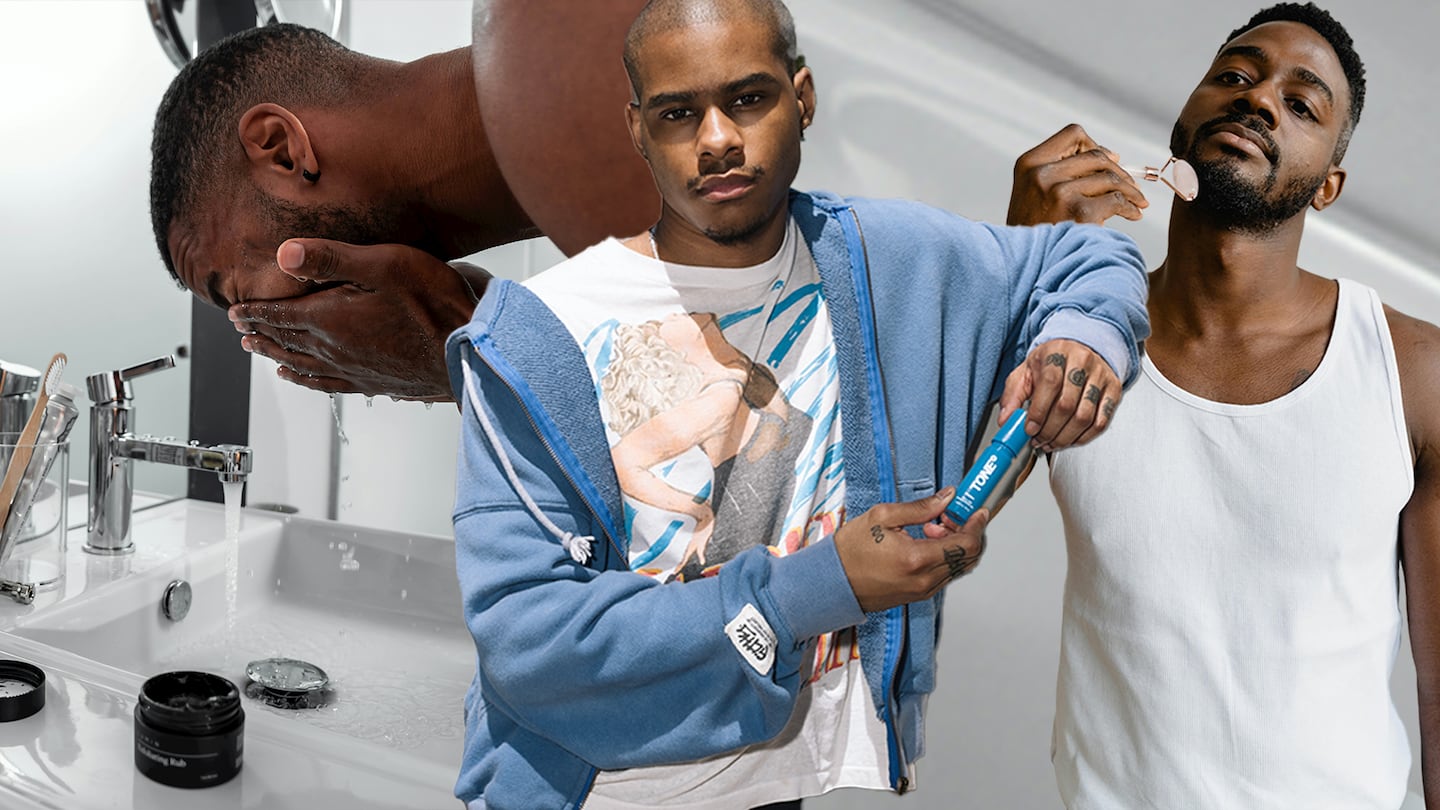
Throughout human history, the most influential voices in men’s beauty — the ones that help shape and shift the billion-dollar male grooming market — have been wives, girlfriends and mothers around the world.
30-year-old New York restaurateur Sameer Bhatt’s routine includes Rhode’s glazing milk, Korean snail mucin and Elta MD sunscreen; 25-year-old British sports reporter Eduardo Tansley’s also has snail mucin, as well as Ouai curl cream and La Roche-Posay cleanser. Both credit their partners with kick-starting their interest in beauty.
But now, they’re shopping more on their own. Tansley said he knows how to look for products that will suit his curlier hair and his oilier skin type. Bhatt said after building up his confidence, he now knows what he wants to add to his cart.
“Most of my routine, I just went out there and got it myself,” said Bhatt.
ADVERTISEMENT
Brands and marketers are aware that mainstream pathways by which brands reach customers, through beauty influencers, glossy campaigns and marketing in retailers like Sephora, don’t land with male customers. They typically take their recommendations from the women in their life, their friends or from creators in different online forums like Reddit or podcasts, making the role of the “influencer” somewhat redundant.
“Influencing women is easy for [gay male creators] or female influencers, because it’s a friend talking to a friend,” said Aditya Madiraju, a beauty influencer with more than 3 million followers, 93 percent of whom are women. “But for anything that’s not packaged like real war paint or really masculine, it’s hard to reach men.”
While the men’s market is smaller than women’s, it’s growing steadily, and being accelerated by successful unisex brands like Cerave and The Ordinary coupled with men’s growing interest in skincare and grooming as a wellness or self-improvement practice and increasing confidence shopping for themselves. According to market research firm Mintel, 68 percent of US Gen-Z men now use facial skincare, up from 42 percent in 2024.
The question is who can influence them, if not traditional influencers themselves.
Athletes and actors have long been the faces — and bodies — of choice for grooming or fragrance brands looking to reach men. Despite his legal issues, Johnny Depp has helped Dior’s Sauvage fragrance become a global best-seller; Cerave recently tapped NBA star Kevin Durant for a moisturiser campaign. But smaller brands like French line Horace and Tone, a line of fragrance and body care products co-founded by the streaming collective AMP, have found more success with “aspirational men” rather than traditional influencers.
The most effective influencers for men today might be, in the words of Tone’s chief marketing officer Justin Taylor, “someone who’s a varsity basketball player that’s probably going to go play at Duke, or a skateboarder that lives in Hawaii that seems like he has a really cool life.” (The streamers who make up AMP, including Gen-Z favourite Kai Cenat, are also top converters.)
In other words, people who are technically influencers, but who feel like peers.
“Even if you’re not an NBA player, you’re in the gym, you take showers… you feel like if it works for them, it could work for you,” said Esther Garcia, Cerave’s US general manager.
ADVERTISEMENT
Winning over male shoppers isn’t just about generating short-term revenue. Taylor — who speaks fluent adolescent male after previously working at Nike and on the video game Call of Duty — said that men tend to be more loyal to brands than their female counterparts.
“Women are always trying new brands, and they’re more interested in ‘What’s the hottest new product?’,” he said. “But if you get a man to use a new deodorant brand, they use that [new] brand forever.”
While many creator and influencer marketing campaigns focus on new launches, recreating trends and building community, male customers are more motivated by product performance, reliability of use and expert approval. Finding the right voices to amplify those messages often means smaller influencers who may not have celebrity chops, but make content that feels aspirational and accessible, or demonstrates that their recommendations are grounded in lived experience or extensive research. Garcia said that male customers have also responded well to Cerave’s use of dermatologists like Dr. Jarett Casale and Dr. Wallace Nozile in its marketing, which is boosted by the product’s lack of strong scent, gentle formulas and clinical claims.
At Horace, chief executive and co-founder Marc Terlet said figures as disparate as designers, architects, musicians and fashion journalists can successfully amplify its brand, like the stylists Keith Mitchhart and Fabrice Cole Kraviz. Athletes also work for the brand, but a different kind: Horace picks those who sit between sports and fashion, like the BMX world champion Matthias Dandois, the runner Yann Gobert and surfers like William Aliotti. In addition to sweat-and-dirt slicked selfies, all three also post more artistically curated content.
“It feels more authentic, and way more entertaining than a [career] creator,” said Terlet, describing them as “boy-next-door.”
Tone doesn’t explicitly market to women, but has done product seeding and features female creators like the streamers ExtraEmily and IndiaLoveWestbrook. It also works with lifestyle and fashion creators like Jacob Flores, Noah Nishon and Sean Williams. In Target, around 65 percent of its customers are women — mostly mothers shopping for their sons, Taylor said — though its direct-to-consumer website has more male customers.
“If we’re building products about smelling good, women are going to understand that,” said Taylor, saying he’s seen women in Target pick up a Tone product to suggest to their partner.
“The guy will be like, ‘Why do I need this?’ and she’s like, ‘So you can smell good all day for me’.”
ADVERTISEMENT
Much of the explosion of the fragrance category is thanks to male customers, many as young as 13, who have become preoccupied with niche or designer scents like Creed Aventus and Jean Paul Gaultier Le Male.
In skincare, hair care and cosmetics, proving value and utility is much more challenging. Madiraju recalled his previous career on Wall Street as a risk analyst where his male colleagues would pepper him with questions about what products to use. “They would ask just for the best of a certain kind of product… the performance was the only thing that mattered,” he said, adding that his colleagues were well-versed in ingredients like vitamin C. The brands that were the most popular were those that “felt more like hygiene products or simple skincare,” he said, suggesting the likes of drugstore brands Neutrogena and Cerave.
Messaging that focuses on benefits and results typically resonates more than appealing to trend or rarefied ingredients. “For men, skincare is more about self confidence and health,” said Garcia. This year’s Cerave campaign with Kevin Durant, announcing the NBA superstar as the “New Face of Legs,” focused on the brand’s #MoistureLikeADerm campaign and riffed on a now-infamous photo of Durant’s ankles looking visibly dry during a basketball game. Garcia said the campaign was effective with men partly because it used a face men recognise and admire, and partly because it played into a meme. But what may have convinced men to try the product, rather than just chuckle at the ad, was showing that its range of lotions fixed an unsightly issue.
Forums like Reddit and podcasts have also become key marketing and brand education spaces for men. The shaving brand Harry’s has been a fixture of the podcast advertising space for shows like Hello Internet for almost a decade; Cerave has used Reddit’s “Ask Me Anything” format with its partner dermatologists like Dr. Marisa Garshick.
Ultimately, performance is what edges out one brand for another for most male customers, and marketing must speak to superior product performance in a way that feels relevant.
Men are loyal customers, said Bhatt.
“But if I see something working better than what I’m using, I’ll go for it.”
Sign up to The Business of Beauty newsletter, your complimentary, must-read source for the day’s most important beauty and wellness news and analysis.
19-year-old Bach Buquen’s ‘hetero dude’ image could push more of his male Gen-Z peers to buy into cosmetics, creating growth opportunities for brands with genderless lines.
The ‘everyman’ skincare market is moving towards premiumisation, as brands like Johnson’s Papatui ditch traditional one-note marketing for a more considered approach.
Remedy Place, a luxury social wellness club, has completely rebranded the spa experience with an eye on the male demographic. This year, the company has an ambitious plan to expand starting with its third and largest 7,400-square-foot club in New York’s SoHo neighbourhood this spring and an upcoming product line that brings self-care into the home.

Daniela Morosini is Senior Beauty Correspondent and Special Projects Editor at The Business of Beauty at BoF. She covers the global beauty industry, with an interest in how companies go to market and overcome hurdles.
Loading recommended reads…
Sales of gems, precious metals and artwork at Japan’s department stores climbed 19 percent in the first half of 2026 from a year earlier to $2 billion.
Though Adidas dressed both teams in the World Cup finals, the global football tournament still presented some bright spots for Nike, writes Bloomberg’s Andrea Felsted.
From our archive, the creator and host of award-winning podcast “Articles of Interest” joins BoF founder, CEO and editor-in-chief Imran Amed to explore what clothing can reveal about identity, culture, labour and the world around us.
Saunders, the brand’s first creative director in five years and a skilled colourist, promises to give Kate Spade the clarity it has long lacked. Now, Tapestry must apply the same long-term brand-building discipline that fueled Coach’s success.