Agenda-setting intelligence, analysis and advice for the global fashion community.
Agenda-setting intelligence, analysis and advice for the global fashion community.


Welcome back to The Week Ahead. This is Eric Sylvers, BoF’s Milan correspondent, with a look at how one company’s earnings will provide a peek behind the curtain of the wider luxury industry.
Sometimes the headline numbers in an earnings report tell you everything you need to know. You see revenue, some measure of profit and perhaps move on. When Richemont reports on Friday, however, it will pay to look under the hood for insight into both growth areas and the activities where drag risks setting in over the longer term.
Richemont groups its around 20 brands ranging from industry leader Cartier to fashion house Chloé into three internal units: Jewellery Maisons, Specialist Watchmakers and “Other.” Together, they offer a useful snapshot of luxury’s fault lines and a preview of the forces shaping the industry more broadly.
Richemont’s results are likely to reinforce the current industry-wide pattern. Jewellery is holding up best, watches are splitting sharply by price and positioning, with the most dominant labels pulling ahead. Fashion, meanwhile, remains the sector’s soft underbelly.
ADVERTISEMENT
In an uncertain economy, luxury shoppers have shifted their attention from the industry’s traditional growth driver, handbags, and are opting for jewellery instead. As the post-Covid boom deflated, the idea that jewellery is more enduring, more tradable and a better store of value has helped boost brands like Cartier and stablemate Van Cleef & Arpels.
That has raised the performance of Richemont while rivals LVMH and Kering, which earn the bulk of their sales from fashion brands like Louis Vuitton and Gucci, struggle to pull out of a slump. Richemont’s more conservative approach to price hikes has also helped, as fashion brands that rapidly pushed up the prices of their handbags during the post-covid spending frenzy saw shoppers turn away.
The dynamic shows up in the forecasts. Thanks to growth at Cartier, Barclays expects Richemont’s average annual revenue growth will be around 8 percent through 2028, the highest in the luxury industry alongside Moncler. That compares with roughly 7 percent for Prada and Hermès, and about 3 percent for Gucci and LVMH’s fashion and leather goods division. The luxury industry as a whole should grow closer to 5 percent a year, according to Barclays.
The market has taken note. Hard luxury assets now command higher valuations than soft luxury, a gap that has widened steadily over the past decade, Barclays notes. The shift is also influencing strategy. Luca de Meo’s priority at Kering is stabilising Gucci’s fashion business, but the chief executive has also said he wants to increase the group’s exposure to jewellery as part of the longer-term plan.
“High-end jewellery is emerging as the sector’s next structural growth engine, and we see it increasingly shaping both competitive dynamics and long-term portfolio strategy across the major luxury groups,” Barclays wrote earlier this month.
Against that backdrop, Richemont’s three divisions tell three very different stories.
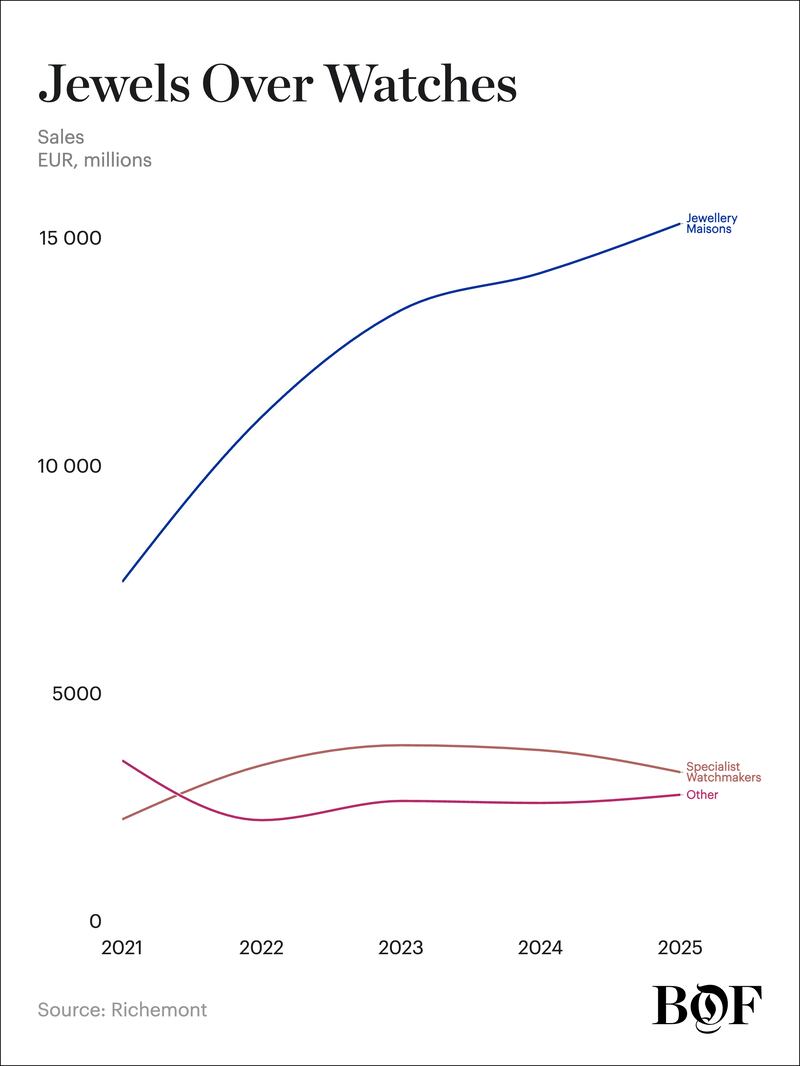
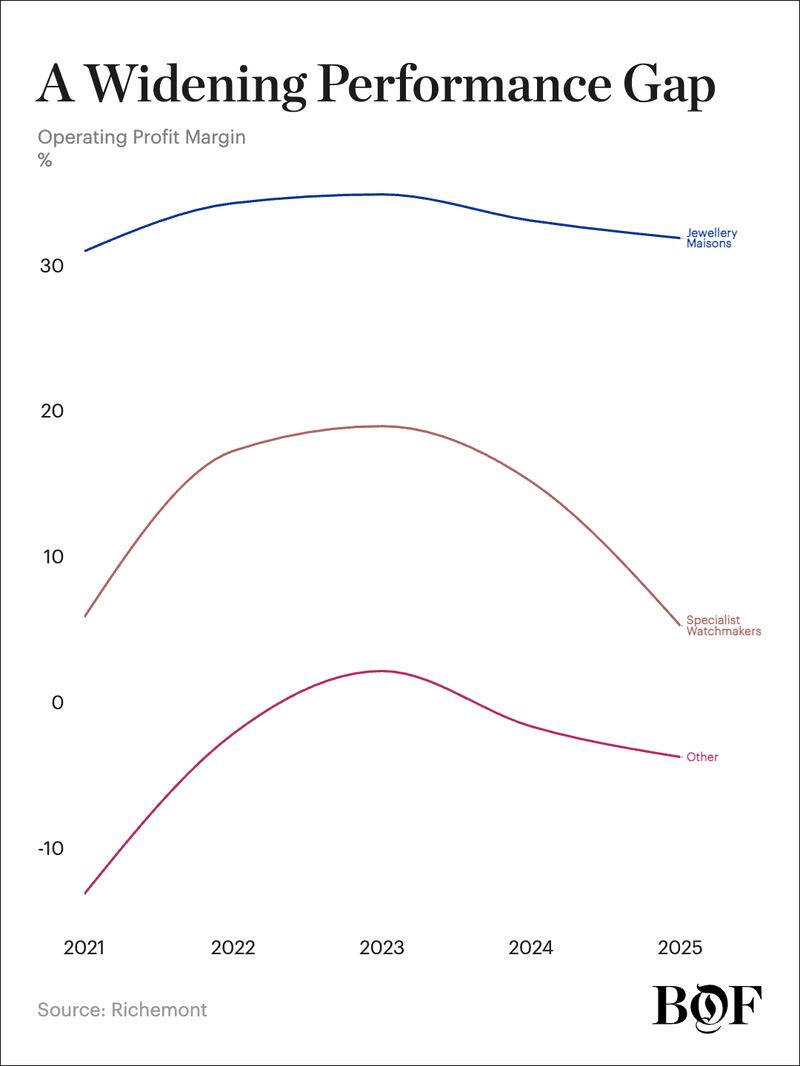
Jewellery Maisons, which account for the bulk of group revenue — about 72 percent — remain the bright spot. Cartier and Van Cleef & Arpels continue to benefit from tailwinds that go well beyond branding. High jewellery and signature pieces are increasingly treated as stores of value as much as discretionary purchases. Analysts expect solid growth again, supported by pricing power, gifting occasions and resilient demand from top-tier clients, including Chinese shoppers spending abroad. Key areas of focus will be on Richemont’s plans for price increases, the effects of shifting gold prices, tariffs and currency swings on margins and any signs creative renewal at fashion rivals could draw attention back to handbags – and away from jewellery.
Specialist Watchmakers, representing roughly 15 percent of Richemont’s revenue, illustrate the luxury slowdown. The more pure play watch brands in this division, including IWC Schaffhausen, Jaeger-LeCoultre and Panerai, remain exposed to softer demand at smaller brands and lower price points than industry heavyweights. Sales over the last three months are expected to be affected by war in the Middle East, where Richemont is more exposed than other luxury groups, and will be scrutinized for any signs of recovery in the market for timepieces, after improvement at the end of last year. Expectations are modest, with HSBC forecasting the division’s growth to slow to 4 percent after 7 percent, year-on-year, in the previous quarter.
ADVERTISEMENT
The Other division, about 13 percent of revenue, includes fashion and accessories brands Alaïa, Chloé and Dunhill. They are grappling with the same issues weighing on the wider fashion industry: cautious consumers, a sense that prices rose too fast without noticeable product improvements and fewer breakout products. A turnaround here is not expected in the near term.
The Jewellery Maisons division has shown strong revenue growth since the end of the pandemic and regularly books an operating profit margin above 30 percent. Revenue has fallen the past two years at the Specialist Watchmakers unit while the “Others” division is unprofitable.
Taken together, Richemont’s results will highlight shifts in the balance of power in luxury over the past few years. Jewellery is doing the heavy lifting, watches are only as strong as their positioning, and fashion is still searching for firmer footing.
The Week Ahead wants to hear from you! Send tips, suggestions, complaints and compliments to eric.sylvers@businessoffashion.com.
Loading recommended reads…
Sales of gems, precious metals and artwork at Japan’s department stores climbed 19 percent in the first half of 2026 from a year earlier to $2 billion.
Though Adidas dressed both teams in the World Cup finals, the global football tournament still presented some bright spots for Nike, writes Bloomberg’s Andrea Felsted.
From our archive, the creator and host of award-winning podcast “Articles of Interest” joins BoF founder, CEO and editor-in-chief Imran Amed to explore what clothing can reveal about identity, culture, labour and the world around us.
Saunders, the brand’s first creative director in five years and a skilled colourist, promises to give Kate Spade the clarity it has long lacked. Now, Tapestry must apply the same long-term brand-building discipline that fueled Coach’s success.