Agenda-setting intelligence, analysis and advice for the global fashion community.
Agenda-setting intelligence, analysis and advice for the global fashion community.


Promotions have long been one of the most powerful tools in marketing, driving everything from customer acquisition and loyalty to inventory movement and short-term revenue growth. Yet brands are becoming more cautious of its long-term implications on pricing power, brand equity and consumer loyalty.
According to McKinsey & Co., markdowns can account for as much as 30 to 40 percent of a fashion company’s revenues, underscoring how heavily the industry relies on promotional activity.
Talon.One, a leading loyalty and promotions platform powering more than 300 global brands, explores this tension in its latest report, “Creative Currencies in Promotions.” With contributions from behavioural marketing research firm System1 Group, WPP Enterprise Solutions and Mando, the analysis examines how brands can move beyond repetitive discounting to build stronger long-term customer engagement.
 Opens in new window
According to Talon.One co-founder and chief executive Christoph Gerber, nearly 20 percent of revenue is discounted away through promotional activity, often creating what the company describes as a “discount death spiral” — a cycle in which consumers become conditioned to wait for the next sale.
Over time, this erodes full-price purchasing behaviour and reduces the effectiveness of promotions themselves, as brands are forced to discount more deeply or more frequently to achieve the same impact. Rather than operating as isolated tactical levers, promotions have become structurally central to how many brands manage demand — particularly in environments shaped by excess inventory, fluctuating demand and heightened competition.
In BoF and McKinsey and Company’s The State of Fashion 2026 report, margin pressure and weakened consumer loyalty are among the industry’s defining challenges, as brands increasingly compete for attention in an oversaturated digital marketplace. Across both luxury and mass retail, perpetual promotions, private sales and outlet expansion have normalised discounting behaviour — conditioning consumers to delay purchases in anticipation of markdowns.
Talon.One and System1 Group surveyed 1,800 consumers on the appeal of six different promotion offers — ranging from straightforward discounts to loyalty rewards and gamified prize mechanics — across six international markets. The research found that while traditional discounts still dominate on immediate purchase appeal, more creative and gamified promotions consistently outperform on metrics linked to long-term brand prominence — including uniqueness, excitement, innovation and memorability.
Below, BoF shares extracts from Talon.One’s “Creative Currencies in Promotions” report, distilling four distinct themes that will define the future of discount strategies.
Talon.One Report: While consumers overwhelmingly preferred guaranteed discounts in Talon.One’s testing, more creative promotional mechanics consistently performed stronger on memorability, excitement, uniqueness and innovation — attributes more closely associated with long-term brand salience than immediate conversion.
Traditional discounts delivered the strongest short-term purchase appeal, with “buy one, second pair 50 percent off” emerging as the highest performing promotion overall – scoring more than twice as high as a flat “15 percent off” discount. Even though the savings are comparable, the 50 percent off mechanic feels more generous and creates significantly higher perceived value.
BoF: The State of Fashion 2026 report notes that as household finances remain a concern, over 80 percent of consumers across all price segments cite “good value for money” as a top buying factor. To adapt, brands must improve and communicate value for money.
Storytelling that highlights craftsmanship, creative differentiation, and initiatives like repair or resale could position products as lasting investments – communicating a brand’s commitment to quality rather than competing on price alone.
In an increasingly polarised and attention-fragmented market, brands are under growing pressure to compete on more than price alone. Consumers are becoming more selective about where they spend, while emotional connection, community and differentiated brand experiences are emerging as key drivers of long-term loyalty.
Across fashion, beauty and luxury, brands are using promotions and loyalty programmes to create a stronger sense of participation, exclusivity and community. As competition for consumers’ attention intensifies, marketers are looking beyond transactional incentives and designing experiences that encourage ongoing engagement, rather than one-off purchases.
Many of the industry’s most successful membership ecosystems are built around access rather than discounts alone. From early access to product launches and exclusive member rewards to limited edition offers and community-driven experiences, brands are increasingly using promotional mechanics to make customers feel part of an insider group. These approaches tap into consumers’ desire for recognition, belonging and status while encouraging deeper engagement over time.
This shift is particularly visible among younger consumers, who expect brands, today more than ever, to offer participation alongside products. In this environment, promotions that create a sense of exclusivity, progression or shared identity can become powerful drivers of both engagement and loyalty. As brands search for alternatives to perpetual discounting, community-building and member-led experiences are emerging as important sources of value.
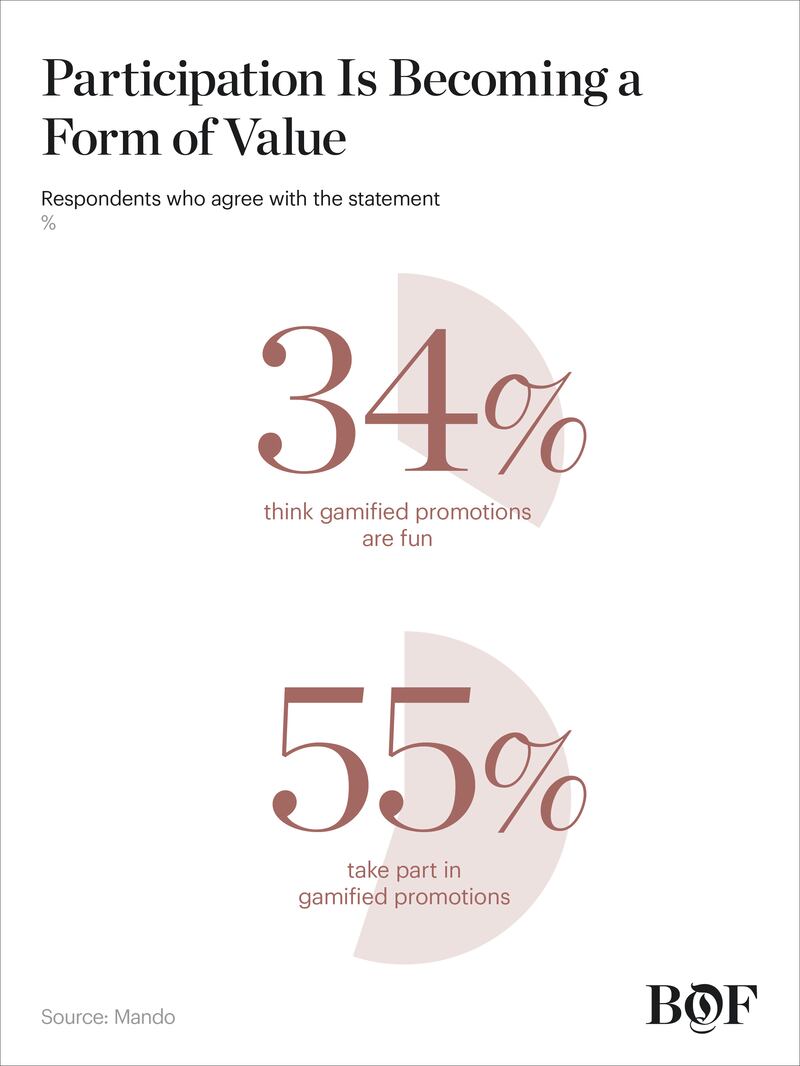
Talon.One: Gamified promotions are becoming an important mechanism for driving customer engagement, particularly as brands look for alternatives to repetitive discounting. According to Mando’s 2026 white paper, “What the Brits Want from Promotions 3.0,” 55 percent of consumers now take part in gamified promotions, while 34 percent describe them as fun — underscoring growing consumer appetite for more interactive and participatory brand experiences.
Across Talon.One’s research with System1 Group, mechanics built around uncertainty and active participation consistently generated stronger emotional engagement than static discounts alone. Consumers responded particularly strongly to promotions that introduced suspense, participation and playability into the purchasing experience. “Roll a Dice, Get it Free,” the most gamified offer tested, ranked highest across all concepts for uniqueness and performed strongly on excitement and memorability.
Behavioural science has even proved that the anticipation of an uncertain reward generates stronger emotional responses than a guaranteed outcome, making moments of suspense and interaction inherently more engaging for consumers.
At the same time, consumers expressed caution towards promotions perceived as unrealistic, overly luck-based or too closely associated with gambling. Gamified mechanics perform strongest when brands clearly communicate odds, create multiple achievable reward tiers and favour active participation mechanics over passive sweepstakes-style entries.
BoF: Across fashion, beauty and luxury, gamification is becoming a core strategy for driving consumer participation in an era where attention is fragmented and brand loyalty is harder to sustain. As younger consumers spend more time in digital environments shaped by gaming, creators and social platforms, brands are increasingly borrowing from entertainment culture — drops, raffles, scavenger hunts, streaks and waitlists — to transform shopping into participatory notion rather than purely transactional.
In a recent BoF case study, How Brands Build Genuine Communities, brands including Arc’teryx, Bandit Running and Corteiz were highlighted as examples of how participation, exclusivity and cultural belonging can drive consumer engagement and loyalty.
Beauty brands are also leaning into challenge-based participation. Sephora’s Beauty Insider ecosystem frequently rewards members for completing engagement-based tasks beyond purchasing, while brands like Rare Beauty have built community-driven activations designed to encourage sharing, interaction and repeat participation across social platforms. However, to avoid a public failure or gimmick accusations, brands must find a gaming strategy that fits the brand’s tone of voice and ethos.
Talon.One: Traditional points-based loyalty systems continue to drive engagement, but consumers respond most strongly when rewards feel visible, aspirational and emotionally meaningful. Programmes tied to status, exclusivity and identity consistently outperform mechanics centred purely around transactional accumulation, particularly when consumers can clearly understand the value they are working towards.
Emirates Skywards is among the strongest examples: where benefits such as lounge access, upgrades and tiered status create a sense of aspiration and belonging that extends well beyond financial reward. The programme reinforces identity, recognition and emotional loyalty through exclusive experiences and visible progression – functioning less as a discount lever than as a relationship architecture. By contrast, overly complex points systems or delayed rewards risk weakening engagement, particularly when customers struggle to understand what they are earning towards.
Loyalty is most effective when rewards feel attainable and culturally relevant to consumers’ lifestyles. By contrast, overly complex points systems or delayed rewards risk weakening engagement, particularly when customers struggle to visualise the eventual benefit.
BoF:Access is becoming one of the most powerful currencies in loyalty. Across fashion, beauty and sportswear, the most compelling membership programmes are those that make consumers feel like insiders. Adidas has leveraged its membership programme to offer exclusive product launches, early access opportunities and member-only benefits, while Mytheresa has invested heavily in top-tier client experiences, including private events and luxury travel activations for its highest spending customers.
Access is also being used as a form of currency. From limited early-access product launches at Skims to community-led membership strategies at Arc’teryx and experiential wellness programming at Lululemon, loyalty is becoming less about transactional rewards and more about reinforcing aspiration, participation and belonging.
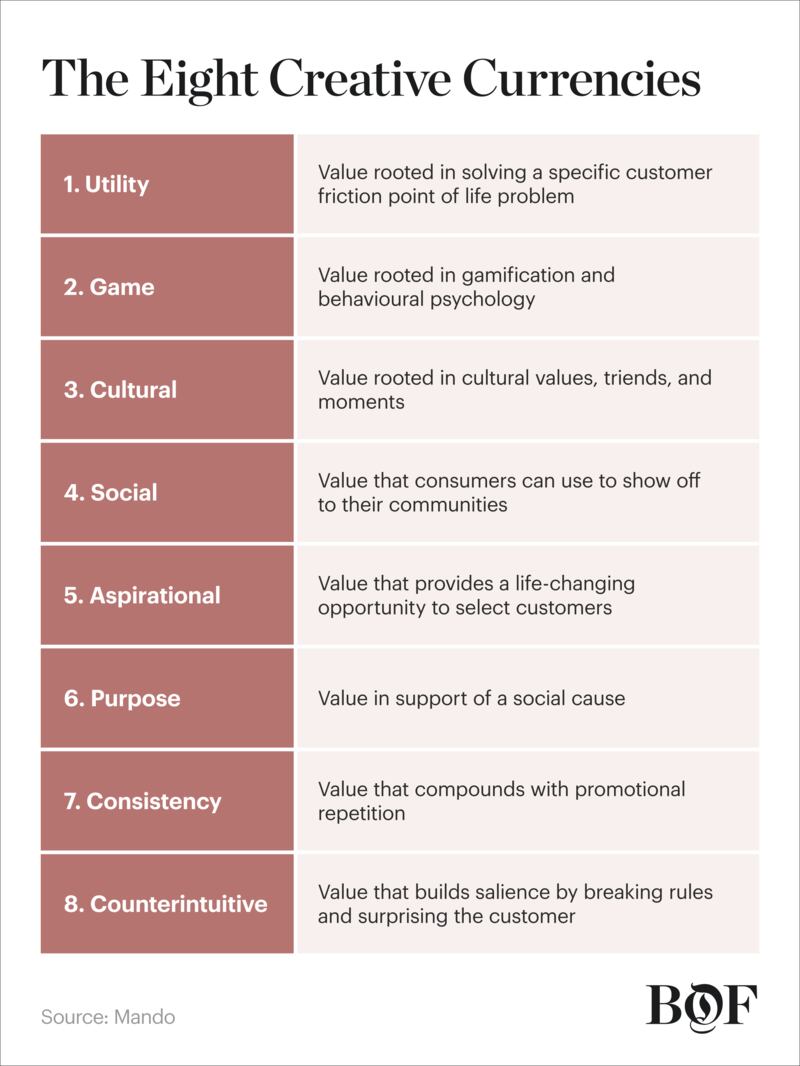
Talon.One Report: Promotional strategy is shifting away from a one-size-fits-all discounting towards more personalised and emotionally resonant forms of value exchange. Rather than relying solely on financial incentives, brands are beginning to build promotional ecosystems around “Creative Currencies” — alternate forms of value that deepen engagement, reinforce brand identity and encourage longer-term loyalty.
The report identifies eight distinct currencies shaping the future of promotions: game, utility, aspiration, social, exploration, culture, purpose and consistency. Together, they reflect a broader shift away from purely transactional marketing towards promotions designed to create participation and emotional connection.
Among the strongest performing were those tied to anticipation, identity and interaction. Gamified formats created stronger emotional responses through uncertainty and active participation while aspirational and culturally relevant rewards resonated as they reinforced status, belonging and personal identity rather than simply lowering price. Social and community-led mechanics also performed strongly, particularly when promotions encouraged consumers to feel part of a wider cultural moment or shared experience.
Brands can now use AI for limitless ideation and simulation to create promotions with personas and predict how they would react — at no cost. However, while technology is the enabler, cross functional teams are non-negotiable.
If teams are to find “the goosebump moment,” they need to use their human intuition to recognise a concept that will elicit real emotions. AI can optimise a discount but creating an experience that is memorable — such as Ikea’s ad doubling as a pregnancy test with a urine-activated coupon code — remains inherently human.
BoF: As highlighted in BoF’s most recent cast study, “The Fashion Marketer’s Guide to AI,” industry leaders remarked how AI and behavioural data are being used to personalise promotions, loyalty strategies and consumer experiences in real time, shifting away from static one-size-fits-all campaigns towards more adaptive engagement ecosystems that respond to individual customer signals.
At the same time, brands such as Burberry and Gucci have been experimenting with more digitally integrated marketing approaches that extend beyond traditional campaigns, using immersive storytelling, gaming-led activations and platform native content to sustain engagement across multiple touchpoints. These strategies reflect a broader move towards building “always-on” brand environments rather than isolated promotional moments.
In parallel, luxury and premium brands are increasingly investing in clienteling systems and CRM infrastructure that connect in-store service with digital behaviour, enabling more tailored outreach, personalised offers and long-term relationship building. Across these approaches, the emphasis is shifting from uniform campaign delivery to much more fluid, data-informed systems designed to reinforce relevance, responsiveness and sustained engagement over time.
However, consumers’ anger towards AI is growing as it becomes more deeply embedded in the workplace and daily life. To maintain customer trust, brands must proceed with caution.
Discover further insights in the report, including the eight “Creative Currencies” brands can use to drive engagement, build loyalty and reduce reliance on discounts.
This is a sponsored feature paid for by Talon.One as part of a BoF partnership.
Loading recommended reads…
The American brand has replaced sustainability targets with AI goals, among a series of other factors including sales growth, as a metric for executives’ annual incentive payouts.
The move follows CFO Philippe Blondiaux’s decision to retire at the end of this year after more than 15 years at Chanel.
Pontegadea Inversiones SL acquired the 51-story One North Wacker in the city’s business district in one of the biggest US office deals this year.
The designer struggled to find his footing at Alexander McQueen after a weak response to his early designs for the brand.