Agenda-setting intelligence, analysis and advice for the global fashion community.
Agenda-setting intelligence, analysis and advice for the global fashion community.

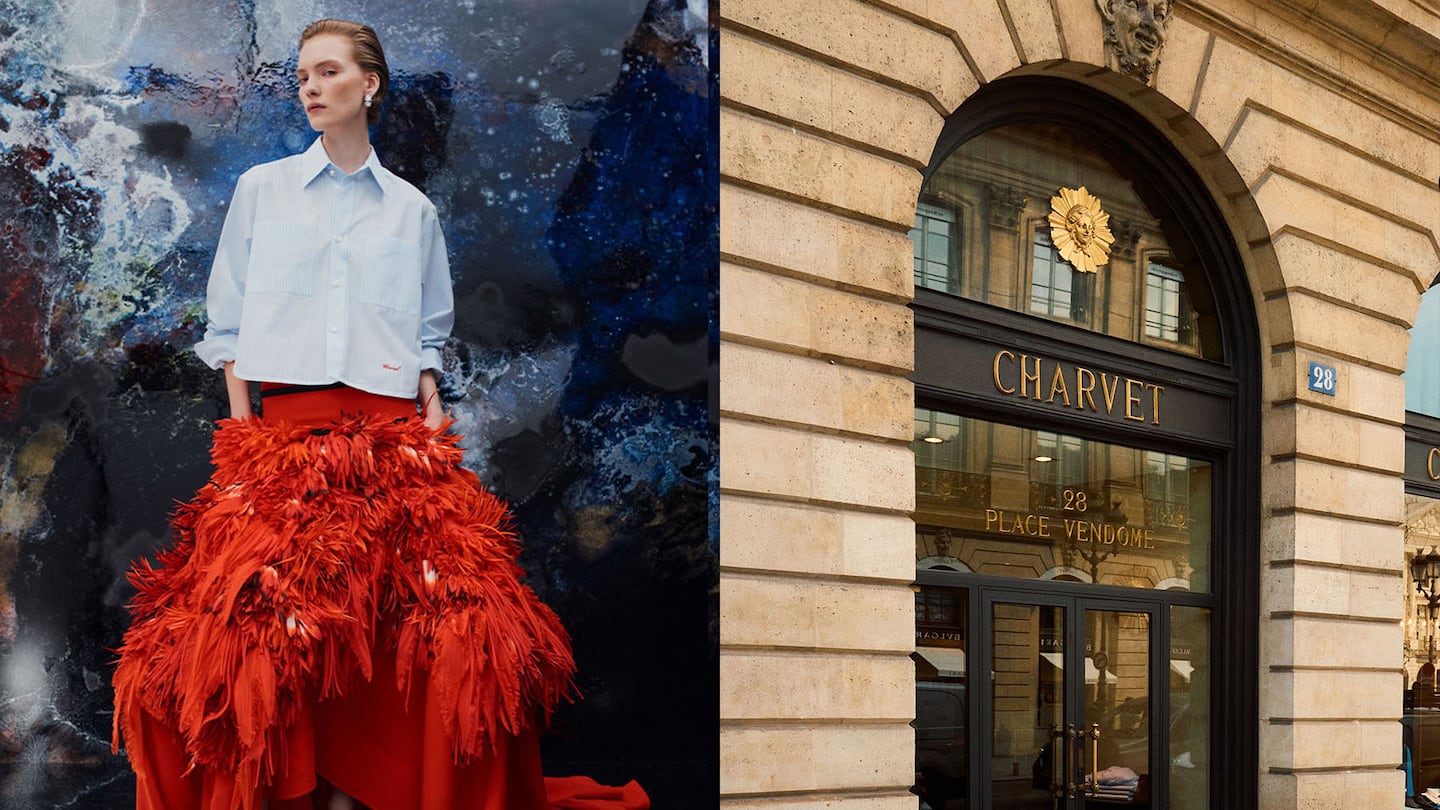
When Chanel approached Charvet to develop shirts for Matthieu Blazy’s debut show in October 2025, owner-operators Anne-Marie and Jean-Claude Colban didn’t want to “make life complicated,” bogging down the process with “complex contracts.”
“We hadn’t begun to imagine where this conversation would lead. We wanted to let things develop organically. And now you see how far things can organically go,” Jean-Claude said.
A year later, Chanel has acquired 100 percent of shares in Charvet, the French menswear institution founded in 1838, for an undisclosed sum. Known for its custom shirting, ultra-fine polos, ribbon belts and grey gift boxes — as well as an old-world approach to managing its illustrious client list — Charvet has sold primarily from its store on Paris’ Place Vendôme for more than a century.
“Chanel has acquired Charvet in order to support, over the long term, the passing down of unique savoir-faire and the continued existence of an iconic French heritage house, while fully respecting its creative independence,” the company said Thursday.
ADVERTISEMENT
Charvet joins roughly a dozen specialty brands Chanel has acquired in a bid to secure its supply chain and perpetuate craft techniques. Some labels in its “Paraffection” craft unit like Lemarié and Lesage are tightly plugged into Chanel’s supply chain; others like swimsuit brand Eres operate as independent brands.
“The goal is really for Charvet to continue to develop as an autonomous company… Some joint projects could arise but nothing is mandatory.” Chanel’s fashion president Bruno Pavlovsky said. “The first few years will be focused on accompanying Charvet’s succession — which isn’t obvious after five generations being managed as a family business by people like Jean-Claude and Anne-Marie. After that we will look at whether there is a need to expand the business further.”
Charvet became France’s first shirting store when it opened on Rue Richelieu in 1838. Men’s shirts had previously been treated as simple undergarments, stitched at home with a blocky construction, but more specialised vendors sprung up in the 19th century as interest grew for closer-fitting designs that required shaping seams and curved armholes. The brand relocated to Place Vendôme in the 1870s before moving to its current emblematic location in 1982. “Chanel believes in the magic of places, and this is an exceptional address,” Pavlovsky said. Charvet owns the building at 28 Place Vendôme.
Famous clients have included Charles Baudelaire, Emile Zola, Charles de Gaulle, Winston Churchill, Yves Saint Laurent, and Karl Lagerfeld, the design impresario who led Chanel for 35 years.
Originally introduced to Charvet by her lover and early financial backer Boy Capel, Gabrielle Chanel would have been highly aware of the brand when she set up shop on neighboring Rue Cambon in 1910. Chanel’s sporty, streamlined womenswear was likely informed in part by Charvet’s refined sartorialism — a story creative director Matthieu Blazy drew on as inspiration for his debut show in October, which included cropped men’s blazers and oversized Charvet shirts embroidered with the word “Chanel.” The boxy, $4,300 shirts helped declare a renewed focus on preciousness and everyday style at Chanel — as well as lending a global spotlight to Charvet, previously seen as an insider label.
“There were all these reasons Charvet could be connected with Chanel, which seemed very coherent and won us over,” Pavlovsky said. “It’s also complementary. Chanel is a women’s brand, with more and more men coming into the boutiques. Charvet is a men’s brand with more and more women.”
“Charvet is about a sense of craftsmanship and finishing. It’s very meticulous work. When you visit the custom floor, you see how Charvet can be a bit like haute couture for men. Not haute couture in the sense of using the metiérs d’arts, et cetera, but it is haute couture through the choice of materials, the details, the construction,” Pavlovsky said.
Chanel is acquiring Charvet from the Colban family, whose father Denis was a fabric importer who acquired the business 1965. He was succeeded by his children Jean-Claude and Anne-Marie Colban, who joined the business in the 1980s. Their mother worked at the store alongside them until just a few years ago. “It’s truly a family business,” Anne-Marie said.
ADVERTISEMENT
Interest in Charvet has surged in recent years as the brand’s discreet, timeless ethos and scarce distribution positioned it as an antidote to an ultra-commercial, global luxury industry. While the brand does not disclose revenues (France does not require private to report consolidated global accounts), filings for French entities linked to the Colbans suggest revenues of at least $10-15 million in 2024. The company has around 40 employees at its Place Vendôme hub and around 60 more at its workshop in France’s central Indre region.
The brand’s website features only a calling card—no e-commerce. Anne-Marie still greets clients herself.
“We don’t like the idea at all of reducing our offer to a narrow range that would sell online. That’s not something we like to do. We prefer to work with a few retailers who are each very different, like Bergdorf Goodman or Mr. Porter. Each of whom, we hope, gives a different image of who we are,” Jean-Claude said.
As the brother-sister duo enters their seventies (Jean-Claude is 71 years old, Anne-Marie 69), they started to think more about what would eventually become of the business.
“What we feared is that our values should be betrayed. That our unique way of doing things should dissolve,” Jean-Claude said. “What we were looking for above all was a solution to maintain our identity and preserve what we do, as we feel it every day just how much we are unique — more and more so, unfortunately. On certain days, we pride ourselves on being the only ones to do things a certain way, but on others, it is exhausting to deal with people who do not understand.”
“Seeing Chanel’s way of doing things, in particular their way of approaching subjects with competence, sensitivity, and also taking the necessary time, respecting expertise — we realised we were aligned,” Jean-Claude said.
“The Colbans have made a very important decision to sell, and a very important decision to sell to Chanel when they could have sold to plenty of others. It’s time for the commitments we made to be put in place,” Pavlovsky said. “Charvet is a beautiful jewel. I love it. Now there’s work to be done to set it up for its next steps and to fully develop it as a jewel.”
With the season’s hottest debut, Blazy is charting new territory for Chanel — and fashion itself — fuelled by new insights into Gabrielle Chanel’s own creative process, the designer tells Tim Blanks in an in-depth global exclusive interview.
The French giant, which returned to high single-digit growth at the end of 2025 on the wings of designer Matthieu Blazy’s brand revamp, plans to maintain elevated investment levels while limiting price increases this year, CEO Leena Nair and CFO Philippe Blondiaux said.
Marie-Laure Cérède, who led the studios of both Cartier and Harry Winston in roles spanning jewellery and watchmaking, will ‘bring a new perspective to the Chanel codes’ as interest in the French couture giant surges.

Robert Williams is Luxury Editor at The Business of Fashion. He is based in Paris and drives BoF’s coverage of the dynamic luxury fashion sector.
Loading recommended reads…
The British retail group has pushed its stake in the German apparel brand above 50 percent in a move that will turn Hugo Boss into a subsidiary of Frasers.
The settlement, equivalent to 44 percent of the ultra fast-fashion company’s second-quarter profit, is the latest blow amid regulatory and tax crackdowns in Europe and the US that have hampered Shein’s growth.
Among the takeaways from the latest round of quarterly reports from European luxury groups: China’s hurting, industry growth in the US has slowed and quiet luxury is having a moment.
Bloomingdale’s chief executive Olivier Bron joins Imran Amed on The BoF Podcast to discuss how a name every American knows is re-earning its place in luxury and why he sees Europe’s biggest houses wrestling with the same problem.