Agenda-setting intelligence, analysis and advice for the global fashion community.
Agenda-setting intelligence, analysis and advice for the global fashion community.



The global luxury industry is at an inflection point in 2025, as brands struggle to engage cost-conscious consumers shifting priorities. Even among high net worth individuals, demand is being tempered by a more critical lens, where consumers are weighing luxury purchases not just against other products but against alternative routes of spending such as travel and wellness.
After a period of aggressive growth, driven largely by price hikes, brands are now being challenged to deliver on the core values of exclusivity, creativity and craftsmanship — promises that many consumers feel have been diluted amid luxury’s rapid expansion.
Italian footwear and leather goods brand Santoni is focused on meeting these expectations with its emphasis on artisanal techniques, high-quality materials, and craftsmanship across its men’s and women’s shoes, sneakers and leather goods.
As it celebrates its 50th anniversary, Santoni is doubling down on its commitment to both heritage and innovation — as well as a focus on sustainability goals by publicly committing its work toward the United Nations’ Sustainable Development Goals, including industry innovation and infrastructure to responsible consumption and production.
Santoni’s focus comes at a pertinent time with sustainability initiatives seemingly falling off executive agendas in 2025 — only 18 percent of executives surveyed for BoF and McKinsey & Co.’s The State of Fashion 2025 report cited sustainability as a top-three risk for growth this year, down from 29 percent in 2024.
What’s more, the “Made in Italy” label is experiencing challenges and criticism: its wider luxury supply chain is under scrutiny for questionable quality and poor working practices, while the manufacturing landscape has become increasingly fragmented.
To keep tight control over the quality of its products and output, Santoni’s production process remains entirely in-house. Its artisans work alongside engineers, leveraging the lean manufacturing system adapted for artisanal work.
This year, Santoni is also making strategic growth efforts in key emerging markets such as Japan and the Middle East — two markets projected to grow despite wider macroeconomic headwinds challenging the luxury space. Its presence in these geographies will expand upon Santoni’s already established footing in Europe and the US.
This milestone year also marks the launch of Santoni Meraviglia, a new commemorative book that captures the soul of the brand through rare archival materials, personal reflections and visual storytelling. Created in collaboration with Assouline and photographed by Oliver Pilcher, the book dives into Santoni’s artisanal legacy and the beauty of Italy’s Le Marche region, where it all began in 1975 — as a shoe manufacturing business, founded by husband and wife duo Andrea and Rosa Santoni.
Exploring these themes around Santoni’s commitment to craftsmanship, its global growth ambitions and its vision for the next 50 years to come, BoF sits down with president and chairman Giuseppe Santoni — Andrea and Rosa’s son — to understand what’s next for the brand.
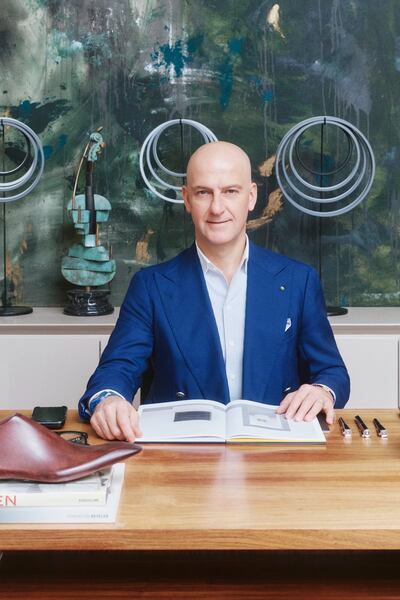
How does Santoni balance craftsmanship with innovation?
Craftsmanship and heritage are everything — they are our competitive advantage. We are one of a few independent Italian luxury shoe brands that isn’t part of a larger group or owned by private equity. We have remained independent because we have built in know-how and a culture that is rooted in excellence.
At Santoni, we manufacture everything in-house and we have created a production process that blends both tradition and innovation. All of our shoes are produced entirely at our headquarters in Corridonia, in Italy, which spans 300,000 square feet and houses around 700 artisans and designers, all working under the same roof. That ensures constant dialogue, mutual respect and collaboration between the creative and the technical.
We use the lean manufacturing system — something that is typically associated with the automotive industry, which we have adapted for artisanal work. Our artisans have learned to think like engineers, and our engineers now understand the language of craftsmanship. It took years, but now they work together seamlessly.
How do you facilitate this approach among your teams?
When a designer wants to introduce something new, they don’t just hand it off to a product manager and walk away. They sit down with the artisans, share their vision and work together to make it happen. That direct exchange is the key to our innovation.
I always say: a worker uses their hands to make a product; an artisan uses their hands and their head; and an artist uses their hands, their head and their heart. That’s what our team does — we create from passion, not just process.
Everyone here respects the philosophy and the direction in which we are headed. Of course, there are ups and downs, but at the core, we are a team — a very special, unified team. And it’s that sense of belonging and shared purpose that sets Santoni apart.
How does Santoni seek to uphold the ‘Made in Italy’ standard?
For us, it’s not just “Made in Italy” — it’s “Made in Santoni.” Every single shoe is made in-house and that level of control is rare. What we are preserving is not just a label, but a culture — a culture of beauty, detail and passion. That’s what makes Italian craftsmanship exceptional, even as others compete on price or scale.
A worker uses their hands to make a product; an artisan uses their hands and their head; and an artist uses their hands, their head and their heart.
To ensure our legacy continues, we have created the Accademia dell’Eccellenza (Academy of Excellence). We train young people in the art of shoemaking — everything from construction to finishing. We have even partnered with a local high school to develop a course focused on the Santoni process. In our small town of around 15,000, this is about more than making shoes — it’s about building a future.
What role does sustainability play in your approach to production?
For Santoni, sustainability isn’t a marketing angle — it’s a personal responsibility. Since 2010, we have been generating our own electricity through solar power. Our facility produces 2.5 megawatts — enough to cover more than 30 percent of our needs.
Beyond that, all our materials go through rigorous quality and sustainability checks. We favour vegetable tanning over chemical, use water-based glues and dyes, and prioritise recyclable components.
To me, sustainability is a matter of quality — how you think, how you work and how you respect the world around you.
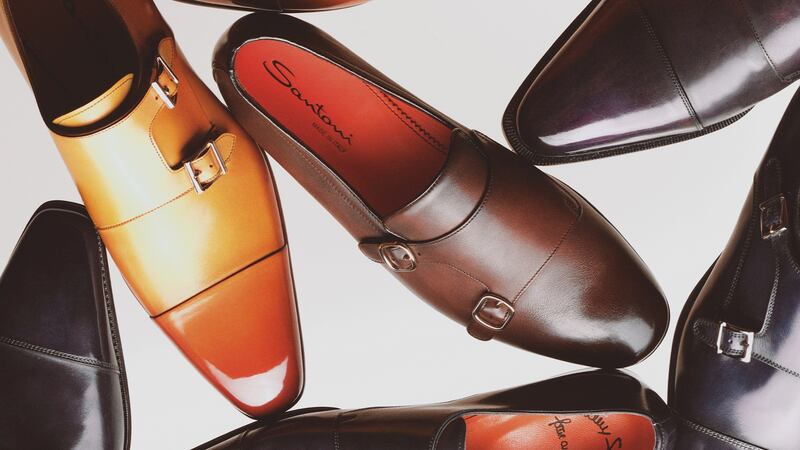
How has category expansion helped Santoni reach new consumers and markets?
It’s more than just expanding into new products — it’s about expanding into new lifestyle areas. We want Santoni to represent everyday elegance and quality, not just something for special occasions. That’s why we have introduced leather goods, scarves, gloves and hats — all of which carry that same DNA as our shoes.
We have also launched a travel-focused line called “Eclipse.” It features a proprietary material we have developed called Nylux — a recyclable nylon embossed with our signature Saffiano leather pattern. It’s a fusion of performance and design that reflects our values.
Today, people don’t buy just to own — they buy to feel something. That’s what we try to offer — not just a beautifully made product, but a story, a memory and a connection.
It’s also about positioning the brand in the right locations and in the right kinds of stores. Once we are there, what we believe sets us apart is our product, the elegance, the craftsmanship and the comfort. Comfort is something I don’t always mention because it’s so inherent to what we do, but it makes a huge difference. We are seeing strong responses in places like Japan and the Middle East, where consumers really appreciate quality and attention to detail.
How is Santoni celebrating its 50 years in business?
To mark our 50th year, we chose the word “meraviglia” — an Italian word that means “wonder” or “marvel”, because we want to move people. We want them to remember how they felt the first time they wore our shoes. That sense of “meraviglia” is at the heart of everything we do.
Today, people don’t buy just to own — they buy to feel something. That’s what we try to offer — not just a beautifully made product, but a story, a memory and a connection. This anniversary is a moment for us to celebrate not only what we’ve achieved, but the soul behind it — the passion, the people and the place.
To commemorate this milestone, during Milan Fashion Week, we unveiled a special 50th anniversary collection that will hit the stores in fall/winter this year. On May 28th, we will also present a new book dedicated to the world of Santoni, titled “Santoni Meraviglia,” in collaboration with Assouline.
Looking ahead, what innovations are on the horizon for Santoni?
Last year, we introduced the “Easy” line — a classic leather shoe with an ultra-lightweight rubber sole. It weighs just 290 grams, making it the lightest leather lace-up in the market. It feels like a sneaker but looks like a dress shoe.
This Spring/Summer, we are launching what we believe is the lightest sneaker ever made — the Santoni Easy Bounce. It’s completely leather but incredibly light and comfortable.
For us, innovation and tradition aren’t at odds — they’re two sides of the same coin. Even though we are seen as a traditional brand, we are constantly innovating.
This is a sponsored feature paid for by Santoni as part of a BoF partnership.
Loading recommended reads…
LVMH’s sales report and Shanghai Fashion Week will bring fresh insight into the Chinese retail environment as Western brands seek to navigate the wobbly market and local labels angle to capture more spending.
As Milano Beauty Week closes its biggest edition yet, Cosmetica Italia and its partners are betting that the country’s entire beauty ecosystem can become a brand in its own right.
The ultra-fast fashion company said sales had been bolstered by marketing partnerships with music festivals, a pop-up shop on London’s Oxford Street and local Christmas gift events.
Frasers Group is expanding its holdings in luxury and retail brands, but what it wants from those investments is not always clear.