Agenda-setting intelligence, analysis and advice for the global fashion community.
Agenda-setting intelligence, analysis and advice for the global fashion community.

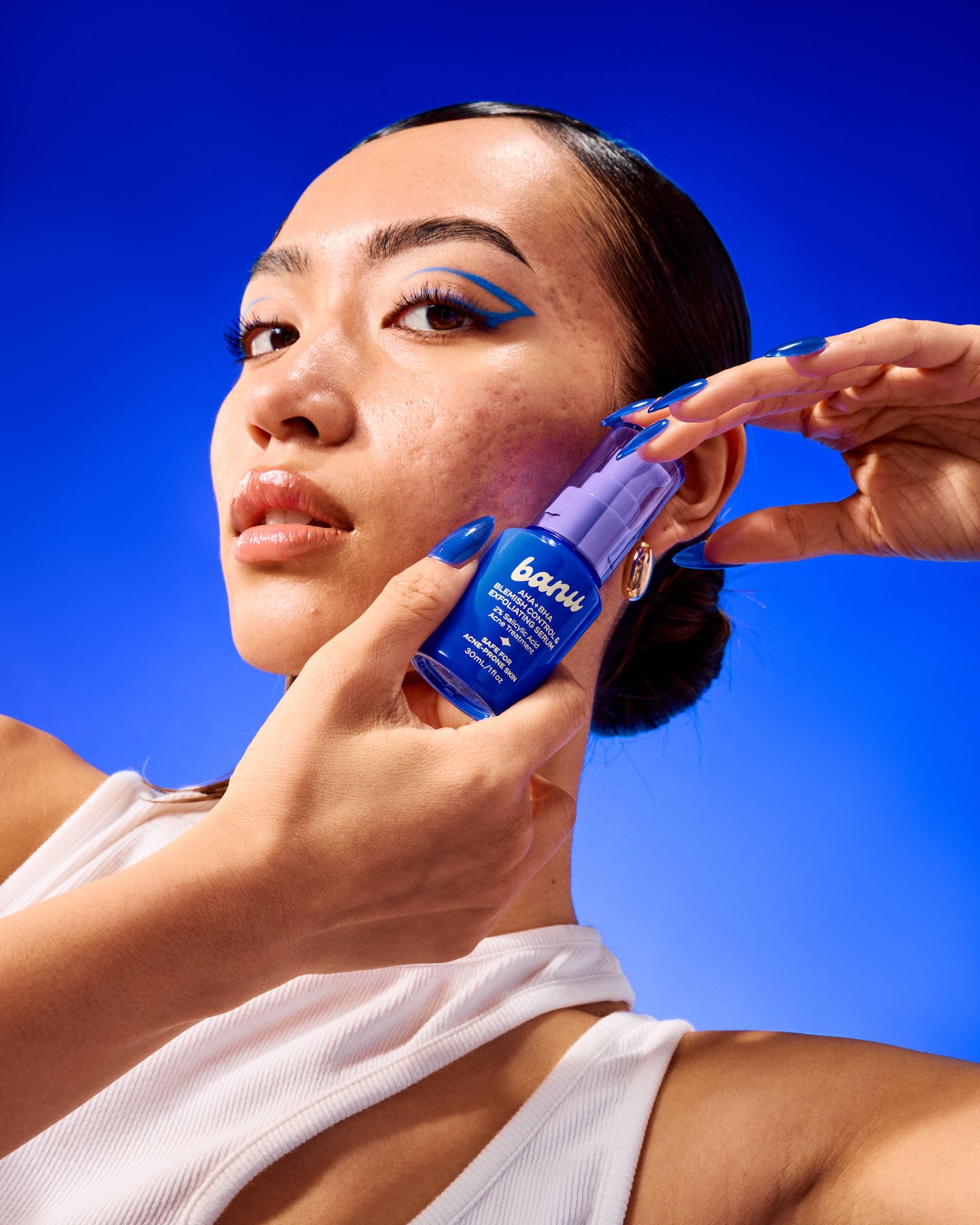
For the vast majority of people on Earth, the difference between getting into skincare and staying out of it can be as simple as an ill-timed breakout.
Acne affects about 1.7 billion teens and adults worldwide, making it the most common skin disorder as well as one of the earliest stations on a person’s beauty journey. Decades after the age of Proactiv commercials and abrasive apricot scrubs, acne remains central to the beauty conversation: 21-year-old model Apple Martin, daughter of Gwyneth Paltrow and Chris Martin, made headlines in February when she revealed her bare face in a Vogue Beauty Secrets video. Commenters were quick to call the move “refreshing.”
They were referring to Martin’s candour but could have also been talking about the behemoth category, which is going through a period of renewal as enterprising brands attempt to capture skincare-initiated Gen Alpha and seize the growing multi-billion-dollar opportunity acne presents. New research suggests the condition is on the rise due to factors like air pollution and climbing stress levels.
“The acne category in general has been quite overdue for a refresh,” said Bianca Fernandez, head of brand engagement at skincare brand Personal Day, founded by the actress Lili Reinhart. Historically, acne care has relied on clinical positioning and results marketing — relegated to the far reaches of medicine cabinets, even as it remains essential to a diverse range of customers. In its ranking released this week, US News & World Report said the top three acne treatments are Galderma’s Differin, Revance’s PanOxyl and Kenvue’s Neutrogena, followed by L’Oréal’s Cerave and La Roche-Posay.
ADVERTISEMENT
Newer entrants, like Personal Day and Sofie Pavitt Face, are disrupting the category by cultivating niche and engaged customer bases in the hopes of developing firm, loyal followings. And more may be on the way: Harper Beckham’s line, set to debut early next year, is inspired by the teen’s struggles with acne, her mother Victoria shared last week on Emma Grede’s podcast.
“What is really amazing about an acne client is once they’ve found something that works for their skin, it’s really hard to shift them from it,” said facialist and founder Sofie Pavitt.
While the urgency around treating acne hasn’t changed, the conversation has. The notion of creating community around acne-care brands, which have thus far often served as clinical catch-alls for acne-prone customers, is relatively new.
One way in which indie brands Sofie Pavitt Face and Banu have found success is in marketing specifically to blemish-prone adults in a category dominated by teenager-focused messaging. The former’s audience aligns with that of her New York studio’s clientele of 25- to 38-year-olds, while Banu, founded by the former fintech executive Roz Samimi, has a primary customer aged between 25 and 44 years old. Adult acne is fairly common — studies have suggested roughly half of women in their 20s and over a quarter of women in their 40s experience it — but the topic remains taboo.
“I’ve had many advisors tell me, ‘Go younger,’” said Samimi. “Well, there [are] plenty of brands that focus on the 15- to 18-year-olds, but what about the adults who are still struggling and are honestly just sidelined because there [aren’t] really a lot of solutions for them?”
Both brands have lent a close eye to details like packaging design. Banu employs bright colours and has ditched the typical sans-serif font to seem warm and approachable. Pavitt wants her line to appear elegant and upscale, something “that’s going to look good on your shelf, that you’re not embarrassed to use,” she said.
Cultural innovations like pimple patches — which Gen Z has championed as a campy expression of perceived imperfections — have also increased adult acne acceptance. Startup Starface, which ignited the trend with its star-shaped patches, closed a $105 million minority round in February, and soon after Rhode released its own line of stickers with a campaign starring founder Hailey and her husband Justin Bieber timed ahead of his Coachella performance.
One criticism of patches is that they’re a cute fix to a couple stray pimples, but tend to alienate those with chronic, pervasive acne engulfing the face. In recognition that acne is an emotionally charged subject, often steeped in shame, next-generation brands are marketing more sensitively, with the idea that acne should be cared for, not corrected.
ADVERTISEMENT
Banu regularly features diverse models in its marketing, sometimes scouted through open casting calls — unlike other brands for whom the face of acne acceptance tends to be a young, thin, abled, white woman, like Martin or Earle.
“Showcasing people with acne across skin tones, ages and genders matters deeply to me because acne is something we all experience regardless of who we are or where we come from,” Samimi said. “I’ve had people push back and be like, ‘How are you selling a serum that’s designed to clear skin with models that have acne?’ From the outside looking in, if you don’t have acne, that doesn’t make any sense. But when you have acne and you see that, you truly appreciate it.”
In efforts to further champion inclusivity in its marketing, Banu is also leaning into Samimi’s cultural heritage: In March, the brand named after Samimi’s Persian middle name, Banoo, co-hosted a Persian New Year, or Nowruz, celebration attended by Iranian editors and influencers, with fellow Iranian-owned cosmetics brand Soshe Beauty. A Sephora Accelerate programme graduate, Banu is on track to generate $1 – 3 million in retail revenue in its first full year.
Topicals is also leading the charge: The Black-owned skincare brand hosts public Juneteenth parties and routinely collaborates with non-profit organisations including the Palestine Children’s Relief Fund and the Sudanese Diaspora Network.
Both Banu and Topicals clinically test their formulas on skin types of all melanin levels, a nonobligatory practice in the industry. Upholding diversity remains important to their core customer bases.
Even for beauty executives, acne can be a bumpy category to navigate. Before she launched Banu, Samimi had “no idea” how difficult the process would be.
Unlike typical skincare, acne products are classified as drugs, and have a higher bar for compliance — including drug facts panels and adverse events reporting — that varies from country to country. Samimi works with an FDA-accredited lab that also doubles as Banu’s contract manufacturer and covers ingredient sourcing, stability and shelf-life testing so the brand doesn’t need to contract with separate manufacturing partners.
High-liability insurance premiums and fast-paced FDA reporting requirements can also add more to acne-care brands’ plates. And beyond the operational and legal issues the category presents, it may be unwise for a cash-strapped indie to put all its eggs in the acne-care basket. Blemishes can be attributed to factors outside of any brand’s control, like lifestyle choices and hormonal imbalances. What customers want to see are results — and skincare brands may be the first to bear the brunt of the blame when they’re not immediately felt.
ADVERTISEMENT
Telehealth firms like Curology, founded in 2014, have tried for years to popularise a model for prescription-strength, personalised skincare routines, opening the door for other acne-focused startups like Honeydew in 2022 and Oddity’s Methodiq in 2025. When it launched, Curology employed an aggressive marketing campaign that relied on free trials, influencer testimonies and its affordable, DTC positioning compared to in-person dermatology appointments. Eight years later, after seeing a plateau in registrations to its telehealth platform, Curology released its first direct-to-consumer line of products through Target, suggesting a limit to how far the model can scale.
Like the treatments they sell, acne-care brands have to be specific in identifying their audiences and articulating their messaging to give customers suffering from an often stressful, painful chronic condition a sense of purpose and pride.
“Skincare is a problem-solution marketing game. You should never say that acne is bad or ugly,” said Charlotte Palermino, the co-founder and chief brand officer of skincare label Dieux. “We tie so much morality around [acne], but a lot of this is genetics and luck of the draw. Acne doesn’t have morality.”
Sign up to The Business of Beauty newsletter, your complimentary, must-read source for the day’s most important beauty and wellness news and analysis.
Editor's Note: This article was amended on May 14, 2026 to clarify the expected launch date of Harper Beckham's skincare line and Charlotte Palermino's title at Dieux.
Beauty built an entire industry around Gen Alpha’s shopping frenzy. But as the legal and ethical consequences of marketing to kids come into focus, tween-focused brands face their watershed moment.
Brands like Methodiq, the newest label to launch out of US beauty conglomerate Oddity, want to put dermatologists in every person’s pocket — and disrupt a decades-old system in the process.

Jessica Kwon is an Editorial Associate at The Business of Fashion (BoF). She is based in New York and holds a bachelor’s degree in English literature, creative writing and Asian/Pacific Islander American Studies from the University of Michigan.
Loading recommended reads…
The 89-page print magazine skips the typical tropes of men’s fashion titles to offer the kind of narrative journalism New York has published for decades. Editor-in-chief David Haskell is confident it will be a success.
The US has emerged as fashion’s most important growth market, with retail sales expected to increase 4.4 percent to $5.6 trillion in 2026. To win in the country, brands need to understand where and how to reach US shoppers, who are scrutinising the value of every purchase and shopping across price points, regardless of income level.
At Giorgio Armani, designer Silvana is bringing her less idealised, more graphic touch to the brand without changing its essence, Angelo Flaccavento writes.
The comments by chief executive Giuseppe Marsocci come as the brand reportedly considers the possibility of LVMH, L’Oreal and EssilorLuxottica sharing the stake.