Agenda-setting intelligence, analysis and advice for the global fashion community.
Agenda-setting intelligence, analysis and advice for the global fashion community.


Follow the series to ensure you never miss an episode.
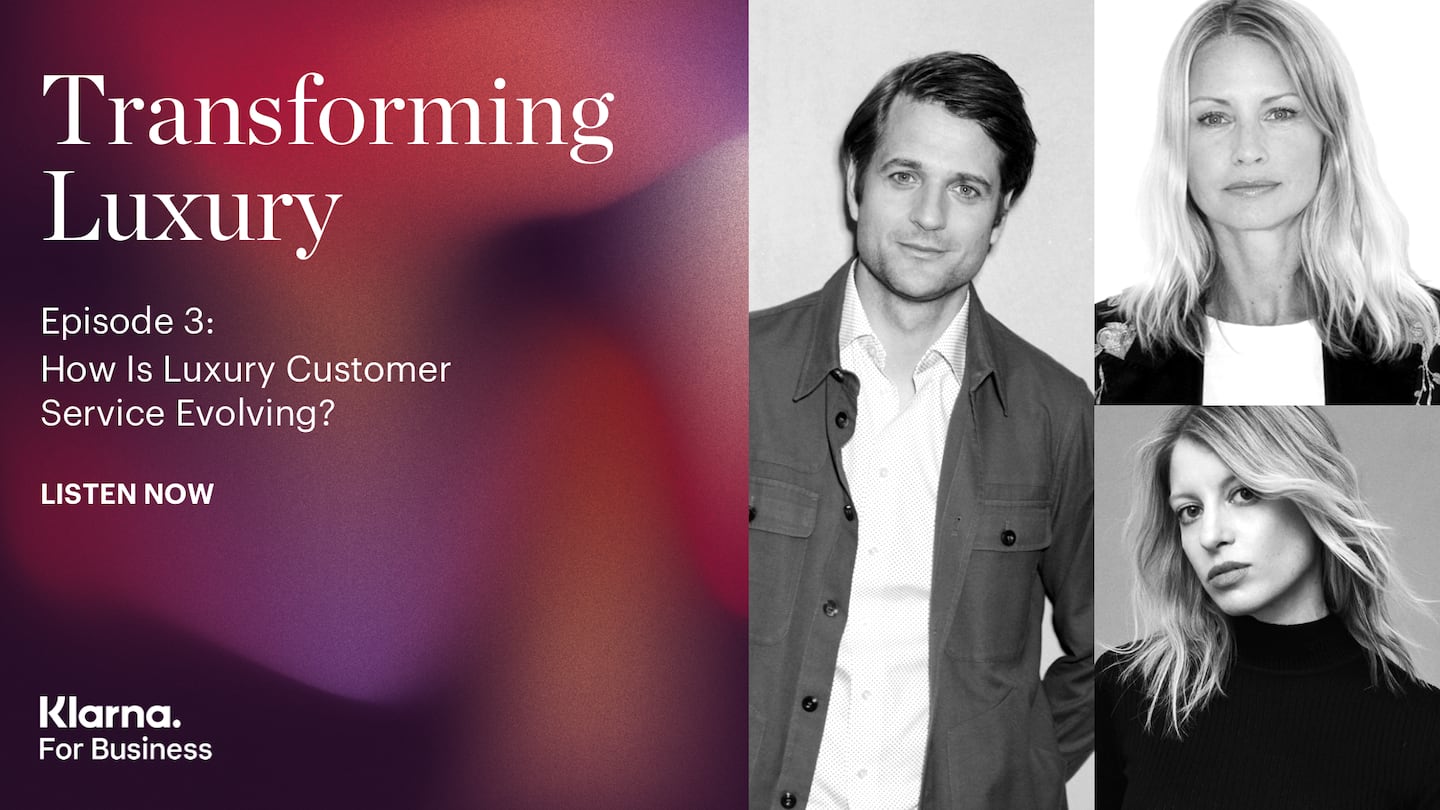
Episode 3 of Transforming Luxury, a new podcast presented by Klarna, explores the evolution of luxury service.
In recent decades, the race to attract and retain customers saw dizzying amounts of money spent on clienteling — the industry term for building a 1 on 1 relationship with customers. Today, for major players of scale with the resources to invest in it, successfully digitising personalised in-store service — which generates higher conversion rates through recommendations and engaging experiences — is being looked to as a key driver of future competitive advantage.
Indeed, the luxury service revolution is now rooted in creating a single customer view, enabling businesses to guide an individual consumer to the products and services it offers that match their specific needs. An opportunity that stems from significant shifts in generational attitudes towards data sharing and its use.
To discover what this means for the future of the luxury goods industry, BoF assembled with three industry innovators to share their insights with host Robin Mellery-Pratt.
Sebastian Siemiatkowski is the CEO and co-founder of Klarna. In 15 years, Siemiatkowski has grown Klarna into one of Europe’s largest financial institutions, which provides alternative payment services to over 90 million shoppers, partnering with over 250,000 retailers globally and its own direct-to-consumer shopping app.
“The whole purpose of digitalisation is utilising data to create value. It’s the information that allows us to create richer experiences. If you sit down and have a [...] conversation with a consumer and you say, ‘yes, you are in control of what data is being shared and you have full transparency, and if you then would be willing to share some specific aspects of your data in order to get a better experience, a better price, a better whatever it might be,’ then the answer is always going to be yes.”
Holli Rogers is chair of renowned concept store Browns and chief brand officer of its parent company, Farfetch. Rogers quadrupled Browns’ business while CEO between 2015 and 2021. Previously, Rogers held roles at Chanel and Neiman Marcus before joining Net-a-Porter in 2002.
“In the past as everything has been separate and disparate in terms of the different technologies. When you speak to different businesses everyone talks about, ‘yeah, I’ve got a client telling app. We use WhatsApp.’ But actually if you break it down, none of them are connected one to the other. So you don’t get a single customer view. It’s this idea of how do you pull all of these pieces together in one space, collecting all of these hundreds of data points that allow you to give the customer what they want when they want.”
Melissa Morris is the founder and designer of Métier, an independent leather maison best known for its logo-free handbags, travel bags and accessories. Prior to launching Métier in 2017, Morris studied sculpture and business at Emory University before working for Armani, Helmut Lang and Belstaff.
“The bespoke aspect of our business is such a great way for us to deepen our relationships with our clients and also get a really clear understanding of what’s missing in the assortment and gives me a clear direction on what to make next. What I’ve found is when I’ve gotten one bespoke request, what’s good for one is good for everyone. So a lot of our bespoke requests that I’ve been brought into the line have turned out to be big successes.”
Follow the series to ensure you never miss an episode and discover actionable insights into the opportunities and challenges a redefined industry will bring and how luxury’s transformation will impact your business.
Loading recommended reads…
While the Middle East conflict has punctured Dubai’s aura of invulnerability and prompted some to question the city’s future, it has done little to erode the advantages that made it the region’s fashion gateway in the first place.
As shoppers seek newer, better solutions for hair shedding and thinning, brands are racing to offer products that go beyond the scalp.
This week’s round-up of global markets fashion business news also features a luxury goods scandal in Hong Kong, Reliance Retail’s latest acquisition in India and Puma caught in the crossfire in Ukraine.
The Swiss brand's stock tumbled after it posted disappointing second-quarter sales and issued a slightly more cautious sales forecast for the year.