Agenda-setting intelligence, analysis and advice for the global fashion community.
Agenda-setting intelligence, analysis and advice for the global fashion community.

Your company — however large or small, new or old — is a member of an astonishingly vast global business system that did not emerge by accident. It is the product of a unique and historic social contract formed more than 80 years ago. In the immediate postwar era nearly two decades before the first Walmart sign went up in Bentonville, Arkansas, the foundations were laid for businesses to scale in ways previously unimaginable, for new markets to emerge, and for innovation to flourish across industries.
For the launch of an unprecedented opportunity market that would birth marketing geniuses like Steve Jobs; for the building of the intellectual superhighways that offered a runway for disrupters like Jeff Bezos. Walmart, Apple, Amazon, and thousands of other household name brands around the world were the product of a remarkable era powered by unprecedented investments in key societal systems: civic trust, broad-based economic prosperity, and widespread access to education. Together, these forces drove one of the most significant expansions of economic growth and social progress in modern history. The rising tide of prosperity lifted most businesses along with it.
Over the past several decades, however, those same systems have been steadily depleted. Businesses, governments and consumers alike have drawn from them without adequately replenishing them. The consequences are now visible across nearly every dimension of the economy.
Public trust in institutions has eroded. Economic gains have concentrated among a narrow set of companies and individuals. Education, once a driver of mobility, has become increasingly inaccessible, ineffective or financially burdensome. The effects of all this are evident in political instability, market volatility and a growing inability to distinguish fact from fiction in the information ecosystem.
ADVERTISEMENT
In practical terms, more companies are operating closer to the edge. Retail closures outpace openings. Entire sectors can be destabilised by a single weak quarter. Revenue and power continue to consolidate among a small number of dominant firms that function less as competitors and more as category gatekeepers and toll booths in the lives of consumers.
At the same time, wealth increasingly flows to capital rather than labour. A relatively small segment of the population benefits from rising asset values and premium markets, while the majority navigate rising debt, constrained wages, and limited opportunity. The economic middle ground that once supported both consumers and businesses is narrowing.
For business leaders, this is not an abstract concern. It directly affects demand, resilience and long-term growth. A system that no longer produces broadly shared prosperity ultimately constrains the very markets companies depend on.
Yet within this disruption lies a distinct opportunity.
Periods of systemic imbalance often create unmet needs that are both urgent and widely shared. Identifying and addressing those needs can form the basis of a durable competitive advantage — one that is difficult for competitors to replicate because it is rooted in structural gaps rather than incremental improvements.
To evaluate this opportunity, leaders can return to three foundational questions:
When these questions point to an immense, underserved demand with limited effective competition, the conditions for meaningful advantage begin to emerge.
Today, several such needs are becoming conspicuously evident. Consumers are looking for institutions and brands they can trust. They are seeking fairness in how they are treated — as customers, employees and participants in the economy. And they are navigating growing complexity in information, technology and decision-making, often without reliable guidance.
ADVERTISEMENT
These needs are not marginal; they are widespread and intensifying. Businesses that can respond to them in credible, consistent ways stand to gain not only market share but also long-term gains in loyalty, productivity and strategic resilience.
This requires a shift in how competitive advantage is defined. Traditional levers — price, convenience, scale and efficiency — remain relevant but are no longer sufficient on their own. In many industries, they have become baseline expectations rather than differentiators.
The emerging advantage lies in rebuilding elements that were once external to the firm but are now increasingly internal responsibilities: trust, fairness and contribution to broader societal systems.
This shift demands both strategic clarity and operational discipline. It is not a matter of positioning or messaging alone; it requires tangible changes in how companies make decisions, allocate resources and measure success.
For example, trust is not established through brand campaigns but through consistent alignment between what a company says and what it does — particularly in moments of stress or scrutiny. Fairness is not a slogan but a set of practices that shape pricing, labour conditions, partnerships and access. Contribution is not philanthropy alone but the degree to which a company strengthens or weakens the systems it depends on — like the free market, public education and democracy to name only a few of the most critical.
Implementing these principles often involves trade-offs, especially in the short term. It may mean prioritising long-term relationships over immediate gains, or transparency over control. However, these trade-offs are proven to return durable competitive and financial advantages that are nearly impossible for competitors to match without similar structural and philosophical changes.
Importantly, this opportunity is not limited by company size. Large enterprises and small businesses alike are exposed to the same systemic risks — and have access to similar pathways for differentiation. The ability to adapt does not depend on scale as much as on intent and execution.
Looking ahead, the trajectory of the business environment can be understood as a choice between two very different paths.
ADVERTISEMENT
One path leads toward renewed stability: stronger institutions, more broad and balanced economic participation and a customer base with increasing capacity and confidence to spend. In this environment, businesses benefit from sustained demand, deeper loyalty and clearer conditions for growth.
The other path leads toward continued societal fragmentation: declining trust, concentrated opportunity and persistent volatility. In that scenario, even successful companies operate within constrained and unpredictable markets. The direction is not predetermined. It is shaped, in part, by the collective actions of businesses themselves.
For leaders, the implication is straightforward. Competitive advantage in the coming years will not be defined solely by how effectively a company competes within existing systems, but by how it responds to — and helps reshape — the conditions those systems create.
The organisations that recognise this shift early, and act on it with discipline, are likely to be the ones that not only endure but define the next era of growth. Trust and fairness are no longer soft ideals. They are the competitive superpowers of the future.
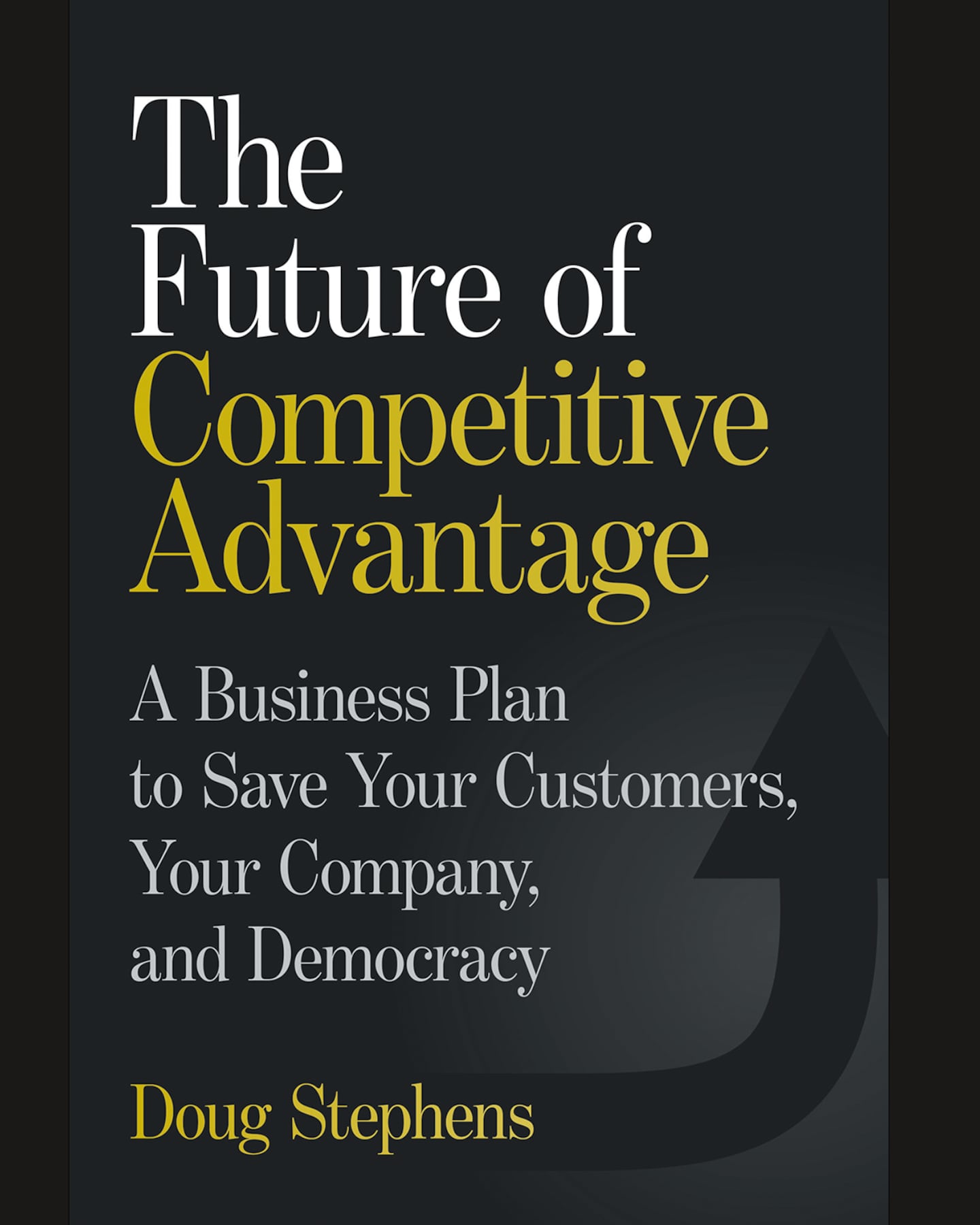
Doug Stephens is the founder of Retail Prophet and the author of three bestselling books on the future of business, including the newly released “The Future of Competitive Advantage: A Business Plan to Save Your Customers, Your Company and Democracy.”
Loading recommended reads…
The retailer swung to a loss as sales slowed after the US removed the de minimis exemption on small packages and it incurred a hefty one-time accounting charge.
This week, Europe’s leading luxury groups LVMH, Kering, Hermès and Prada will show who’s pulling ahead in the stubbornly choppy environment.
Sales of gems, precious metals and artwork at Japan’s department stores climbed 19 percent in the first half of 2026 from a year earlier to $2 billion.
Though Adidas dressed both teams in the World Cup finals, the global football tournament still presented some bright spots for Nike, writes Bloomberg’s Andrea Felsted.