Agenda-setting intelligence, analysis and advice for the global fashion community.
Agenda-setting intelligence, analysis and advice for the global fashion community.


Interviews and views on creativity and business in the world of luxury writ large — from fashion and watches to art, wellness, travel and more — from our chief luxury correspondent in Paris.
Subscribe to High Margin by Robert Williams: perspectives on creativity and business in the world of luxury.
Hello from Paris. I’m just back from a reporting trip to London, where I checked in on Melissa Morris’ leather goods store Métier, which is looking great. Her brand is so androgynous — masculine even — in a way that still feels rich 10 years in.
At Selfridges, I met up with Judd Crane and Leonie Foster for a walk-through of the department store’s new members-only restaurant and personal shopping hub for VICs, which opened today. Read about it here.
After that, Easter weekend was spent hiking in the Calanques near Marseille. On the way back to the train I made a mandatory stop at Maison Empereur, the homeware emporium that honestly might be my favourite store in France. This shop continues to be a must-visit for anyone who cooks, cleans, gardens, recently moved or plans to move, is renovating or plans to renovate or is looking for some small victory in the battle against microplastics. My haul: hemp rubber gardening clogs, a stainless steel tomato peeler, an oilcloth table cloth and some black linen work trousers (the jury’s still out on those).
ADVERTISEMENT
In this week’s newsletter:
Brunello Cucinelli was the first luxury firm to report Q1 sales after market Thursday.
Sales blew past estimates, rising 14 percent excluding currency swings. Analysts had expected 9–10 percent.
The brand isn’t normally a sector bellwether, as it tends to perform quite steadily in the face of various industry-wide swings. It’s insulated by a focus on engaging loyal (wealthy) clients, as well as expanding its base by rolling out new stores and wholesale accounts.
This quarter is a bit different as the company was the first to put a number on how war in the Middle East is impacting luxury sales, both in the region and via ripple effects worldwide.
According to Brunello Cucinelli’s CEO Luca Lisandroni, “only the Middle East had experienced some impact” from the US and Israel’s war in Iran, with no impact showing up in other regions. In March, store traffic in the Middle East fell by more than 50 percent, “though it’s important to highlight that all stores remain fully open and operational,” the company said. The quarter was positive in the Middle East thanks to an “excellent first two months.”
Investors are also watching to see how the bankruptcy at Saks Global will impact Brunello Cucinelli. The companies’ fortunes are seriously enmeshed, as BC has leaned heavily on the group to broker its expansion in the US.
After briefly pausing shipments, deliveries to Saks Global have resumed from mid-January with revenues increasing year on year, the company said. “Payments have been very punctual,” Lisandroni said.
ADVERTISEMENT
The brand forecast 10 percent growth for both 2026 and 2027.
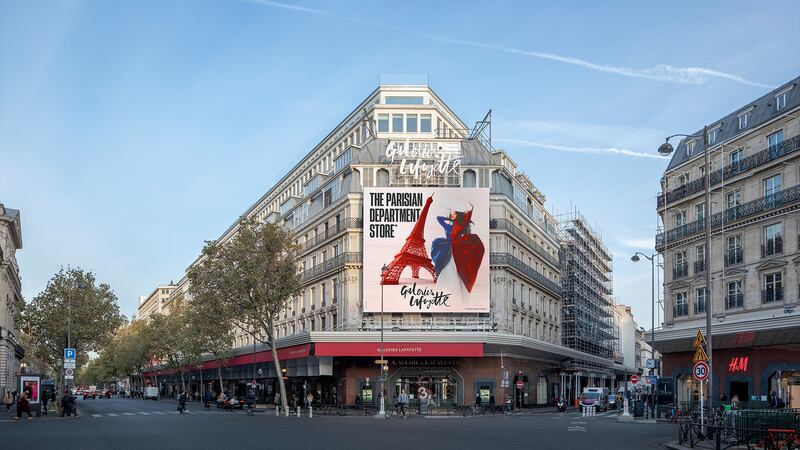
Galeries Lafayette was another player to offer clues to how luxury is holding up amid the current crisis.
First-quarter sales were flat overall, the French department store chain said Wednesday, slowing compared to 2025 mostly due to softening demand from Asian clients. Conflict in the Middle East — and its ripple effects — likely played a role: shaking consumer confidence as well as disrupting European travel plans that require flying over the region.
But sales to Middle Eastern clients themselves actually rose, up 14 percent year on year in March at the group’s Haussmann flagship. Ramadan was earlier this year — shifting some holiday sales to February — making the performance in March even more surprising.
Galeries Lafayette shared those figures at its first major strategy presentation in years. The family-owned group usually plays its cards close, but this was an opportune moment for new leadership to share its vision: Revenues (€4 billion [$4.7 billion] annually) have finally climbed back above their 2019 pre-Covid levels. Arthur Lemoine stepped into the chief executive role last year, succeeding longtime CEO Nicolas Houzé (both are members of France’s Moulin family, which owns the group). The group also has a tighter footprint now after closing its two stores in Marseille last year, as well as shedding seven franchised locations operated by SGM (which was going to open Shein corners in them).
Lemoine and his deputy Alexandre Liot presented a plan for the group’s next steps that includes investing €260 million over the next 4 years. Investment priorities include brand image, client service, recruitment and training. The menswear building on Boulevard Haussmann is being renovated. Galeries Lafayette says it’s also working on making sure its now-leaner network of regional locations is more aligned with the Haussmann flagship in terms of store experience and product selection.
Flagship-sized corners for brands including Chanel and Rolex have powered growth for Galeries Lafayette in recent years as fashion’s middle market cratered. The challenge now is how to keep leaning into that momentum in luxury without abandoning the middle-class client base that has always been the store’s bread and butter.
To this end, shoes, skincare and haute parfumerie are all in focus. “Whether it’s in Paris or Nice, we want to be the go-to destination for shoes,” Lemoine said.
ADVERTISEMENT
“While the perfumes now being sold by brands like Bottega Veneta or Louis Vuitton are very elevated relative to the category, they still provide an attractive entry point compared to fashion and accessories,” he added.
Even as war in the Middle East thwarted international travel and drove up fuel prices worldwide, several financial analysts have issued reports in recent weeks reaffirming their position that luxury’s recovery remains more or less on track.
“While heightened geopolitical uncertainty is likely to weigh on sentiment in the near term (consumer sectors typically underperform during periods of oil- and energy-related shocks), we have yet to see any evidence of a demand slowdown, especially in Asia,” UBS analyst Zuzanna Pusz wrote March 30.
“We continue to foresee a rebound in luxury, coming on the back of 1) an injection of product creativity; and 2) more attractive price points, leading to a renewed interest from the luxury consumers,” HSBC analyst Anne-Laure Bismuth wrote March 30.
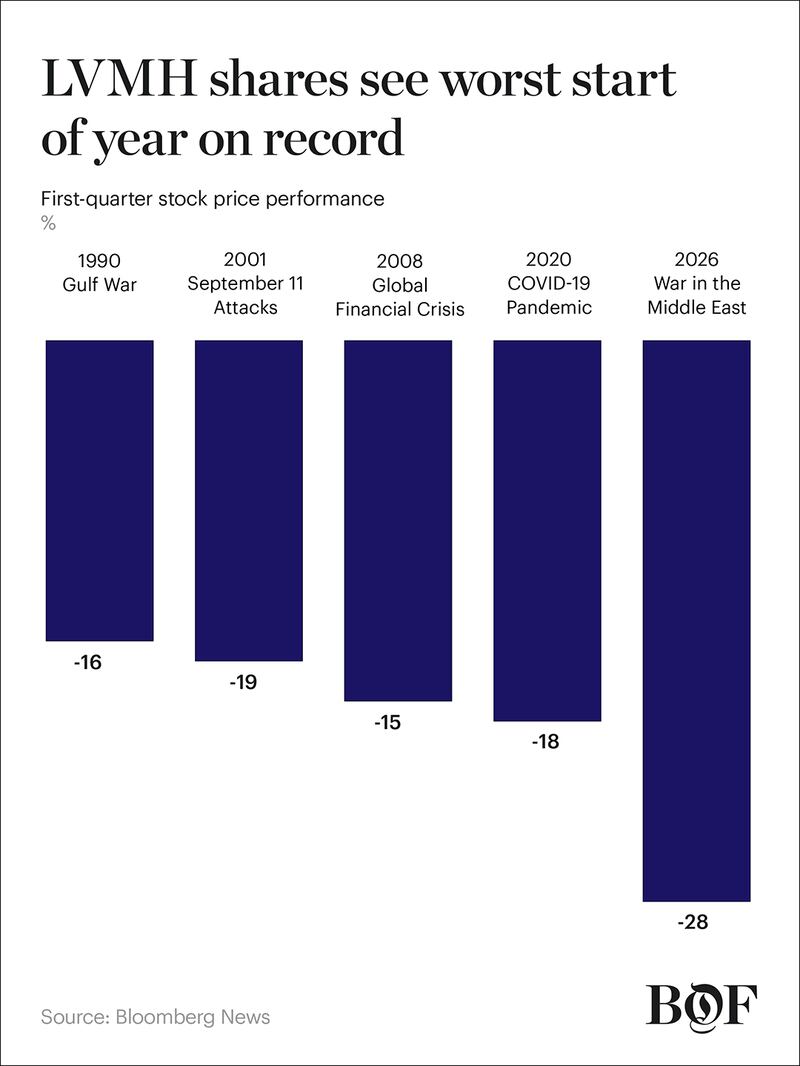
Investors have yet to be convinced: LVMH’s share price has had its worst start to the year on record, Bloomberg reported. Its valuation fell 28 percent in Q1 — worse than during the 2009 financial crisis or the initial outbreak of Covid-19 in 2020.
In addition to tracking the impact of macro shocks like war in the Middle East, investors will be looking for brand-specific insights to how changes to management, creative direction, pricing and more are playing out.
LVMH (Monday after market):
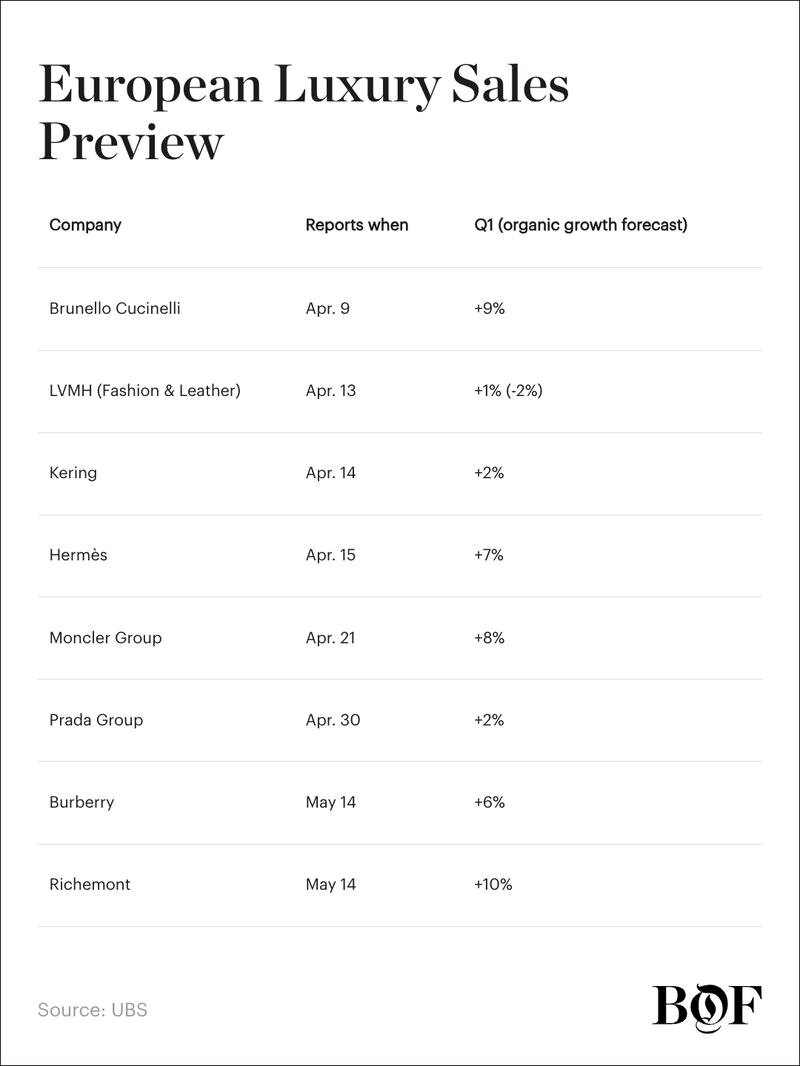
Group sales are expected to rise 1 percent while the key fashion and leather goods unit declines 2 percent, according to UBS.
A miss could raise concerns for how the Dior revamp is landing: While creative director Jonathan Anderson’s image refresh has younger, cooler people paying attention to the brand again, the commercial rollout has yet to gain obvious traction.
I was seated with the brand at Babeth Dijan’s gala a few weeks back, and was pleasantly surprised at how easily and desirably the ready-to-wear silhouettes were translating to real life. Items like shrunken bar jackets and cutout silk blouses looked quite natural while staying true to the runway. Give it time, I thought! That said, a lot of the merch (big belt buckles, logo neckties, T-shirts and canvas topsiders) feels a bit contrived compared to rivals who have recently dialled up the level of craft and materials innovation in their commercial collections as well as on the runway (Chanel, Bottega Veneta).
Investors will also be seeking clarity on what the strategy is at Louis Vuitton, as well as who’s in charge. Officially, Pietro Beccari remains CEO in addition to overseeing LVMH Fashion Group. But sources say Damien Bertrand, the former Loro Piana chief who became Vuitton’s deputy CEO last June (as well as joining LVMH’s executive committee) is already operating as the decider for all manner of important decisions.
Confusion at the top is mirrored in the brand’s consumer-facing message. Vuitton’s products and image have become increasingly fragmented, and divorced from the house’s historic pillars of travel, Frenchness, monogram and innovation.
In the spring womenswear campaign, Jennifer Connelly inexplicably grips a pink mattress that is propped up against a wall, wearing a beige knit tunic and tasselled booties. What is the story, and what does it have to do with Vuitton? Meanwhile, the menswear offer is split between streetwear-inflected novelties that might have sparked excitement a decade ago (the current focus is a print blending the LV monogram with blurry daisies) and a new “Trunk” line of ultra-classic, inoffensive pieces. This brand is big enough to offer variety, but lately it feels like it’s contradicting itself.
Beyond fashion, levers for growth remain scarce for the group’s 75-plus brands selling everything from Hennessy cognac to Bulgari bracelets to Sephora cosmetics. China’s recovery remains fragile. The Middle East had been identified as a top priority for the year: The region’s outlook is now uncertain. In the US, tariffs are on hold but spiking fuel costs spell the return of inflation.
Kering (Tuesday after market):
Group sales are hoped to return to modest growth (up 2 percent) with Gucci remaining in the red (down 5 percent).
Investors will be impatient to know what the response has been to the initial Gucci collections by Demna: His September drop, La Famiglia, is now fully rolled out to stores, while certain items from his February runway debut were made available “see-now-buy-now.”
Elsewhere, the group has reorganised its segment reporting, and will no longer break out BV, YSL and the “Other Houses” segment dominated by Balenciaga. This should gradually refocus the conversation on group-wide initiatives rather than tracking desirability and momentum brand by brand.
Tuesday’s call is unlikely to feature any big announcements, as the company plans to go in-depth on its future plans under new CEO Luca de Meo at an all-day strategy event in Florence next Thursday. I’ll be there!
Hermès (Wednesday before market):
The French giant’s sales are expected to rise 7 percent — with growth slowing slightly following a multi-year surge.
While “growth is not as strong as we could have hoped for … Hermès remains the most resilient name in our luxury coverage when the macro environment is getting more challenging,” HSBC’s Bismuth wrote.
Softening resale demand for the Birkin and Kelly, and critiques of Hermès sales practices by vocal customers have lightly shadowed the brand’s narrative in recent months — raising the spectre that while it continues to outperform the broader sector, Hermès could face a more difficult time clearing its own high bar for desirability and growth.
That isn’t likely to take a toll on sales just yet — at least not in the key leather goods category. “Demand is still exceeding supply for its most iconic handbags, no change on that front,” according to HSBC.
Disclosure: LVMH is part of a group of investors who, together, hold a minority interest in The Business of Fashion. All investors have signed shareholders’ documentation guaranteeing BoF’s complete editorial independence.
Loading recommended reads…
Protestors targeted public buildings, looted luxury boutiques and supermarkets and attacked police vehicles and officers in demonstrations against rising cost of living.
Financial results from Hermès, Kering, Prada and others will test the resilience of luxury’s biggest brands as US consumer spending shows signs of slowing and demand in China remains weak.
The Chinese designer won the grand prize for her airy, sculptural pieces at the 41st edition of the festival, which is undergoing a revamp under new leadership.
The move, which was facilitated by Jean Arnault, comes as Hublot undergoes a repositioning in a bid to reignite sales.