Agenda-setting intelligence, analysis and advice for the global fashion community.
Agenda-setting intelligence, analysis and advice for the global fashion community.
A ruling earlier this month from the UK’s Advertising Standards Authority against two jewellers, which had not labelled their lab-grown diamonds as “synthentic” or “laboratory-grown,” was a win for natural diamond advocates.
De Beers and industry groups like the Natural Diamond Council have spent the better part of the last decade highlighting the differences between diamonds that are mined and those that are lab-grown in hopes of showing mined stones are worth the higher price tag. And indeed, the original complaint that led to the ruling was filed by promoters of natural diamonds — London Diamond Bourse, together with Natural Diamond Council, who took issue with online advertising from jewellers Linjer and Novita Diamonds that described their products as “brilliant diamonds” and “premium diamonds,” respectively.
“It is imperative that [people] make informed and confident decisions,” said Natural Diamond Council chief executive Amber Pepper in an emailed statement. “We are delighted that the ASA has once again championed transparency in this matter as it all helps our wider mission to educate and inspire consumers on the value, rarity and beauty of natural diamonds.”
Those who disagreed with the decision, however, shot back that marketing for synthetic and natural stones has moved beyond the “real” vs “synthetic” labels, and that shoppers are knowledgeable enough to make the distinction.
ADVERTISEMENT
In its response to the ruling, Novita argued that it failed to take into account a common understanding by consumers of the differences between lab-grown and natural diamonds.
Novita “strongly disagrees with the ASA’s ruling and believes it does not reflect current consumer understanding of lab-grown diamonds or the reality of today’s jewellery market,” the company said in an emailed statement. “At no point in our operations have consumers been confused about what we sell,” the company added.
The popularity of lab-grown diamonds has soared in recent years, particularly in the US, the largest consumer market for diamonds: Sixty-one percent of engaged couples in the US taking part in The Knot’s 2026 “Real Weddings” survey have opted for lab-grown diamonds, more than double the proportion in 2020.
Mass produced in an often energy-intensive process, mostly in China and India, lab-grown diamonds carry many of the same properties as natural diamonds, but at a much lower price. The rise of lab-grown into the mainstream over the past few years has driven down prices of natural diamonds and raised questions about their pricing power. For natural diamond jeweller The Clear Cut, the initial surge of lab-grown diamonds on the market prompted sales growth to slow in 2023 after doubling each year since its 2018 launch. It returned to a higher level of growth in 2025 by carving out its specific niche for natural gem enthusiasts.
Some brands focus marketing on sustainability. While lab-grown diamonds are associated with high energy usage, and natural stones have a history of labour exploitation and environmental damage from mining — which natural diamond sellers like De Beers have worked to combat with campaigns around the positive economic benefits on countries like Botswana — retailers like Fiametta, which sell both, highlight that they only use synthetic diamonds produced with renewable energy and recycled and antique natural diamonds on their website.
Pandora publishes the carbon emissions (calculated by external experts) of each diamond it sells — creating a “fifth C” of diamond descriptors, alongside the traditional cut, carat, colour and clarity — to further convince shoppers, said chief marketing officer Jennie Farmer.
Many brands are already moving their messaging beyond the lab-versus-mined debate and turning their focus to brand storytelling and design.
“I don’t think being a lab-grown company or a mined company is a marketing angle,” said Meg Strachan, founder and chief executive of jeweller Dorsey, which exclusively uses lab-grown stones.
ADVERTISEMENT
Eighty-four percent of people polled in a survey by jewellery industry organisation The Plumb Club last year were aware of lab-grown stones; 83 percent were open to buying them in fashion jewellery. The broad acceptance comes in part thanks to efforts from the natural-diamond sector to distinguish lab-grown from natural stones, which ultimately introduced lab-grown stones to a wider audience, said Strachan.
“The natural-diamond industry … did a mass marketing push on lab-grown [stones] in a way that really helped companies like Dorsey, because [now] everyone knew what it was,” she said.
Today, many shoppers already have a preference, having made up their minds “because there’s so much more education out there,” said Kegan Fisher, the co-founder and chief executive of jeweller Frank Darling, which sells both natural and synthetic stones, with the large majority of clients — 80 percent — shopping for the latter.
“Unless you feel very, very strongly that emotionally, you resonate with wanting a natural diamond more, it’s very hard to say that you’re going to spend more money … because of the fact that it came from the earth,” said Fisher.
Now that the awareness — and appetite — is there, lab-grown companies are evolving their messaging beyond educating people about the differences. Sellers of natural stones, meanwhile, are focused on showing people that their product is worth the price.
Still, design preferences are important to many buyers, whether they are shopping for lab-grown stones because the price allows them to attain a certain look, or seeking to buy a uniquely-coloured, imperfect antique natural gem.
“For a woman who doesn’t have price as a barrier and can buy whatever she wants, why would she go for a lab diamond? It’s purely because of the branding and the styling,” said Akshie Jhaveri Shah, founder of lab-grown diamond company Grown Brilliance.
“It’s something that she wants to wear, she wants to layer with her other pieces. It’s reflecting her personality.”
ADVERTISEMENT
Natural-diamond jewellers De Beers and Kay have focused on highlighting their stones’ uniqueness with campaigns featuring darker-hued “desert diamonds,” thus differentiating them from the larger, white stones most associated with lab-grown diamonds on offer.
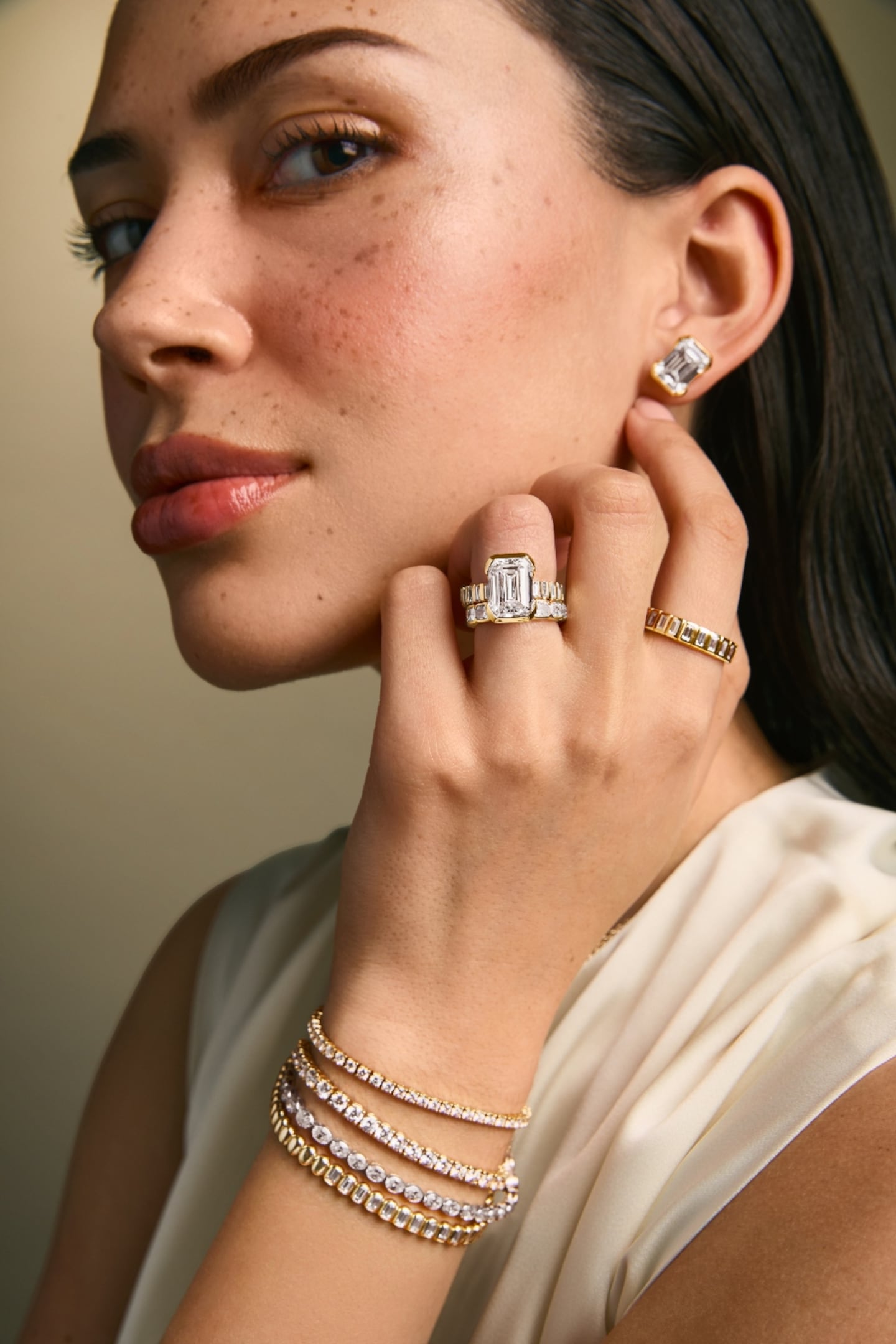
Lab-grown brands, which typically centred messaging on price, are increasingly highlighting the design of their products, from engagement rings to everyday pieces like Dorsey’s “Rivière” tennis necklaces through trendy imagery of women wearing the jewellery in the city or on the beach — with a gown or a more casual tank and flip-flops — to showcase versatility. Even Pandora, which still focuses on the price element with its “Diamonds for All” campaign, is trying to do so in a more elevated way, enlisting tastemakers and models like Grace Coddington and Pamela Anderson.
“It’s really about this idea that you don’t have to wait for those milestones,” said Mads Twomey-Madsen, senior vice president of global communications and sustainability at Pandora, which only uses lab-grown gems in its jewellery. “You can buy that diamond for yourself.”
Still, as the ASA ruling shows, there’s a grey area. While both Linjer and Novita said they did not omit terms with the intent of confusing shoppers or breaching regulations, critics say they failed to live up to expectations around transparency that have become the norm.
“There has been a lot of bad behaviour with various brands in the sector,” said Fisher.
While education has come a long way, there’s still room to grow. Both lab-grown and natural sellers are hiring licensed gemologists to ensure product information is accurately conveyed.
The industry is moving towards a future in which both types of stones are seen as desirable. As consumers naturally bifurcate towards their preferred stone type early on in the shopping process, brands — particularly those that sell both types — will likely have to sharpen their positioning in order to convey why they are worth adding to shoppers’ jewellery boxes.
“It’s important, whether you’re a lab-grown or natural brand, to know who you are and have your audience, because then that customer will know where to go,” said Olivia Landau, founder of The Clear Cut.
As lab-grown stones become more of a force in the jewellery industry, sellers of both man-made and natural diamonds are looking for ways to differentiate themselves in their marketing.
In a move away from marketing fine jewellery as an occasion-specific opportunity, Zales is hoping to sell Gen-Z on diamonds and precious metals as everyday staples they can buy for themselves.
The diamond company produced less than 22 million carats last year, down from almost 35 million in 2022.

Haley Crawford is Marketing Correspondent at The Business of Fashion. She is based in New York and covers the marketing and public relations industries.
Loading recommended reads…
This week, Priya Rao dives into the rampant copycats in beauty — and no, she’s not talking about dupes.
BOLD, the French conglomerate’s venture capital fund, will collaborate with retailer Nykaa to invest in the next generation of Indian beauty brands.
The European investor, which previously backed Medik8, has taken a 49 percent stake in the premium French nail line.
At Milan Beauty Week, one of the world’s cosmetic manufacturing hubs demonstrated why ‘Made in Italy’ still matters with a new urgency.