Agenda-setting intelligence, analysis and advice for the global fashion community.
Agenda-setting intelligence, analysis and advice for the global fashion community.

BEIJING, China — Consumer confidence in China is hitting 20-year highs, yet retail sales growth is plateauing on the back of China's broader economic slowdown. So why are consumers still so cheerful?
There are a number of factors at play, among them government-led efforts to encourage consumption through supply-side measures, including rebalancing the economy towards the service sector and strengthening market supervision. A cut to the country's import tariffs on almost 200 consumer goods categories in December 2017 also lowered prices for everything from cashmere to cosmetics.
Growing spending potential in lower-tier cities has also contributed to the shift. Shanghai's urban population size has contracted since 2015, according to a report by Morgan Stanley, and policymakers’ initiatives to relocate citizens into lower-tier cities and develop infrastructure have reduced the income gap between top-tier and lower-tier city populations. As a result, second and third-tier cities could contribute two-thirds of incremental growth in private consumption by 2030.
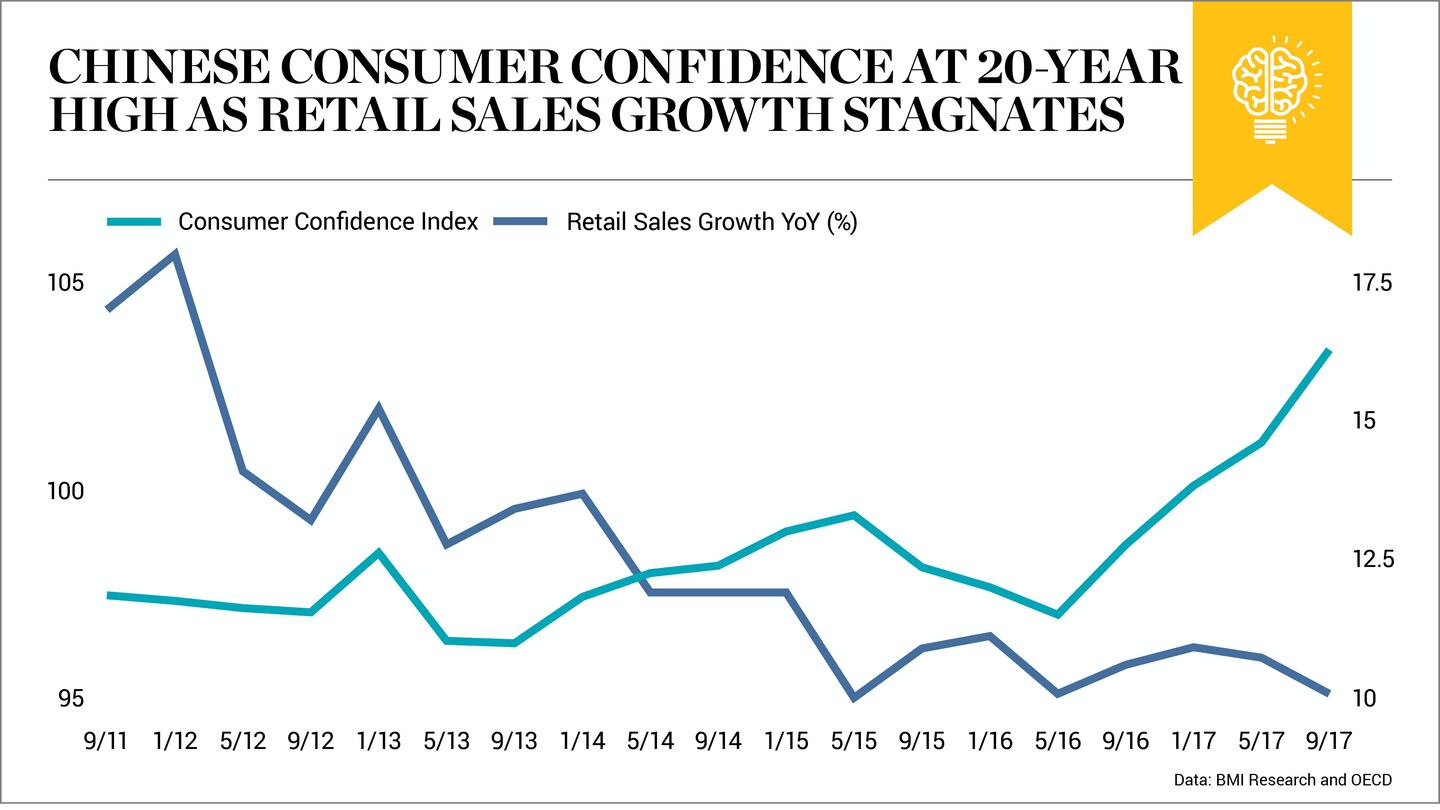
Together, these factors have contributed to the sharp upward trend in consumer confidence — defined as the degree of optimism in the economy expressed through saving and spending — beginning in March 2016 and reaching an all-time high of 104.87 in December 2017, according to the consumer confidence index created by the OECD.
ADVERTISEMENT
The slowdown in retail sales comes on the back of the broader economic slowdown in China.
But analysts caution that consumer confidence isn’t translating into a higher retail sales growth, which is plateauing from the double-digit growth rates recorded in early 2017. While retail sales of consumer goods in China grew to reach 36,63 trillion yuan (about $5.69 trillion) in 2017, growth was 9.4 percent year-on-year in December, far from growth rates of 12.5 to 15 percent registered between 2013 to 2015.
“The slowdown in retail sales comes on the back of the broader economic slowdown in China as the Chinese government focuses on sustainable economic expansion and reins in credit expansion in the country,” said Nainika Singh, consumer and retail analyst at BMI Research. “[It] comes as a result of growth gradually easing due to the higher year-on-year base effect.”
Indeed, GDP growth in the country fell from a high 10.64 percent in 2011 to 6.7 percent in 2016, in line with BMI’s forecast of an announced growth target of 6.5 percent at the National People’s Congress in March 2018. Retail sales growth is directly correlated with GDP growth, thus a boom in the economy until 2015 was coupled with exceedingly high retail sales, and lowered but sustained growth in one is reflected in the other. Thus, while initiatives like Alibaba’s “New Retail” are at the forefront of a retail revolution in the country, with the e-commerce sector growing by 33 percent year-on-year, retail sales growth from the heady days of 2011 will only return if the wider economy booms.
Still, Chinese shoppers remain paramount to the growth of international fashion brands. While retail sales are growing more slowly, luxury consumption by Chinese consumers remains robust. Indeed, Chinese consumers now account for 32 percent — almost a third — of the $308 billion luxury global market. Sales of luxury goods in China reached 142 billion yuan (about $22.1 billion) last year, up about 20 percent from the year before, according to Bain & Company.
But there are clouds on the horizon. While household debt remains lower in Mainland China than other East Asian markets, including Hong Kong and South Korea, consumer debt is growing and is likely to make up a larger percentage of overall debt, climbing from 16 percent. As Chinese consumers continue to spend, some observers are wary of a credit bubble. According to the IMF, credit has been growing faster than the economy, and concerns are mounting that a decelerating China steering its people towards greater domestic consumption could ultimately implode.
Related Articles:
[ Cuts to China’s Import Tariffs to Buoy Fashion and CosmeticsOpens in new window ]
[ Keeping Pace With the Changing Chinese ConsumerOpens in new window ]
Loading recommended reads…
French entity Coperni SAS will cease operations after the brand failed to reach an agreement with stakeholder and distributor Tomorrow, founders Arnaud Vaillant and Sébastien Meyer said.
The French private equity group announced on Wednesday that it will buy the UK skin and body care brand for an undisclosed sum.
At its capital markets event in Shanghai, leadership said it aims to deliver mid-single-digit organic net sales growth through fiscal 2030, and unveiled a new cost-cutting and strategic roadmap.
The Indian beauty retailer said on Wednesday its second-quarter profit nearly tripled, as improved operating efficiency and strong demand for premium beauty products boosted margins.